Book Review: Immortality, Inc. (variant title: Time Killer), Robert Sheckley (1958)

(Uncredited cover for the 1959 edition)

3.75/5 (Good)

Nominated for the 1959 Hugo Award for Best Novel

Robert Sheckley’s first novel Immortality, Inc. (variant title: Time Killer) (1958) has a somewhat checkered publication history.  It was originally published by Avalon books under the title Immortality Delivered (1958) where it was abridged against Sheckley’s wishes.  Unless you are a collector of the Avalon publication series I recommend procuring the complete 1959 Bantam Book edition with its gorgeous (and alas, uncredited) cover.  Later editions were decked with rather unfortunate covers linking the book to the atrocious film Freejack (1992) (replete with Mick Jagger) which was supposedly influenced by Sheckley’s novel.

Thematically, Immortality, Inc concerns the societal ramifications of the important discovery that death is not the end of existence and nor does the Christian conception of the afterlife Continue reading
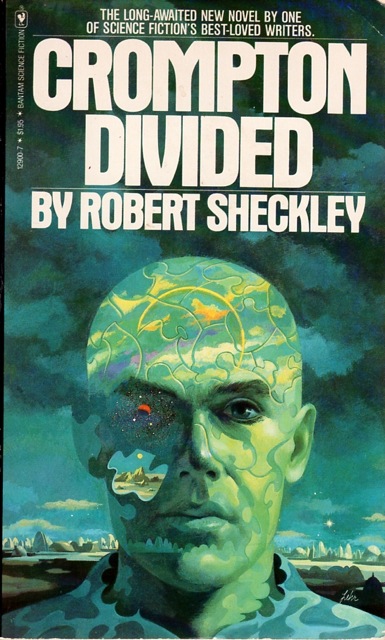
Adventures in Science Fiction Cover Art: Fractured Bodies (unraveling, decaying, [de]constructing)

CRMPTNDVDD1979

(Paul Lehr’s cover for the 1979 edition of Crompton Divided (variant title: The Alchemical Marriage of Alistair Crompton) (1978), Robert Sheckley)

Paul Lehr’s cover for the 1979 edition of Robert Sheckley’s Crompton Divided (1978) was the inspiration for this post.  I found the cover many years ago while looking through Lehr’s entire (mostly brilliant catalogue) and was intrigued.  The man, comprised of puzzle-like pieces that slowly morph into the swirls of his clothes, stares at us with hybridized eyes — a planet, a pupil — while one missing puzzle piece allows the viewer a glimpse of a barren landscape.  His brain, entirely a puzzle, is complete, but are his senses crumbling?

 Dean Ellis’ cover for the 1971 edition of Larry Niven’s collection All the Myriad Ways (1971) is even more fantastic — the puzzle pieces (bones, faces, limbs) dangle in the air Continue reading

Book Review: Xenogenesis, Miriam Allen deFord (1969)

(Richard Powers’ cover for the 1969 edition — there is some speculation that it might be a collaboration with Leo and Diane Dillon)

3.5/5 (Collated rating: Good)

Miriam Allen deFord—one of the more prolific SF short story authors of the 50s-70s whose works appeared in The Magazine of Fantasy and Science Fiction, If, Fantastic Universe, Galaxy, Worlds of Tomorrow, etc—deserves a Gollancz Masterworks volume.  But, as Ian Sales has pointed out so forcefully in his recent article (here), despite the number of prolific women SF authors in the 50s-70s they were rarely republished and are perhaps the least read group of SF authors for modern audiences.  There are some exceptions but few readers can name a women author pre-Ursula Le Guin.  deFord’s shorts were collected in only two volumes, Xenogenesis (1969) and Elsewhere, Elsewhen, Elsehow (1971) and both print runs were limited to the first year of publication.

Informed by her feminist activism (she was an important campaigner for birth control) and her earlier career in the newspapers, deFord’s stories tackle themes such as overpopulation, racism, colonialism, gender issues, sexism, and alienation.  Her works range from deceptively simple allegories to future histories vast in scope and complexity (for short stories).  Her female characters are almost all individualistic, resourceful, and highly educated–they often struggle against increasingly regimented/mechanized/homogenized societies in order to raise families in addition to their careers.  In short, deFord advocates forcefully the right to self-determination Continue reading

Updates: Recent Science Fiction Acquisitions No. LXXIX (Haldeman + Chalker + Oliver + Anderson)

Some Chicago finds from Powell Books (Hyde Park)…  I own too many SF novels in my to read pile (I have close to 300 waiting to be read so I am going to try to put a stop on rampant — yes, they are cheap — purchases).

Last one of these for a while?  Should I take bets?

Some titles definitely not my normal fare — I’ve read Haldeman’s The Forever War (1975), Forever Peace (1999), and Forever Free (1999) but not a single one of his short stories so Infinite Dreams (1978) is a welcome addition to my collection.

Chad Oliver is one of the “second-tier” greats whom I’ve not read…. And Chalker falls in that category as well.  Poul Anderson’s The Byworlder (1971) is generally not considered one of his best but it did snag a Nebula award nomination.

Thoughts?

1. Infinite Dreams, Joe Haldeman (1978)

(Clyde Caldwell’s cover for the 1979 edition) Continue reading