Which books/covers/authors intrigue you? Which have you read? Disliked? Enjoyed?
The first purchases of 2026!
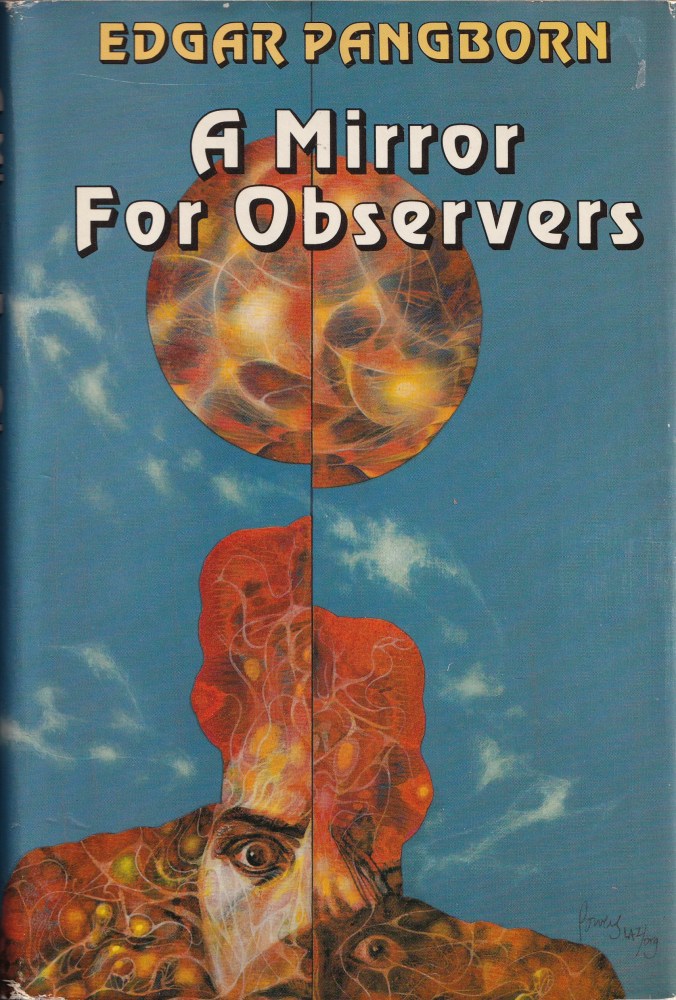
1. A Mirror For Observers, Edgar Pangborn (1954)
Richard Powers’ cover for the 1985 edition
From the back cover: “We would call them Martians, though they refer to themselves as Salvayans. Refugees from their dying planet, they arrived on our world almost 30,000 years ago to make new lives for themselves. From their vast underground cities, hidden from discovery, the Salvayans have ben observing us with care and concern, waiting for the day when humans will be ready to meet them. The Salvayans are not many, but they are long-lived and patient….
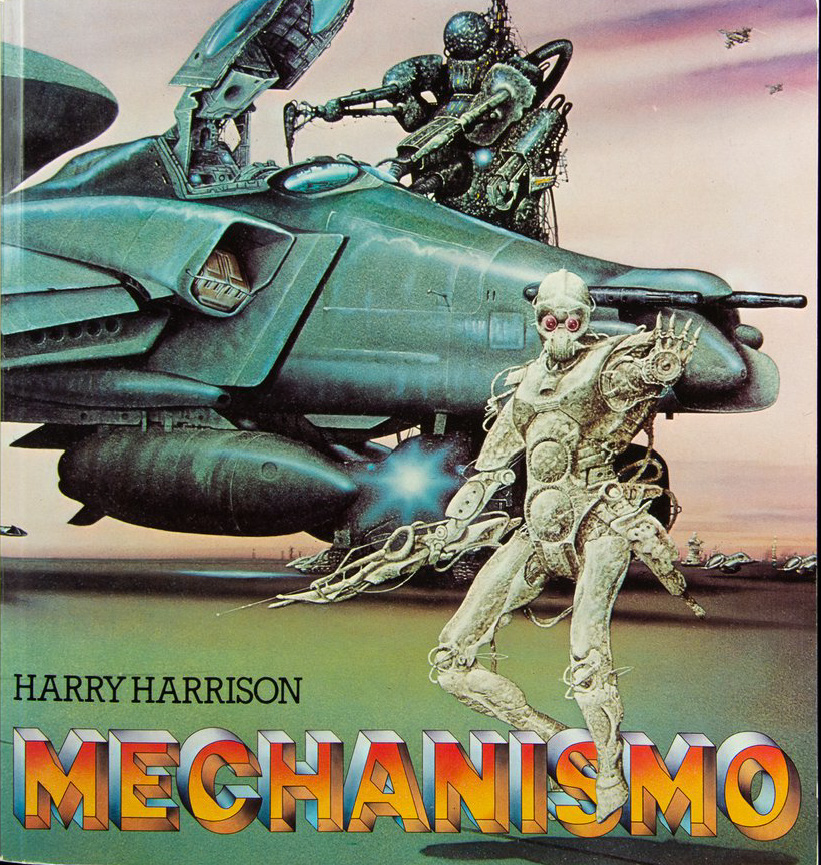
Jim Burns’ cover for the 1st edition of Mechanismo (1978)
I would like to welcome Adam Rowe again to Science Fiction and Other Suspect Ruminations. Back in 2023, I interviewed him about his lovely book Worlds Beyond Time: Sci-Fi Art of the 1970s (2023)–on 70s science fiction cover art with a foreword by SF artist Vincent Di Fate. You can buy Worlds Beyond Time on Amazon and Barnes and Noble. You can follow Adam’s art account on Bluesky and Tumblr. I also recommend subscribing to his free 70s SF art newsletter.
Adam Rowe is a writer who has been collecting retro science fiction art online since 2013. He covers technology at Tech.co and has been a Forbes contributor on publishing and the business of storytelling. He has also written for iO9, Popular Mechanics, Reactormag.com (previously Tor.com), and the Barnes & Noble Sci-Fi & Fantasy Blog. Worlds Beyond Time: Sci-Fi Art of the 1970s (2023) is his first book.
Graphic created by my father
Your Guide to the Best Retro Science Fiction Art Collections
Adam Rowe
I’ve read a lot of art books covering science fiction in the 20th century. This likely isn’t a big surprise, given that I sunk more than a few years into compiling my own retrospective art collection, Worlds Beyond Time: Sci-Fi Art of the 1970s.
Please note that Rachel and I are interested in learning about a large range of authors and works vs. only tracking down the best. That means we’ll encounter some stinkers. This time we have an interesting German-language tale of ecological dystopia from Austria.
You can read Herbert W. Franke’s “Slum” (1970, trans. by Chris Herriman 1973) here if you have an Internet Archive account. This is an six page story. It’s really hard to talk about it in any substantial way without revealing spoilers.
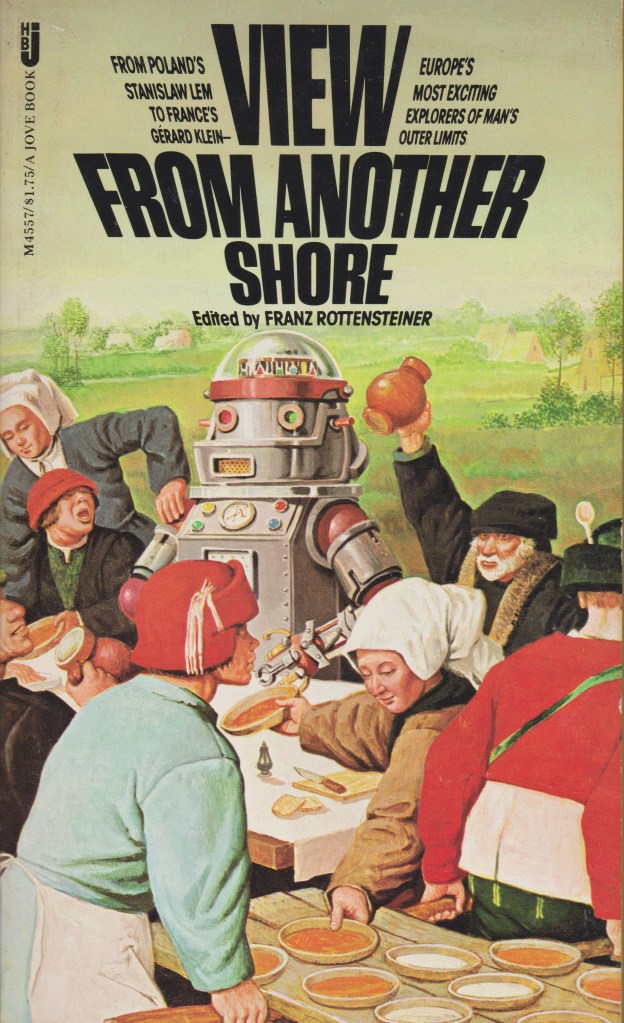
Austrian-born author and cyberneticist Herbert W. Franke used speculative fiction to imagine distant planets and alternative societies for over half a century. Known to Anglophone readers mostly for three novels translated in the 1970s (The Orchid Cage, The Mind Net, and Zone Null) and a few short stories, Franke asked readers to think through what “exploration” really means and the responsibilities that the explorers have to those whom they find (or don’t find). Appearing first in English in F&SF (1963), Franke was subsequently featured in Franz Rottensteiner’s three major SFT anthologies: View From Another Shore: European Science Fiction (1973),The Best of Austrian Science Fiction (2001), and The Black Mirror and Other Stories: An Anthology of Science Fiction from Germany and Austria (2008). Other Franke stories appeared in Donald A. Wollheim’s The Best from the Rest of the World (1976) and James Gunn’sThe Road to Science Fiction 6: Around the World (1998).
Here’s to happy reading in 2026! I hope you had a successful reading year. Whether you are a lurker, occasional visitor, a regular commenter, a follower on Bluesky or Mastodon, thank you for your continued support. As I say year after year, It’s hard to express how important (and encouraging) the discussions that occur in the comments, social media, and via email are to me. I’m so thankful for the lovely and supportive community of readers, writers, and discussion partners that stop by.
What were your favorite vintage SF reads–published pre-1985–of 2025? Let me know in the comments.
Throughout the later part of the year I’ve dropped hints about a research project. Perceptive readers might have parsed together the contours of the research: late 19th/early 20th century, utopian, African American, the American South, radical politics… It’s taking longer than expected. I’ve read a good ten monographs, five dissertations, countless articles. I’ve written twenty pages. I hoped to have it posted by early in this year. Alas. It’s coming together–slowly. Stay tuned.
Without further ado, here are my favorite novels (I only read a few) and short stories (I read a ton of those) I read in 2025 with bonus categories. I made sure to link my longer reviews where applicable if you want a deeper dive.
Check out my 2024, 2023, 2022, and 2021 rundowns if you haven’t already. I have archived all my annual rundowns on my article index page if you wanted to peruse earlier years.
My Top 5 Science Fiction Novels of 2025
Alan Gutierrez’s cover for the 1985 edition
1. Octavia E. Butler’s Clay’s Ark (1984), 4.5/5 (Very Good). Full review.
Note: My read but “waiting to be reviewed pile” is growing. Short rumination/tangents/impressions are a way to get through the stack before my memory and will fades. My website partially serves as a record of what I have read and a memory palace for future projects. Stay tuned for more detailed and analytical reviews.
You’ll soon understand why I haven’t posted regularly. There’s a substantial article (mostly complete) with original (and laborious) research on the horizon. Stay tuned!
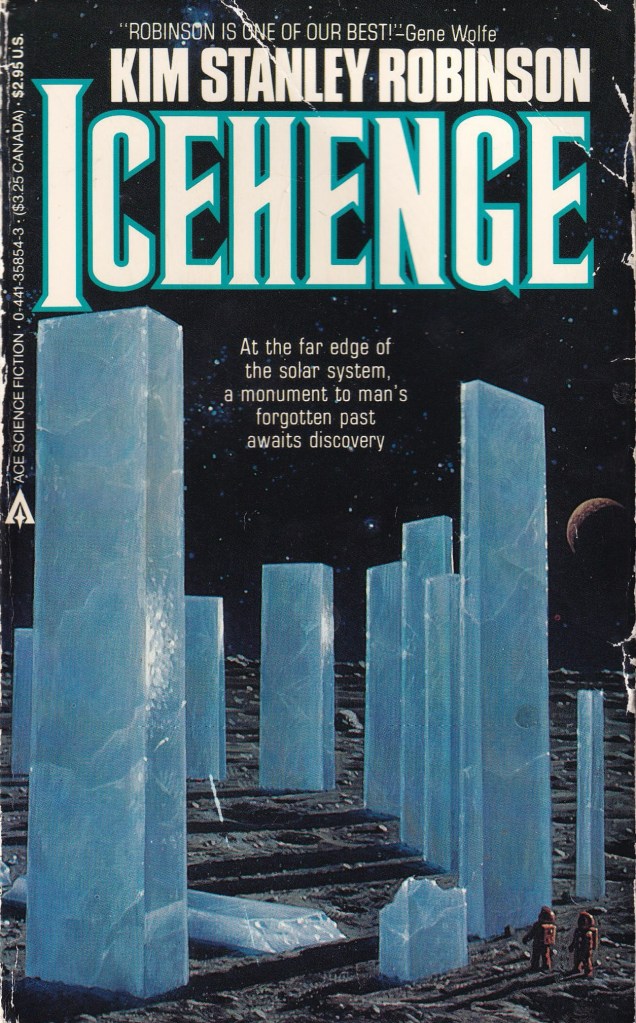
1. Kim Stanley Robinson’s Icehenge (1984)
Mark Weber’s cover for the 1st edition
4.5/5 (Very Good)
Kim Stanley Robinson’s Icehenge (1984), a fix-up from two previously published stories “To Leave a Mark” (1982) and “On the North Pole of Pluto” (1980), tells three interconnected tales that all connect to a mysterious monolith left on Pluto (the titular Icehenge).
In part I (2248 A.D.), hydroponics specialist Emma Weil, stationed on a mining ship in the asteroid belt, finds herself caught up in a radical act of defiance to coincide with a revolt on Mars–the creation of a spaceship for a voyage outside the solar system. She must confront the pull of home and the multitude of ways the power of the state informs and manipulates her life. In part II (2547 A.D.), historian and archaeologist Hjalmar Nederland discovers evidence of the revolt on Mars long covered up by authorities, the diary of Emma Weil, and the monolith on Pluto — a testament to the act of defiance? In so doing, he too, must reckon with Mars’ bureaucratic dictatorship and its amorphous ability to claim narratives of resistance as its own. In part III (2610 A.D.), Edmond Doya, a descendant of Nederland, spins his own conspiracy theory casting all that went before into question. As the threads intersect and split and cross, a voyage sets off, again, for Pluto and its icy pillars—a testament to our desire to find meaning in a disenchanted world.
What pre-1985 science fiction are you reading or planning to read next month? Here’s the October installment of this column.
A selection of read volumes from my shelves
If I’m feeling a bit unmotivated to write about science fiction, I always end up on Fanacor another online repository of fanzines/newspapers exploring all the old historical fannish debates. I especially enjoy their reports on various conventions and the community (from accepting to reactionary) that emerges. For example, the details I uncovered about a lost Philip José Farmer speech titled “SF and the Kinsey Report at the 11th World Science Fiction Convention (Philcon 2) in Philadelphia (September 1953) and Pat M. Kuras and Rob Schmieder’s article “When It Changed: Lesbians, Gay Men, and Science Fiction Fandom” (1980) on the first Worldcon panel with an openly LGBTQ topic: “The Closed Open Mind: Homophobia in Science Fiction Fantasy Stories” moderated by Jerry Jacks, one of the “early openly gay fans.” I recently edited a friend’s article for academic publication on the role of conventions in forming feminist and political activism. Conventions sound like fascinating places, at least from my historically-minded vantage point and lens.
Today I’m joined again by Rachel S. Cordasco, the creator of the indispensable website and resource Speculative Fiction in Translation, for the sixth installment of our series exploring non-English language SF worlds. Last time we covered Arkady and Boris Strugatsky’s ruminative “Wanderers and Travellers” in International Science Fiction, ed. Frederik Pohl (November 1967).
Please note that Rachel and I are interested in learning about a large range of authors and works vs. only tracking down the best. That means we’ll encounter some stinkers. Thankfully, not this time! We got a powerful one.
Unfortunately, Izumi Suzuki’s “Terminal Boredom” (1984, trans. by Daniel Joseph 2021) does not exist online. A large range of her SF stories were translated and published in two volumes by Verso books with various translators. You can acquire Terminal Boredom (2021) and Hit Parade of Tears (2023) at relatively inexpensive prices online. Despite my substantial qualms with the editions (see my review below), I recommend acquiring them.
“Terminal Boredom” (1984) does double duty as the 35th installment of my review series on media landscapes of the future.
In an article on the “iconoclast” Japanese sf writer Izumi Suzuki, Andrew Ridker distills her stories down to three words: “Ambivalence, disappointment, resignation: Suzuki’s stories speak so eloquently to our burnt-out moment that it’s easy to forget the importance of her cultural context” (LitHub, 5/7/21). We are indeed burnt out, more burnt out even than when Ridker was writing just four years ago. It’s now 2025 and time to face the fact that Facebook and YouTube have been around for over twenty years. The iPhone has been around for nearly that long, and for an entire year, the world was turned upside down during a pandemic, during which time we were even more closely connected to our devices. We’re burnt out by phones, by the rapidly-developing world of AI, by the streaming services that offer us so many choices that it’s nearly impossible to pick something to watch.
Which books/covers/authors intrigue you? Which have you read? Disliked? Enjoyed?
Finally acquired a new scanner!
1. The Memory of Whiteness, Kim Stanley Robinson (1985)
Fred Gambino’s cover for the 1999 edition
From the back cover: “In the 33rd century humanity is scattered among the planets of the Solar System. Millions of lives depend on the revolutionary physics of Arthur Holywelkin; millions of hears are moved by the music created by the strange, eerie instrument he built in the last years of his life: the Orchestra. Johannes Wright is the Ninth–and youngest–Master of the Orchestra. But as he sets out on his first Grand Tour of the Solar System, unseen foes are at his heel, ready to reveal all but the meaning of their enmity. In confronting them, Wright must redefine the Universe–for himself and all humanity.”
Octavia E. Butler’s Clay’s Ark (1984) is the final published volume of her Patternist sequence (1976-1984).1 It is the third novel according to the internal chronology of the series. Clay’s Ark is, without doubt, the most horrifyingly bleak science fiction novel I have ever read.2 It’s stark. It’s sinister. It’s at turns deeply affective before descending into extreme violence and displaced morality. The moral conundrum that underpins the central problem, the spread of an extraterrestrial disease, unfurls with an unnerving alien logic. Butler’s characters are trapped by the demands of the alien microbes, scarred by the pervasive sense that their humanity is slipping away, and consumed by the fear of starting an epidemic. A true confrontation of the moment cannot lead to anything other than suicide or the first steps towards an apocalyptic transformation.




 Science Fiction and Other Suspect Ruminations