Here’s to a happy 2024! I hope you had a successful reading year. Maybe you pulled down some dusty tome that you’ve wanted to dive into for a decade. I’d like to imagine you finally picked up a book I raved about in years past that you acquired with great anticipation but never opened. Whether you are a lurker, occasional visitor, or a regular commenter, thank you for your continued support and wonderful conversation.
What were your favorite vintage SF reads–published pre-1985–of 2023? Let me know in the comments.
Continuing a trend, I read only a handful of novels this year. Instead, my obsessions focused on my science short story review initiatives (listed below), collections, and histories of the science fiction genre. Without further ado, here are my favorite novels and short stories I read in 2023 with bonus categories. I made sure to link my longer reviews where applicable if you want a deeper dive into the rich seam of science fictional gems.
Check out last year’s rundown if you haven’t already for more spectacular reads. I have archived all my annual rundowns on my article index page if you wanted to peruse earlier years.
My Top 5 Science Fiction Novels of 2023
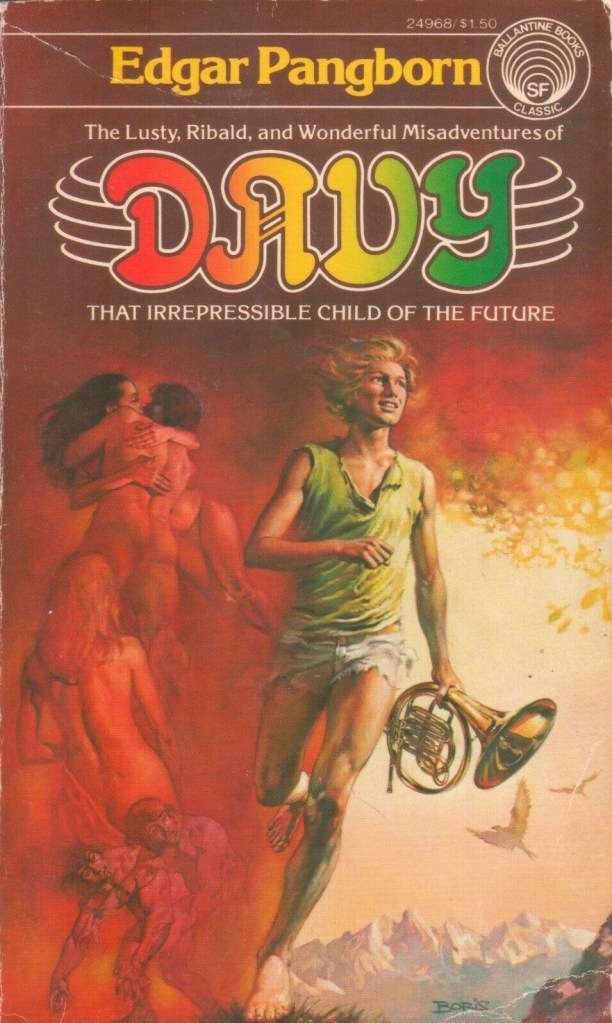
Boris Vallejo’s cover for the 1976 edition
1. Edgar Pangborn’s Davy (1964), 5/5 (Masterpiece): Nominated for the 1965 Hugo Award for Best Novel. Full review.
Davy (1964) takes place in a future devastated by a partially abortive nuclear war and the depravations of subsequent plagues (50). A powerful theocracy and perpetually warring microstates in the American Northeast emerged from the Years of Confusion. The novel takes the form of an autobiography. We follow a young orphan named Davy in love with life and desperate to escape his unfortunate circumstances. As the story progresses, how Davy interprets his own life, the future, and the autobiographical process shifts. A spectacular conjuration of character and the nature of storytelling emerges.
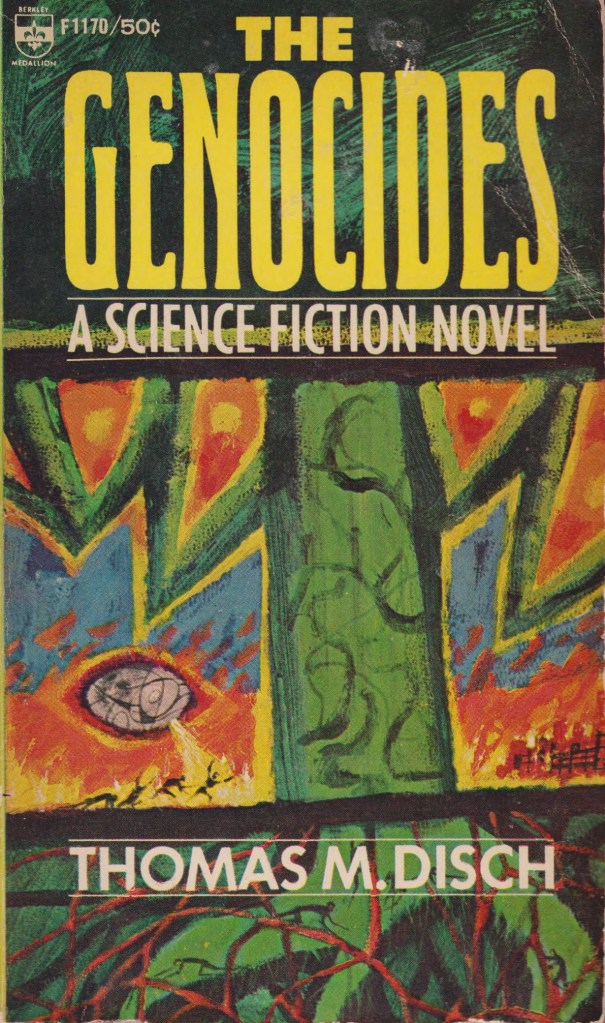
Richard Powers’ cover for the 1965 1st edition
2. Thomas M. Disch’s The Genocides (1965), 5/5 (Masterpiece): Nominated for the 1966 Nebula Award for Best Novel. Full review.
Disch’s masterpiece is an incendiary assault on our senses and expectations of trope and genre. In the face of apocalyptic annihilation at the hands of a vast alien Plant spread across the Earth, biblical stories of redemption and (re)birth are subversively recast as either delusions or decrepit meaningless patterns. Disch conjures a frontier landscapes inhabited by the sinful. Apocalypse cannot lead to rebirth.

Richard Powers’ cover for the 1960 edition
3. Sarban’s The Sound of His Horn (1952), 4.25/5 (Very Good): Full review.
Sarban’s novel is a hypnotic horror in which a soldier, escaping from a Nazi prison camp, awakes in a dystopia a hundred years after Hitler’s victory in WWII. Drawing on a rich English tradition of pastoral novels, The Sound of His Horn (1952), despite its brief length, weaves a disquieting vision of the mechanisms of power and control. It’s unusual. It’s terrifying. It’s possessed by a gorgeous turn of phrase. And, in its most ruminative moments, an incisive exploration of the nature of desensitization and the fear that underpins all actions.

John Jude Palencar’s cover for the 1994 edition
4. Octavia E. Butler’s My of My Mind (1978), 4/5 (Good): Full review.
Mind of My Mind (1977) is the second-published and second chronological installment of Butler’s Patternist series of novels (1976-1984), that chart the dystopic and hyper-violent development (and destruction) of a telepathic society. The immortal Doro, able to hone into those with telepathic talent and shift his essence into new human bodies at will, oversees a generations-old telepathic breeding project. The harrowing story follows one his many daughters, Mary, a rare active telepath (vs. latent), as she comes of age and begins to understand the role that she is designed to play.
I found the collision of Butler’s brutal view of power–and its interplay with relationships, gender roles, and race–and telepathy a heady mixture. It’s hard not to feel for Mary and the horror she has to experience. But soon telepathy becomes a way for Mary to create new–and disturbing–power relationships. I bounce off rosy views of telepathy in science fiction. I imagine Butler’s gut-punch is a bit closer to the truth.

Peter Goodfellow’s cover for the 1972 UK edition
5. Kate Wilhelm’s The Killer Thing (1967), 4/5 (Good): Full review.
Wilhelm’s brutal response to the unfolding Vietnam War. A killer robot stalks Lieutenant Ellender Tracy (Trace) on a desert planet. Trace must keep the robot occupied to prevent it from repairing its space dinghy, shrouded by a cloaking device, and escaping the planet via its orbiting spaceship. The problem? Trace is running out of fuel. And he’s alone for the first time in his life. His fellow officer Lieutenant Ford Duncan died soon in a crash landing their pursuit of the killing machine. The goal? Wait for the World Group’s fleet to arrive. But doubt creeps amongst the desert emptiness and swirling sands.
My Top 20 Science Fiction Short Stories Reads of 2022 (click titles for my full review)
1. Kate Wilhelm’s “Ladies and Gentlemen, This Is Your Crisis” (1976), 5/5 (Masterpiece): The show, This Is Your Crisis, plays every hour of the weekend in Lottie and Butcher’s house on a portable TV and their new expensive wall unit–required for the full experience. The premise? Survival in Alaska! Get to the extraction point first and win one million dollars, after taxes. He pulls up his recliner–they’ll sleep in front of the softly flickering screens–Lottie microwaves the dinners and brings her husband beer. The ritual commences. The metaphor is simple. Lottie and Butcher, trapped in their lives, imagine they would win. They project their own desires and insecurities onto the contestants. They are consumed.
2. Henry Kuttner’s “Year Day” (1953), 5/5 (Masterpiece): Set against geopolitical chaos and endless urban sprawl, “Year Day” imagines an America beset by the desperate and sinister machinations of capitalism unbound. This is a brilliant short story. Kuttner’s imagery and prose create a sonic advertising deluge nightmarish in its physicality and deep resonances. There’s a sense of America’s retreat from the external world and a new battle on the Homefront, a battle to maintain sanity in the face of forces that seek to dictate all desire. Kuttner’s most disturbing implication is that we will more and more mediate our existence through the artificially created avatars that will “think” for us.
3. Vonda N. McIntyre’s “Aztecs” (1977) , 5/5 (Masterpiece): A deeply affective rumination on sacrifice and initiation and the rituals that bind it all together and set everyone apart. Laenea Trevelyan aspires to be a Pilot so she can experience the unspoken, the trip between the stars. The Crew are drugged for the trip. Recovering in the hospital after the operations, she practices controlling the flow of blood into the artificial mechanism. Yearning to rejoin the community of spacers who reside at the port, a huge, floating, artificial island, anchored far from shore, she sneaks out before her rehabilitation is complete. But her friends in the Crew now see her as someone else. Set apart by her choice. She chaffs as the new lines of delineation, of interaction, of values.
4. Edgar Pangborn’s “The Music Master of Babylon” (1954), 5/5 (Masterpiece): In his old age, Brian, the sole occupant of the Museum of Mankind, tries not to remember his childhood. But bits of the happy past interject into the post-apocalyptic now — a world increasingly submerged by water. He spends his days hunting for food and keeping one Grand Piano in the Hall of Music in functional order, and practicing the music of Andrew Carr, a manifestation of the tumultuous post-Hiroshima world. But soon two young teenagers approach the museum and Brian must confront the possibility of a new world.
5. Richard Matheson’s “Pattern for Survival” (1955), 4.75/5 (Near Masterpiece): “Pattern for Survival” does so much with so little space. There’s not an extra moment. It successfully dives into the psychological landscape of those that can delude themselves into carrying–in the post-nuclear war world–on in a unique and metafictional way.
6. Robert Silverberg’s “By the Seawall” (1967), 4.75/5 (Very Good): Micah-IV, a synthetic human, patrols a thousand-meter-long section of a massive seawall. The sea writhes with terrifying beasts (mutants?) kept at bay with poison vents and electrification. Humans stop by the visitor center to look out over the wild expanse. But something has happened in the heart of humanity protected behind the wall. And Micah-IV cannot stop the first of many suicides.
7. Damon Knight’s “You’re Another” (1955), 4.5/5 (Very Good): The artist Johnny Bormish seems to have the worst luck. He crashes into things. He’s the proverbial fruit cart the car always runs into. Something just seems off. The existential fear that someone was doing it to him lingers in his mind like a persistent sore. Was he the punchline to some script he cannot see?
8. Doris Piserchia’s “Pale Hands” (1974), 4.5/5 (Very Good): The year is 2021. Overpopulation results in draconian policies–culminating in the Conditioning Center in Illinois–to fixate all sexual desire of the populace on the park toilet-like masturbation stall. This is a future where “no one could live together; no roommates; no girls together, no men together, and, of course, a male and a female were not permitted to share a pad.” Vega cleans masturbation stalls on Fifth Avenue. Lydon cleans stalls on the other side of the street. She initially views Lydon as “a grubby little mutt.” But something inside her clicks.
9. Ward Moore’s “Lot” (1953), 4.5/5 (Very Good): Moore reimagines the horrifying story of Lot in the aftermath of a nuclear war. In the biblical story, Lot–with his daughters and wife–flee the city of Sodom before its destruction by God. Lot’s wife looks backward and is turned into a pillar of salt. As they have no men to marry while hiding out in a desert cave, Lot’s daughters conspire to bear children by their father. In Moore’s telling, Mr. Jimmon flees Malibu after a nuclear strike with his family–wife Molly, sons Jir and Wendell, and daughter Erika–in tow. He knew the end was coming and had prepared his station wagon accordingly and identified place away from the highways to create a new life.
10. Vonda N. McIntyre’s “Spectra” (1972), 4.5/5 (Very Good): . A profoundly disquieting story of future horror–downright hellish. A young girl with metal sockets instead of eyes and glowing symbols on her]back, narrates her torture at the hands of distant uncaring forces. Meticulously written in the best (but most nightmarishly vivid) way possible, “Spectra” is a beautiful yet brutal exercise in unease and sadness.
11. Vonda N. McIntyre’s “Fireflood” (1979), 4.5/5 (Very Good): Fireflood” follows the flight of the genetically modified human Dark to the preserve of winged Flyers. Replete with armor and belly scales and the ability to detect magnetic fields, Dark’s people were designed to survive under the harsh surface (liquid or earth) of an alien world. But the humans never sent the exploration vessels and her people wait for a purpose that will never come.
12. William Tenn’s “Eastward Ho!” (1958), 4.5/5 (Very Good): Tenn constructs a remarkably complex expose on America’s history of racism and conquest by subverting the canonical mythologized historical moments in the collective memories of all American school children. Humanity cannot escape reenacting the same historical patterns–laying the ground for future mythologies and future cycles of destruction. There is no past to learn from. Linguistic and historical chaos reigns.
13. Frederik Pohl’s “The Gold at the Starbow’s End” (1972), 4.5/5 (Very Good): A series of messages by Lt.-Col. Sheffield N. Jackman on the US Starship Constitution become more and more bizarre. The crew doesn’t seem to be following the guidelines set out by the planners of the mission. Pohl’s story functions as a satire of the morality of the post-WWII military-industrial complex, willing to sacrifice its citizens for the sake of national security on the taxpayer dime.
14. Kate Wilhelm’s “Planet Story” (1975), 4.25/5 (Very Good): A nameless narrator recounts the experience of their deep space survey vessel crew, tasked with charting possible colonies, on a distant planet that appears harmless. Unlike other worlds they’ve charted with clear dangers that bring the crew together, this plant contains no menace. Someone goes missing. And another.
15. Clark Ashton Smith’s “Master of the Asteroid” (1932), 4/5 (Good): In the bleak future (1980) in which “Master of the Asteroid” transpires, tragedies litter the interplanetary gulfs: “vessel after vessel […] disappeared in the infinite–and has not returned” (5). Humanity plunges outward like a lemming, unprepared, unrelenting, unwilling to acknowledge the “inconceivably hostile environment of a cosmos not designed for men” (5). The fate of most of the dead, lost in other desolate realms, remains unknown until the discovery of a diary… The story, written at Clark’s most productive moment, reads like an unnerving catalog of manias.
16. William Tenn’s “Generation of Noah” (1951), 4/5 (Good): This is a well-wrought commentary on the destructive nature of hypermasculine world-views that threaten to obfuscate human kindness. Tenn ridicules the middle-aged American father, who spends his days planning for the nuclear war and yearns to make anew.
17. Damon Knight’s “The Enemy” (1958), 4/5 (Good): The fifteen-year-old Zael is left alone by her mother on a remote planetoid, replete with ruins of some earlier civilization, with a temporary inflatable home, escape pod, and all-terrain vehicle. Her task? Survey the surface and identify potential mineral deposits. After a crash that ruins the vehicle, she accidentally unleashes an alien force dormant for centuries in a stasis pod. They must work together to cross the chasms. But there’s a sense that only one will reach their destination.
18. Sydney J. Van Scyoc’s “Pollony Undiverted” (1963), 4/5 (Good): “Shatter the Wall” effectively charts the disintegrating individuality of a family subsumed by the constructed media personas who sell both products and experiences. A family yearns to become, in the malaise of this post-scarcity world, someone else. They are consumed by imaginary perfection, the absence of conflict, and the possibility that another life would have more meaning.
19. Richard Matheson’s “Through Channels” (1951), 4/5 (Good): Detective James Taylor and Sergeant Louis Ferazzio conduct (and record) their interrogation of a young boy named Leo, who came home to a flickering TV. “Through Channels” feels like a primordial kernel of TV-related SF-ish horror that will be remade and reworked in countless later forms. It’s punchy. It’s historically important. It’s minimalist in its construction of otherworldly terror and hyper-gore.
20. Russell Bates’ “Rite of Encounter” (1973), 4/5 (Good): More fantasy than science fiction, Bates renders the intrusion of an anthropomorphic manifestation of smallpox brought by white colonists into the life of a young Kiowa named Singing-owl. An overt, and brutal, commentary on the effects of colonization.
Reading Initiatives
I have continued, resurrected, and created new science fiction short story reading series over the course of the year. All the stories I’ve picked for the series are available in some fashion online via links to Internet Archive in each review. I’ve included installments from 2023 in each series below. Feel free to read along with me! And thanks for all the great conversation.
The Science Fiction Stories of Kiowa author Russell Bates (1941-2018) (Started 2023)
- “Legion” (1971), 3.5/5 (Good)
- “Get With the Program” (1972), 2.75/5 (Below Average)
- “A Modest Proposal” (1973), 3/5 (Average)
- “Hello, Walls and Fences” (1973), 3.75/5 (Good)
- “Rite of Encounter” (1973), 4/5 (Good)
- “Warning: The Surgeon General Has Determined…” (1977), 3.5/5 (Good)
The First Three Published Short Fictions by Female Authors (started in 2021)
The Media Landscape of the Future (started in 2022)
- Damon Knight’s “Thing of Beauty” (1958), 3/5 (Average)
- Damon Knight’s “You’re Another” (1955), 4.5/5 (Very Good)
- Richard Matheson’s “Through Channels” (1951), 4/5 (Good)
- Robert F. Young’s “Audience Reaction” (1954), 3/5 (Average)
- Kate Wilhelm’s “Ladies and Gentlemen, This Is Your Crisis” (1976), 5/5 (Masterpiece)
- Langdon Jones’ “The Empathy Machine” (1965), 3/5 (Average)
- Henry Kuttner’s “Year Day” (1953), 5/5 (Masterpiece)
- Sydney J. Van Scyoc’s “Shatter the Wall” (1962), 3/3 (Avereage)
- Edmond Hamilton’s “Requiem” (1962), 3.5/5 (Good)
- John Anthony West’s “George” (1961), 2.5/5 (Below Average)
- Russell Bates’ “Warning: The Surgeon General Has Determined…” (1977), 3.5/5 (Good)
- Russell Bates’ “Hello, Fences and Walls” (1973), 3.75/5 (Good)
The Search for the Depressed Astronaut (continued from 2020)
- George R. R. Martin’s “The Second Kind of Loneliness” (1972), 4/5 (Good)
- Tom Godwin’s “The Nothing Equation” (1957), 3.25/5 (Above Average)
- Philip K. Dick’s “The Infinites” (1953), 3.5/5 (Good)
- James Causey’s “Competition” (1955), 3/5 (Average)
- Philip K. Dick’s “Precious Artifact” (1964), 4/5 (Good)
- Henry Slesar’s “Mr. Loneliness” (1957), 3/5 (Average)
- Kate Wilhelm’s “Planet Story” (1975), 4.25/5 (Very Good)
- Clark Ashton Smith’s “Master of the Asteroid” (1932), 4/5 (Good)
Generation Ship Short Stories (continued from 2019)
- Julian May’s “Star of Wonder” (1953), 2/5 (Bad)
Radical Stories on Sex and Sexuality (started in 2022)
- Damon Knight’s “Not With a Bang” (1950), 3.5/5 (Good)
- Ward Moore’s “Lot” (1953), 4.5/5 (Very Good)
- Langdon Jones’ “I Remember, Anita…” (1964), 3.75/5 (Good)
- Robert Silverberg’s “The Seed of Earth” (1958), 3.5/5 (Good)
- Doris Piserchia’s “Pale Hands” (1974), 4.5/5 (Very Good)
- Robert Silverberg’s “Eve and the Twenty-Three Adams” (1958), 1/5 (Bad)
Note: I am discontinuing this series. The second I expanded the range and included 60s and 70s tales it lost its focus and I lost my interest. That is not to say that I won’t read further stories that fit the theme if they crop up in collections, anthologies, or connect to other series.
Exploration Logs (started 2022)
My Top 5 Academic Science Fiction History Reads of 2023
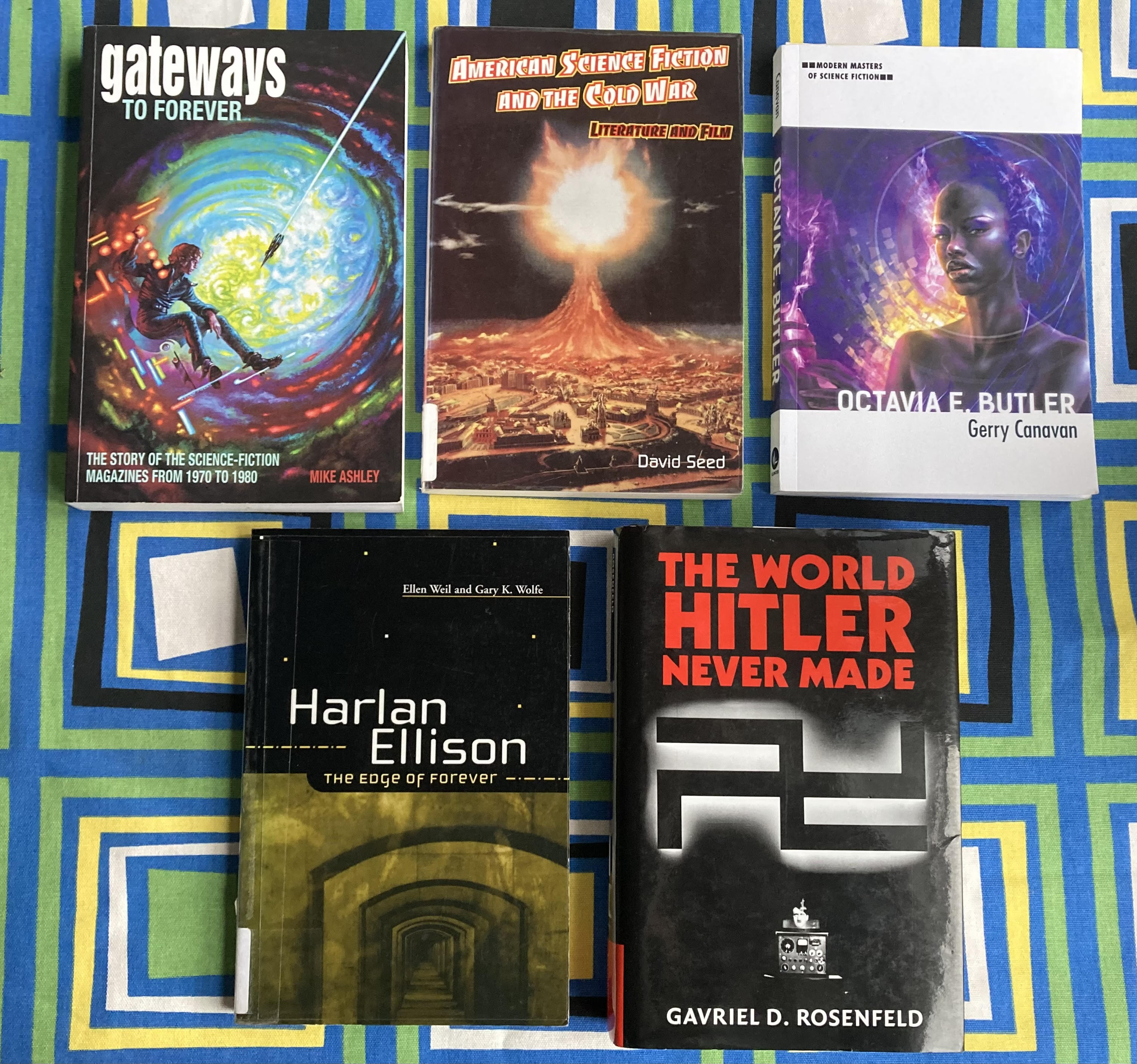
In a given year, I tend to read far more history than science fiction. As with 2022, I made a serious effort to read more scholarship on science fiction. A brief caveat worth repeating: I’m a PhD-wielding historian and have a high tolerance for academic texts. That said, I suspect all five I’ve chosen will be enjoyed by anyone interested in the history of genre.
1. Gerry Canavan’s Octavia E. Butler (2016): The best volume so far in the series as Canavan dives into Butler’s personal papers, drafts, and accumulated documents to examine how she rewrote and reconceptualized her stories over time.
2. David Seed’s American Science Fiction and the Cold War: Literature and Film (1999): I’m a sucker for SF commentaries on post-apocalyptic fears. This is a solid introduction to the scholarship on the subject. I also own Seed’s more recent but very similar Under the Shadow: The Atomic Bomb and Cold War Narratives (2013.
3. Gavriel D. Rosenfeld’s The World Hitler Never Made (2005): A spectacular, neigh encyclopedic, analysis of the persistent allure of creating alternate histories where Hitler won WWII. Rosenfeld explores the relationship between the history and memory of Nazism within these complex texts. Fascinating!
4. Mike Ashley’s Gateways to Forever: The Story of the Science-Fiction Magazines from 1970 to 1980 (2007): While occasionally a bit descriptive and annoyed with the prevalence of nuclear gloom stories, Ashley’s series on SF magazines is indispensable for fans of the genre.
5. Ellen Weil and Gary K. Wolfe’s Harlan Ellison: The Edge of Forever (2002): Weil and Wolfe’s monograph on Ellison examines his entire prodigious writing output–it helped me place his SF works into his larger intellectual project and provided a window into the market demands of the day.
Goals for 2023
1. Keep reading and writing.
2. Read more reviews by other bloggers.
For cover art posts consult the INDEX
For book reviews consult the INDEX
For TV and film reviews consult the INDEX


Merry 2024, Dr. B. I found something on Tumblr today that stretches your Media Lanscape story initiative. A long-forgotten novel called ADS INFINITUM https://www.isfdb.org/cgi-bin/title.cgi?611533
Yes yes yes, novel not story…but well worth at least considering in my never-remotely humble opinion. Sending hugs
Cool! I’ve looked through the entire Curtis bibliography but apparently missed this one… Thank you!
I have mentioned most of my 2023 favorites previously: Doris Lessings Canopus in Argos cycle, Ballards Hello America, The Strugatskys Lame Fate/Ugly Swans, and Aldiss’ Who Can Replace a Man.
Those were all parts of my summer readings, I have mostly read non-SF the rest of the year, but Kobo Abes The Face of Another deserves a mention, if it counts as SF. And recently I just finished Anna Kavans A Bright Green Field, where at least the closing novella “New and Splendid” is SF of sorts, and several of the other stories are perhaps bordeline cases. A great collection in any case.
In addition, one of my absolute favorite SF reads of the year was Antoine Volodines Radiant Terminus, but thats outside the time frame – has a slight new wave-ish feel to it, though.
Of the bunch, I think the Abe and Ballard are on my radar for 2024. I adore Ballard and consumed Abe’s Secret Rendezvous (1977, trans. 1979) with relish. I have Face of Another on my shelf.
The Face of Another is good, but I don’t think it’s among his very best. It’s much more subdued and realistic than Secret Rendevous – more in line with Woman of the Dunes you could say – but there’s also a slightly Ballardian psychological aspect that I think you’ll enjoy (as well as a meta-fictional element).
For something more resembling the weirdness of Secret Rendesvous, I very much recommend The Box Man and Ark Sakura.
From your list, I recently got my hands on The Genocides, so I’m looking forward to getting to that sometime in 2024.
I’ve read Abe’s Woman in the Dunes and watched the film (which Abe wrote the screenplay for). And watched the film version of Face of Another!
I’ve read about The Ark Sakura and read The Box Man already (and seen the film adaptation as well!).
I look forward to your thoughts on The Genocides. It was a toss up with Davy which one I enjoyed more.
I also discovered Edgar Pangborn in 2023, and I really wish his books were still in print.
For my own site I’d say my favorite novella read was “Hardfought” by Greg Bear, which also happened to be my first of that year, and it was never quite topped. It’s still totally a mind-bender, and I hope to read it again soon just so that I might understand everything. For short stories it might be “Paycheck” by Philip K. Dick or “Angel’s Egg” by Edgar Pangborn. Two very stories with different goals that strike me as almost perfect in execution.
All three of those are stories I could cover in 2024. Especially the Pangborn…. Planning on reading anything from my list?
I hope to get to The Genocides sooner rather than later.
Let me know what you think!
Happy new year 🎂🎂
You too. Have any vintage SF reading plans?
Thanks for the year Joachim.
I’m so happy ‘Davy’ made it to the top of your list for this year. I know you wend your own way through the back streets of SF, but you really must read Pangborn’s ‘A Mirror for Observers’. You won’t be sorry…
PS. I’m sorry I missed your foray and discussion into Damon Knight waters. Such a strange, compelling and uneven figure–as all the best people are!
Thanks for all the conversation over the year — and your own posts that I’ve enjoyed.
I struggled to figure out whether The Genocides or Davy was my top top read of the year. I still think they are virtually tied in my mind — both do things that I deeply appreciate (reflexive moments that discuss/subvert narrative).
I plan on continuing my Pangborn read-through. Not sure what is up first.
I like the sound of Ward Moore’s ‘Lot’. Have you read “Bring The Jubilee’ in which the South wins the Civil War? And, a propos of ‘The World Hitler Never Made’, I’ll mention Katharine Burdekin’s ‘Swastika Night’ which is really spine-chilling. The Nazis did win, 700 years ago…
I have not read Bring the Jubilee, yet. I have a copy on the shelf. Same with Swastika Night.
The best books from this period that I read last year and that really stuck in my mind were Butler’s “Kindred” and Priest’s “The Affirmation”, the latter of which elicited the unusual compulsion in me to read it again as soon as I finished it (ultimately I resisted).
Yeah, Kindred is still my favorite Butler. And The Affirmation my favorite Priest — so far.
Also – Disch is generally an excellent if idiosyncratic and unpredictable writer, and while I did find The Genocides nihilistic rewrite of religious/mythical tropes compelling I would actually rank it third behind 334 and Camp Concentration from his peak period. Inknow others also rank Wings of Somg very highly and I’ll probably get around to it at some point, but I admit I dont find the premise particularly appealing. The one novel I’ve read of his that I thought was genuinely bad was “Echo Round His Bones”, which was bound up in some specifically Catholic theological concerns that ultimately I just found silly and boring.
334 is on the list for this year. But I’ve been saying that for years. I read but never wrote about Camp Concentration. I should revisit it. Wings of Song is unread on the shelf.
I might be mixing that up w one of his others re: the Catholic stuff, I do recall finding the whole duplicate/ghost premise to be nonsensical and not in a fun way
As I quite enjoy Disch, I’ll probably end up reading all of his earliest novels — even the duds.
I agree, though my ranking would switch CAMP CONCENTRATION and 334.
I agree that you must read A MIRROR FOR OBSERVERS! (Among other things, you will meet (very slightly) a character from “The Music Master of Babylon”, though it’s not at all clear that the two pieces are actually intended to be in the same future.)
And I must reread DAVY!
I also read “You’re Another” last year, by coincidence, and I agree that it is brilliant. Knight is a major writer who has gotten a lot of well-deserved attention, but oddly “You’re Another” doesn’t seem to get as much attention as it merits. Also, I can’t remember if you’ve read Knight’s great novella (or long novelette) “The Earth Quarter”, which I very highly recommend.
My favorite older SF novels from last year’s reading are THE SOUND OF HIS HORN, John M. Ford’s THE DRAGON WAITING, Elizabeth Hand’s WAKING THE MOON (not to be confused with Elizabeth Moon’s WAKING THE HAND 🙂 ), Rose Macaulay’s WHAT NOT, and Carol Emshwiller’s CARMEN DOG.
Favorite older short fiction (besides “You’re Another”) would include “The Second Inquisition” (and other Russ stories such as “My Boat”), A. S. Byatt’s “The Djinn in the Nightingale’s Eye”; Avram Davidson’s “The Sources of the Nile”, and J. R. R. Tolkien’s “Leaf by Niggle”.
I haven’t covered “The Earth Quarter” yet. Maybe this year.
“The Second Inquisition” is spectacular. It might be my favorite Russ I’ve read so far.
Thanks for all your great reviews in 2023. I’ll try to be more involved in commenting and interacting with them in 2024.
I just read “Nuclear War: A Scenario” by Annie Jacobsen and it was utterly terrifying and now I need to read more sci-fi stories about nuclear war. I read “Davy” and we ended up with pretty different opinions on it, and I’ve read every Hugo-nominated novel that touches on nukes. I’m curious on what you think are some of the best science fiction and non-fictional works on the topic (I remember you sharing some non-fiction about nuclear sci-fi on Twitter but can’t seem to find the post).
Mordecai Roshwald’s Level 7 (1959) is a favorite. There’s an old review on my site. https://sciencefictionruminations.com/2013/01/05/book-review-level-7-mordecai-roshwald-1959/
I recently reviewed Alas, Babylon (1959) — which many consider a classic. I was a bit more ambivalent. https://sciencefictionruminations.com/2024/08/04/book-review-alas-babylon-pat-frank-1959/
P. C. Jersild’s After the Flood (1982) is spectacular. Depressing as all hell… https://sciencefictionruminations.com/2022/05/30/book-review-after-the-flood-p-c-jersild-1982-trans-1986/
As for scholarship, I found David Seed’s Under the Shadow: The Atomic Bomb and Cold War Narratives (2013) a solid analysis. For an academic book, 20$ is a cheap price….
The reality is, I know you want to read more novels than short stories but I greatly prefer the short form.
A handful of short stories that aren’t to be missed from my more recent reviews:
Richard Matheson’s “Pattern for Survival” (1955) https://sciencefictionruminations.com/2023/03/14/short-story-reviews-richard-mathesons-pattern-for-survival-1955-and-margaret-st-clairs-quis-custodiet/
William Tenn’s “Generation of Noah” (1951) and “Eastward Ho!” (1958) https://sciencefictionruminations.com/2023/03/04/short-story-reviews-william-tenns-generation-of-noah-1951-and-eastward-ho-1958/
Sonya Dorman’s “Go, Go, Go, Said the Bird” (1967) https://sciencefictionruminations.com/2022/12/29/short-story-reviews-fritz-leibers-the-moon-is-green-1952-and-sonya-dormans-go-go-go-said-the-bird-1967/
There are many many many more as it’s one of the main threads of my reviews from the last few years…
Walk to the End of the World, Suzy McKee Charnas (1974) is not to be missed. My single example of why I could care less about what won or was nominated for an award 😉 https://sciencefictionruminations.com/2015/07/30/book-review-walk-to-the-end-of-the-world-suzy-mckee-charnas-1974/
Charnas’ novel is a bit after the actual nuclear war. Again, an acquired taste for some I assume… Does so many fascinating things with memory and song and resistance.
There’s a recent edition of Termush by Sven Holm (1967, trans. 1969). I tracked it down before the new edition and feel that the fortune I paid for my rare copy was worth it! Huge fan of Scandinavian SF. https://sciencefictionruminations.com/2020/06/19/book-review-termush-sven-holm-1967-trans-1969/
Two more short stories not to be missed:
Alice Eleanor Jones “Created He Them” (1958): https://sciencefictionruminations.com/2022/09/10/short-story-reviews-alice-eleanor-jones-created-he-them-1955-and-katherine-macleans-interbalance-1960/
And Leiber’s “The Moon is Green” (1952): https://sciencefictionruminations.com/2022/12/29/short-story-reviews-fritz-leibers-the-moon-is-green-1952-and-sonya-dormans-go-go-go-said-the-bird-1967/
Again, these are all my more recent reviews. I could gather a neigh on infinite number from the archives. Hah.