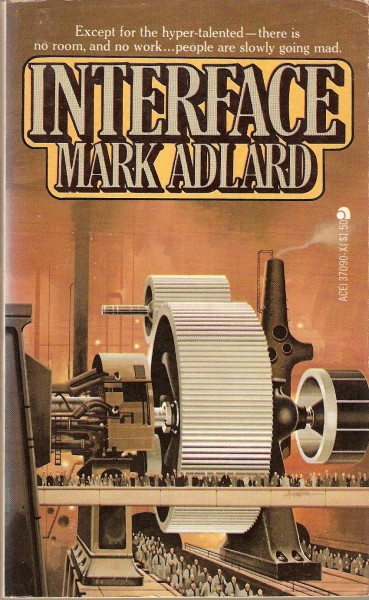
Book Review: Interface, Mark Adlard (1971)

NTRFCKRGSP1977

(Paul Alexander’s cover for the 1977 edition)

3.25/5 (Vaguely Good)

“Stahlex! Stahlex!

I want it thick!

I want it quick!

I want something that’ll do the trick!

Use Stahlex! Use Stahlex!

A benevo-o-olent monopo-o-oly” (160).

Mark Adlard’s SF output consisted primarily of the Tcity trilogy: Interface (1971), Volteface (1972), and Multiface (1975).  The domed (and doomed) city is a powerful scenario to explore a cornucopia of future social issues such as conformity, Continue reading

Update: Recent Science Fiction Acquisitions No. CXXXVII (Bulychev + Sladek + Effinger + Wilhelm)

A wonderful range of 70s and early 80s SF…

I am not much of a “collector” but I am getting the collector’s itch after acquiring one of many amazing volumes in the SF from the USSR series from Collier (and Macmillan in hardback) books in the late 70s.  The Lehr covers!

Sladek short stories….

Killer robots… (with societal commentary!)

And Geo Alec Effinger being Effinger…

Thoughts?

1. Half a Life, Kirill Bulychev (USSR 1975, USA 1977)

HLFLFVVRDQ1978

(Paul Lehr’s cover for the 1978 edition) Continue reading

Book Review: An Infinite Summer, Christopher Priest (1979)

NNFNTSMMR1981

(Don Puchatz’s cover for the 1981 edition)

4.75/5 (collated rating: Very Good)

With Christopher Priest’s second short story collection, An Infinite Summer (1979), he enters the pantheon of my favorite SF authors.  The thing is, I knew he would all along once I moved past the sour taste of his first novel Indoctrinaire (1970) and finally picked up one of his later endeavors.

Priest’s fiction appeals to my sensibilities: he is the consummate wordsmith; his worlds (especially the stories in the loose sequence of the Dream Archipelago) are evocative; the stories drip with a certain nostalgic longing and/or are populated with characters who cannot escape their memories; metafictional experimentation (a novel within a story, a novel that Priest himself would go on to write–perhaps with a different plot!) is rooted to the aims of each story (you cannot separate the two without Continue reading