Which books/covers/authors intrigue you? Which have you read? Disliked? Enjoyed?
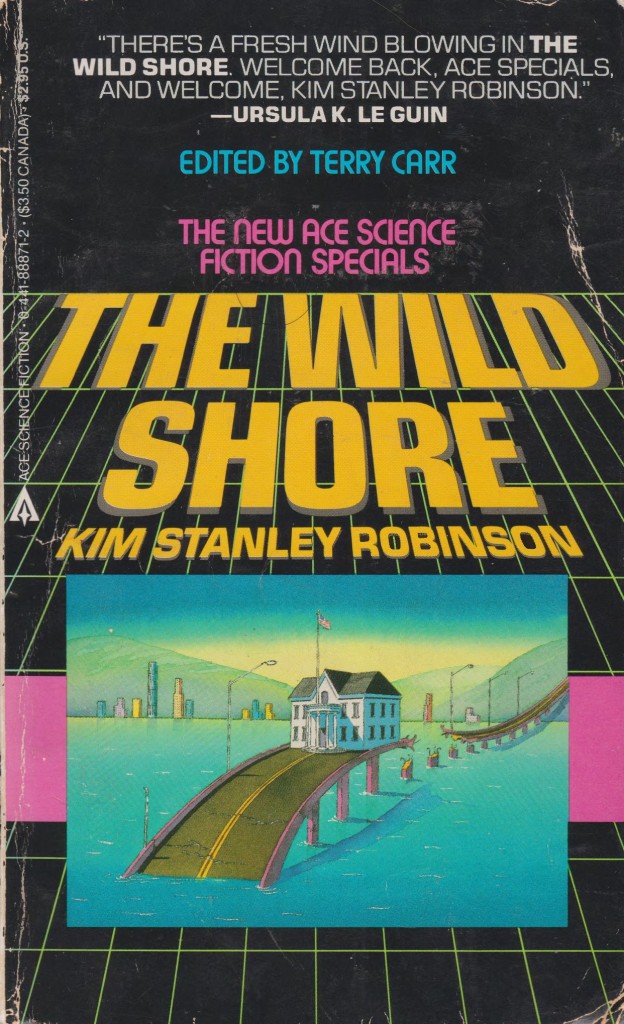
1. The Wild Shore, Kim Stanley Robinson (1984)
Andrea Baruffi’s cover for the 1st edition
From the back cover: “Seventeen-year-old Henry wanted to help make America great again, like it had been sixty years ago, before all the bombs went off. But for the people of Onofre Valley, just surviving was challenge enough. Then one day the world came to Henry, in the shape of two men who said they represented the American Resistance…”
Robert Silverberg (1935-) was one of the authors of the first decade of my site. I’ve reviewed twelve of his novels and thirty-two of his short stories. I also consumed with relish Tower of Glass (1970) and A Time of Changes (1971) as audiobooks and thus couldn’t review them. While an occasional story crops up here and there in an anthology, it’s about time I return to a Silverberg-specific volume. Dimension Thirteen (1969) collects six 50s stories and five from the 60s. The collection charts the moment when Silverberg’s career profoundly shifted from workman adventure to exemplary texts of the New Wave. They range from humorous commentaries on peccadillos and lusts to sinister ruminations on egotism and power.
The following reviews are the 21st and 22nd installments of my series searching for SF short stories that are critical in some capacity of space agencies, astronauts, and the culture which produced them. Some stories I’ll review in this series might not fit. Many are far from the best. And that is okay. I relish the act of literary archaeology.
I’ve paired a take by Tom Godwin (1915-1980) and George R. R. Martin (1948-) on the psychiatric impact of isolation in the bleak emptiness of space. Both explore the interior landscape of the mind alone with itself and all its memories, and delusions, and terrors. There are no heroes in these pages.
Kelly Freas’ cover for Analog Science Fiction/Science Fact, ed. Ben Bova (December 1972)
4/5 (Good)
George R. R. Martin’s “The Second Kind of Loneliness” first appeared in Analog Science Fiction/Science Fact, ed. Ben Bova (December 1972). You can read it online here.
At the Edge of the Vortex We Tell So Many Lies
The location: the Cerberus Star Ring, six million miles beyond Pluto (10). The manmade station, “a circle whose diameter is more than a hundred miles” (12), surrounds a nullspace vortex (think wormhole) to an unknown location across the universe. Humanity sends ships through the brightly colored swirling eddies of the portal to establish colonies somewhere beyond. A single man operates the machinery on the ring from a featureless white control room via a holograph helmet (11). The story follows the journal entries of an unreliable narrator ostensibly counting down the days until his relief arrives from Earth: “It will be at least three months before he gets here, of course. But he’s on his way” (10). It’s a mantra he tells himself. Relief is on its way. Relief is on its way. But does he want relief?


 Science Fiction and Other Suspect Ruminations