Updates: Recent Science Fiction Purchases No. CCCXX (Michael Moorcock, Dean Ing, Vonda N. McIntyre, John Hersey)

Which books/covers/authors intrigue you? Which have you read? Disliked? Enjoyed?

1. Pulling Through, Dean Ing (1983)
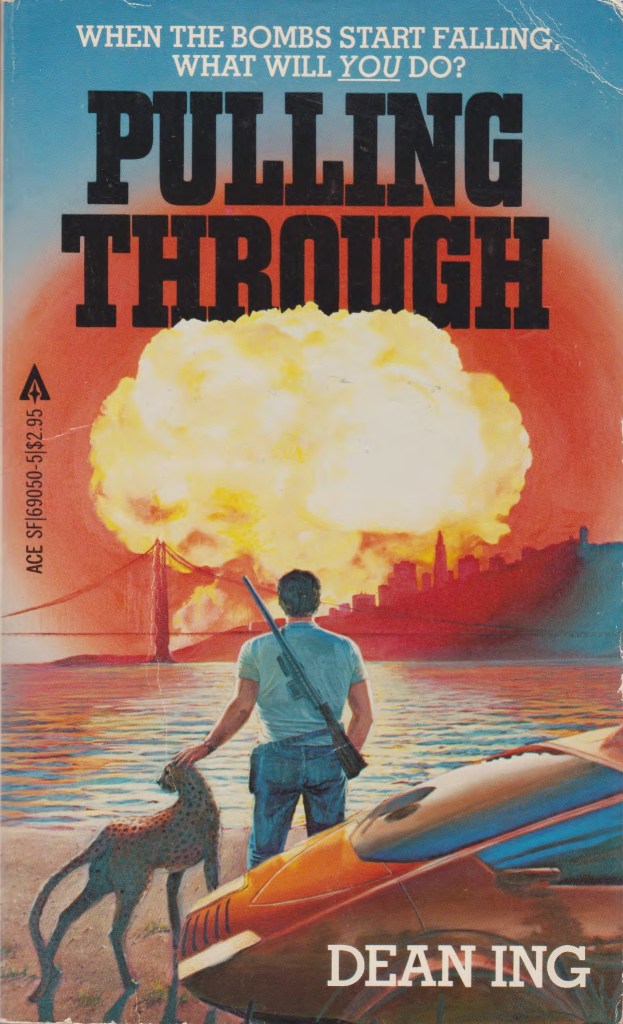
From the back cover: “DOOMSDAY. ARE YOU READY?

HARE RACKHAM, bounty hunter, race-car driver. His best friend is a hunting cheetah. Harve has turned his California home into a survival shelter. He intends to pull through.

SHAR MCKAY, Harve’s little sister. Shar’s latest fad is nuclear survival. She intends for her husband and kids to all pull through.

ERNEST MCKAY, engineer. He has the knowledge and skills to save his family. With his help they’ll all pull through.

KATE GALLOW, runaway, forger, a tough street survival. She’s trouble–but when real troubles come down, Kate will always pull through.

Dean Ing has thought a lot about survival, and he wants as many of you as possible to pull through inevitable disaster of nuclear war. That’s why he’s written this more-than-a-novel. Dean Ing lays all the cards on the table in this one. The story tells why. The articles and blue-prints tell how. PULLING THROUGH won’t save your hide all by itself, but it sure will give you a head start on pulling through by yourself.”

Continue reading

Short Book Reviews: John M. Ford’s The Princes of the Air (1982), Keith Roberts’ The Furies (1966), and John D. MacDonald’s Wine Of the Dreamers (1951)

Note: My read but “waiting to be reviewed pile” is growing. Short rumination/tangents are a way to get through the stack before my memory and will fades. My website partially serves as a record of what I have read and a memory apparatus for any larger project I might conduct in the future. I rather have a short review than none at all! Stay tuned for more detailed and analytical reviews.


1. The Princes of the Air, John M. Ford (1982)

3.5/5 (Good)

John M. Ford (1957-2006) is one of those authors I’ve read a lot about but never sat down and read. As if often my strategy, I decided to explore around the edges a bit before reading his best-known novels Web of Angels (1980) and The Dragon Waiting (1983). I settled on his second novel The Princes of the Air (1982)….

The first layer of The Princes of the Air reads as a traditional space opera. Three young men from rough poverty-filled pasts–Orden Obeck, David Kondor/Koleman, and Theodor Thorn/Norne–aspire to serve the Queen of Humankind. On the dusty planet Riyah Zain, the three friends scam the unwary and while away their days in the Asterion Arcade playing military games in which they imagine how they will serve the queen—Obeck will be the Ambassador-Global, Kondor the Admiral of the Fleet, and Theodor Norn the best Pilot and writer of the book on piloting. Obeck, indentured to the state as he voluntarily went on the government dole, trains to be a diplomat. He brushes up against the classist views of the students, who look down on Obeck’s achievements as an indentured man. Soon his accomplishments mean that he, and his friends, can leave the planet. Eventually, they find themselves embroiled in the machinations of the state and the powers that bind everything together.

Continue reading

Short Story Reviews: Philip K. Dick’s “The Infinites” (1953) and James Causey’s “Competition” (1955)

The following reviews are the 23rd and 24th installments of my series searching for SF short stories that are critical in some capacity of space agencies, astronauts, and the culture which produced them. Some stories I’ll review in this series might not fit. Many are far from the best. And that is okay. I relish the act of literary archaeology.

I’ve paired two 1950s stories, by Philip K. Dick and the far lesser-known James Causey, that explore the inability to understand the universe outside our Earth. Explorers find themselves at each others throats caught up in paranoid delusions of grandeur.

Previously: George R. R. Martin’s “The Second Kind of Loneliness” (1972) and Tom Godwin’s “The Nothing Equation” (1957)

Up Next: Philip K. Dick’s “Precious Artifact” (1964) and Henry Slesar’s “Mr. Loneliness” (1957)

3.5/5 (Good)

Philip K. Dick’s “The Infinites” first appeared in Planet Stories, ed. Jack O’Sullivan (May 1953). You can read it online here.

A preliminary note: I dislike writing about Philip K. Dick. As I mentioned in my 2021 review of “A Little Something for Us Tempunauts” (1974) for this series, “I find it far more enjoyable and liberating to write about lesser-known authors.” Or at least those whose works and lives are less encyclopedically covered by fans and academics alike. There are and will be far superior takes on this story. I don’t have the will or focus. And that’s okay. I rather focus my obsessive eye on others. To be clear, I love Philip K. Dick. Along with C. J. Cherryh, Frank Herbert, and Stanislaw Lem, he was one of the authors of my early twenties–right before I started this website.

A few observations on “The Infinites” (1953)….

Continue reading

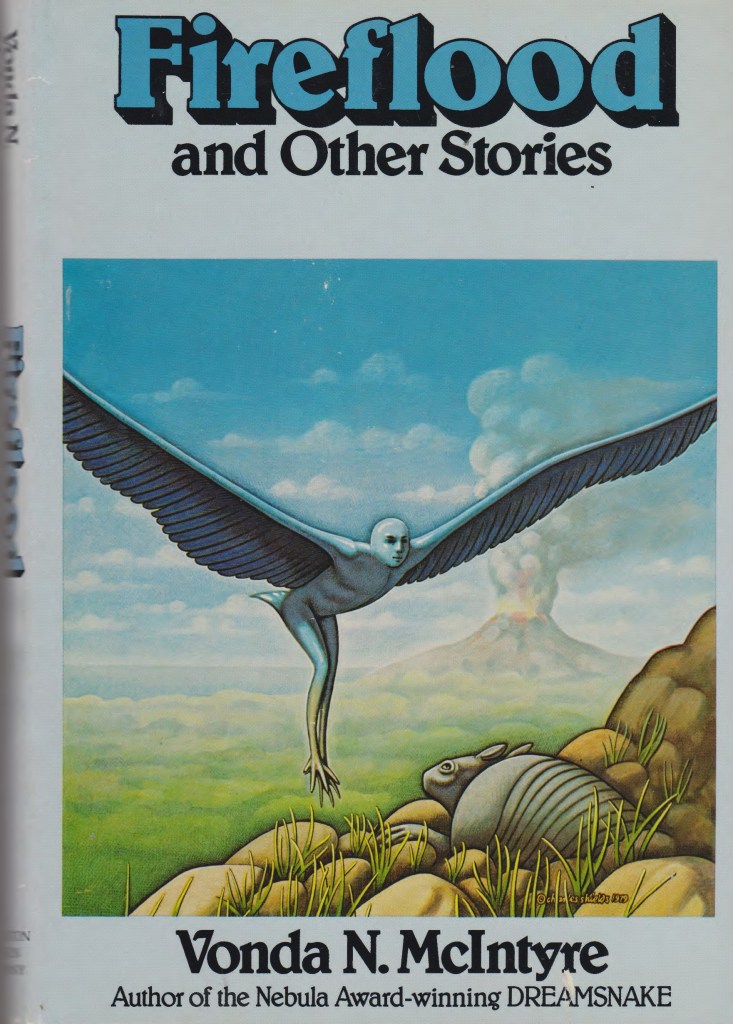
Book Review: Fireflood and Other Stories, Vonda N. McIntyre (1979)

4.25/5 (Collated Rating: Very Good)

After Vonda N. McIntyre’s passing in 2019, I made a promise to finally tackle her spectacular array of 70s fictions, including her Hugo and Nebula-winning Dreamsnake (1978). Her stories appeal to so many of my sensibilities. Her perceptive eye resides in interior spaces, the moody psychological landscapes of society’s pariahs and traumatized. Her work reflects the best of the New Wave. The prose rarely flashes with excessive experimental exuberance but relies on the poetic moment hinting at internal sadness, decay, and the inability to truly escape.

Despite her often depressed narrators, the stories are not all without hope. In “Of Mist, and Grass, and Sand” (1973), horrific misunderstanding reinforces a healer’s calling. In “Wings” (1973) and “The Mountains of Sunset, the Mountains of Dawn” (1974), the transformed find meaning in interpersonal connection as the unknown spins closer.

There’s a running theme in the collection of technology prematurely and cruelly unleashed. In “Spectra” (1972), a girl is enslaved to a machine that causes others pleasure. In “Aztecs” (1977), the choice–the physical reworking of the body–to become a Pilot servers all possibilities of love. And in “The Genius Freaks” (1973), the mental workings of genetically modified are harvested by cruel overlords unable to confront the lives they have ruined.

Continue reading