My rough start to the semester proves hard to dispel. I’ll get back to my regular programming soon–I promise. In the meantime, I’ve collected some goodies!
Which books/covers/authors intrigue you? Which have you read? Disliked? Enjoyed?
1. The Man Who Fell to Earth, Walter Tevis (1963)
Jim Burns’ cover for the 1982 edition
From inside page: “He was not a man; yet he was very much like a man. He was six and a half feet tall, and some men are even taller than that; his hair was as white as that of an albino, yet his face was a light tan color, and his eyes a pale blue. His frame was improbably slight, his features delicate. There was an elfin quality to his face, a fine, boyish look to the wide intelligent eyes.
Today I’ve reviewed the 29th story in my series on the science fictional media landscape of the future. In Sydney J. Van Scyoc’s debut “Shatter the Wall” (1962), a bedraggled wife attempts to prevent her daughter and husband from taking on the personas of a television family.
Sydney J. Van Scyoc (1939-2023) published eleven novels and around thirty short stories across her writing career (primarily 1962-1991). Her visions were rarely republished or anthologized. “A Visit to Cleveland General” (1968) might be her best-known short story as it appeared in Carr and Wollheim’s best of 1969 anthology. I have a positive impression of her work so far.
Have you read any of her work? If so, what were your thoughts?
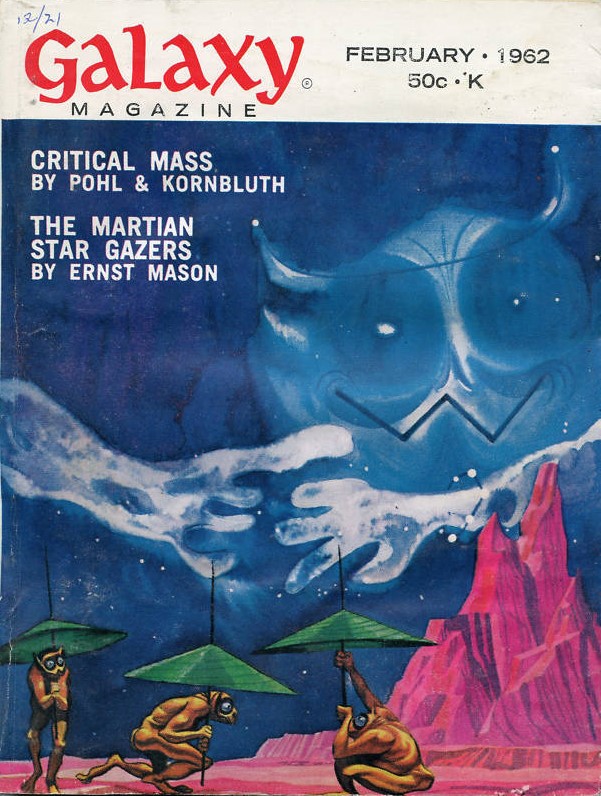
Jack Gaughan’s cover for Galaxy, ed. Frederik Pohl (February 1962)
3/5 (Average)
“Shatter the Wall” first appeared in Galaxy, ed. Frederik Pohl (February 1962). You can read it online here.
According to Gary R. Edgerton in The Columbia History of American Television (2007), a debate emerged in the late 1950s about American materialism and its glorification on television. John Kenneth Galbraith’s The Affluent Society (1958) suggested that advertising created synthetic needs and damaging desires in American citizens. “Shatter the Wall” is all about synthetic needs and damaging desires.
What pre-1985 science fiction are you reading this week?
Thanks again for all the great conversation. Make sure to check out the previous installment if you haven’t already. As before, I’ve included a bit about the books in the photograph, birthdays from the last two weeks, and brief ruminations on what I’ve been reading and writing.
After Frederik Pohl (1919-2013) left his editorial position at Galaxy and If in 1969, he set his pen towards a productive vein of form in the 70s that would culminate in his Hugo and Nebula-winning Gateway (1977). The Gold at the Starbow’s End contains five short stories–including the first of his Heechee sequence–from this period. Two of the best stories, the titular “The Gold at the Starbow’s End” (1972) and “The Merchant of Venus” (1972), demonstrate Pohl’s characteristic blend of hyperbolic satire and delirious energy. There are no duds in this collection.



 Science Fiction and Other Suspect Ruminations