Exploration Log 6: Clifford D. Simak’s 1971 Worldcon Guest of Honor Speech

In an August 1967 editorial in Galaxy titled “S.F. as a Stepping Stone”, Isaac Asimov (1920-1992) voiced his extreme disapproval of the New Wave movement as “‘mainstream’ with just enough of a tang of the not-quite-now and the not-quite-here to qualify it for inclusion in the genre” (4). He concludes: “I hope that when the New Wave has deposited its forth and receded, the vast and solid shore of science fiction will appear once more and continue to serve the good of humanity” (6). The implication is clear: there is an Platonic science fiction form that exists (and that he writes) that must be rediscovered.

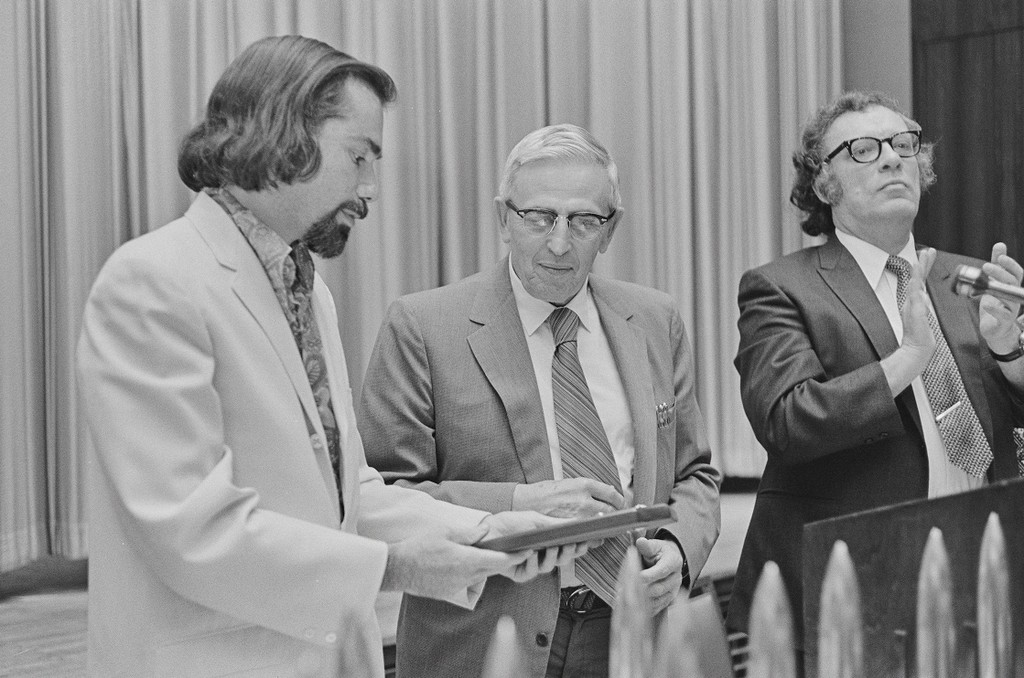
Fellow “classic” author Clifford D. Simak (1904-1988) offered a different, and far more inclusive, take at his Guest of Honor speech at Norescon 1 (Worldcon 1971). In an environment of “shrill” disagreement between various New Wave and anti-New Wave camps, Simak celebrated science fiction as a “forum of ideas” open to all voices (148).

Preliminary note: I read the speech in Worldcon Guest of Honor Speeches, ed. Mike Resnick and Joe Siclari (2006). You can listen to the speech (at the 28:00 min. mark) here. For a wonderful range of photographs of Simak at the convention, check out this indispensable photo archive.

As I did with six Simak interviews earlier this year, I will paraphrase his main points and offer a few thoughts of my own.

Let’s get to the speech!
Continue reading

Short Fiction Reviews: Leigh Kennedy’s “Salamander” (1977), “Whale Song” (1978), “Detailed Silence” (1980), and “Speaking10 to Others2; Speaking3 to Others20” (1981)

In the past few years, I’ve put together a series on the first three published short fictions by female authors who are completely new to me or whose most famous SF novels fall mostly outside the post-WWII to mid-1980s focus of my reading adventures.

Today I’ve selected the first four stories by an author I’ve only recently started to read–Leigh Kennedy (1951-). I’d previously reviewed “Helen, Whose Face Launched Twenty-Eight Conestoga Hovercraft” (1982) and placed her on the list for this series. According to SF Encyclopedia, Kennedy’s “writing is succinct, polished, lucent, and her stories are emotionally penetrating; it is unfortunate that she has fallen from the world of novel publishing, though continuing to work as a professional indexer.” And I can’t agree more! Her first four stories show great promise and moments of refined vision. I can’t help but think the backlash to her Nebula-nominated (and best-known work) “Her Furry Face” (1983) might have had some effect on her trajectory.

So far I’ve featured Alice Eleanor Jones (1916-1981), Phyllis Gotlieb (1926-2009), Sydney J. Van Scyoc (1939-2023), Josephine Saxton (1935-), Carol Emshwiller (1921-2019), Wilmar H. Shiras (1908-1990), Nancy Kress (1948-), Melisa Michaels (1946-2019), Lee Killough (1942-), Betsy Curtis (1917-2002), and Eleanor Arnason (1942-). To be clear, I do not expect transformative or brilliant things from first stories. Rather, it’s a way to get a sense of subject matter and concerns that first motivated authors to put pen to paper.

Let’s get to the stories!


Continue reading

Updates: Recent Science Fiction Purchases No. CCCXXXIX (Frank Herbert, Alan E. Nourse, Ann Maxwell, Craig Harrison)

Which books/covers/authors in the post intrigue you? Which have you read? Disliked? Enjoyed?

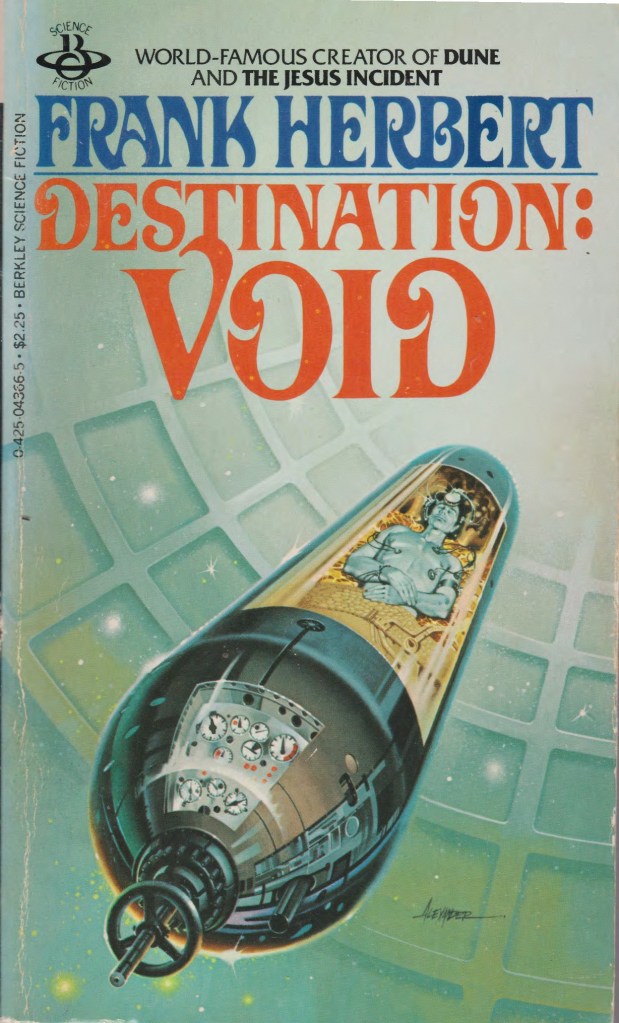
1. Frank Herbert’s Destination: Void (1966, rev. 1978)

From the back cover: “DESTINATION: VOID

THE COMPLETELY REVISED AUTHOR’S EDITION OF THE CLASSIC DEEP-SPACE ADVENTURE!

‘When the publishers announced that they were going to bring out a new edition of DESTINATION: VOID, they offered me the opportunity to make any changes I felt were necessary. Because of the tightly interwoven scientific premises behind this story and rapid development in the fields related to these premises, it would be extraordinary if discoveries across thirteen years did not dictate certain revisions.

Continue reading

Short Book Reviews: Lisa Goldstein’s A Mask for the General (1987) and Philip McCutchan’s The Day of the Coastwatch (1968)

Note: My read but “waiting to be reviewed pile” is growing. Short rumination/tangents/impressions are a way to get through the stack before my memory and will fades. My website partially serves as a record of what I have read and a memory apparatus for future projects. Stay tuned for more detailed and analytical reviews.

1. A Mask for the General, Lisa Goldstein (1987)

3/5 (Average)

One of many attempts to dispel fascist gloom novels I’ve been drawn to recently, Lisa Goldstein’s A Mask for a General: A Novel (1987) imagines a deliberate retreat into the “primitive” as a way to resist. The story follows Mary, a young naive teenager desperate to strike out on her own, and her encounter with Lisa, a master mask maker. In this future, in the wreckage of the University of California, Berkeley campus (the parallel to the historical role of the university in the 60s is deliberate), various “Tribes” attempt to escape the grip of The General by wearing masks and taking on new personas detached from the present. Apparently after a series of disasters, Japan has far surpassed the United States as a technological power. Considering how the world viewed Japan in the 80s, this is not a ridiculous assumption. The General controls media and has dismantled every semblance of democratic government. Mary gets drawn into a larger, rather bizarre, attempt to influence The General that might tear down the state.

Continue reading

What pre-1985 science fiction are you reading? + Update No. XVII

What pre-1985 science fiction are you reading or planning to read this month? Here’s the September installment of this column. I am a few days late with this post. We’ll pretend it appeared in October!

I’ve been reading the little scholarship on H. Beam Piper (1904-1964) in order to more adeptly understand his political views when I tackle his various union-related stories for my series. I was struck by the extreme poverty, impact of a memorable cover, and dependence on a responsive agent that he found himself mired in after he lost his railroad guard job and had to rely on writing. He kept himself alive by selling off his gun collection that he had accumulated over the years and eating pigeons his shot on his porch. While he doesn’t seem to have been the best with the little money that came his way, often blowing the majority of a paycheck from Campbell, Jr. on expensive suits, it’s shocking what he had to do to survive between story acceptances. Piper seems to have committed suicide in part due to his financial hardships.

Despite the fact that I can’t wholeheartedly recommend John F. Carr’s H. Beam Piper: A Biography (2008) or Typrewriter Killer (2015) as large sections take the form of haphazardly strung together journal entries with little larger historical analysis, I found Carr’s often unnervingly voyeuristic look into his life lay bare the financial realities of publishing SF, even in a moment when magazines paid well. Unfortunately, Carr leaves comments like Piper’s 1961 letter in which he states “John [Cambell, Jr.] is almost as big a fascist sonofabitch as I am — but he wants a couple of points hammered home a bit harder” un-analyzed.

And let me know what pre-1985 science fiction you’ve been reading!

Continue reading