Science Fiction in Dialogue with The Great Depression: Frank K. Kelly’s “Famine on Mars” (1934)

Sherwood Anderson (1876-1941) confides in the introduction to his travel memoir Puzzled America (1935) that the Great Depression was inescapable: “I was a writer of tales. It might be that I should have remained just that, but there is difficulty. There are, everywhere in America, these people now out of work. There are women and children hungry and others without enough clothes.”1 Edgar Albion Lyons, in the author’s note to his science fiction novel The Chosen Race: A Novel Based on the Depression and Machine Age (1936), echoes this sentiment: “The following chapters were written during the months of 1932 when the words ‘Depression’ and ‘Unemployment’ were on everyone’s lips.”2 Magazine science fiction, with its eye towards the marvelous technological future, likewise could not escape contemporary economic, political, and societal convulsions.3 Science, “in the form of a hypothesized device or theory,” enabled exciting adventures but also the exploration of “diverse and dire social implications.”4

On May 9th, 1934, a massive two-day dust storm caused by severe drought and human-made factors, removed massive amounts of Great Plains topsoil. The Dust Bowl unleashed its fury. The dust clouds reached Chicago and cities in the east, blotted out the Statue of Liberty and the United States Capitol. Red snow fell in New England.5 In the September 1934 issue of Astounding, a twenty-year-old Frank K. Kelly published “Famine on Mars” (1934) about a desperate attempt to assist Martians dying of thirst and starvation after a drought. In Kelly’s vision, The Combine, Earth’s government, deliberately caused the genocide and refuses to provide assistance.6

Continue reading

Updates: Recent Science Fiction Purchases No. CCCXLII (Robert Silverberg, C. L. Moore, Henry Kuttner, Peter Tate, and Thomas Burnett Swann)

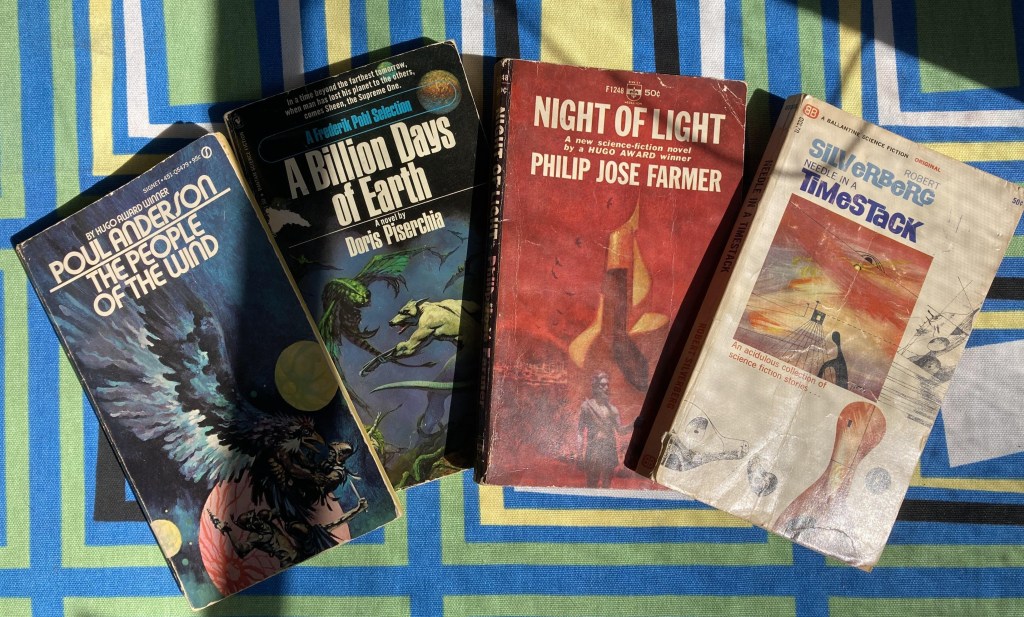
Which books/covers/authors intrigue you? Which have you read? Disliked? Enjoyed?

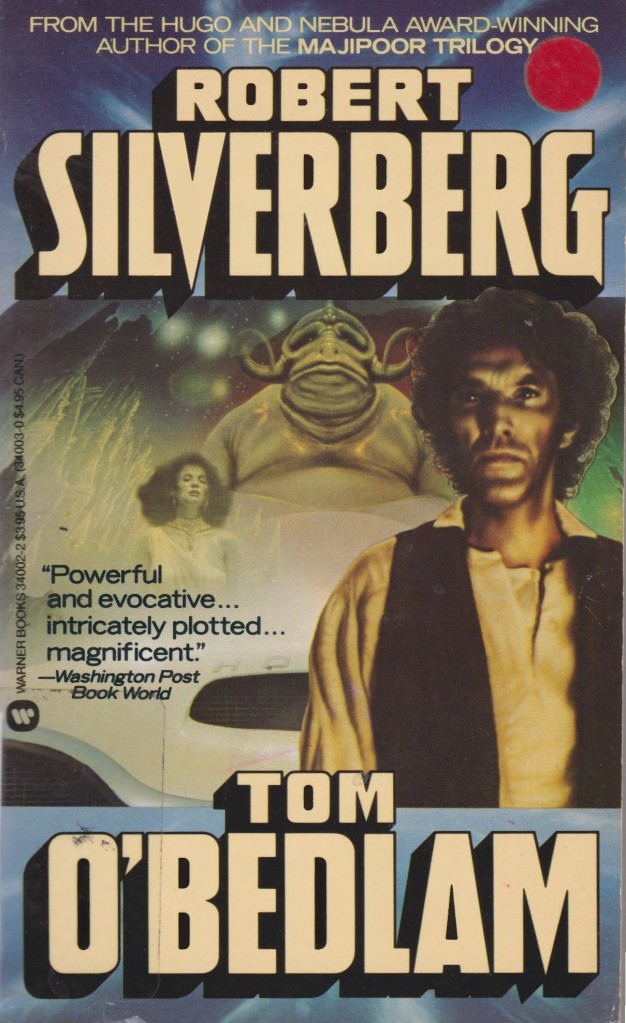
1. Tom O’Bedlam, Robert Silverberg (1985)

From the back cover: “MESSIAH OR MADMAN? It is 2103 and Tom O’Bedlam, madman, prophet, and visionary, wanders through California, dwelling place of the last humans on a continent decimated by radioactive dust. Tom, caught up in a living vision of distant worlds ruled by godlike beings, is the herald of a new age, a herald no one wants to hear until others too begin to dream of salvation beyond the stars. Yet while many dream, only tom has the power to make the wondrous visions real, to give people the ultimate escape they desire. Across the universe they must go… if Tom is humanity’s last hope–and not its final destroyer.”

Continue reading

What pre-1985 science fiction are you reading? + Update No. XX

What pre-1985 science fiction are you reading or planning to read this month? Here’s the January installment of this column (sorry I missed a month).

Before John W. Campbell, Jr. (1910-1971) attempted to raise the “standards and thinking in magazine SF,” David Lasser (1902-1996) attempted his own brief (1929-1933) program to improve science fiction as managing editor of Hugo Gernsback’s Science Wonder Stories, Wonder Stories, and Wonder Stories Quarterly. According to Mike Ashley’s The Time Machine: The Story of the Science-Fiction Pulp Magazine from the Beginning to 1950 (2000), Lasser is a “much neglected revolutionary in science fiction” and through his efforts the genre “started to mature” (66).

Ashley highlights Lasser’s letter of instruction mailed to his regular contributors on the 11th of May, 1931, in which he “exhorted them to bring some realism to their fiction” (72). He also outlawed common tropes like the giant insect story and space opera (73). He emphasized the need to focus on characters that “should really be human” — not everything needs to be a “world-sweeping epic” (73). Stories in this vein, according to Ashley, include Clifford D. Simak’s religiously themed “The Voice in the Void” (1932), P. Schuyler Miller and Walter Dennis’ “The Red Spot on Jupiter” (1931) and “The Duel on the Asteroid” (1934), which featured a grim realism and character development (74).

Continue reading

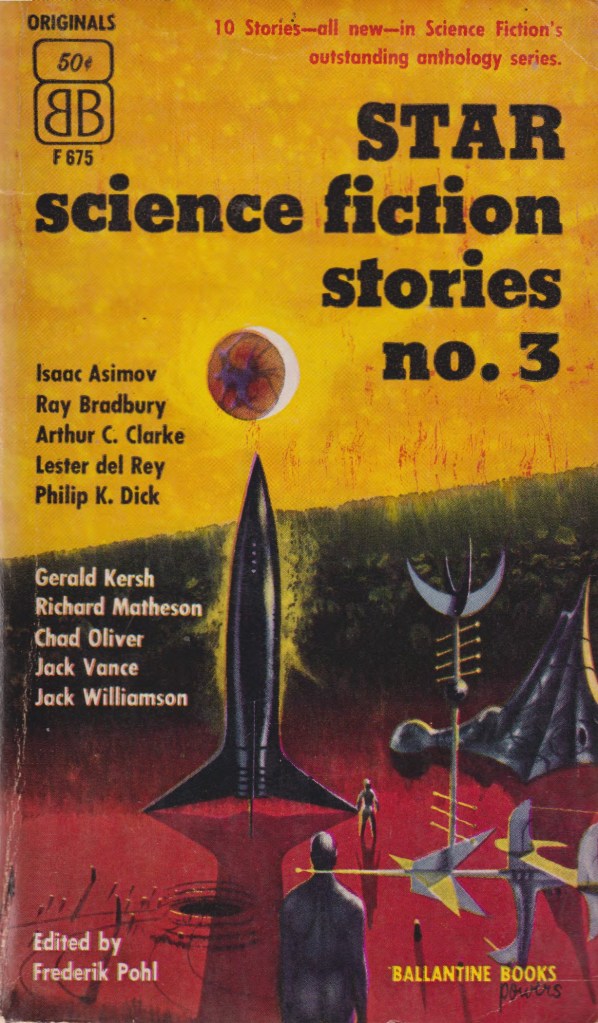
Book Review: Star Science Fiction Stories No. 3, ed. Frederik Pohl (1955)

3.5/5 (collated rating: Good)

Ballantine Books’ illustrious science fictional program started with a bang–Star Science Fiction Stories. According to Mike Ashley’s Transformations: The Story of Science-Fiction Magazines from 1950 to 1970 Frederik Pohl’s anthology series of original (mostly) stories was “intended as both a showcase of Ballantine’s authors and a lure to new writers.” Paying better rates than magazines, the Star series foreshadowed the explosion of original anthologies that would provide a sustained challenge to the eminence held in the 50s by the magazine.

I’ve selected the third volume of the six-volume series.1 It contains an illustrative cross-section of 50s science fiction. Philip K. Dick’s “Foster, You’re Dead” (1955), Richard Matheson’s “Dance of the Dead” (1955), and Jack Williamson’s “Guinevere for Everybody” (1955) are not to be missed.

Continue reading