The following review is the 13th installment of my series searching for “SF short stories that are critical in some capacity of space agencies, astronauts, and the culture which produced them.” Some stories I’ll review in this series might not fit. And that is okay. I relish the act of literary archaeology.
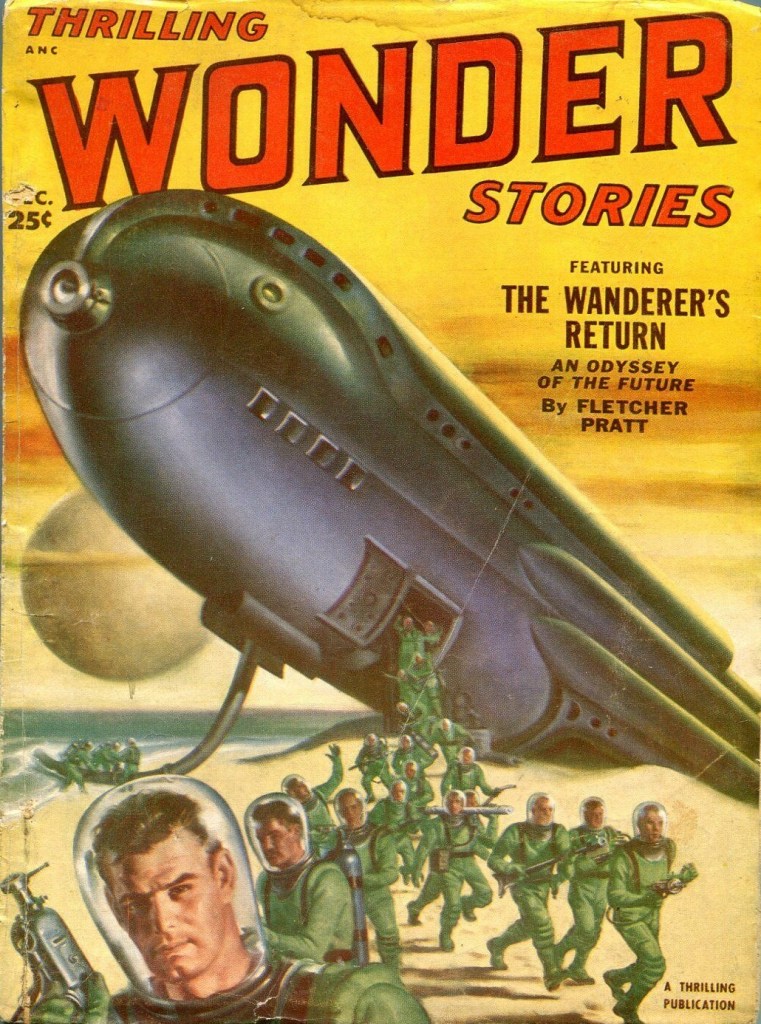
Uncredited cover for the December 1951 issue of Thrilling Wonder Stories
2/5 (Bad)
“Star Bride” (1951) first appeared in the December 1951 issue of Thrilling Wonder Stories, ed. Samuel Mines. You can read it online here.
Anthony Boucher’s short “Star Bride” is a tepid condemnation of colonialism written in the immediate post-WWII stages of decolonization (the Philippines gained its independence from the United States in 1946 and India from the British Empire in 1947). While a deeply problematic and forgettable story, a handful of Boucher’s themes and observations are worth teasing out due to later SF formulations I’ll be exploring in this series.
Note: My read but “waiting to be reviewed pile” is growing. Short rumination/tangents are a way to get through the stack before my memory and will fades. Stay tuned for more detailed and analytical reviews.
1. The Chrysalids (variant title: Re-Birth), John Wyndham (1955)
Richard Powers’ cover for the 1st edition
3/5 (Average)
John Wyndham’s The Chrysalids (1955), my first exposure to his science fiction, transpires in a standard post-apocalyptic cozy catastrophe scenario with a deeply emotional core. The narrative follows David’s childhood in the backwater territories of Labrador, Canada hundreds of years after a nuclear war. The Church, inspired by Nicholson’s Repentances—which along with the Bible are only surviving books–imposes a draconian theology that “only God produces perfection” (51). Mutations, a visual sign of diabolical influence, must be destroyed. David, the son of the local strongman and preacher, discovers a young girl with a terrifying secret–she has six toes. David starts to accumulate secrets including his own mysterious telepathic abilities and recurrent dreams of a city in a world without cities. He shares them with his sympathetic Uncle Axel, who attempts to protect him from the forces narrowing in.
There are some nice touches throughout. Uncle Axel recounts his travels and knowledge of the world as a seaman and the effects is that of a medieval map, filled with pseudo-legendary beings, historical fragments, and “real” flora and fauna that, at first glance, seems too fantastic to exist (54-57).
The following review is the 12th installment of my series searching for “SF short stories that are critical in some capacity of space agencies, astronauts, and the culture which produced them.” Some stories I’ll review in this series might not fit. And that is okay. I relish the act of literary archaeology.
J. G. Ballard’s “The Cage of Sand” (1962) first appeared in New Worlds Science Fiction (June 1962), ed. John Carnell. You can read it online here.
Amidst the wreckage of Cape Canaveral, with its “old launch-gantries and landing ramps [..] like derelict pieces of giant sculpture” (140), three souls attempt to find meaning in the buried hotels and relics of a rapidly disappearing past.
The following review is the 11th installment of my series searching for “SF short stories that are critical in some capacity of space agencies, astronauts, and the culture which produced them.” Some stories I’ll review in this series might not fit. And that is okay. I relish the act of literary archaeology.
Preliminary Note: I am getting a bit carried away by this project. The historian in me rears its obsessive head. I experience intense enjoyment reading any and all stories on the theme regardless of their quality. I know my readers might want me to feature some higher quality stories. Right? While I have a few average to solid stories in the docket read and waiting for reviews, I plan on tackling some harder-hitters in the near future (more Malzberg, Ballard, Sturgeon, etc.).
I had fun writing about this one! As always, feel free to join the conversation.
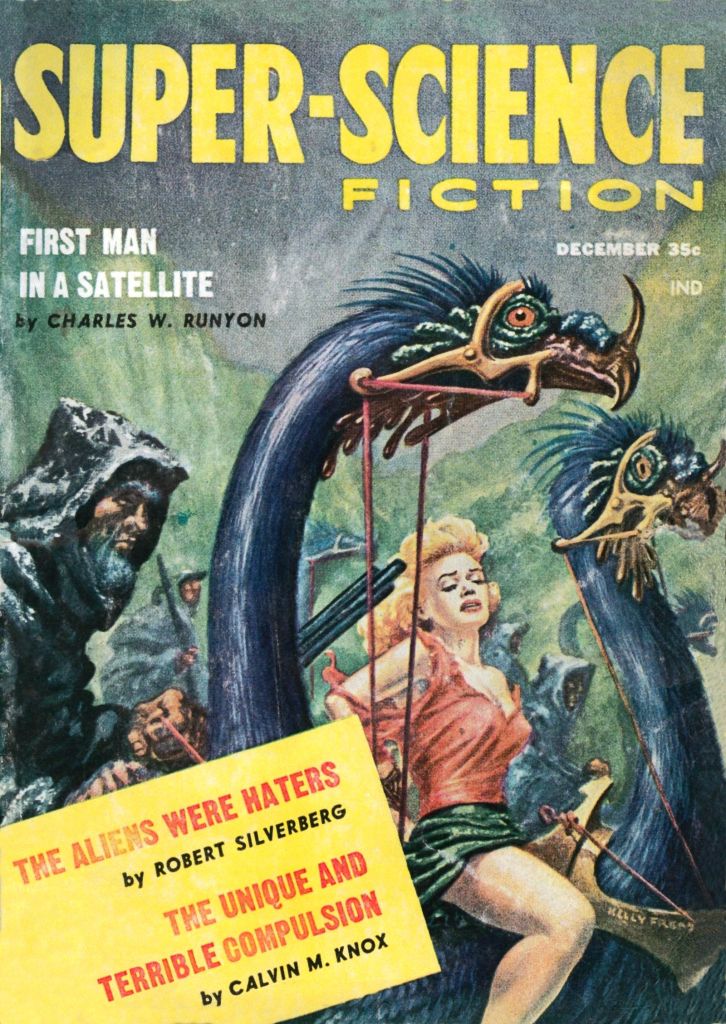
Frank Kelly Freas’ cover for the December 1958 issue of Super-Science Fiction, ed. W. W. Scott
2.75/5 (Vaguely Average)
Charles W. Runyon’s “First Man in a Satellite” appeared in Super-Science Fiction (December 1958), ed. W. W. Scott. You can read it online here.
For two years of my youth in the early 1990s, I lived in Washington, D.C with the National Air and Space Museum a few blocks away from our tiny home in Dupont Circle. While I could not yet read, I knew how long it shouldtake for my parents to read each and every exhibit label to me. And, agape at Able the monkey’s space couch and preserved body, I asked the predictable question: “did she survive the voyage into space?” “She did,” my mother would said, “she died soon after.” “And the monkeys before her?”
Preliminary note: This review is a slightly different version of the article I wrote for The Magazine of Fantasy and Science Fiction‘s “Curiosities” column in the recent March/April (2021) issue. I received permission from C. C. Finlay to post it on my site after the magazine hit shelves. You can read the article on the publisher website here. An index of earlier installments of the column can be found here. It makes fun browsing if you are interested in the more esoteric reaches of the genre.
Josephine Young Case (1908-1990), the daughter of pioneering industrialist and the first chairman of General Electric Owen D. Young (1874-1962), crafts a novel in blank verse. Released in the ninth year of the twentieth century’s worst economic crisis, this speculative epic poem is a strident call to return to the soil and reaffirm the value of work.
As if hermitically sealed, the town of Saugerville—a distillation of rural Americana newly electrified—remerges in a pre-Beringian wilderness of loneliness and endless trees. Roads evaporate into forests, electricity flickers off. A new cartography intrudes with its center on the clustered houses, two steeples, and roughhewn fields. Tracing an ensemble cast over one year, Case unearths a traumatic tapestry of severed horizons and grim survival.
Don Dixon’s canvas (“Jupiter Seen from Io”) for Omni (June, 1979), ed. Ben Bova and Frank Kendig
The following review is the 10th post in my series searching for “SF short stories that are critical in some capacity of space agencies, astronauts, and the culture which produced them.” Some stories I’ll review in this series might not fit. And that is okay. I relish the act of literary archaeology.
As always, feel free to join the conversation!
Previously: Frederik Pohl’s (as Paul Flehr) “The Hated” (1958)
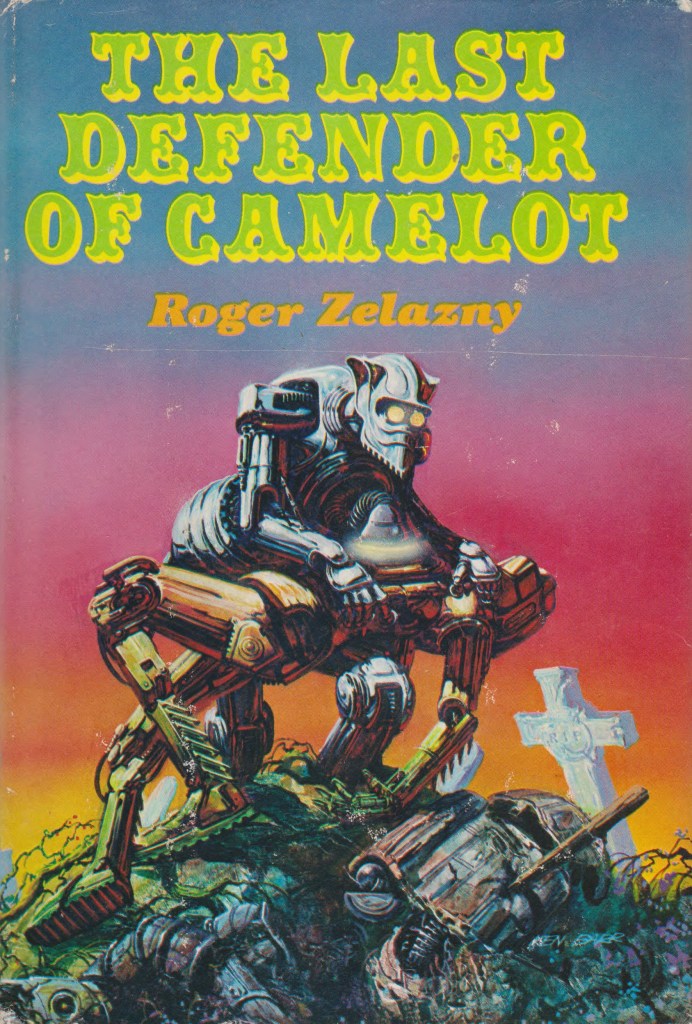
Ken Barr’s cover for the 1981 edition of Roger Zelazny’s The Last Defender of Camelot (1980)
3.5/5 (Good)
Roger Zelazny’s “Halfjack” first appeared in the June 1979 issue of Omni, ed. Don Dixon. You can read it online here. I read the story in the The Last Defender of Camelot (1980).
Here are the next three stories of my series exploring Carol Emshwiller’s short stories (published between 1955-1979) in chronological order. And if you missed it, Part I contained her first three stories.
Emshwiller’s next three science fiction stories, all published by Robert A. E. Lowndes, are polished fables utilizing standard genre tropes (alien possession, humans abducted by aliens, etc.) to highlight humanity’s encounter with itself in idiosyncratic and grim ways. I am particularly entranced by the stories told from a non-human perspective. This distancing effect allows Emshwiller to play with tone (“Bingo and Bongo”) and spin macabre horror (“Nightmare Call”).
While lacking the intense power of “Animal” (1968) (the best story of hers I’ve read so far), all three are worth the read for fans of clever weirdness.
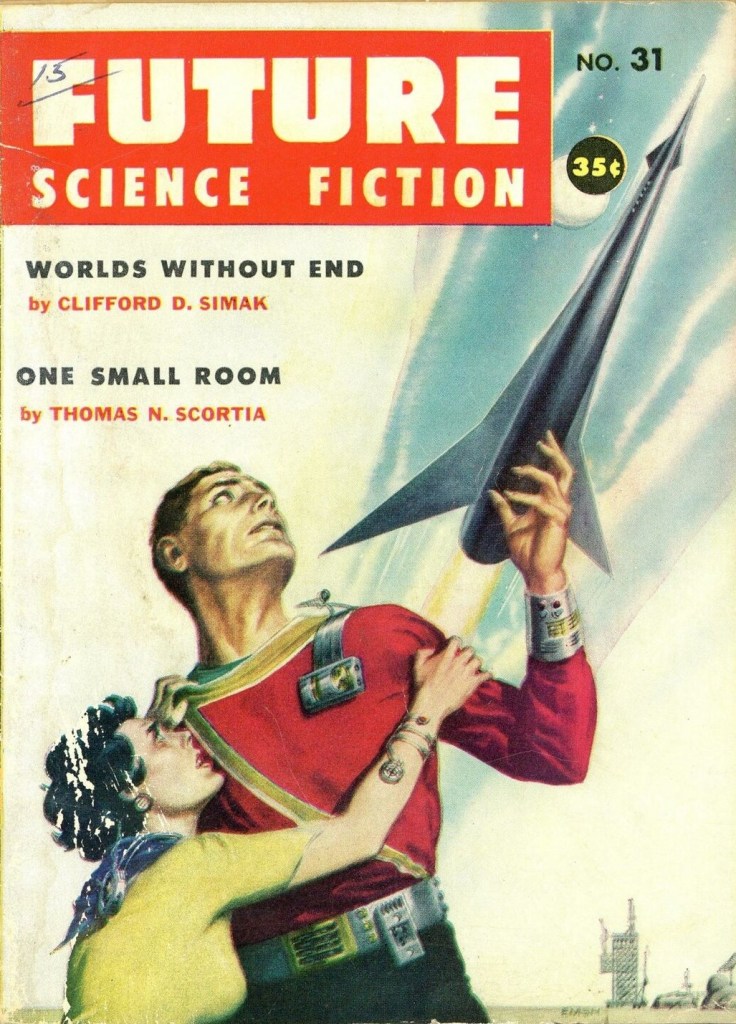
Ed Emshwiller’s cover art for Future Science Fiction, #31 (Winter 1956-1957)
“Bingo and Bongo” (1956), 3.5/5 (Good): First appeared in Future Science Fiction, #31 (Winter 1956-1957), ed. Robert W. Lowndes. You can read it online here. In William Tenn’s Of Men and Monsters(1968) and F. M. Busby’s Cage a Man(1973), humans are imprisoned like lab rats by distant and truly alien aliens. The captives learn just enough about their world and captors in order to escape. Emshwiller brilliantly inverts the perspective. “Bingo and Bongo” is told from the perspective of an alien, a “Mother-Father-Aunt” entity with children, who believes humans are little more than non-sentient pets. The Mother-Father-Aunt’s progeny want new humans after the unfortunate death of their last in an escape attempt (they didn’t want to pay the money to have him professionally healed).
The following review is the 9th post in my series searching for “SF short stories that are critical in some capacity of space agencies, astronauts, and the culture which produced them.” Some stories I’ll review in this series might not fit. And that is okay. I relish the act of literary archaeology.
Robert Foster’s cover for the 1969 edition of Turn Left at Thursday (1961)
3.75/5 (Good)
Frederik Pohl’s “The Hated” (1958) first appeared in the January 1958 issue of Galaxy Science Fiction, ed. H. L. Gold. He wrote it under the pseudonym Paul Flehr. You can read it online here.
“The Hated” (1958) postulates that astronauts will require psychological conditioning to survive the confines of space travel to Mars. In Pohl’s future, the Mars-craft crams six men in a space the size of a Buick (51). The continuous sounds of machine and crew, the fetid taste of the air filled with sweat, the omniscient fear of crushing your oxygen line while sleeping, the free fall, the dreams of drowning, generates an intense drive to kill your crewmates. Byron, the narrator, wants a knife for Sam, to strangle Gilvey with his bear hands, gun Chowderhead with one bullet to the belly, turn a tommy gun on Wally, and cage the captain with hungry lions. The conditioning is “like a straightjacket”–Byron elaborates: “You know how to make a baby cry? Hold his hands […] What they did to us so we couldn’t kill each other, it was like being tied up, like having out hands held so we couldn’t get free” (50).
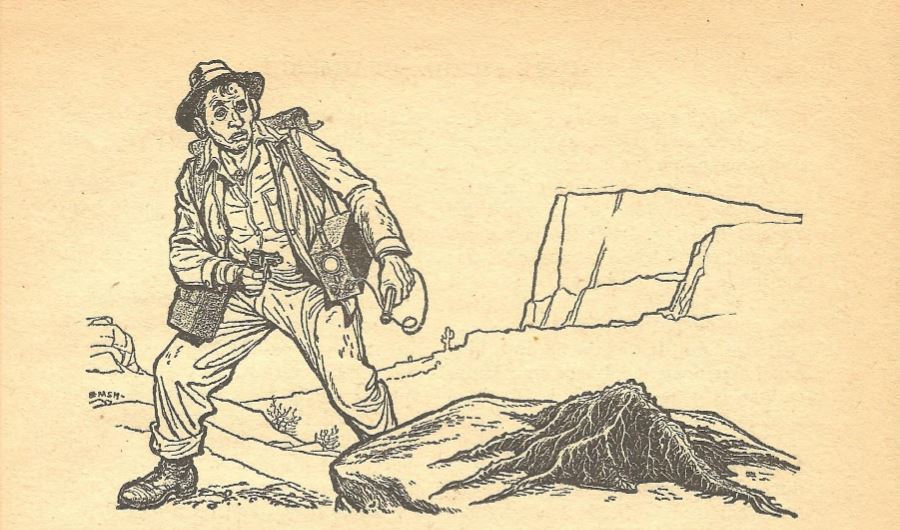
Ed Emshwiller’s interior art for Carol Emshwiller’s “The Piece Thing” in Science Fiction Quarterly (May 1956)
I have decided to do something I have never done before–read a contiguous chunk of an author’s work in chronological order. “Philip K. Dick? Robert A. Heinlein?” you might ask. “No! You know me….” I respond [in jest]. I have chosen to chart Carol Emshwiller’s short stories published in genre magazines and anthologies between 1955 and 1979. SF Encyclopedia conveys my fascination best: “In her hands, sf conventions became models of our deep estrangement from ourselves.” Of the two short stories of hers I’ve read–“Animal” (1968) and “Lib” (1968)–the former, an unnerving fable of the sexualized “Other” whose exclusion reinforces a community’s self-identity and cohesion, resides in my mind like a luminescent beacon. And I have finally latched on to its ever-present light.
If you are interested in all of Emshwiller’s short stories, check out Nonstop Press’ 2011 (vol. 1) and 2016 (vol. 2) omnibus release which includes those in non-SFF genre magazines. Here’s an example of what I am cutting: while her first published short story “Built for Pleasure” was SF, it only appeared in Long Island Suburban (November 1954) before the omnibus. Instead, I will start with 1955’s “This Thing Called Love” in Future Science Fiction,#28, ed. Robert A. W. Lowndes.
As I’ve only scratched the surface of Emshwiller’s output and can’t adequately summarize her work (I hope to by the end of this project), here’s the blurb from the Nonstop edition:
“Crossing the boundaries between fabulist literature, science fiction, and magical realism, the stories in this collection offer a valuable glimpse into the evolution of Carol Emshwiller’s ideas and style during her more than 50-year career. Influenced by J. G. Ballard, Steven Millhauser, Philip K. Dick, and Lydia Davis, Emshwiller has a range of works that is impressive and demonstrates her refusal to be labeled or to stick to one genre. This exhilarating new collection marks the first time many of the early stories have been published in book form and is evidence of the genius of Emshwiller, one of America’s most versatile and imaginative authors.”
This series will happen concurrently with the other short story reading exploration I am conducting and other reviews I have planned. Caveat: like my attempt to watch and reviewSurvivors (1975-1977), this series could stop after three posts or take five years. I am a reader of whim.
Her next three published short stories can be found in Part II.
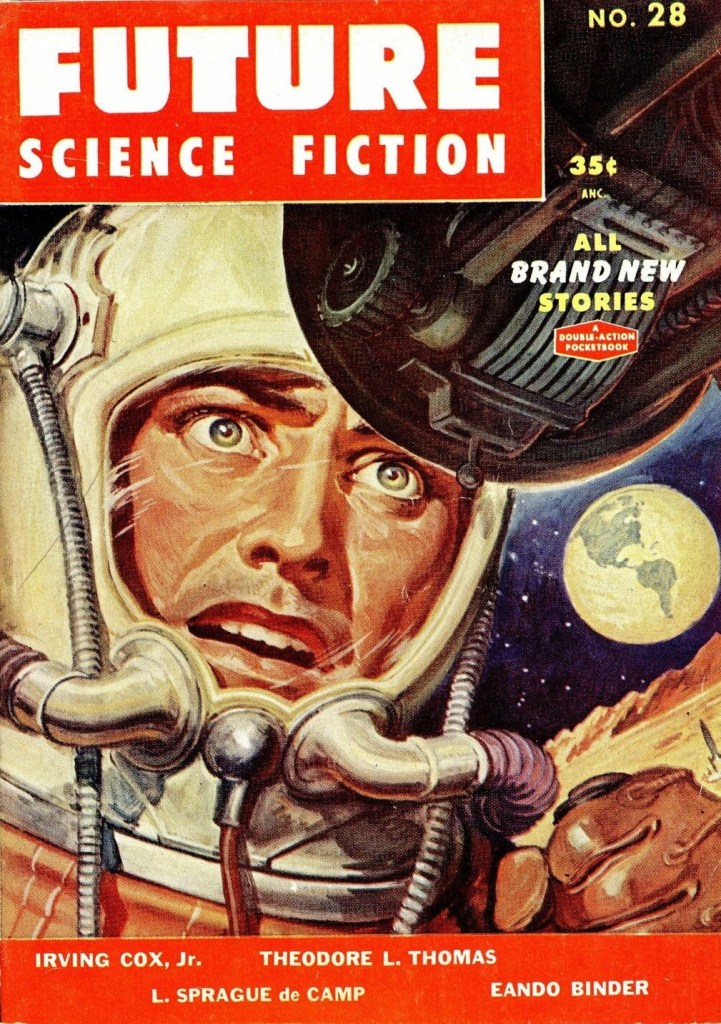
Rudolph Belarski’s cover for Future Science Fiction,#28 (1955)
“This Thing Called Love” (1955), 3.5/5 (Good). First appeared in Future Science Fiction,#28 (1955), ed. Robert A. W. Lowndes. You can read the story online here.




 Science Fiction and Other Suspect Ruminations