Book Review: The Men Inside, Barry N. Malzberg (1973)

(Ron Walotsky’s cover for the 1973 edition)

4.5/5 (Very Good)

Caveat: If a perverse (and Freudian) metafictional (and literary) retelling of Otto Klement and Jerome Bixby’s Fantastic Voyage replete with filmic flashbacks does not intrigue you then stay away….

There are few SF authors who utilize metafictional elements as gleefully and effectively as Barry N. Malzberg.  Beyond Apollo (1972), his masterpiece, is a labyrinthine sequence of 67 short chapters of a novel written by the main character who may or may not be recounting real (imagined?) events.  While in In the Enclosure (1973) the excruciating paranoia that permeates the pages and the impossible escapes that transpire, recounted as if they were entries in a diary, could indeed be generated by an external force—the exact nature of which is unknowable—implanting memories.  Revelations (1972) was entirely comprised of a sequence of documents (interview transcripts, diary fragments, epistolary fragments) Continue reading

Book Review: Fireship (variant title: Fireship / Mother and Child), Joan D. Vinge (1978)

(Stephen Hickman’s cover for the 1978 edition)

3.5/5 (collated rating: Good)

Like so many SF fans, my first exposure to Joan D. Vinge’s work was via her wonderful Hugo-winning novel The Snow Queen (1980).  Eventually I found a copy of her first published novel, The Outcasts of Heaven Belt (1978), which had an intriguing premise but a less than satisfactory delivery (poor characterizations, pacing, etc).  The collection Fireship (1978) is comprised of two novellas: the Hugo- and Nebula-nominated “Fireship” (1978) and one of her earlier works, “Mother and Child” (1975).

The title story is the lesser of the two despite its (dare I say dubious) award nominations.  It’s a light-hearted and unchallenging proto-cyperpunk Continue reading

Book Review: The Downstairs Room and Other Speculative Fiction, Kate Wilhelm (1968)

(Ron Walotsky’s cover for the 1968 edition)

4/5 (collated rating: Good)

By the late 60s Kate Wilhelm’s SF moved from generally uninspiring pulp (à la the collection The Mile-Long Spaceship) to psychologically taught and emotive mood pieces exploring the almost existential malaise of daily existence and the disturbing effects of “programmed” lives (especially the housewife).  The fourteen short-stories in The Downstairs Room and Other Speculative Fiction (1968) (the term “speculative fiction” was coined by Judith Merril in the 60s) comprise a snapshot of Wilhelm’s best New Wave work.  It should be noted that not all are SF.

Although some are less engaging than others, her harrowing portrayal of starlets subjected to endless psychological torments at the whims of their viewers in “Baby, You Were Great” (1967) (Nebula nominated) and the evocative tapestry of daydreams Continue reading

Book Review: The Shores of Another Sea, Chad Oliver (1971)

(Michael Booth’s cover for the 1984 edition)

3.25/5 (Vaguely Good)

Suppose that one day man landed on some distant planet.  Why would he have come, what impulse would have driven him across the darkness and the light-years?  Could he explain, and would he even try?  If he set out to explore that fearful world, if he trapped some specimens, what would he do if he were attacked by monstrous beings he could not understand? (135)

Chad Oliver is a well-known proponent of anthropological science fiction.  John Clute (of SF encyclopedia) proclaims him “pioneer in the application of competent anthropological thought to sf themes.”  Despite being relatively prolific between the 50s-70s (a handful of short stories appeared in the 80s), The Shores of Another Sea (1971) retains a distinctly 50s tone, Continue reading

Book Review: Immortality, Inc. (variant title: Time Killer), Robert Sheckley (1958)

(Uncredited cover for the 1959 edition)

3.75/5 (Good)

Nominated for the 1959 Hugo Award for Best Novel

Robert Sheckley’s first novel Immortality, Inc. (variant title: Time Killer) (1958) has a somewhat checkered publication history.  It was originally published by Avalon books under the title Immortality Delivered (1958) where it was abridged against Sheckley’s wishes.  Unless you are a collector of the Avalon publication series I recommend procuring the complete 1959 Bantam Book edition with its gorgeous (and alas, uncredited) cover.  Later editions were decked with rather unfortunate covers linking the book to the atrocious film Freejack (1992) (replete with Mick Jagger) which was supposedly influenced by Sheckley’s novel.

Thematically, Immortality, Inc concerns the societal ramifications of the important discovery that death is not the end of existence and nor does the Christian conception of the afterlife Continue reading

Book Review: Xenogenesis, Miriam Allen deFord (1969)

(Richard Powers’ cover for the 1969 edition — there is some speculation that it might be a collaboration with Leo and Diane Dillon)

3.5/5 (Collated rating: Good)

Miriam Allen deFord—one of the more prolific SF short story authors of the 50s-70s whose works appeared in The Magazine of Fantasy and Science Fiction, If, Fantastic Universe, Galaxy, Worlds of Tomorrow, etc—deserves a Gollancz Masterworks volume.  But, as Ian Sales has pointed out so forcefully in his recent article (here), despite the number of prolific women SF authors in the 50s-70s they were rarely republished and are perhaps the least read group of SF authors for modern audiences.  There are some exceptions but few readers can name a women author pre-Ursula Le Guin.  deFord’s shorts were collected in only two volumes, Xenogenesis (1969) and Elsewhere, Elsewhen, Elsehow (1971) and both print runs were limited to the first year of publication.

Informed by her feminist activism (she was an important campaigner for birth control) and her earlier career in the newspapers, deFord’s stories tackle themes such as overpopulation, racism, colonialism, gender issues, sexism, and alienation.  Her works range from deceptively simple allegories to future histories vast in scope and complexity (for short stories).  Her female characters are almost all individualistic, resourceful, and highly educated–they often struggle against increasingly regimented/mechanized/homogenized societies in order to raise families in addition to their careers.  In short, deFord advocates forcefully the right to self-determination Continue reading

Book Review: At the Seventh Level, Suzette Haden Elgin (1972)

(George Barr’s cover for the 1972 edition)

3/5 (Average)

At the Seventh Level (1972) is part of a loose sequence of novels that feature Trigalactic Intelligence Service agent Coyote Jones and his voyages to various worlds. Although this sequence ostensibly has the trappings of SF space opera, Suzette Haden Elgin subverts the genre conventions so that the premise functions as a polemical feminist text with satirical underpinnings.  At the Seventh Level is an important installment in a long line of “women as slaves trapped in vast repressive patriarchy propped up by appeals to tradition and brute force” type novels which, some might argue, culminated in Margaret Atwood’s The Handmaid’s Tale (1985).  It is important to note that there were many novels on similar themes before Atwood’s acknowledged masterpiece hit Continue reading

Book Review: A Way Home, Theodore Sturgeon (1956)

(Mel Hunter’s cover for the 1956 edition)

3/5 (collated rating: Average)

Although Theodore Sturgeon is generally considered a master of the SF short form, his collection A Way Home (1956) contains only two worthwhile stories — “Thunder and Roses” (1947) and “Bulkhead” (1955).  The rest I was either unable to finish or struggled to muddle through over the course of the last two or so weeks.  Fortunately,  the near masterpiece “Bulkhead” was almost worth the pain induced by the intelligent dog related subgenre of SF manifest in “Tiny and the Monster” (1947) or the cute accidentally destructive hurkle kittens of “The Hurkle Is a Happy Beast” (1949).

At this stage in my recent endeavor to brush up on the best of the 50s short story wordsmiths, I place Sturgeon below Robert Sheckley, Brian Aldiss, Philip K. Dick, Fritz Leiber, Miriam Allen deFord, Lester del Rey, Walter M. Miller, Jr., C. M. Kornbluth, and Frederik Pohl. (shocking to some, I know!).

However, before I make a more definitive conclusion I call on my readers to list what you consider his best short work Continue reading

Book Review: And Strange at Ecbatan the Trees (variant title: Beneath the Shattered Moons), Michael Bishop (1976)

(Jonathan Weld’s cover for the 1976 edition)

4/5 (Good)

Michael Bishop’s And Strange at Ecbatan the Trees (variant title: Beneath the Shattered Moons) (1976) is a melancholic and allegorically inclined parable about a coming cataclysm that threatens a programmed and hierarchically rigid society (accomplished via genetic modification).  Bishop’s voice is an intensely humanistic once, futuristic technology is present but not a central concern…. The simple but effective plot is the perfect vehicle for his moralistic ruminations: a man forced into action, a world compelled — despite the external forces at play — to adapt.

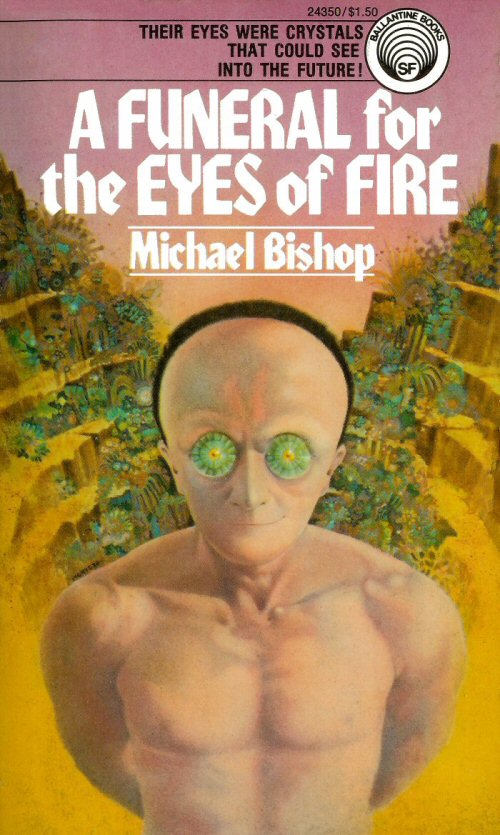
 And Strange at Ecbatan the Trees is the first of Michael Bishop’s works I have read and I am definitely intrigued enough to place his supposedly superior Nebula-nominated first novel, Funeral for the Continue reading