Book Review: There Will Be Time, Poul Anderson (1972)

(Fernando Fernandez’s cover for the 1973 edition)

4/5 (Good)

Nominated for the 1973 Hugo Award for Best Novel

(Hugo Award related tangent: how Silverberg’s Dying Inside lost to Asimov’s The Gods Themselves is beyond me.  There Will Be Time is the lesser of the three)

Frequent readers of my reviews will have noticed my general dislike of time travel themed SF.  I have two central qualms: Firstly, I am frustrated by the tendency of authors to expound endlessly on the nuances of the particular temporal theory they have chosen to deploy;  secondly, the common obsession with “understanding how the past really was” strikes me as an incredibly superficial/fallacious analysis of the nature of history and historical thinking — individuals today cannot understand “the true nature of the present” simply by existing in it yet alone a different historical period.  Rather, perspective taking, Continue reading

Book Review: Godling, Go Home!, Robert Silverberg (1964)

(Uncredited cover for the 1964 edition)

3.25/5 (Average)

Before Robert Silverberg wrote his late 60s and early 70s New Wave masterpieces (A Time of Changes, Dying Inside, The World Inside, etc), he produced a vast quantity of pulp science fiction novels and short stories.  Godling, Go Home! (1964) is a surprisingly solid collection of 50s shorts that can, at times, be surprisingly meditative (on death, exploration, civilization).  That said, expect rather naive messages — à la “we travel in space because we can!” or “Alien contact requires out-of-the-box thinking” — grafted onto a by the numbers pulp plot.

A fun collection — recommended for fans of slightly more intelligent than normal pulp SF, Silverberg completes, and 50s SF.  “Godling, Go Home!” (1957), “Why?” (1957), and Continue reading

Book Review: Chronocules (variant title: Hot Wireless Sets, Aspirin Tablets, the Sandpaper Sides of Used Matchboxes, and Something that Might have been Castor Oil), D. G. Compton (1970)

(Diane and Leo Dillon’s cover for the 1970 edition)

3/5 (Average)

D. G. Compton has long been one of my favorite SF authors.  Regrettably, his readership remains small and he has ceased publishing SF.  Novels like The Continuous Katherine Mortenhoe (variant title: The Unsleeping Eye) (1973) and Synthajoy (1968) are first rate masterworks with Farewell, Earth’s Bliss (1966) and The Steel Crocodile (1970) close behind.  All of his works have a distinctly English feel with solid, and occasionally beautiful, prose.

Chronocules (1970), with its outrageous variant title Hot Wireless Sets, Aspirin Tablets, the Sandpaper Sides of Used Matchboxes, and Something that Continue reading

Book Review: As on a Darkling Plain, Ben Bova (1972)

(Chris Moore’s cover for the 1981 edition)

2.75/5 (Average)

Unfortunate title aside (“darkling” sound like a small evil creature in a work of fantasy), Ben Bova’s As on a Darkling Plain (1972) is a middling fix-up novel in every respect.  It is worth noting that Chapters 5 (‘The Jupiter Mission’) and 6 (‘The Sirius Mission’), which comprise a great majority of the novel, appeared earlier in If February 1970 and Galaxy January 1969 as “Pressure Vessel” and “Foeman, Where Do You Flee?” respectively.  I’m not sure how much was expanded or subtracted.  If anyone knows please leave a comment — I find that the act of revising earlier work interesting in itself.

Bova’s novel inspired my recent cover art post on Future Archeology and Mysterious Artifacts.  The premise is a standard one: A mysterious artifact Continue reading

Book Review: Approaching Oblivion, Harlan Ellison (1974)

(Leo and Diane Dillon’s cover for the 1974 edition)

4.25/5 (collated rating: Good)

Ellison’s stories punch where it hurts.  Approaching Oblivion (1974) is filled with transfixing tales about violent future racism (“Knox”), humanity’s last moments (“Kiss of Fire”), the desperate desire to change one’s own past (“One Life, Furnished in Early Poverty”), a last rebel against the militarizing system (“Silent in Gehanna”), and familial rivalry within a vast arcology (“Catman”), etc…

They are terrifying and vicious, immersive and gut-wrenching, and span from baroque far future speculations to near future warnings.  Above all, they are well-written and intelligent.  Many are infused with (pseudo) autobiographical content and lament the societal ills Continue reading

Book Review: Brain Wave, Poul Anderson (magazine publication 1953)

(Richard Powers’ cover for the 1954 edition)

3.25/5 (Vaguely Good)

I have long been a fan of Poul Anderson’s functionalist yet engaging SF adventures.  He is one of the masters at integrating social commentary (often on the impact of future technology) into the framework of the early Cold War influenced SF story without unduly weighing it down.  Brain Wave (1954) is  a good example of both his virtues and faults.

Brain Wave in a nutshell: a fascinating premise,  a somewhat frustrating ending, dubious social commentary, while the incredibly brief length (even for the 50s)  and uneven pacing suggest heavy cuts by editor…  That said, I suspect other famous works — such as the Daniel Keyes’ Flowers of Algernon (novelette: 1959, novel: 1966) and perhaps even Continue reading

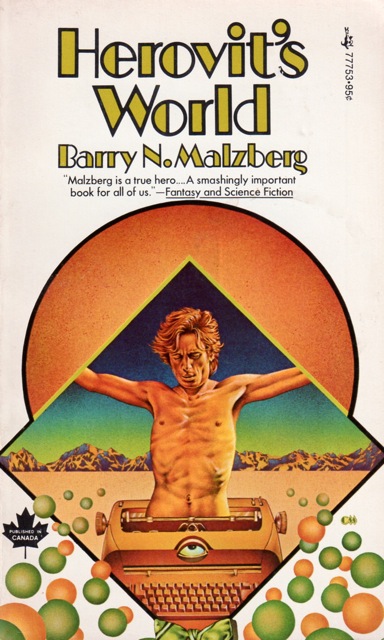
Book Review: Herovit’s World, Barry N. Malzberg (1973)

(Charles Moll’s cover for the 1974 edition)

3.5/5 (Good)

Note: Today is Barry N. Malzberg’s birthday!

Upon reading In the Enclosure (1973) I was immediately seduced by Barry N. Malzberg’s metafictional brand of science fiction — best illustrated by his masterpieces Beyond Apollo (1972) and Revelations (1972).  Although Herovit’s World (1973) contains many of the same metafictional trademarks of Malzberg’s best work, it should be noted that the novel is not science fiction and more a work about writing (pulp) science fiction.  In this case, the mental collapse of a pulp writer whose life may or may not contain “true” autobiographical kernels from Malzberg’s own experience Continue reading

Book Review: Why Call Them Back From Heaven?, Clifford D. Simak (1967)

(Leo and Diane Dillon’s cover for the 1970 edition)

4.5/5 (Very Good)

I have found that the most successful science fiction novels on the theme of immortality are not about the immortals themselves or the state of “being immortal.”  Novels like Raymond Z. Gallun’s The Eden Cycle (1974) might attempt to convey, at moments effectively, the ennui of an endless existence with endless possibilities but, as with mind of the immortal in question, the reader too feels the effects of endless, repetitive inundation.  Rather, the most successful and evocative novels — for example James Gunn’s The Immortals (1962) — explore the social space that is created by the presence of immortals although they might be only peripheral characters.  Simak’s Why Call Them Back From Heaven? (1967) takes Gunn’s premise a step further: What would happen to our society if almost everyone bought into the idea that immortality would be a real possibility sometime in the future? Continue reading

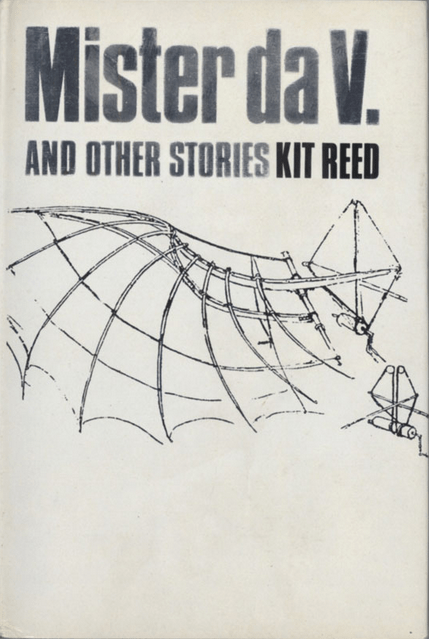
Book Review: Mister Da V. and Other Stories, Kit Reed (1967)

Screen shot 2013-07-16 at 10.06.04 AM

(Uncredited cover for the 1967 edition)

4.25/5 (collated rating: Good)

Kit Reed has been publishing literary, thought-provoking, and darkly satirical sci-fi + speculative fiction + non-genre fiction since the late 50s… And she is still going strong — her most recent novel Son of Destruction (2012) came out last year.  Reed’s collection Mister Da V. and Other Stories (1967) contains three stories from the late 50s including her first published work, ‘The Wait’ (variant title: ‘To be Taken to a Strange Country’) (1958) and ten others from the 60s.  A few of the stories in the collection are not overtly science fiction — regardless, one could argue that all but ‘I am Through with Bus Trips’ (1967) contain speculative and/or sci-fi elements.

There are superficial differences between the 1967 Faber and Faber edition and the 1973 Berkley Medallion edition.  Because I own the Berkley paperback I’ve gone ahead and followed its chronological story order and page numbers.

A few of the themes/topics of the volume:  Paranoia.  Post-apocalyptic Landscapes.  Youth  Continue reading