SF Article: Barry N. Malzberg (b.1939): Metafiction and the Demystification of the Cult of the Astronaut

This was my recent guest post on Little Red Reviewer.

For those who didn’t see it I decided to post it here….

——-

 Barry N. Malzberg (b. 1939): Metafiction and the Demystification of the Cult of the Astronaut

Screen shot 2013-01-14 at 1.55.20 PM

In the World Book Encyclopedia Science Service publication The United States Astronauts and their Families: A Pictorial Presentation (1965), each astronaut is allotted a two-page spread replete with staged photos of their family life and hobbies.  Otis L. Wiese, the editor of the volume, proclaims grandiosely “Man’s reach for the world of space is born of his insatiable curiosity about the unknown… his indomitable drive for accomplishment… his instinctive response to a challenge. Astronauts-Husbands-Fathers: these men are the men featured here but it’s essentially as family men that we portray them” (i).

The photographs are fascinating.  Roger B. Chaffee’s wife Martha teaches him lunar geography (22), L. Gordon Cooper, Jr. sits at the helm of his speedboat Bluebonnet which is capable of reaching 80 knots (28), in another photo him and his family spend time with their German shepherd (29), Donn F. Eisele teaches his daughter “the finer points of marksmanship” (35), while Alan B. Shepard, Jr. plays piano tunes for his daughters (61) and in the facing image shakes hands with John F. Kennedy (61).

Their families illustrate the epitome of the American family: the ultra-masculine man with his cars and boats, the supportive wife facilitating Continue reading
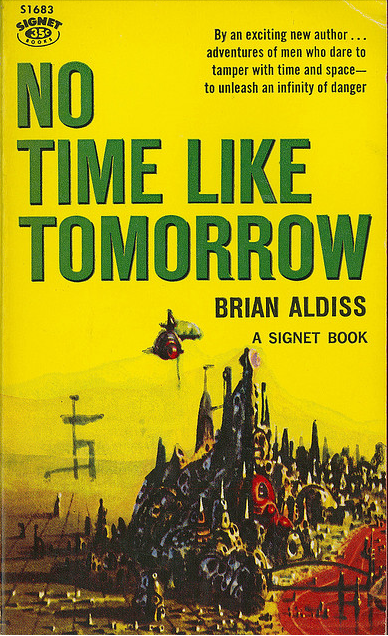
Book Review: No Time Like Tomorrow, Brian Aldiss (1959)

Screen shot 2013-01-10 at 11.21.02 PM

(Richard Powers’ cover for the 1959 edition)

3.75/5 (collated rating: Good)

This collection of Brian Aldiss short stories from the mid-to-late 50s is a notch above the middling Galaxies Like Grains of Sand (1960), collated from the same period, which I reviewed a few months back.  Aldiss is definitely one of the more bizarre and original (along with Philip K. Dick) sci-fi voices of the 50s (and beyond).

Most collections are purposely comprised of a mixture of good and bad stories hence the generally low collated ratings I hand out.  Unlike Galaxies, most of the stories in this collection are worth reading and none are egregiously bad.  ‘Not for an Age,’ ‘Judas Danced’, ‘The Failed Men’, and ‘Outside’ are all highly Continue reading

Book Review: Level 7, Mordecai Roshwald (1959)

(Sanden’s cover for the 1960 edition)

4.75/5 (Very Good)

I recently received a copy of Modecai Roshwald’s Level 7 (1959) from 2thD at Potpourri of Science Fiction Literature (his enthusiastic review of the novel here).  Roshwald’s novel should be considered along with Walter Miller, Jr.’s A Canticle for Leibowitz (1959, published 1960) as one the best nuclear disaster sci-fi novels of the late 50s (and all time).  Unlike Nevil Shute’s On the Beach (1957) or Pat Frank’s Alas, Babylon (1959) the allegiance (Soviet or American) of the protagonists of Level 7 remains Continue reading

Book Review: Dark Dominion, David Duncan (1954)

Screen shot 2012-12-22 at 9.06.53 PM(Richard Powers’ cover for the 1954 edition)

2.5/5 (Bad)

David Duncan, most famous for writing the screenplay to George Pal’s film The Time Machine (1960), produced a handful of genre and non-genre novels in the 1950s.  Bluntly put, the Dark Dominion (1954) was one of the more disappointing novels I’ve read this year.  It is worthwhile for one thing alone, Richard Powers’ gorgeous cover.  Duncan’s novel is characterized by an incredibly painful strain of melodrama even for the 50s, downright preposterous science Continue reading

Book Review: Lords of the Starship, Mark S. Geston (1967)

(John Shoenherr’s cover for the 1967 edition)

3.75/5 (Good)

Mark S. Geston’s first novel Lords of the Starship (1967), written at the age of 21 while he was an undergraduate history student, revolves around a fascinating premise: The construction of a massive (fake) spaceship intended to lift a society out of a crippling malaise.  The narrative covers hundreds of years and seemingly innumerable characters.  The lack of distinct characters is the most frustrating aspect of the work.  However, the extremely dark tone and satirical underpinnings lift the novel above the endless morass of earlier pulp sci-fi.

For fans of 50s/60s space opera and more traditionalist 60s Continue reading

Book Review: Needle in a Timestack, Robert Silverberg (1966)

(Richard Powers’ cover for the 1966 edition)

*Review for the 1966 edition.  The 1979 and 1985 editions were revised.*

collated rating: 3/5 (Average)

Needle in a Timestack (1966) is an uneven collection of ten short stories from the late 50s and early 60s by Robert Silverberg.  By the late 60s and early 70s Silverberg was producing his masterpieces.  However, earlier in his career he wrote mostly pulp novels and short stories.  A few in this collection tackle, in varying degrees of success, social science fiction themes: the media, war propaganda, colonialism, unusual criminal punishment, the suburban lifestyle etc.  Many of these Continue reading

Book Review: What Entropy Means to Me, George Alec Effinger (1972)

(Stanislaw Hernandez’s cover for the 1973 edition)

5/5 (Masterpiece) (*caveats below*)

Nominated for the 1973 Nebula Award (lost to Asimov’s disappointing The Gods Themselves)

“She was Our Mother, so she cried.  She used to sit out there, under that micha tree, all day as we worked cursing in her fields.  She sat there during the freezing nights, and we pretended that we could see her through the windows in the house, by the light of the moons and the hard, fast stars.  She sat there before most of us were born; she sat there until she died.  And all the time she shed her tears.  She was Our Mother, so she cried” (11)

What Entropy Means to Me (1972) is one of the more satisfying products of the New Wave science fiction movement of the 60s and 70s that I’ve read.  I place it in the pantheon of Malzberg’s Revelations (1972), Samuel Delany’s Nova (1968), and Brunner’s Stand on Zanzibar (1968).  Effinger revels, and I mean gloriously revels, in metafictional Continue reading

Book Review: Slave Ship, Frederik Pohl (1956)

(Robert Foster’s cover for the 1969 edition)

2.75/5 (Bad)

Robert Foster’s salacious cover for the 1969 edition of Slave Ship (1956) implies a sort of John Norman-esque — of Gor “fame” — sexist slave girl sci-fi fantasy with collars and all.  Don’t worry, I bought the novel knowing full well that the “slaves” were not nubile young women but dogs + cats + chimps + seals drafted into the war effort.  But a naked seal on a leash won’t sell many books… At least Foster’s outlandish fabrication and manipulation of Pohl’s vision includes a hapless chimpanzee strapped into a mechanical device!  In case you’re fourteen years old and find Foster’s cover all dusty in some abandoned seldom seen corner of a used book store be warned Continue reading

Book Review: The Garments of Caean, Barrington J. Bayley (1976)

(H. R. Van Dongen’s cover for the 1980 edition)

3.75/5 (Good)

Barrington J. Bayley’s novels — I’ve reviewed Collision Course (1973), Empire of Two Worlds (1972), The Fall of Chronopolis (1974), The Pillars of Eternity (1982), and Star Winds (1978) — are characterized by extremely inventive concepts, generally poor characterization, and an uncanny lightness combined with a dose of visceral brutality.  In the works of his I’ve read so far he never leaves the galactic empire/space opera format and is utterly uninterested in extrapolating potential or possible future technology.

Along with Doris Piserchia’s The Billion Days of Earth (1976) and Lloyd Biggle, Jr.’s The Light That Never Was (1972), The Garments of Caean is one of the most off-the-wall strange space operas Continue reading