Book Review: Station in Space, James Gunn (1958)

(Walter Murch and Jerry Powell’s cover for the 1958 edition)

collated rating: 3.75/5 (Good)

James Gunn’s Station in Space (1958) is an interconnected series of stories that form a cohesive chronologically organized whole tracking the development of human exploration into space (Earth –> first space flight –> first space station –> second space station –> Mars).  Because multiple characters reappear in later stories and the earlier events all have a direct bearing the work must be read in order.  The result is more a loose form novel than short story collection.

The most intriguing aspect of Gunn’s stories is the careful demystification of the glamor of space travel.  Many of the works begin like a juvenile à la Heinlein or Blish where space travel is fun and rosy and easy as picking corn before Gunn’s brutal realist streak seeps in and overwhelms the pages. I suspect that Continue reading

Book Review: The Outcasts of Heaven Belt, Joan D. Vinge (1978)

(Vincent Di Fate’s cover for the 1978 edition)

3.25/5 (Average)

The title of Joan D. Vinge’s first novel, The Outcasts of Heaven Belt (1978), is an homage to The Outcasts of Poker Flat (1869) by the turn of the century western writer and poet Bret Harte.  He is famous for his depictions of resourceful women in California pioneer settlements.  Vinge creates a resourceful female captain of a powerful but weaponless spaceship who finds herself beset–with only a depleted crew–by a series of challenges in the decadent, grasping, and fractured pioneer societies of Heaven Belt.  Although the often less than amicable conflict between the egalitarian society with powerful women and the male-focused pioneer cultures could be the focus of the novel, Vinge is less interested in exploring the social ramifications (à la Le Guin and other works of the previous decade — the 1960s).  Instead, this conflict provides a suitable world-building backdrop for a traditional space opera — a bedraggled but technologically Continue reading

Book Review: Traitor to the Living, Philip José Farmer (1973)

(Hans Ulrich Osterwalder and Ute Osterwalder’s cover for the 1973 edition)

2.5/5 (Bad)

In disappointing fashion, Traitor to the Living (1973) follows a similar pattern to Philip José Farmer’s famous Hugo winning To Your Scattered Bodies Go (1971) — the fascinating premise is bogged down by blank characters and repetitive action.  Despite my fervent conviction that To Your Scattered Bodies Go is one of the worst Best Novel Hugo winners (and I’ve read a majority of them) and that the endlessly laborious sequels are a complete waste of ink, paper, and time, I gave Farmer a second chance — albeit with one of his lesser known works.  Because some of the pieces are in place in Traitor to the Living for a worthwhile novel, I hold out hope that he produced a readable work that I might be compelled to acquire (queue question: what is your favorite novel/short story/novella by Farmer?).

If you’re a Farmer completest, Traitor to the Living might be Continue reading

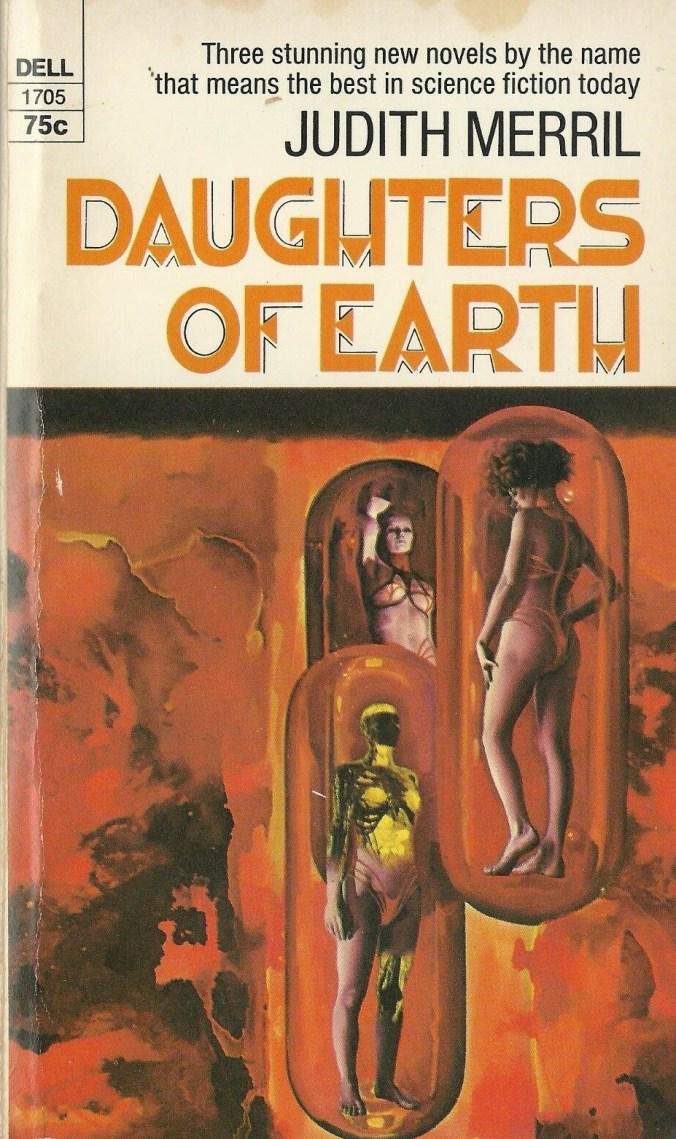
Book Review: Daughters of Earth, Judith Merril (1968)

daughters of earth

(Robert Foster’s cover for the 1970 edition)

4/5 (Good)

Judith Merril was not only an important early science fiction author of novels and short stories but a political activist and a member of the influential 1940s sci-fi group known as the Futurians (members included her husband Frederik Pohl, James Blish, Damon Knight, David A. Wollheim, C. M. Kornbluth, et al.).  Her fascinating collection, Daughters of Earth (1968), contains three novellas from the 1950s: ‘Project Nursemaid’ (1955), the highlight of the collection — ‘Daughters of Earth’ (1952), and the underwhelming ‘Homecalling’ (1956).  

All three contain a plethora of female characters Continue reading

Book Review: The Dark Side of the Earth, Alfred Bester (1964)

(Uncredited cover for the 1964 edition)

3/5 (Average)

Despite enjoying Alfred Bester’s famous novels The Demolished Man (1952) and The Stars My Destination (1956), I found his short stories in The Dark Side of the Earth (1964) on the whole nowhere near as masterful.  Yes, they are witty, comedic, playful, silly, pseudo-intellectual (references to film directors such as De Sica, etc), and on occasion refreshingly experimental in structure (‘The Pi Man’).  Of those adjectives, ‘silly’ is the most constant.

Bester is at his best when he blends his satirical/comedic side with a fascinating concept — for example, an inventive theory of time travel in ‘The Man Who Continue reading

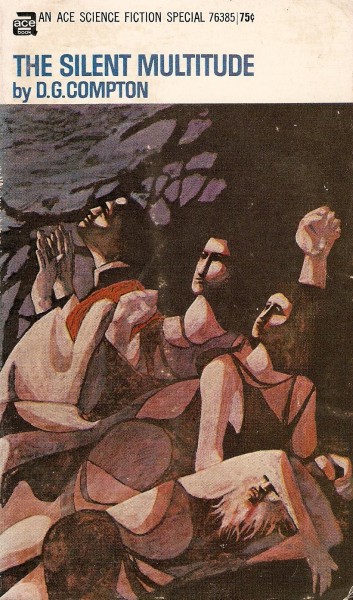
Book Review: The Silent Multitude, D. G. Compton (1966)

(Leo and Diane Dillon’s cover for the 1969 edition)

4.25/5 (Very Good)

“He was out now looking for signs.  He knew how to stay alive.  He was a strangely violent man, to him the fall of the city was some sort of unholy celebration (89).”

The decaying/empty city as allegory: its few post-evacuation occupants (a tramp and his cat, the cathedral’s dean, a young suburban woman, a troubled architect’s son — all well-drawn characters) wander the deserted streets of Gloucester consumed with their own obsessions.  The cement consuming fungus — a vague agent of destruction that severs us from our loci of civilization, our functionalist cityscapes, Continue reading

Book Review: The Falling Torch, Algis Budrys (1959)

(Bob Engle’s cover for the 1959 edition)

3.25/5 (Vaguely Good)

A smile, or tears, perhaps.  Tears are easier than laughter.  Tears need no gust of breath, as laughter must though breath is short — tears do not crack the muscles of the back or make the jaws ache when the jaws are sore-gummed from the artificial teeth — yes old men’s or old women’s gentle tears; these too are safe; not grown men’s sobs, but children’s tears;  not children’s tantrum-cries but children’s tears upon the moment when they learn that, in all justice, children, too, can fairly died–those are the tears that we regain when we are very old (pg 149).

Algis Budrys’ The Falling Torch (1959) is on the surface yet another simplistic brave oppressed mankind rebelling against the alien invaders who have conquered Earth novel à la Aldiss’ Bow Down to Nul (variant title: The Interpreter) (1960) and the ilk.  And I was deluded into thinking it was Continue reading

Book Review: The End of the World (1956), ed. Donald Wollheim

(Ed Emshwiller’s? cover for the 1956 edition)

3.75/5 (Good)

 The End of the World (1956) is a highly readable collection of short works by some of the leading figures of the 50s:  Robert Heinlein, Edmond Hamilton, Philip K. Dick,  and Arthur C. Clarke are the most notable contributors.  All the works, including the short by the virtually unknown author Amelia Reynolds Long, have appeared in other volumes but it’s nice to have them grouped according to theme with a quality Ace edition 50s Emshwiller cover.

Wollheim gathers together a fascinating range of accounts of the end of the world — seen through the eyes of aliens, humans from the present viewing the future, the last men on earth surveying the ruins, a robotic bomb who thinks it’s human and “accidentally” triggers the end of the Continue reading

Book Review: The Bright Phoenix, Harold Mead (1955)

(Richard Powers’ cover for the 1956 edition)

3/5 (Average)

Harold Mead’s The Bright Phoenix is a readable future ultra-regulated “perfect” State themed science fiction novel with a time-worn but proven plot. Unfortunately, the end product, despite moments of intriguing characterization and oppressive gloom, sinks into forgettable melodrama and the conclusion resorts to frustratingly obvious references to a “second coming” (of sorts).  Mead is less interested in describing the mechanisms of the “perfect” state and more interested in the slow evolution of a character coming to grips with the deficiencies of the system.  This is an admirable program that falls woefully short in part due to the paltry descriptions of the before mentioned system.  This causes our hero’s evolution to occasionally ring hollow.  The primitive but somehow “truer” pseudo-Christian civilization contacted by our hero, the fulcrum of his transformation, lacks any seductive qualities that would facilitate Continue reading