Future Media Short Story Review: Ray Bradbury’s “Almost the End of the World” (1957)

Today I’ve reviewed the twenty-first story in my series on the science fictional media landscape of the future. Ray Bradbury conjures a strange new world without television.

Previously: Frederik Pohl’s “The Wizards of Pung’s Corners” (October 1958).

Up Next: Two stories by Damon Knight

“Thing of Beauty” (September 1958) and “You’re Another” (June 1955).

3.5/5 (Good)

Ray Bradbury’s “Almost the End of the World” first appeared in The Reporter (December 26, 1957). It later appeared in his short story collection The Day It Rained Forever (1959). If you have an Internet Archive account, you can read it online here.

In multiple earlier reviews in this series, I’ve laid out television’s transformative and speedy infiltration of the American consciousness and daily activities over the course of the 1950s. Multiple Bradbury stories critique this new world. The lovely and crystalline “The Pedestrian” (1951) imagined a future night city in which its denizens are transfixed by their TV scenes. The city, observed by the solitary one-time writer Leonard Mead, is as silent as “a wintry, windless Arizona country” (90). “Almost the End of the World” (1957) ruminates on the effects on American society if a cosmic event severs the viewer from the succor of the screen.

Continue reading

Updates: Recent Science Fiction Purchases No. CCCIX (John Brunner, Lester del Rey, John Domatilla, anthology of Best SF 1965)

Which books/covers/authors intrigue you? Which have you read? Disliked? Enjoyed?

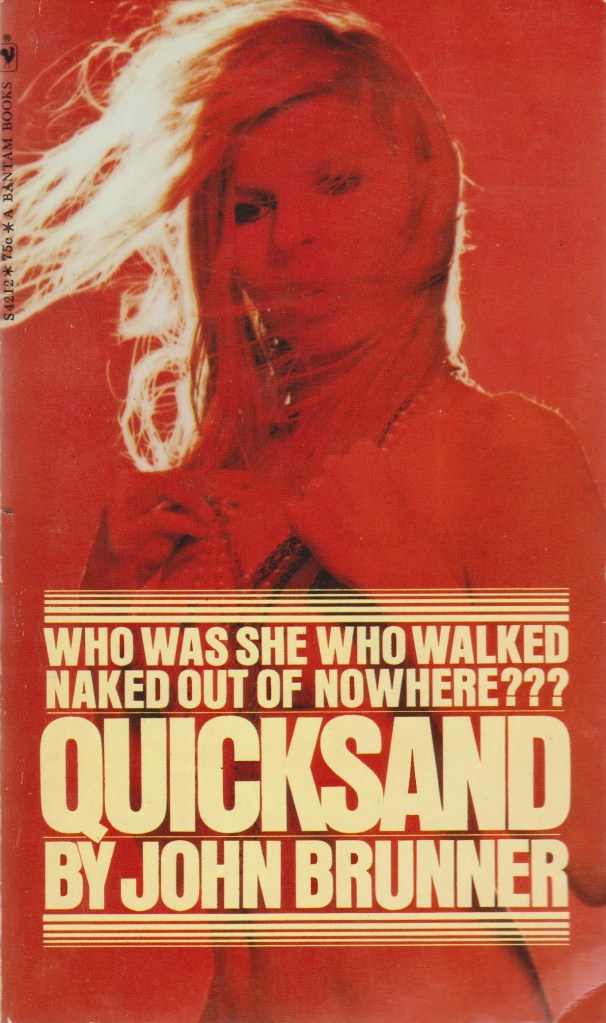
1. Quicksand, John Brunner (1967)

From the back cover: “She had nearly killed a man who tried to assault her. She spoke a language no one could understand. Commonplace objects like clothing and cars were a mystery to her.

Paul was haunted and entranced by her. He licked at the secrecy that surrounded her until, inevitably, his fate became linked to hers. And she gave him a vision of a world more beautiful than any he had ever known.

THEY LIVED IN A PARADISES OF SENSUAL ECSTACY… UNTIL IT WAS TOO LATE. BECAUSE HER LOVE WAS LIKE QUICKSAND.”

Initial Thoughts: My Brunner obsession in my early 20s generated a packed few years of reading as many novels–the good and the bad–that I could get my hands on. This one escaped my grasp.

Continue reading

Updates: Recent Science Fiction Purchases No. CCCVIII (Brian W. Aldiss, D. G. Compton, and Shirley Jackson)

Which books/covers/authors intrigue you? Which have you read? Disliked? Enjoyed?

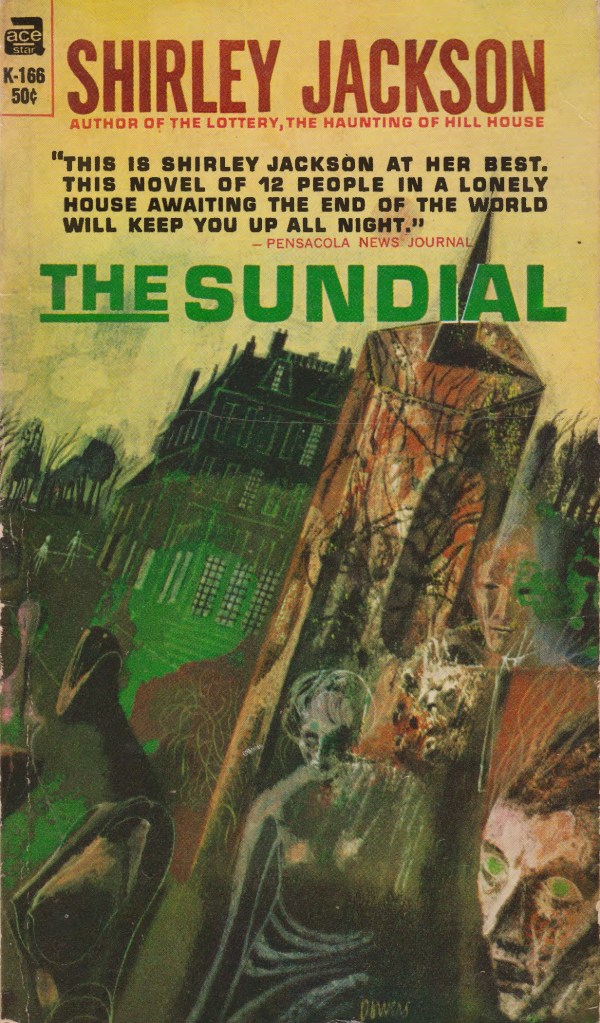
1. The Sundial, Shirley Jackson (1958)

From the back cover: “THE SUNDIAL is a chilling, suspenseful, bloodcurdlingly macabre novel of twelve strange people awaiting the end of the world in a fantastical house like no other on earth.” SF Encyclopedia describes The Sundial as “the closet to SF she came.”

Continue reading

Updates: Recent Science Fiction Purchases No. CCCVII (Jack Williamson, William E. Cochrane, a Groff Conklin anthology, and an anthology of gay and lesbian SF)

Which books/covers/authors intrigue you? Which have you read? Disliked? Enjoyed?

1. 6 Great Short Novels of Science Fiction, ed. Groff Conklin (1954)

From the back cover: “THE BLAST: STUART CLOETE envisions New York City under atomic attack, and tells the story of the lone survivor.

COVENTRY: ROBERT HEINLEIN shows what happens to one of the last individualists, who request a sentence to purgatory.

THE OTHER WORLD: MURRAY LEINSTER reveals a savage, feudal civilization which lives off the sweat of slaves kidnapped from our world.

BARRIER: ANTHONY BOUCHER writers of a time traveler, and his strange encounters with the people who will come after us.

SURFACE TENSION: JAMES BLISH traces a race of microscopic men that works out its destiny under water on a planet somewhere far out of the galaxy.

MATURITY: THEODORE STURGEON depicts the agonizing plight of a super man born in our midst.

Continue reading

Recent Science Fiction Purchases No. CCCV (William Golding, John Wyndham, Mervyn Peake, Joan D. Vinge, Ralph Blum, and an anthology)

Which books/covers/authors intrigue you? Which have you read? Disliked? Enjoyed?

1. 5 Tales From Tomorrow, ed. T. E. Dikty (1957)

From the back cover: “THE TIME: TOMORROW… when

…space travel is as simple as suburban commuting

…robots do everything from washing dishes to waging wars

…do-it-yourself surgery kits are as common as Band-aids

…giant electronic brains mastermind all human activity

THE PLACE: SPACE SPACE SPACE

where the cold, dark islands of abandoned planets drift in a fabulous universe flooded with blazing energy, the dust of old suns and the heat of smoldering new stars.

Space–the promise of new life to a crowded earth–the new frontier–the hope of tomorrow!”

Contents: Bud Foote’s “Push-Button Passion” (1954), Tom Godwin’s “The Cold Equations” (1954), Clifford D. Simak’s “How-2” (1954), Robert Abernathy’s “Deep Space” (1954), Everett B. Cole’s “Exile” (1954)

Continue reading

Updates: Recent Science Fiction Purchases No. CCCIV (Philip José Farmer, Keith Roberts, Pauline Ashwell, Stephen Minot)

Which books/covers/authors intrigue you? Which have you read? Disliked? Enjoyed?

1. The Lovers, Philip José Farmer (1961)

From the back cover: “In 1952, Philip José Farmer excited instant acclaim in the science fiction field with the publication of a short story, THE LOVERS.

In 1961, he wrote and published the full-length novel based on that short story.

And in 1972, Ballantine Books is proud to bring this classic work back into print.

Mr. Farmer, who is known for his explorations into the psychological byways of odd relationships, here postulates a love affair which might well have surprised even Haverlock Ellis. but words such as ‘normal’ or ‘abnormal’ simply have no application in the original concepts to which Mr. Farmer’s imagination gives rise. The book remains unique and fascinating.”

Continue reading

Updates: Podcast Interview and Vintage Science Fiction Discussion Extravaganza

I appeared in my first ever podcast–Postcards from a Dying World with David Agranoff–last week. Organized around a series of interview questions, David and I ended up discussing vintage SF for a good hour. I cover how studying history has inspired my project, reasons for my focus on SF from post-WWII to the mid-1980s, favorite authors and themes, etc. Please check out his twitter and website as well. I have gathered together a list of the SF works I mention in the interview with links to my reviews when applicable.

I hate listening to myself as I am far too excited about vintage SF! (but is that a surprise?)

Continue reading

Updates: Recent Science Fiction and Fantasy Purchases No. CCCII (C. L. Moore, Marc Laidlaw, Fredric Brown, Mack Reynolds)

Which books/covers/authors intrigue you? Which have you read? Disliked? Enjoyed?

1. Dad’s Nuke, Marc Laidlaw (1986)

From the back cover: “BARBECUE THE NEIGHBOURS. In post-collapse suburban America, keeping up with the Joneses has got a little out of hand. Fallout shelters used to be the ultimate status symbol–until Mr. Johnson had his baby daughter’s digestive system adapted to consume radioactive waste.

Now Jock Smith has the edge on his neighbours–he has installed his very own tactical nuclear missile in the back yard.

After all, these are dangerous times..”

Continue reading

Updates: Recent Science Fiction Acquisitions No. CCCI (Angela Carter, Keith Roberts, J. L. Hensley, and a Leo Margulies Anthology)

Which books/covers/authors intrigue you? Which have you read? Disliked? Enjoyed?

1. Heroes & Villains, Angela Carter (1969)

From the back cover: “The Barbarians had attacked the village, looting and burning. And when they left, Marianne, a daughter of the scientists, went with them. Now she followed Jewel, leader of the barbarians, and lived with him as his captured bride…”

Initial Thoughts: A few years ago I read, and was blown away, by Angela Carter’s The Infernal Desire Machines of Doctor Hoffman (1972). I placed it on my best reads of 2016 list but never managed to write a review. Inspired by the novel, I wrote an article derived from a fascinating 1979 interview on Angela Carter’s views on science fiction–including her inspirations and the state of the British SF scene, Michael Moorcock’s prodigious production and New Worlds editorship, and the unescapable influence of J. G. Ballard.

Continue reading