Which books/covers/authors intrigue you? Which have you read? Disliked? Enjoyed?
1. Tales of Science and Sorcery, Clark Ashton Smith (1964)
Bob Haberfield’s cover for the 1976 edition
From the back cover: “A universe of remote and paralyzing fright–jungles of poisonous and iridescent blossoms on the moons of Saturn, evil and grotesque temples in forgotten elder worlds and dark-morasses of spotted death-fungi in spectral countries beyond the earth’s rim. Who else has seen such gorgeous, luxuriant and feverishly distorted visions and lived to tell the tale?” — H. P. Lovecraft
I can’t escape the post-apocalyptic wasteland. Like a voyeuristic shadow, I follow the denizens of the charred surface as they plod their slow movements toward the end. I observe how they push away the looming violent redness that blots out the sky, and, when everything else seems lost, they turn interior. A final movement that lays bare tattered dreams and ephemeral memories…
Ed Emshwiller’s cover for Galaxy Science Fiction, ed. H. L. Gold (November 1954)
5/5 (Masterpiece)
Edgar Pangborn’s “The Music Master of Babylon” first appeared in Galaxy Science Fiction, ed. H. L. Gold (November 1954). You can read it online here.
Fresh of Edgar Pangborn’s masterpiece Davy (1964), I decided to cover some of his short fiction on the site. He’s shaping up to be my author of the year. “The Music Master of Babylon” (1954), which I suggest should be included as part of his Tales of a Darkening World sequence due to multiple references to events and people present in the world of Davy, contains many of the embryonic concerns that crop up in the later novel. Pangborn is the master of interweaving narrative and personal memory and the ways art–in this instance music–lays bare the topography of self.
What pre-1985 science fiction are you reading this week?
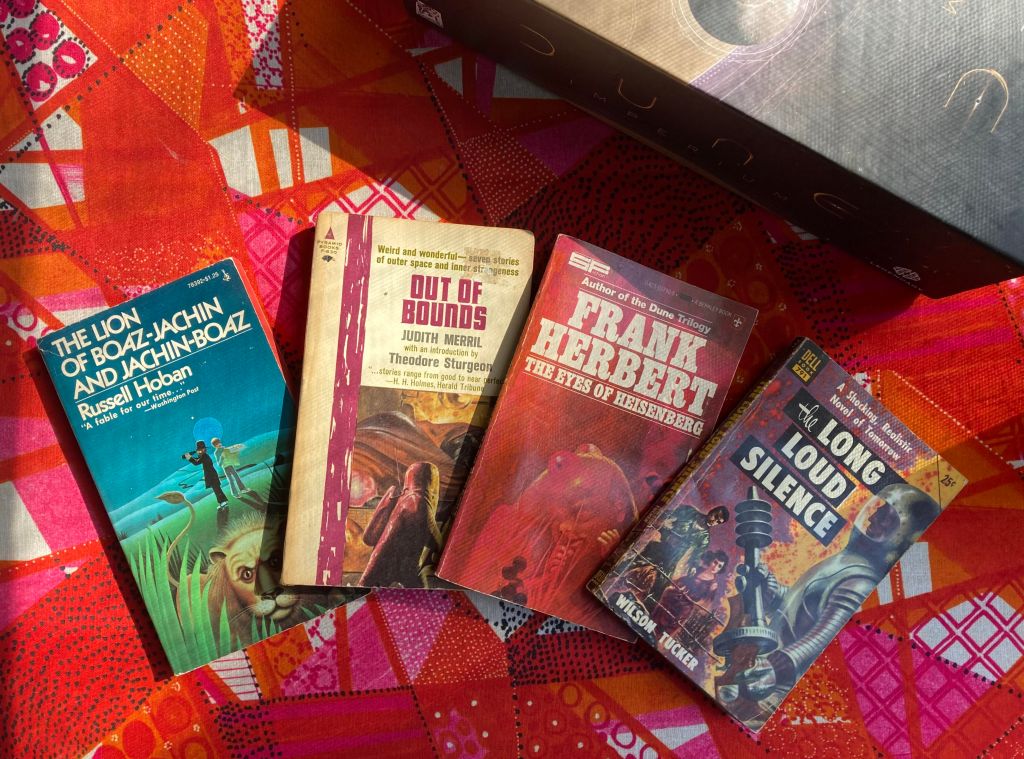
I apologize for the break in my update schedule. It’s been a month since the previous installment. Alas. As I say week after week, thank you for all the great conversation. The community that’s emerged over the years is one of the main reasons I keep writing. I’ve included a bit about the books in the photograph, birthdays from the last two weeks, and brief ruminations on what I’ve been reading and writing.
Note: My read but “waiting to be reviewed pile” is growing. Short rumination/tangents are a way to get through the stack before my memory and will fades. My website partially serves as a record of what I have read and a memory apparatus for future projects. Stay tuned for more detailed and analytical reviews.
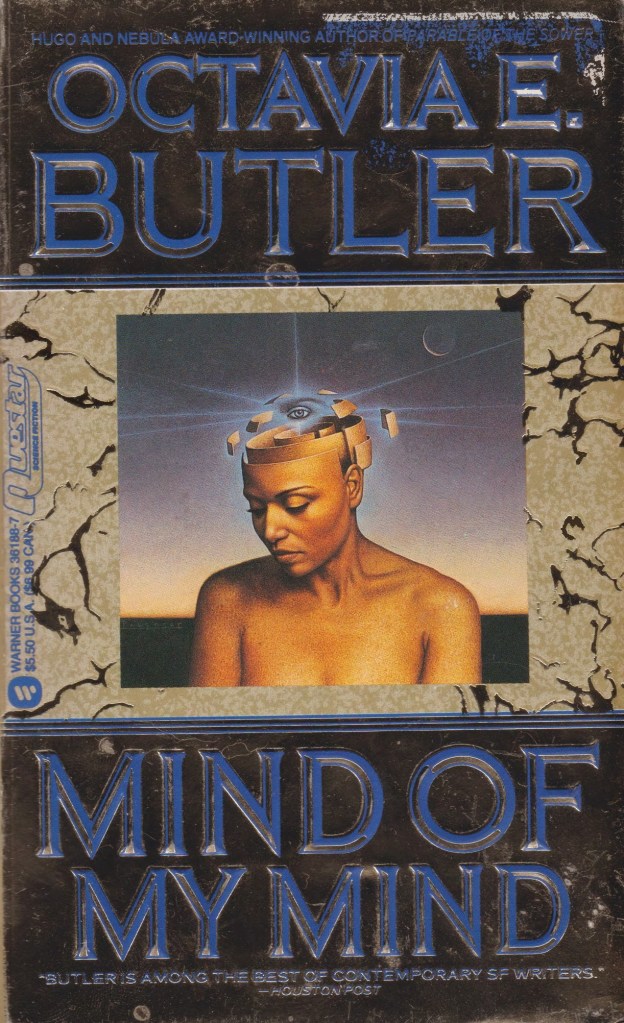
1. Mind of My Mind, Octavia E. Butler (1977)
John Jude Palencar’s cover for the 1994 edition
4/5 (Good)
Octavia E. Butler’s Mind of My Mind (1977) is the second-published and second chronological installment of her Patternist series of novels (1976-1984), that chart the dystopic and hyper-violent development (and destruction) of a telepathic society. The series also contains her disowned (and hard-to-afford without selling a child) novel Survivor (1978). I wish I had read Wild Seed (1980) first!
The immortal Doro, able to hone into those with telepathic talent and shift his essence into new human bodies at will, oversees a generations-old telepathic breeding project. The harrowing story follows one his many daughters, Mary, a rare active telepath (vs. latent), as she comes of age and begins to understand the role that she is designed to play. Doro preys on the downtrodden and abandons the majority of latent telepaths to live miserable lives, unable to filter out the emotions they sponge up. Doro pairs Mary with another active telepath named Karl in order to guide her through her transition. But something new appears in her mind, she seems to have created a pattern that compulsively draws in actives from across the country. And Doro begins to feel threatened by his own creation.
My rough start to the semester proves hard to dispel. I’ll get back to my regular programming soon–I promise. In the meantime, I’ve collected some goodies!
Which books/covers/authors intrigue you? Which have you read? Disliked? Enjoyed?
1. The Man Who Fell to Earth, Walter Tevis (1963)
Jim Burns’ cover for the 1982 edition
From inside page: “He was not a man; yet he was very much like a man. He was six and a half feet tall, and some men are even taller than that; his hair was as white as that of an albino, yet his face was a light tan color, and his eyes a pale blue. His frame was improbably slight, his features delicate. There was an elfin quality to his face, a fine, boyish look to the wide intelligent eyes.
Today I’ve reviewed the 29th story in my series on the science fictional media landscape of the future. In Sydney J. Van Scyoc’s debut “Shatter the Wall” (1962), a bedraggled wife attempts to prevent her daughter and husband from taking on the personas of a television family.
Sydney J. Van Scyoc (1939-2023) published eleven novels and around thirty short stories across her writing career (primarily 1962-1991). Her visions were rarely republished or anthologized. “A Visit to Cleveland General” (1968) might be her best-known short story as it appeared in Carr and Wollheim’s best of 1969 anthology. I have a positive impression of her work so far.
Have you read any of her work? If so, what were your thoughts?
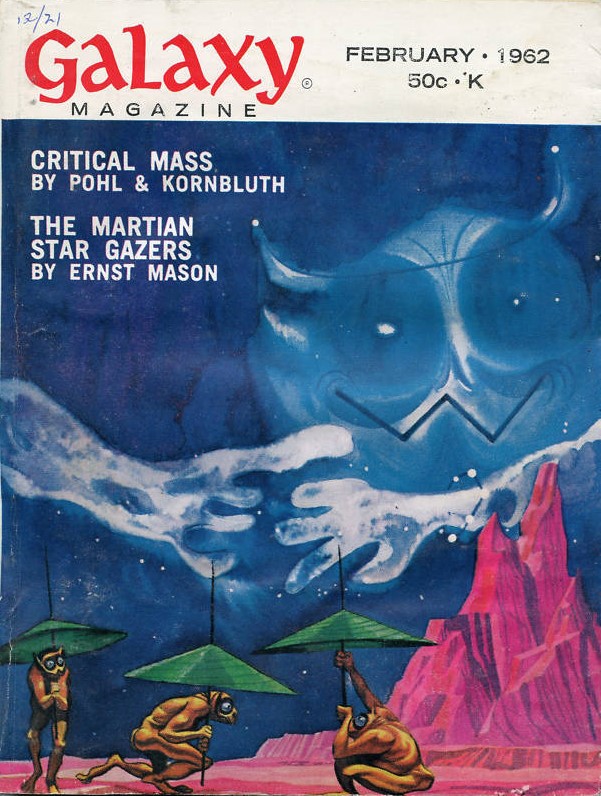
Jack Gaughan’s cover for Galaxy, ed. Frederik Pohl (February 1962)
3/5 (Average)
“Shatter the Wall” first appeared in Galaxy, ed. Frederik Pohl (February 1962). You can read it online here.
According to Gary R. Edgerton in The Columbia History of American Television (2007), a debate emerged in the late 1950s about American materialism and its glorification on television. John Kenneth Galbraith’s The Affluent Society (1958) suggested that advertising created synthetic needs and damaging desires in American citizens. “Shatter the Wall” is all about synthetic needs and damaging desires.
What pre-1985 science fiction are you reading this week?
Thanks again for all the great conversation. Make sure to check out the previous installment if you haven’t already. As before, I’ve included a bit about the books in the photograph, birthdays from the last two weeks, and brief ruminations on what I’ve been reading and writing.
After Frederik Pohl (1919-2013) left his editorial position at Galaxy and If in 1969, he set his pen towards a productive vein of form in the 70s that would culminate in his Hugo and Nebula-winning Gateway (1977). The Gold at the Starbow’s End contains five short stories–including the first of his Heechee sequence–from this period. Two of the best stories, the titular “The Gold at the Starbow’s End” (1972) and “The Merchant of Venus” (1972), demonstrate Pohl’s characteristic blend of hyperbolic satire and delirious energy. There are no duds in this collection.
Which books/covers/authors intrigue you? Which have you read? Disliked? Enjoyed?
1. The Company of Glory, Edgar Pangborn (serialized 1974, novel 1975)
Vincent Di Fate’s cover for the 1st edition
From the back cover: “BEHOLD DEMETRIOS! With the same rich imagination and dazzling insights that won him the International Fantasy award, Edgar Pangborn weaves a magical tapestry set far in man’s future.
It is a time when man, struggling to rise above the ashes of nuclear holocaust, has returned to the simpler values and lifestyles of medieval times. And in this society, Demetrios the storyteller is revered among men for his captivating tales of the Old Time, with its miraculous Telephones, and Jet Planes, and TV, and Automobiles. But Demetrios is also feared–for one storyteller with a head full of ancient truth can be dangerous.
So Demetrios is forced to flee, with six compatriots, and together they embark on a journey full of unexpected sorrows, and unimagined delights, a journey through realms of fantasy, philosophy, and rich human possibility, which the reader will be delighted and privileged to share.”
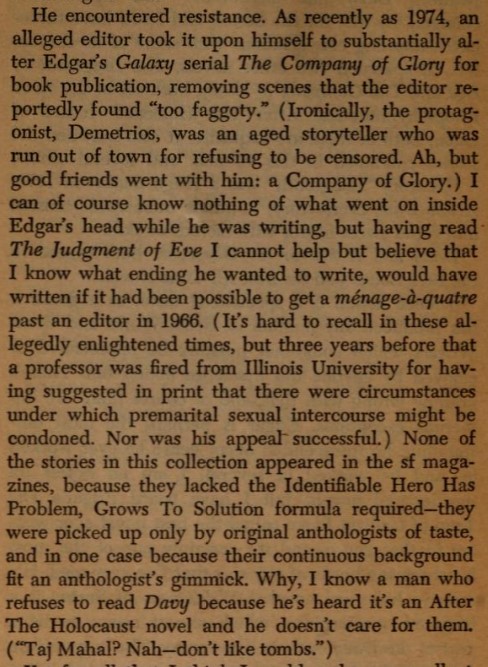
Initial Thoughts: After reveling in Pangborn’s masterpiece Davy (1964), I decided to acquire everything in the Tales of a Darkening World sequence I didn’t own already. According to Spider Robinson, the editor at Pyramid Books cut portions of the novel that was serialized in Galaxy… Inset image is from Robinson’s intro to Still I Persist in Wondering (1978).





 Science Fiction and Other Suspect Ruminations