Today I’ve reviewed the twenty-fourth and twenty-fifth story in my series on the science fictional media landscape of the future. In Richard Matheson’s horror short “Through Channels” (1951), a terrifying entity comes through the TV! Robert F. Young, in “Audience Reaction” (1954), speculates on a new form of virtual reality immersion in which desires become enmeshed in the narrative.
Both stories I cover engage with the newly popular entertainment medium of television. According to Gary R. Edgerton’s magisterial monograph The Columbia History of American Television (2007), no “technology before TV every integrated faster into American life” (xi). As I’ve discussed TV’s impact on the American and British family, entertainment and free time, and its intersection with brainwashing and fears of Communism at length, I won’t belabor the point here. Check out my reviews of Ray Bradbury’s “The Pedestrian” (1951), Brian W. Aldiss’ “Panel Game” (1955), Ann Warren Griffith’s “Captive Audience” (1953), if you want additional 1950s historical context.
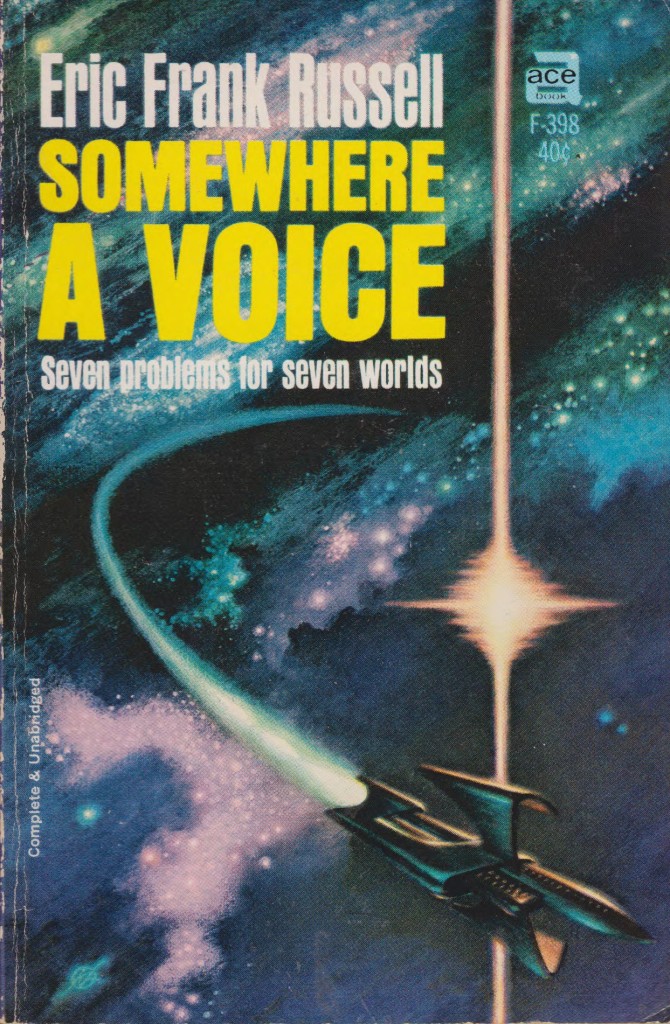
Ed Emshwiller’s cover for the 1st edition of Science Fiction Terror Tales, ed. Groff Conklin (1955)
4/5 (Good)
Richard Matheson’s “Through Channels” first appeared in The Magazine of Fantasy and Science Fiction, ed. Anthony Boucher and J. Francis McComas (April 1951). You can read it online here.
I’ve decided to reframe my series on 50s sex and sexuality to include my entire area of SF interest (1945-1985). Thus, I’ve paired Robert Silverberg’s “The Seed of Earth” (1958), a rumination on colonization and human/alien sex, with Doris Piserchia’s “Pale Hands” (1974), a distressing dissection of a future society designed to fixate all sexual desire on masturbation stalls.
If any short stories published between 1945-1985 on sex and sexuality come to mind that I haven’t reviewed yet, let me know in the comments. I have a substantial list waiting to be covered but it’s far from comprehensive.
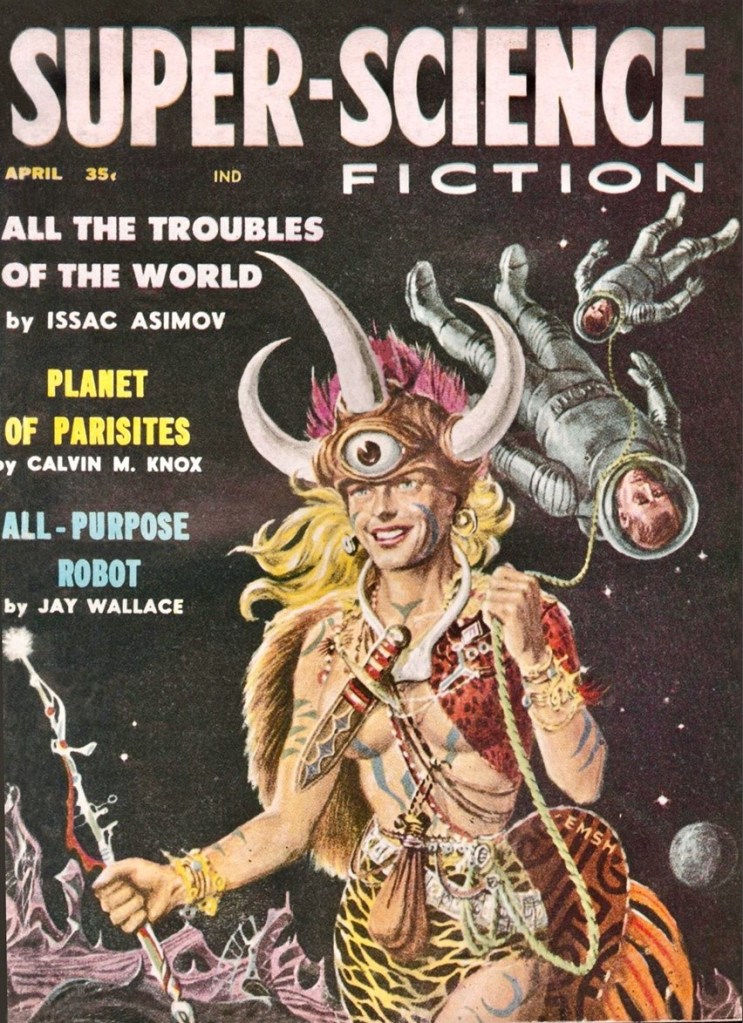
Ed Emshwiller’s cover for Super-Science Fiction, ed. W. W. Scott (April 1958)
3.5/5 (Good)
Robert Silverberg’s “The Seed of Earth” (variant title: “Journey’s End”) first appeared in Super-Science Fiction, ed. W. W. Scott (April 1958). You can read it online here. It is also available in his collection Dimension Thirteen (1969) that I plan on reviewing in the near future.
A preliminary note about publication: Silverberg reused the title “The Seed of Earth”–chosen by W. W. Scott over “Journey’s End”–for a later unrelated novella and a novel.
Which books/covers/authors intrigue you? Which have you read? Disliked? Enjoyed?
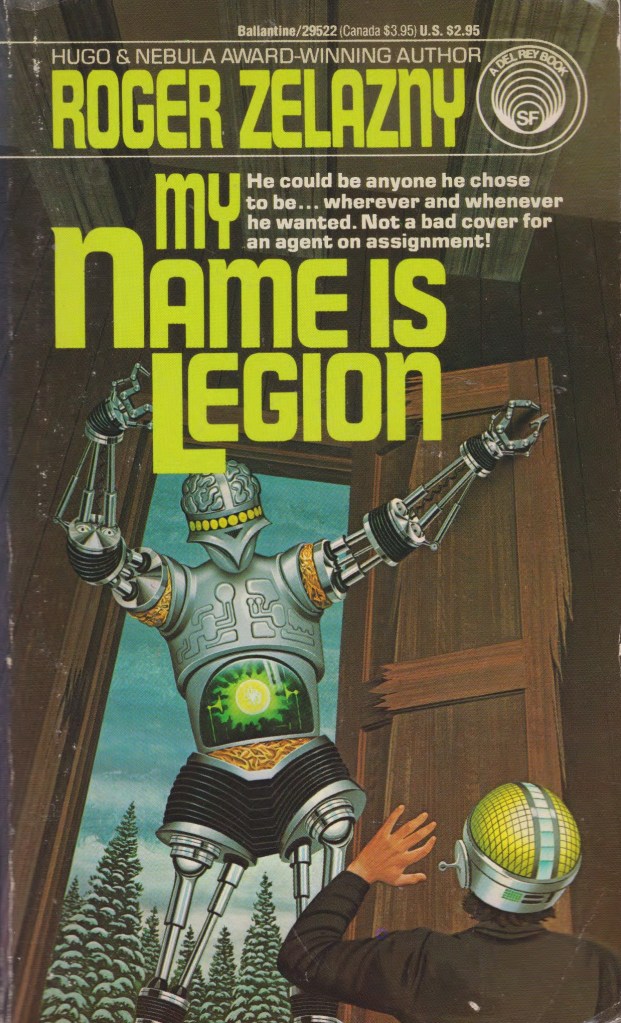
1. My Name is Legion, Roger Zelazny (1976)
Ralph Brillhart’s cover for the 1981 edition
From the back cover: “HE DID NOT EXIST… OR DID HE? He had destroyed his punch cards and changed his face. There was no credit card, birth record, or passport for him in the International Data Bank.
His names were many… any he chose.
His occupation was taking megarisks in the service of a vast global detective agency.
His interworld assignments were highly lucrative, incalculably vital, and terrifyingly deadly.
And more often than not, his life was a living hell!”
Contents: “The Eve of RUMOKO” (1969),” “‘Kjwalll’kje’k’koothaïlll’kje’k” (1973), “Home Is the Hangman” (1975)
Initial Thoughts: In the early days of my site read I reviewed the first in the Nemo sequence–“The Eve of RUMOKO” (1969). At the time I did not care for it. However, I recently read F. Brett Cox’s monography Roger Zelazny (2021) and retrospectively I’m not sure that I understood the character or what Zelazny was trying to accomplish with the story sequence. Often after I read a monograph, I end up making a few impulsive purchases and this is one of them! I hope, at the very least, it gives me a deeper understanding of Zelazny’s SF project. And “Home Is the Hangman” (1975) is a Hugo and Nebula-winning novella that I have not read.
Today I’ve reviewed the twenty-second and twenty-third story in my series on the science fictional media landscape of the future. In “Thing of Beauty” (1958) Damon Knight speculates on something very similar to AI art. And in “You’re Another” (1960) Knight conjures a delirious manifestation of reality TV unlike any other. I’ve gone ahead and included reviews of the rest of the stories in Knight’s collection Far Out (1961).
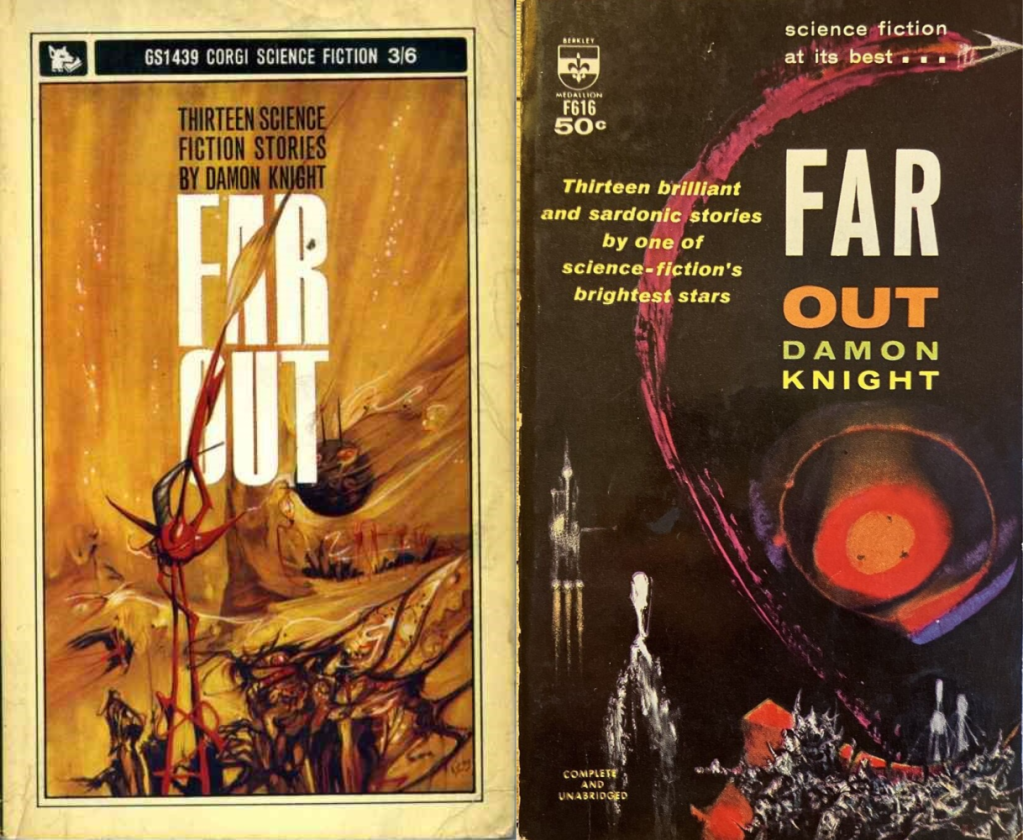
Covers: L, Josh Kirby, 1963; R, Richard Powers, 1962
3.5/5 (Collated rating: Good)
Damon Knight’s impact on the science fiction field can be felt to this day. He founded the Science Fiction and Fantasy Writers of America and co-founded two influential science fiction workshops (Milford and Clarion). Knight also edited the Orbit series of anthologies, notable for their larger-than-average number of female science fiction authors and overall quality–I’ve reviewed Orbit 1 (1966), Orbit 3 (1968), Orbit 4 (1968), and Orbit 8 (1970) so far. I can’t help but notice that his fiction, on the other hand, has faded a bit from popular knowledge. I struggle to identify a masterpiece Knight novel. Did he write one?
I’ve enjoyed his short fiction, notably “Down There” (1973) and “I See You” (1976), immensely. With that in mind, I consumed my first collection of his short stories. I can add “The Enemy” (1958), “You’re Another” (1955), and “Cabin Boy” (1951) to my list of favorite Knight visions.
In Martha Bartter’s article “Nuclear Holocaust as Urban Renewal” (1986), she explores the deep ambivalence within tales of future atomic war. Authors, and their characters, yearn to “build, a new infinitely better world out of the old” (148), and what better way than to destroy all that was. Narratives often betray a sinister destructive urge. She argues that “atomic war has traditionally been presented both as obvious disaster and as secret salvation” (148). I planned on featuring this thought-provoking article in my Exploration Log series but never got around to writing it. Alas! Maybe a comment or two from my readers will inspire me to finally do so.
With Bartter’s argument in mind, I’ve paired two divergent post-nuclear stories. Margaret St. Clair affirms, despite devastation and violence, the possibility of a revitalized future that avoids the pitfalls of the past. Richard Matheson sidesteps the issue entirely and instead explores how survival, even if fleeting, depends on an interior retreat into a world of pulp science fiction (and thus posits a meta-analysis of genre).
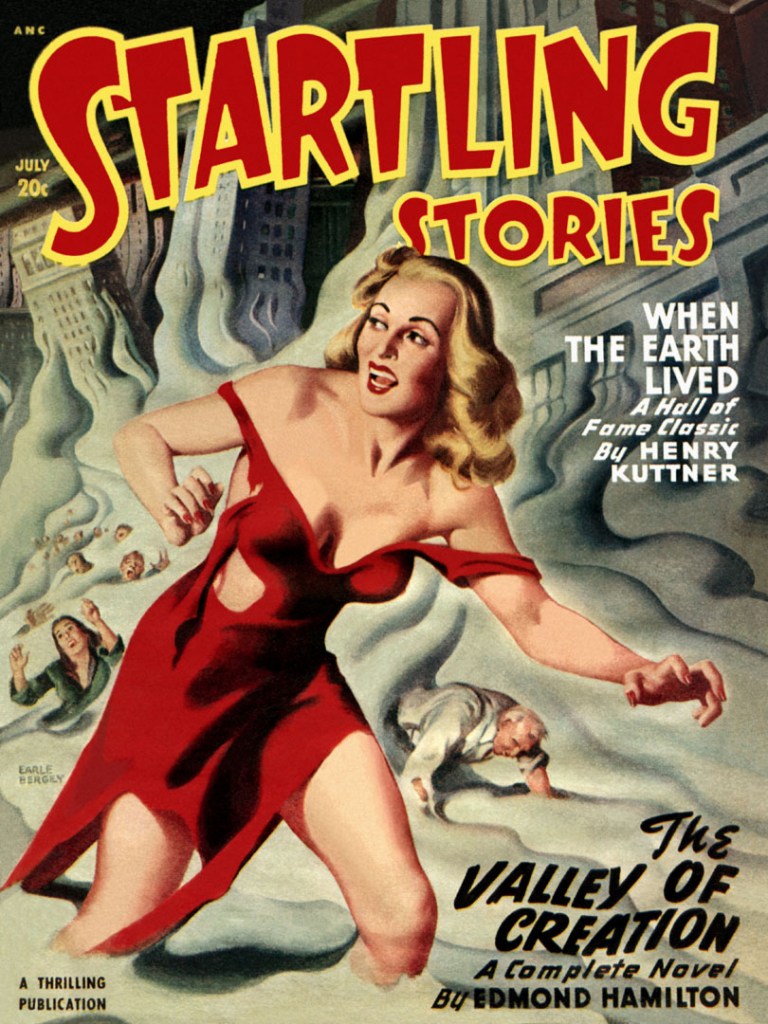
Earl Bergey’s cover for Startling Stories, ed. Sam Merwin, Jr. (July 1948)
3/5 (Average)
Margaret St. Clair’s “Quis Custodiet…?” first appeared in Startling Stories, ed. Sam Merwin, Jr. (July 1948). You can read it online here.
Margaret St. Clair (1911-1995) was a mainstay of the major pulp magazines and maintained a prolific career from 1946 to the late 60s (between the 70s and early 80s she produced only one novel and a handful of stories).”Quis Custodiet…?” explores a conflict three hundred odd years after the “big atom bombs fell” (114) between “homo mutatus,” or the “Blown-up” humans who experience the effects of radiation mutation and the “Formers,” those spared the mutations (110).
William Tenn’s brand of satire has long fascinated me. Today I’ve selected two smart satires of Cold War terror that map the new rituals of the apocalyptic age. I read both in his worthwhile collection The Wooden Star (1968). I’ve previous read and reviewed two of his collections–Of All Possible Worlds (1955) and The Human Angle (1956)–in addition to his only novel, Of Men and Monsters (1968).
Are there any other Tenn fictions that I haven’t covered that I should track down?
Uncredited cover for the 1955 edition of Frontiers in Space: Selections from The Best Science Fiction Stories, ed. Everett F. Bleiler and T. E. Dikty (1955)
4/5 (Good)
William Tenn’s “Generation of Noah” first appeared in Suspense Magazine, ed. Theodore Irwin (Spring 1951). You can read it online here if you have an Internet Archive account.
Elliot Plunkett, WWII veteran and one-time company man, abandons his previous life in order to train his family to survive future nuclear apocalypse. His rural poultry farm raises money for a complex of underground living and store rooms with generators, supplies, Geiger counters, and lead-lined suits (16). He inundates his conversations with quotes from issues of Survivor magazine (16). He teaches his children in a “scientific way” in “keeping with the latest discoveries” (13). He selects the virtues that his children might need in the new future–“strength and self-sufficiency” (19). But this is not survivalist manifesto Dean Ing style or a messianic Heinlein narrator. “Generation of Noah” reveals the profound cruelty Plunkett deploys to beat in his vision of the new morality (placed in stark contrast to the adoring kindness of his wife).
Which books/covers/authors intrigue you? Which have you read? Disliked? Enjoyed?
1. 200 Years to Christmas, J. T. McIntosh (1959)
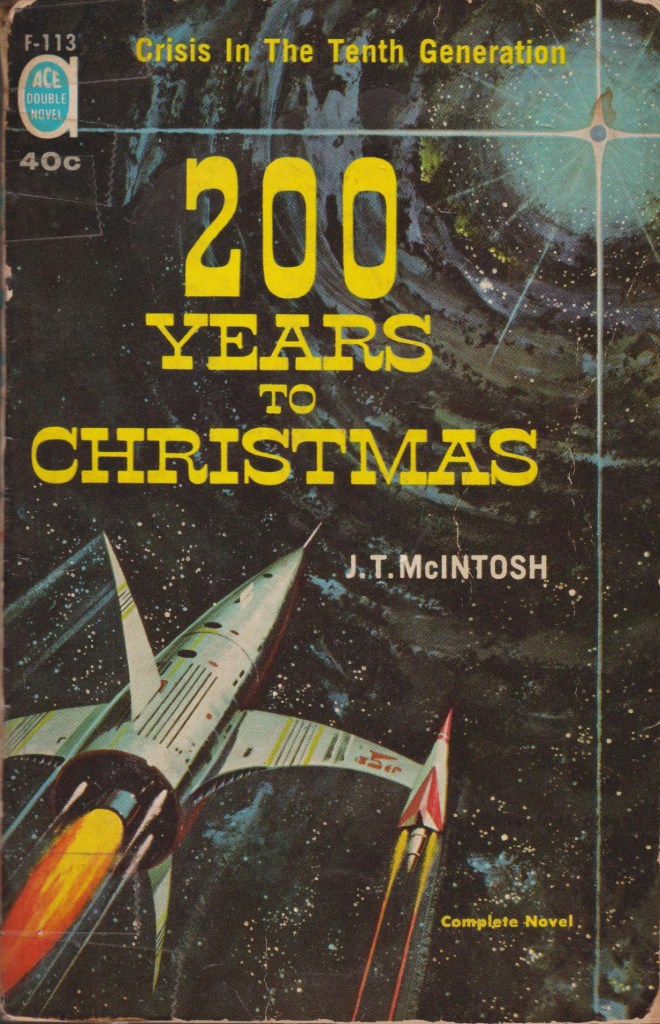
Ed Valigursky’s cover for the 1961 edition
From the inside flap: “For almost two centuries the huge spaceship had speared its way through the stars, bound for another two hundred years of travel before it would put down on a new planet, a new home for the Earth people.
On board the metal-enclosed worldlet were four hundred people; the last survivors of Earth. It was up to them to start life anew, to correct the mistakes their ancestors had made.
This is the 16th post in my series of vintage generation ship short fiction reviews. Today I have an interesting formulation of the generation ship–its component parts dispersed across multiple vessels–that did not appear on Simone Caroti’s list that spurred this project.
As a reminder for anyone stopping by, all of the stories I’ll review in the series are available online via the link below in the review.
You are welcome to read and discuss along with me as I explore humanity’s visions of generational voyage. And thanks go out to all who have joined already. I also have compiled an extensive index of generation ship SF if you wish to track down my earlier reviews on the topic and any that you might want to read on your own.
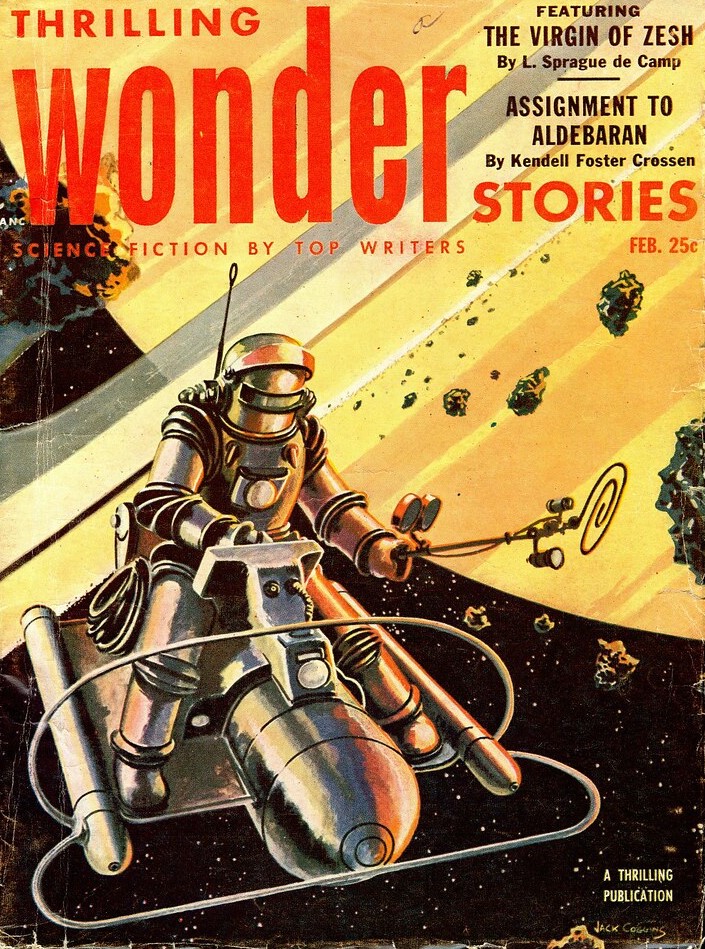
Jack Coggins’ cover for Thrilling Wonder Stories, ed. Samuel Mines (February 1953)
2/5 (Bad)
Julian May’s “Star of Wonder” first appeared in the February 1953 issue of Thrilling Wonder Stories, ed. Samuel Mines. You can read it online here.
After getting involved with SF fandom in her teens, Julian May (1931-2017) published two short stories in the 1950s before returning in the 1980s with the multi-volume Saga of the Pliocene Exile sequence (1981-1984). In between, according to Wikipedia, May worked with her husband T. E. Dikty in publishing, wrote children’s fiction and nonfiction, Buck Rogers comic strips, and even Catholic catechism for publishers affiliated with the Franciscans. Of her two 50s SF tales, “Dune Roller” in the December 1951 issue of Astounding Science Fiction remains by the best known (I suspect for good reason). It received both a TV adaptation for Tales of Tomorrow and film version.