Updates: Recent Science Fiction Acquisitions No. CXLVI (Holdstock + Howard + Guin + Anthology with Zelazny, Pohl, Dick, Aldiss, et al.)

An eclectic range of books from my annual pilgrimage to Ann Arbor, MI.  Unfortunately, the anthology series I was most excited about—Best of New Worlds and Orbit—were lacking from the shelves of Dawn Treader Books….

….but!

World’s Best Science Fiction: 1967 (1967) contains stories famous stories by Philip K. Dick, Roger Zelazny (2xs), R.A. Lafferty, Michael Moorcock, Frederick Pohl, Brian W. Aldiss, and lesser known stories by Dannie Plachta, Paul Ash, Bob Shaw, A. A. Walde….

Also, I also procured a 1967 Nebula-nominated novel by Hayden Howard, more Richard Holdstock, and a collection containing the famous short story “Beyond Bedlam” (1951).  Over the next few weeks I’ll post the rest of my acquisitions.

Thoughts/comments?

1. The Eskimo Invasion, Hayden Howard (1967)

THSKMNVSNN1967

(Stephen Miller’s (?) cover for the 1967 edition) Continue reading

Book Review: The Eye of the Lens, Langdon Jones (1972)

Richard Jones1972

(Richard Jones’ cover for the 1972 edition)

4/5 (collated rating: Good) (*see note below)

Langdon Jones is best known for his involvement in New Worlds Magazine: he contributed stories (published 16 in various New Worlds venues), cover art, and edited the April-July 1969 issues.  One of his stories, “To Have and To Hold,” was slated to appear in the never published Last Dangerous Visions, and languishes unread and unknown.  Why Ellison doesn’t relinquish control of the copyright is beyond me…  Sadly, Jones’ output had all but dried up by 1969.  If anyone knows why, please let me know.

Three of the seven stories in the collection—“The Hall of Machines” (1968), “The Coming of the Sun” (1968), and “The Eye of the Lens” (1968)—form a loose triptych (the religious connotations of the term is purposeful).

*NOTE: Recommended only for fans of the most radical New Wave SF that graced the pages of New Worlds magazine.  Experimental, allegorical, and occasionally Borgesian, all the stories revolve around our perception of time and memory.  Even in the collection’s weakest moments—the Continue reading

Book Review: Starship and Haiku, Somtow Sucharitkul (S. P. Somtow) (1981)

STRSHPHKJJ1981

(Gerry Daly’s cover for the 1981 edition)

3.25/5 (Vaguely Good)

“Nature does not write haiku.  Men write haiku.  The world cannot end in chaos, with things running wild, with gangs running rampant, with cannibals, with dog eating dog and plague-deaths and the abominable mutations.  O, I know it is so in some other countries, but we are Japanese.  We are the children of the whale, who have committed the original sin of patricide… but we have pride, and we must die in beauty” (131).

Somtow Sucharitkul (S. P. Somtow after 1985) is a fascinating individual.  He’s a Thai-American SFF author/composer who moved back and forth between Thailand and the UK (English was his first language and he received his education at the University of Cambridge).  Perhaps best known for his Mallworld sequence of stories (1979-2000), Somtow’s output is immense and ranges from horror to mainstream fiction (in addition to numerous symphonies and operas).

His first novel Starship & Haiku (1981), which won the 1982 Locus Best First Novel Award, joins the ranks of a veritable subgenre of SF about whales and pseudo-whales—including (off the top of my head, there are bound to be more!): Star Trek IV: The Voyage Home (1986), Ian Watson’s The Jonah Kit (1975), T. J. Bass’ The Godwhale (1974), Philip José Farmer’s The Wind Whales of Ishmael (1971), John Varley’s Gaean series (1979-1984), Alan Dean Foster’s Cachalot (1980), and  Robert F. Young’s Spacewhale sequence of short stories (1962-1980) which includes “Starscape with Frieze of Dreams” (1970).  And yes, a whale makes a fateful appearance in Adams’ The Hitchhiker’s Guide to the Galaxy (1979)… The interest in whale SF was probably rooted to the increasing scientific research on whale song in the 1970s.  And whales do hold a certain allure as the largest mammals on our planet! Continue reading

Update: Recent Science Fiction Acquisitions No. CXLV (Platt + Cowper + Gawron + Pfeil)

An eclectic collection of 70s SF…. Two virtually unknown authors (Gawron + Pfeil) and two authors slightly better known by SF fans (Platt + Cowper).

I’ve not been impressed with Platt in the past—for example, maybe you all remember my review for Garbage World (1966) or Planet of the Voles (1971)?  But, nothing peeks my interest more than future urbanization gone amok… [2theD’s review: here].

Richard Cowper’s work intrigues but I often find it on the slight side. See my reviews of The Custodian and Other Stories (1976) and Profundus (1979).  The book I procured below is considered his most famous although the premise does little to inspire….

Donald J. Pfeil wrote three novels (SF encyclopedia is somewhat dismissive of all three) and remains best known for editing the short-lived Vertex magazine: according to SF encyclopedia, “in quality [Vertex] was the strongest of the new sf magazines from the first half of the 1970s.”  Unfortunately, it ran into financial problems and folded after only a few years…. Might be worth collecting!

Thoughts? Comments?

1. An Apology for Rain, Jean Mark Gawron (1974)

Screen Shot 2016-04-25 at 7.59.14 AM

(Margo Herr’s cover for the 1974 edition) Continue reading

Book Review: The Alley God, Philip José Farmer (1962)

TLLYGD19XX

(Richard Powers’ cover for the 1962 edition)

3.5/5 (Collated rating: Good)

The 1950s stories in Philip José Farmer’s collection Strange Relations (1960) rekindled my interest in in his earlier work.  Yes, I want odd stories about hard-shelled, hilltop living, female-only womb aliens who fertilize themselves via roving mobile “male” objects whom they capture and thrust into their womb-spaces. But, there is not an author whom I have more polarizing relationship with….  Outside of the 50s stories I’ve had no success with his work—readers of the site will know my views on Traitor to the Living (1972)To Your Scattered Bodies Go (1971), and the latter novel’s endlessly bland and bloated sequels.  I recently read the novel version of Night of Light (1966), based on the 1957 story by the same name, Continue reading

Book Review: The Dream Millennium, James White (serialized 1973, novel 1974)

THDRMMLLNN1974

( John Berkey’s cover for the 1974 edition)

4.75/5 (Very Good)

“The thought of the vast, utterly silent ship stretching away on all sides of his cubicle, guarded and guided by silent computers, was paralyzing his own ability to make sounds […]” (3)

The crew of a seed ship sent to find a new habitable planet dream the same dreams, dreams of unnatural clarity plagued by pain and death.  As a young woman lies dying in her cold cubicle, her final meal at her lips and unaware of her predicament, she whispers to our reluctant hero (Devlin), “All I seem to dream about is being a lady dinosaur” (32).  Devlin’s dreams follow some pseudo-evolutionary schema, first he dreams he’s a trilobite in some Silurian sea crushed by the tentacles of a cephalopod, “he went on feeding while the hot, constant flame of hunger was punctuated by explosions of pain as his appendages were twisted and crushed and torn away […]” (10).  Then he dreams he’s a brontosaurus, and then an early primate…

Periodically, the automated machines that tend the colonists in cold storage awake their charges, “BASIC INSTRUCTIONS. SPEAK. EXERCISE. REMEMBER” (2).  The Continue reading

Adventures in Science Fiction Cover Art: Max Ernst and his landscapes of decay (on SF/F covers)

barbarians-marching-to-the-west-1937.jpg!Blog

Max Ernst’s Barbarians Marching to the West

Max Ernst (1891-1976) has long been one of my favorite artists.  I had no idea, until browsing through the Penguin SF cover images from the 60s, that his art appeared on a variety of SF/F novels and related literature/nonfiction….  Yes, I had seen the memorable cover for J. G. Ballard’s The Crystal World (1966) [below] but I had not put the two together.

My favorite is without a doubt the use of Ernst’s awe-inspiring Europe After the Rain II (1940-42) for J. G. Ballard’s collection of stories, Memories of the Space Age (1988).  The malaise generated by his landscapes of decay combined with the sheer power of Ballard’s visions evoke are almost palpable shudders of joy…

There are a handful more but I have included most of the 50s to early 80s examples.

And today, April 2nd, is Max Ernst’s birthday!  So, share, if you are so inclined, your favorite of his works of art.  And, feel free to identify any that might appear on the covers below…  Too bad more publishers don’t latch onto the joy that are his collages (do a google search and you will understand).

Enjoy!

MMRSSPCG1988

(Max Ernst, Europe After the Rain, cover for the 1988 edition of J. G. Ballard’s Memories of the Space Age, 1988) Continue reading

Updates: Recent Science Fiction Acquisitions No. CXLIV (Farmer + Anderson + Two Anthologies including Aldiss, Wilhelm, Priest, Disch, etc.)

I have been on a short story kick as of late! Three of the following volumes are short story collections (two anthologies).  I want to complete the Orbit series, ed. Damon Knight….

And, well, I have a soft spot for Philip José Farmer’s 50s/60s SF after Strange Relations (1960).

Thoughts? Comments?

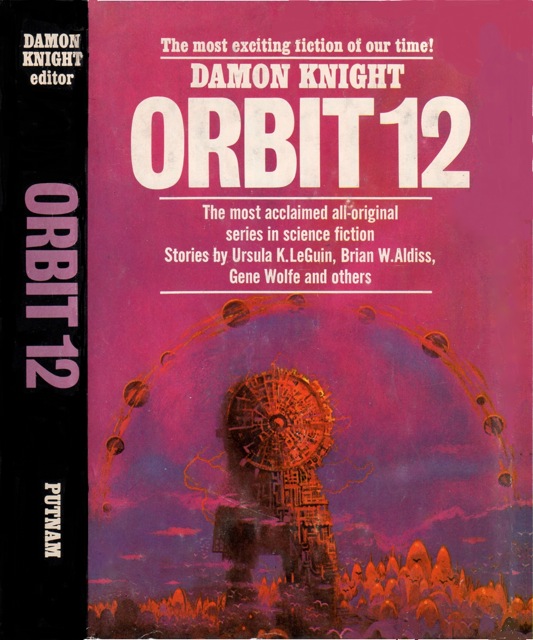
  1. Orbit 12, ed. Damon Knight (1973)

RBTDBDGFSX1973

(Paul Lehr’s cover for the 1973 edition) Continue reading

Book Review: Orbit 3, ed. Damon Knight (1968)

RBTFBJNLFG1968

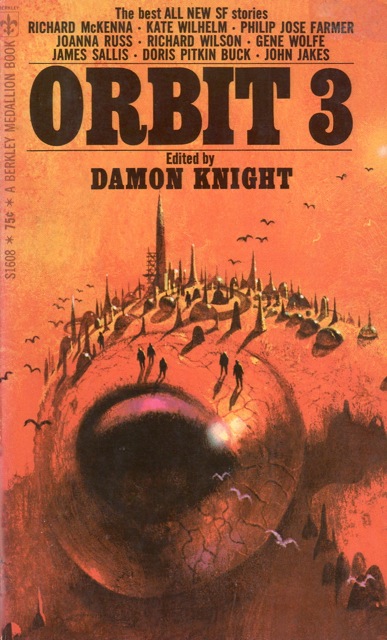
(Paul Lehr’s cover for the 1968 edition)

3.5/5 (collated rating: Good)

Orbit 3 contains both masterpieces (by Gene Wolfe and Kate Wilhelm) and complete duds (by Doris Pitkin Buck and Philip José Farmer).  Damon Knight’s willingness to select a range of known and lesser known authors creates an enjoyable and unpredictable reading experience—but, most of the greats are on their game in this collection, other than Farmer who puts in a lazy shift…  Contains two Nebula award winners: Wilson’s problematic “Mother to the World” (novelette) and Kate Wilhem’s “The Planners” (short story).  The former was also nominated for a Hugo.

Recommended for fans of 60s SF of the experimental bent.  Do not let the collated rating sway you—there are some great stories behind the Paul Lehr Continue reading