Updates: Recent Science Fiction Acquisitions No. LXXI (Malzberg, Bishop, Mano, Runyon)

Part 2 of 5 acquisition posts covering my massive haul from Dawn Treader Books in Ann Arbor Michigan….  I suspect that if I lived nearby I’d slowly migrate their entire SF collection to my shelves.  Two books below are by unknown authors (or at least to me) — Charles Runyon and D. Keith Mano.  Runyon is supposedly average to bad (one of my risk buys) while Mano polarizes readers — he tends to be rather right wing in his views so it’ll be intriguing to see what he does with the dystopic future in The Bridge (1973).  But, as with Runyon my expectations are low.

On the other hand, Malzberg’s The Men Inside (1971) seems to be one of his stranger works — I look forward to it.  And despite how well-known Michael Bishop is I’ve yet to read any of his works so I’ll be reading Beneath the Shattered Moons (1976) soon.

Thoughts?

1. The Men Inside, Barry N. Malzberg (1971)

(Ron Walotsky’s cover for the 1971 edition) Continue reading

Book Review: A Pail of Air, Fritz Leiber (1964)

(Richard Powers’ cover for the 1964 edition)

4/5 (Collated rating: Good)

My only previous exposure to Fritz Leiber was his enjoyable and highly experimental Hugo-winning novel The Big Time (1958) — an unusual story (evoking a one-act play) whose characters are soldiers recruited from all eras of history relaxing in between missions during a vast temporal war.  The same sort of invention and incisive wit abounds in the collection A Pail of Air (1964).  Against a post-apocalyptical backdrop that runs throughout most of the stories, Leiber’s stories are chimeric (and satirical) parables on a vast spectrum of themes — the mechanization of the future, gender relations, endless war, media saturation…  The stories shift between whimsical delight and gut-wrenching despair.

This collection of eleven stories from the early 50s to the early 60s is highly recommended for all SF fans — especially the title story  “A Pail of Air” (1951),  “The Foxholes of Mars” (1952), Continue reading

Updates: Recent Science Fiction Acquisitions No. LXX (Lafferty, Sheckley, Lightner, Ball)

There is no better book store for used SF in the US (that I have been to) than Dawn Treader Books in Ann Arbor, Michigan….  Thankfully, I made the pilgrimage for an altogether different purpose — I delivered a paper at a conference at the University of Michigan — but couldn’t help but spend a while amongst the heavenly stacks (well for a SF fanatic).  This is part 1 of 5 acquisition posts which will showcase the bounty I procured.  And there were probably close to 80 other books I wanted.  Alas.

So, what have we here?  One of Lafferty’s most famous novels — nebula nominated Fourth Mansions (1969).  I’ve only read his shorter work so I’ll be devouring this one soon. More Sheckley for one can never have enough of his biting, wonderful, and hilariously satirical short stories.  A straight-forward space opera by Brian N. Ball (yes, I know, not normally my cup of tea) on recommendation from Mike at Potpourri of Science Fiction Literature… And a somewhat more risky purchase, A. M. Lightner’s The Day of the Drones (1969) — this work of social SF is supposedly her most mature work (she tended to write for the young adult audience) but it was still edited for publication to be suitable for younger readers.  Despite the socially relevant theme, I suspect it will come off as rather corny/undeveloped.

1. Fourth Mansions, R. A. Lafferty (1969)

(Diane and Leo Dillon’s cover for the 1969 edition) Continue reading

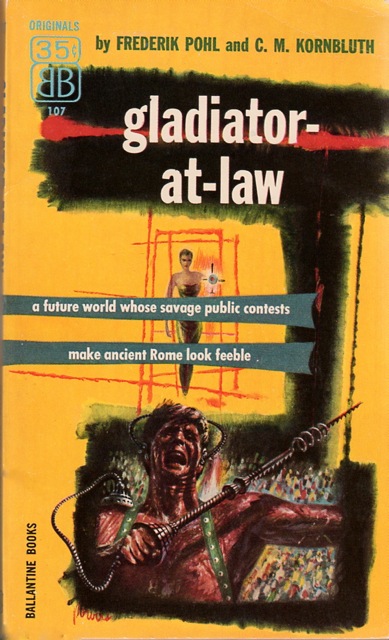
Book Review: Gladiator-At-Law, Frederik Pohl and C. M. Kornbluth (magazine publication 1954)

(Richard Powers’ cover for the 1955 edition)

3.25/5 (Good)

In honor of Frederik Pohl, who recently passed away, I decided to pick up one of his works from the dark maw that is my extensive and overwhelming to read pile.  The last Pohl novel I attempted was a complete disappointment — Slave Ship (1956) — but his collaborations with one of my favorite 50s short story authors, C. M. Kornbluth (who died in 1958 at 34), are often highly readable.   Perhaps the most famous writing duo in SF history, Kornbluth and Pohl produced five novels together including the SF classic The Space Merchants (1953) and multiple short story collections.  The dystopian satire Gladiator-At-Law (1954), although far from the heights of The Space Merchants, is a fine example of their fruitful collaboration.

The world they create is downright fantastic: A future where youth gangs rule the tough streets of Belle Rave (known as Belly Rave), fantastically brutal arena spectacles where old people clubbing each other draw large crowds, lavish bubble houses that supply virtually all needs and are given only Continue reading

Adventures in Science Fiction Cover Art: Crashed Spaceships, Part II

SFA53-02

(Earle Bergey’s cover for the February 1953 issue of Science Fiction Adventures, ed. Philip St. John — i.e. Lester del Rey)

Make sure to take a peek at Part I if you haven’t already.

Crashed spaceships!  Our heroes forced to trek across desolate landscapes, fight giant robots, and evil aliens….  Or, aliens stumble from the wreckage of their flying saucers — unusual green matter emanates while the flames reach ever upward.  I suspect that if I were a kid in the era of pulp SF magazines I would have snatched everyone with a crashed spaceship regardless of the often dubious contents.

I am generally no fan of Kelly Freas but his cover for the July 1957 issue of Science Fiction Stories, is one of my favorite action/adventure type SF covers.  Unusual aliens on the back of a massive turtle alien swimming through lava Continue reading

Book Review: Of Men and Monsters, William Tenn (1968)

MNNDMN1968

(Stephen Miller’s cover for the 1968 edition)

4/5 (Good)

There’s a small pile of novels on my shelf that wait ever so patiently to be reviewed months and months after I’ve read them — J.G. Ballard’s The Drowned World (1962), Robert Silverberg’s The Masks of Time (1968) and Dying Inside (1972), David R. Bunch’s Moderan (1972) (among others), and, until now, William Tenn’s Of Men and Monsters (1968).  Perhaps I was put off by the three mysterious pages filled with small chicken scratch composed by some earlier reader– “224 PKNY, 248 MINCED, 219 M in OKST” — that hinted at some arcane undercurrents or masonic messages that had alluded me.  Perhaps it was my confusion over Tenn’s Heinlein-esque female character, who, in a work of satire, could indicate something so much more progressive than Continue reading

Book Review: Armed Camps, Kit Reed (1969)

Screen shot 2013-08-29 at 9.24.15 AM(Bob Haberfield’s cover for the 1969 edition)

4.5/5 (Very Good)

“[…] and the men were on the way to the bar, they were talking about the performance, they had to compare it to every other performance, they had to link them all and form them into something continuous, something to keep away the dark” (19).

Kit Reed’s first SF novel Armed Camps (1969) is all about characters constructing narratives and conjuring visions in order to keep the aphotic tides of societal disintegration at bay.  The two paralleled narratives — a woman (Anne) running from her past and a man (Danny March) slowly recounting what led to his own downfall — are two different ways of fighting off what is bound to come.  An oppressive melancholy that never lifts soaks the passages, presaging the motions of the characters as if they are trapped in some Thucydidean manifestation of the cyclicality Continue reading

Book Review: The Deep, John Crowley (1975)

(Richard Powers’ cover for the 1976 edition)

4.5/5 (Very Good)

The Deep (1975) was John Crowley’s first published novel and his first of three SF works from the 70s (The Deep, Beasts, Engine Summer).  He is best known for Engine Summer (1979) and his complex/literary fantasy — Little, Big (1981) and the Ægypt sequence (1987-2007).  In the two novels of his I’ve read (the other is Beasts), Crowley’s prose is characterized by an almost icy detachment, an adept construction of unusual images, and dialogue that says only what is needed.

The Deep deploys, in minimalistic fashion, the standard tropes of the fantasy genre mixed with distinctly SF elements: namely, an android visitor whose blood “was alive — it flowed  Continue reading

Book Review: Darkover Landfall, Marion Zimmer Bradley (1972)

(Jack Gaughan’s cover for the 1972 edition)

3/5 (Average)

Marion Zimmer Bradley (1930-1999), most famous for her Arthurian fantasy novel Mists of Avalon (1983) from late in her career, published countless SF works starting in the late 1940s.  Her first novel The Planet Savers (1958) introduced readers to the massive and complex Darkover sequence of works — by far her most famous and iconic contribution to SF.

Darkover Landfall (1972) is a somewhat routine adventure (with a good dose of social commentary) which, according to internal chronology, is the beginning of the vast Darkover series.  Although I cannot speak for the rest of the sequence as this is the first of Bradley’s novels I’ve read, I found Darkover Landfall a problematic and Continue reading