Exploration Log 10: Interview with Jaroslav Olša, Jr., author of Dreaming of Autonomous Vehicles: Miloslav (Miles) J. Breuer: Czech-American Writer and the Birth of Science Fiction  (2025)

Over the last few years, I have incorporated a smattering of the vast range of spectacular scholarship on science fiction into my reviews and highlighted works with my Exploration Log series that intrigue me.1 Today I have an interview with Jaroslav Olša, Jr. about his brand-new book, Dreaming of Autonomous Vehicles: Miles (Miroslav) J. Breuer: Czech-American Writer and the Birth of Science Fiction (2025). In the book, he covers the life and career of Miles (Miroslav) J. Breuer (1889-1945), the first SF author to regularly write original stories for Hugo Gernsback’s Amazing. Breuer’s career also provides a fascinating window into the literary and cultural world of immigrants in late 19th and early 20th century America.

You can buy an inexpensive physical copy ($15.80 at last look) directly from Space Cowboy Books here (preferred) and on Amazon.


Thank you so much for agreeing to this interview. First, can you introduce yourself and your interests in science fiction?

Since childhood, I have loved reading science fiction, but — except for a short time — I have not been professionally attached to it. After studying Asian and African Studies and social sciences in Prague, Tunis and Amsterdam, I joined the Czech diplomatic three decades ago, and have served in various positions including Director of the African Dept. and the Head of the Policy Planning Dept. at the Czech Ministry of Foreign Affairs. I also served as a Czech Ambassador three times: to Zimbabwe for six years, to South Korea for another six years, and to the Philippines for four years. Since December 2020, I have served as Czech Consul General in Los Angeles in charge of the US West.

In the early 1980s, I became a part of a small but very active fandom when—in the then communist Czechoslovakia—the first science fiction club emerged. I started the SF fanzine Ikarie XB, which in 1990 turned into the first Czech-language professional SF magazine Ikarie, with monthly editions until 2024.

I have also translated many short stories and edited numerous SF anthologies, but never wrote fiction. But since the very beginning, the center of my interest in SF was to write about science fiction. I co-edited and authored entries in the only Czech SF encyclopedia, published in 1995. Thus my book about Miles (aka Miloslav) J. Breuer is somewhat of a culmination of my work on science fiction.

What drew you to the science fiction of Miles (Miloslav) J. Breuer (1889-1945)?

Continue reading

Updates: Recent Science Fiction Purchases No. CCCXXXVI (Clare Winger Harris, Frederik Pohl, Barrington J. Bayley, and Robert Asprin)

Which books/covers/authors in the post intrigue you? Which have you read? Disliked? Enjoyed?

1. Away From the Here and Now, Clare Winger Harris (1947)

From the inside flap: “In this age of atomic bombs and radar to the moon, Mrs. Harris’ stories may prove closer to the “here and now” than the title would indicate. Mrs. Harris Proudly claims the distinction of being the first woman science-fiction writer in the country. Each of her stories is based upon a sound scientific fact, carried so plausibly to the nth degree that at no time does it overstain credulity. The stories possess the qualities of dealing with ideas of big importance to the human race, of presenting those ideas in a plausible form, and of appealing to emotions that exist deep within the heart of every human being whether he be scientific or not.

Continue reading

Updates: Recent Fantasy Acquisitions No. I (Hoban + Peake + Eddison)

Something different!

I have always had a soft sport for fantasy (mostly the non-Tolkein ripoff type) à la Mervyn Peake’s Titus Groan (1946), Stephen Donaldson’s Lord Foul’s Bane (1977), Jeff VanderMeer’s Shriek: An Afterword (2006).  Yes, as a kid I read tons of “standard fanasy” i.e. almost all those horrid Wheel of Time novels + Tad Williams’ Memory, Sorrow & Thorn  sequence, etc. etc.  And then I discovered SF and my reading parterns shifted drastically….

Over the past few months I’ve collected the two sequels to Titus Groan and a few Russell Hoban novels—my site name Joachim Boaz is  partially derived from Hoban’s remarkable The Lion of Boaz-Jachin and Jachin-Boaz (1973).

I’m not sure if I’ll review these novels here but, I might read Peake’s Gormenghast (1950) soon.

Thoughts?

1. Pilgermann, Russell Hoban (1983)

(Rowena’s cover for the 1984 edition) Continue reading

Updates: Recent Science Fiction Acquisitions No. LXIV (Herbert + Tenn + Geston + Cummings)

More from my local dirt cheap book store…

By far most interested in William Tenn’s lone novel (he was predominately a short story writer) Of Men and Monsters (1968) — humans living in the walls, like mice, in the homes of the alien invaders of Earth.  Geston’s novelette The Day Star (1972) should be a fast and fun read — hopefully despite the comment by previous owner of the book who inscribed “TEDIOUS” on the back cover with a ballpoint pen…

Some fun covers.

1. Hellstrom’s Hive, Frank Herbert (1972)

HLLSTRMSHV1974

(R. Shore’s cover for the 1975 edition)

Excerpt from the inside flap of the first edition hardback: “In the summer of 1971, Doctor Nils Hellstrom appeared in his own film production, The Hellstrom Chronicle.  The motion picture Continue reading

Updates: Recent Science Fiction Acquisitions No. LXII (Amis + Cummings + Van Vogt)

A strange conglomeration of novels….

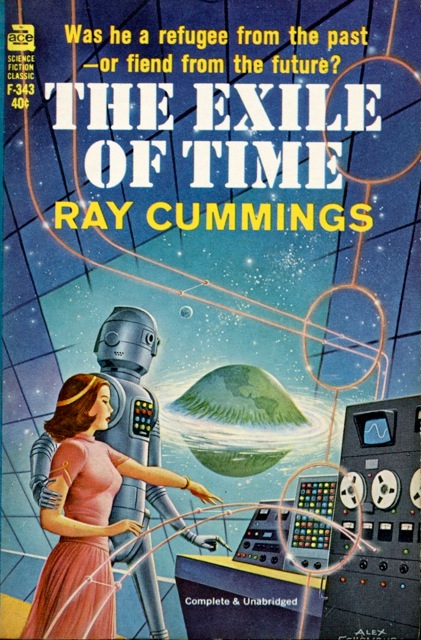
If there’s any era I’m lacking knowledge in it’s late 20s-early 40s (well, I’ve read some Van Vogt + Edgar Rice Burroughs) pulp science fiction — so I decided to brush up on some of the greats.  With that in mind I acquired five Ray Cummings novels (the rest will be in a later acquisition post) and Van Vogt’s Slan (1940)…..  I don’t have high hopes.  But now I own my first Alex Schomburg cover!

I generally do not accept review copies due to the fact that most offers are for self-published works rather than republished novels from the period I’m most familiar with (and prefer to read) — 1950-1985.  So, when New York Review of Books offered me a copy of Kingsley Amis’ well-known alt-history/sci-fi (depending on whose definition you’re reading) novel The Alteration (1976) I happily agreed….

1. The Exile of Time, Ray Cummings (magazine publication 1931)

XLTIME1965

(Alex Schomburg’s cover for the 1964 edition) Continue reading

Adventures in Science Fiction Cover Art: Chess/Checkers (with people + planets)

(Ed Valigursky’s cover for the 1962 edition of Cosmic Checkmate (1962), Charles V. DeVet and Katherine MacLean)

Queue Ed Valigursky’s cover for the Cosmic Checkmate (1962): a chessboard arrayed against a background of stars, men stand on different colored squares, as much pawns of some distant player as the pieces nearby.  Spaceships flash across the vast expanse of space — remember, the game has galactic ramifications — with our characters arrayed, the game opens, and the battle (of wits and secret weapons) begins.  Although I have not (yet) read Charles V. DeVet and Katherine MacLean (whose later novel Missing Man (1975) I highly recommend) is explicitly about Chess, or more precisely, a similar alien game, and the ramifications are indeed, galactic in scope.  Other covers are more metaphoric Continue reading

Adventures in Science Fiction Cover Art: Imprisoned in Glass Vials (of the metaphoric + medical + experimental variety)

(Uncredited cover for the 1969 edition of The Fortec Conspiracy (1968), Richard M. Garvin and Edmond G. Addeo)

Humans and aliens in glass vials of all shapes and sizes waiting to be measured, matured, tested, analyzed, exposed to a variety of chemicals and emulsions.  The artists often combine the iconic laboratory scene filled with the tools of the trade with sci-fi speculation on human experimentation (queue babies grown in containers in Brave New World).  The result, humans in tubes.  The effect is downright terrifying and one suspects, evokes a certain moribund fascination.  As with the famous introductory sequence in Brave New World, the reader is horrified by birth entirety regulated by machines.  Or, we are simultaneously titillated Continue reading

Adventures in Science Fiction Cover Art: My Top 15 Science Fiction Covers

1. Harold Bruder’s cover for the 1967 edition of Pyschogeist (1966), L. P. Davies.

Because everyone loves lists…

…I’ve selected from my collection of cover art, placed in no particular order, my fifteen favorite science fiction covers of all time.  Of course, lists being lists, and the fact that I’ve only seen a portion of all the covers ever made, it is incomplete and maleable.  Although many of the most famous sci-fi artists (Powers, Lehr, and pulp masters such as Wesso) feature, some of my favorites are by lesser known artists whose visual contributions to the field should not be forgotten (Bruder, Podwil, Foster, Schongut, etc).

A few points to consider: 1) The artist rarely had control over the font.  If the graphic designer responsible for putting together the final cover wasn’t up to snuff, the text often doesn’t Continue reading