Frank R. Paul’s cover for Wonder Stories, ed. Hugo Gernsback (September 1934)
The following review is the 36th installment of my series searching for “SF short stories that are critical in some capacity of space agencies, astronauts, and the culture which produced them.” Some stories I’ll review in this series might not fit or are poor quality. And that is okay. I relish the act of literary archaeology.
Why John Wyndham? I snagged a copy of David Seed’s new book John Wyndham (2025) out via University of Liverpool Press and realized how little I knew about his pre-War science fiction.1 This story, among a few others, jumped out to me due to its critical stance on human exploration.
Uncredited banner for the Table of Contents in Wonder Stories, ed. Hugo Gernsback (September 1934)
3.5/5 (Good)
John Wyndham, writing as John Benyon Harris, published “The Man from Beyond” (variant title: “The Man from Earth”) in Wonder Stories, ed. Hugo Gernsback (September 1954). You can read the story online here.
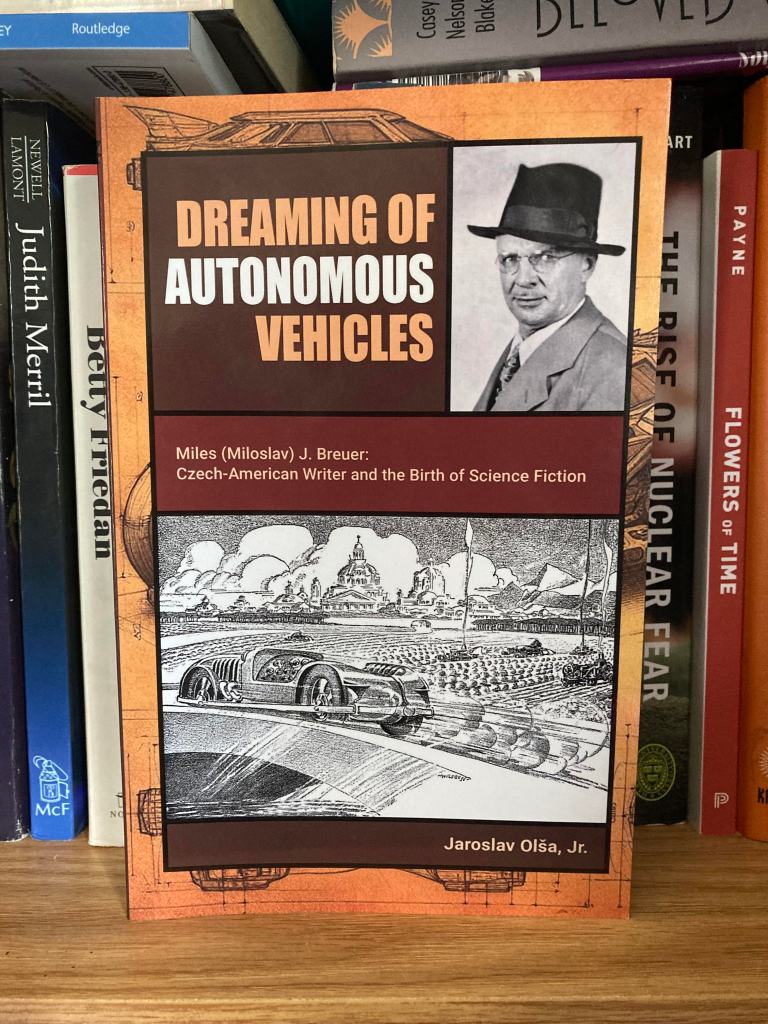
Over the last few years, I have incorporated a smattering of the vast range of spectacular scholarship on science fiction into my reviews and highlighted works with my Exploration Log series that intrigue me.1 Today I have an interview with Jaroslav Olša, Jr. about his brand-new book, Dreaming of Autonomous Vehicles: Miles (Miroslav) J. Breuer: Czech-American Writer and the Birth of Science Fiction (2025). In the book, he covers the life and career of Miles (Miroslav) J. Breuer (1889-1945), the first SF author to regularly write original stories for Hugo Gernsback’s Amazing. Breuer’s career also provides a fascinating window into the literary and cultural world of immigrants in late 19th and early 20th century America.
You can buy an inexpensive physical copy ($15.80 at last look) directly from Space Cowboy Books here (preferred) and on Amazon.
Thank you so much for agreeing to this interview. First, can you introduce yourself and your interests in science fiction?
Since childhood, I have loved reading science fiction, but — except for a short time — I have not been professionally attached to it. After studying Asian and African Studies and social sciences in Prague, Tunis and Amsterdam, I joined the Czech diplomatic three decades ago, and have served in various positions including Director of the African Dept. and the Head of the Policy Planning Dept. at the Czech Ministry of Foreign Affairs. I also served as a Czech Ambassador three times: to Zimbabwe for six years, to South Korea for another six years, and to the Philippines for four years. Since December 2020, I have served as Czech Consul General in Los Angeles in charge of the US West.
In the early 1980s, I became a part of a small but very active fandom when—in the then communist Czechoslovakia—the first science fiction club emerged. I started the SF fanzine Ikarie XB, which in 1990 turned into the first Czech-language professional SF magazine Ikarie, with monthly editions until 2024.
I have also translated many short stories and edited numerous SF anthologies, but never wrote fiction. But since the very beginning, the center of my interest in SF was to write about science fiction. I co-edited and authored entries in the only Czech SF encyclopedia, published in 1995. Thus my book about Miles (aka Miloslav) J. Breuer is somewhat of a culmination of my work on science fiction.
What drew you to the science fiction of Miles (Miloslav) J. Breuer (1889-1945)?
Sherwood Anderson (1876-1941) confides in the introduction to his travel memoir Puzzled America (1935) that the Great Depression was inescapable: “I was a writer of tales. It might be that I should have remained just that, but there is difficulty. There are, everywhere in America, these people now out of work. There are women and children hungry and others without enough clothes.”1 Edgar Albion Lyons, in the author’s note to his science fiction novel The Chosen Race: A Novel Based on the Depression and Machine Age (1936), echoes this sentiment: “The following chapters were written during the months of 1932 when the words ‘Depression’ and ‘Unemployment’ were on everyone’s lips.”2 Magazine science fiction, with its eye towards the marvelous technological future, likewise could not escape contemporary economic, political, and societal convulsions.3 Science, “in the form of a hypothesized device or theory,” enabled exciting adventures but also the exploration of “diverse and dire social implications.”4
On May 9th, 1934, a massive two-day dust storm caused by severe drought and human-made factors, removed massive amounts of Great Plains topsoil. The Dust Bowl unleashed its fury. The dust clouds reached Chicago and cities in the east, blotted out the Statue of Liberty and the United States Capitol. Red snow fell in New England.5 In the September 1934 issue of Astounding, a twenty-year-old Frank K. Kelly published “Famine on Mars” (1934) about a desperate attempt to assist Martians dying of thirst and starvation after a drought. In Kelly’s vision, The Combine, Earth’s government, deliberately caused the genocide and refuses to provide assistance.6
M. Marchioni’s interior art for “Famine on Mars” (1934)
Over the last few years, I have attempted to incorporate a smattering of the vast range of spectacular scholarship on science fiction into my reviews and highlight works with my Exploration Log series that speak to me.1 Today I have an interview with Jordan S. Carroll about his brand-new book, Speculative Whiteness: Science Fiction and the Alt-Right (2024). In the book, he examines the ways the alt-right uses classic science fiction imagery and authors to mainstream fascism and advocate for the overthrow of the state.
You can buy an inexpensive physical copy ($10) directly from the University of Minnesota Press website or an eBook version ($3.79) on Amazon.
Thank you so much for agreeing to this interview. First, can you introduce yourself and research interests?
Which books/covers/authors in the post intrigue you? Which have you read? Disliked? Enjoyed?
1. Away From the Here and Now, Clare Winger Harris (1947)
Uncredited–JM initials but no known name–cover for the 1st edition
From the inside flap: “In this age of atomic bombs and radar to the moon, Mrs. Harris’ stories may prove closer to the “here and now” than the title would indicate. Mrs. Harris Proudly claims the distinction of being the first woman science-fiction writer in the country. Each of her stories is based upon a sound scientific fact, carried so plausibly to the nth degree that at no time does it overstain credulity. The stories possess the qualities of dealing with ideas of big importance to the human race, of presenting those ideas in a plausible form, and of appealing to emotions that exist deep within the heart of every human being whether he be scientific or not.
The following review is the 27th and 28th installment of my series searching for “SF short stories that are critical in some capacity of space agencies, astronauts, and the culture which produced them.” Some stories I’ll review in this series might not fit. And that is okay. I relish the act of literary archaeology.
Kate Wilhelm’s “Planet Story” (1975) charts a planetary mystery that seems just out of reach of the cold, factual truth of scientific instruments. And Clark Ashton Smith’s “Master of the Asteroid” (1932) imagines the fragile minds of human explorers unable to grapple with the interplanetary gulf.
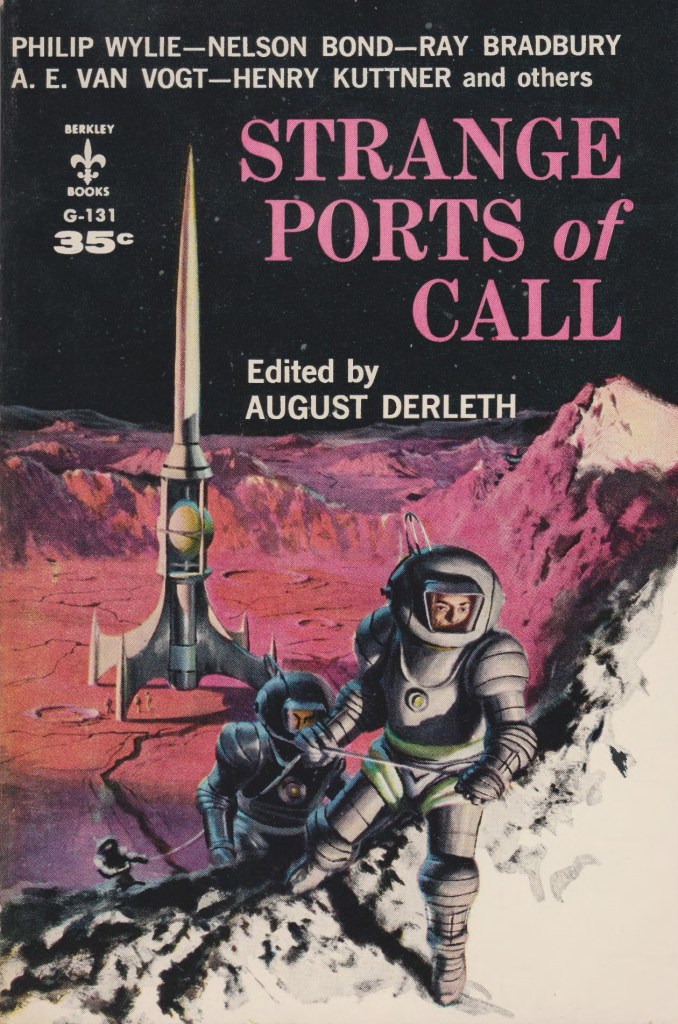
Clark Ashton Smith’s “Master of the Asteroid” first appeared in Wonder Stories, ed. Hugo Gernsback (October 1932). You can read it online here. I read it in the 1958 edition of Strange Ports of Call, ed. August Derleth (1948).
Cark Ashton Smith (1893-1961) is characterized as “one of the big three of Weird Tales, with Robert E. Howard and H. P. Lovecraft.” His fiction was deeply influenced by his psychological afflictions, “including intense agoraphobia,” and nightmares. Due to the Great Depression and the declining health of his parents, Smith wrote more than a hundred short stories between 1929-1934. “Master of the Asteroid” (1932), produced in this productive moment, reads like an unnerving catalog of manias.
Which books/covers/authors intrigue you? Which have you read? Disliked? Enjoyed?
1. Dad’s Nuke, Marc Laidlaw (1986)
Tony Robertts’ cover for the 1988 edition
From the back cover: “BARBECUE THE NEIGHBOURS. In post-collapse suburban America, keeping up with the Joneses has got a little out of hand. Fallout shelters used to be the ultimate status symbol–until Mr. Johnson had his baby daughter’s digestive system adapted to consume radioactive waste.
Now Jock Smith has the edge on his neighbours–he has installed his very own tactical nuclear missile in the back yard.
Preliminary note: This review is a slightly different version of the article I wrote for The Magazine of Fantasy and Science Fiction‘s “Curiosities” column in the recent March/April (2021) issue. I received permission from C. C. Finlay to post it on my site after the magazine hit shelves. You can read the article on the publisher website here. An index of earlier installments of the column can be found here. It makes fun browsing if you are interested in the more esoteric reaches of the genre.
Josephine Young Case (1908-1990), the daughter of pioneering industrialist and the first chairman of General Electric Owen D. Young (1874-1962), crafts a novel in blank verse. Released in the ninth year of the twentieth century’s worst economic crisis, this speculative epic poem is a strident call to return to the soil and reaffirm the value of work.
As if hermitically sealed, the town of Saugerville—a distillation of rural Americana newly electrified—remerges in a pre-Beringian wilderness of loneliness and endless trees. Roads evaporate into forests, electricity flickers off. A new cartography intrudes with its center on the clustered houses, two steeples, and roughhewn fields. Tracing an ensemble cast over one year, Case unearths a traumatic tapestry of severed horizons and grim survival.






 Science Fiction and Other Suspect Ruminations