Which books/covers/authors in the post intrigue you? Which have you read? Disliked? Enjoyed?
1. Away From the Here and Now, Clare Winger Harris (1947)
Uncredited–JM initials but no known name–cover for the 1st edition
From the inside flap: “In this age of atomic bombs and radar to the moon, Mrs. Harris’ stories may prove closer to the “here and now” than the title would indicate. Mrs. Harris Proudly claims the distinction of being the first woman science-fiction writer in the country. Each of her stories is based upon a sound scientific fact, carried so plausibly to the nth degree that at no time does it overstain credulity. The stories possess the qualities of dealing with ideas of big importance to the human race, of presenting those ideas in a plausible form, and of appealing to emotions that exist deep within the heart of every human being whether he be scientific or not.
Today I’ve selected two early Clifford D. Simak “apprentice” stories–“Masquerade” (1941) and “Tools” (1942)–deeply critical of the American business ethic.1 Collectively they posit a future in which colonization goes hand-in-hand with the exploitation of resources, workers, and threatens the alien intelligences they encounter.2
Welcome to a future of capitalistic vastation!
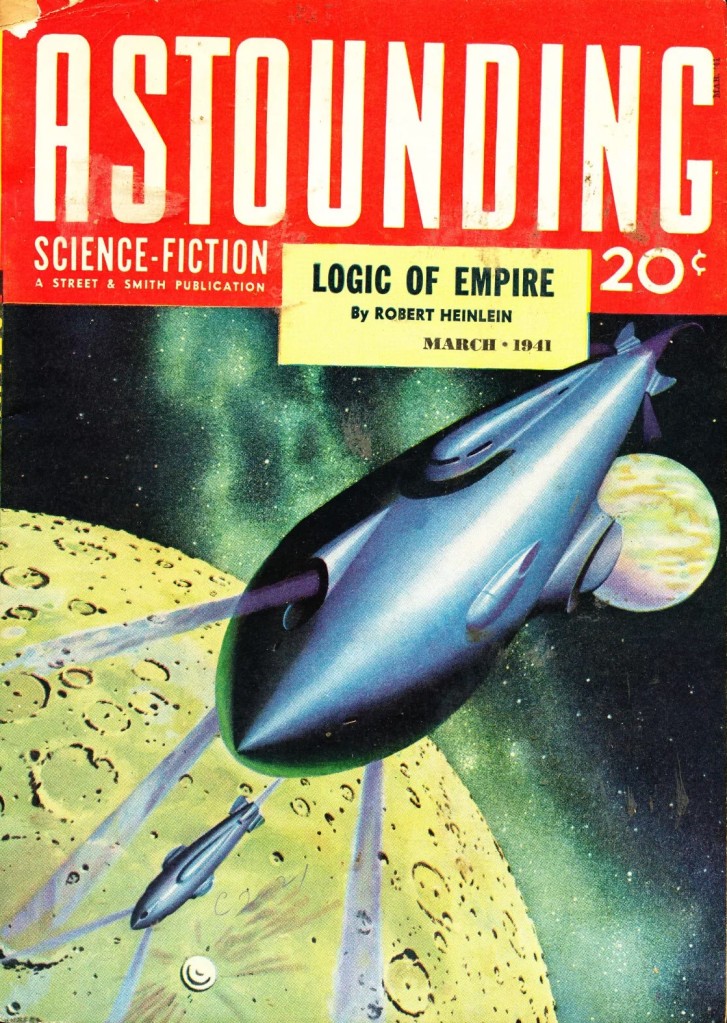
Hubert Rodger’s cover for Astounding, ed. John W. Campbell, Jr. (March 1941)
3/5 (Average)
“Masquerade” first appeared in Astounding, ed. John W. Campbell, Jr. (March 1941). You can read it online here.
In the surprisingly bleak “Masquerade” (1941), metamorphic aliens on Mercury’s radiation-blasted surface parrot human actions. Beneath their clownish behavior is a plot, a plot to takedown an Earth corporation. The story begins with a disquieting sequence in the bleak expanse outside a sunlight harvesting power station on the surface of Mercury: “the Roman candles, snatching their shapes from Creepy’s mind, had assumed the form of Terrestrial hillbillies and were cavorting the measures of a square dance” (57). The Candles, “kicking up the dust, shuffling and hopping and flapping their arms” (58), are the mysterious natives of Mercury. In classic Simak fashion, there’s a method to their apparent comic madness.3
From 1937 to 1958, the dynamic writing duo of Henry Kuttner (1915-1958) and his wife C. L. Moore (1911-1987) wrote countless stories together. As SF Encyclopedia puts it, “much of [Kuttner’s] later work is inextricably entwined” with that of Moore–often to the point of being unable to entangle who wrote what. While the cover of Clash by Nightand Other Stories (1980) does not mention Moore, all the stories in the collection were co-written with her.1
Chan Davis (1926-2022) was a fascinating figure. He was a communist activist, fanzine editor, mathematician, and political prisoner. He was fired from the University of Michigan in 1954 and imprisoned for six months in 1960 on charges of contempt of Congress leveled by HUAC. The Unofficial Hugo Book Club recently posted a fantastic interview, from which I derived the bibliographic blurb above, with Steve Batterson, the author of The Prosecution of Professor Chandler Davis: McCarthyism, Communism, and the Myth of Academic Freedom(2023) that I plan on purchasing soon.
Today I have selected three of Chan Davis’ thirteen published SF short stories. The connecting theme? 1940s speculations on nuclear war in the immediate post-Hiroshima world. All three appeared in Astounding Science Fiction under the tutelage of John W. Campbell, Jr.
William Timmins’ cover for Astounding Science Fiction, ed. John W. Campbell, Jr. (May 1946)
3/5 (Average)
“The Nightmare” first appeared in Astounding Science Fiction, ed. John W. Campbell, Jr. (May 1946). You can read it online here.
A few months before the atomic bomb attack on Hiroshima (August 6th, 1945), a group of scientists at the University of Chicago published The Franck Report (June 11th, 1945). James Franck and his colleagues argued that “within ten years other countries may have nuclear bombs, each of which, weighing less than a ton, could destroy an urban area of more than ten square miles.” They point out the great disadvantage of the United States with its “agglomeration of population and industry in comparatively few metropolitan districts” in comparison to countries with a population and “industry […] scattered over large areas.” In the months after Hiroshima, Chan Davis published his first SF story “The Nightmare” with The Franck Report warning firmly in mind [1].
I’ve returned from my expedition abroad. It’s time to get back to writing about science fiction! But first, there are always new books that have accumulated at my doorstep…
Which books/covers/authors intrigue you? Which have you read? Disliked? Enjoyed?
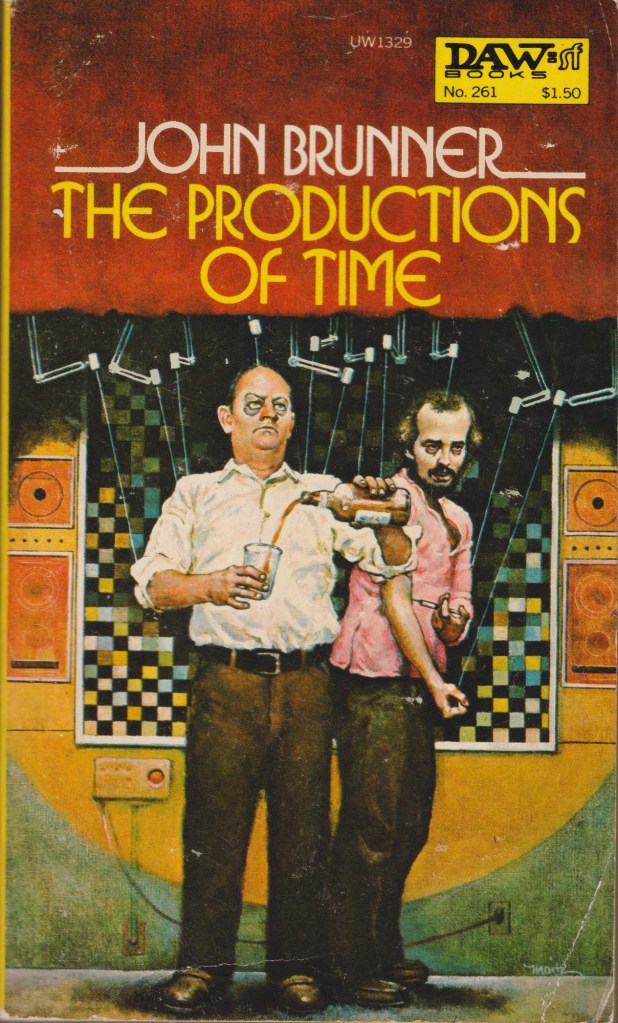
1. The Productions of Time, John Brunner (serialized 1966)
Don Maitz’s cover for the 1977 edition
From the back cover: “Murray Douglas had been a theatrical star until he’d hit the bottle once too often. But now he had broken the habit, and, handsome and fit, was ready for a comeback. The most challenging opening available was an avant-garde play where the actors themselves would make up the drama as they went along.
But out at an isolated country estate where the rehearsals were going on, Murray found himself trapped on a real-life day-and-night stage in which nothing was as it seemed, in which inexplicable devices monitored everything and eerie lures attracted each actor’s psychological weakness.
Who then was the real sponsor of this terrifying play–and to what alien audience was it to be presented?
By the Hugo-winning author of STAND ON ZANZIBAR, this is the first unabridged American edition of this John Brunner classic.”
2022 was the single best year in the history of my site for visits and unique viewers!
As I mention year after year, I find reading and writing for the site—and participating in all the SF discussions generated over the year—a necessary and greatly appreciated salve. Whether you are a lurker, occasional visitor, or a regular commenter, thank you for your continued support.
Continuing a trend from 2021, I read only a handful of novels this year. Instead, I devoted my obsessive attention to various science short story review initiatives (listed below), anthologies, and histories of the science fiction genre. Without further ado, here are my favorite novels and short stories I read in 2022 with bonus categories. Descriptions are derived from my linked reviews.
Check out last year’s rundown if you haven’t already for more spectacular reads. I have archived all my annual rundowns on my article index page if you wanted to peruse earlier years.
My Top 5 Science Fiction Novels of 2022 [TITLES LINK TO FULL REVIEWS]
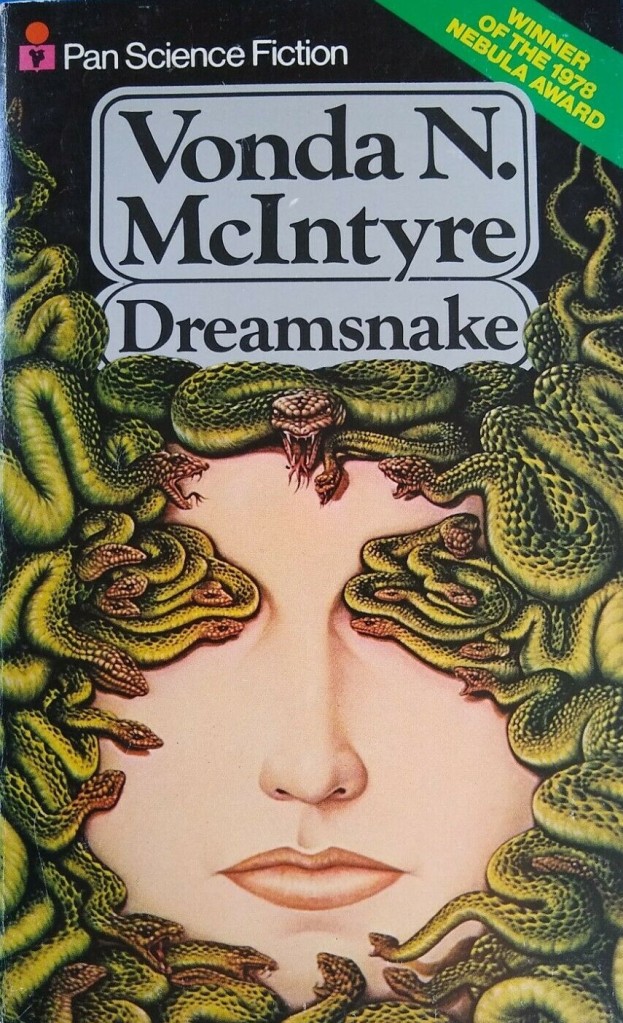
George Underwood’s cover for the 1979 edition
1. Vonda N. McIntyre’s Dreamsnake(1978), 4.75/5 (Near Masterpiece): Won the 1979 Hugo, Locus, and Nebula Award for Best Novel. Snake journeys across the post-apocalyptic wastes of a future Earth with three serpents healing the sick and caring for the dying. She is a member of the healers, who adopt orphans and rescue the oppressed and train them how to use the serpents. Mist and Sand are genetically modified vipers of terrestrial origin. But Grass comes from another alien world. Snake uses Mist and Sand’s venom to create vaccines, treat diseases, and cure tumors. Grass, the rare dreamsnake, with its alien DNA is the most important of them all–it provides therapeutic pleasure and dreams that facilitate conquering one’s fear and healing in the ill. In Snake’s voyages, she encounters prejudice and violence. A joyous sense of sexual freedom permeates the proceedings. A powerful and different take on a post-apocalyptic worldscape in every possible way.
Which books/covers/authors intrigue you? Which have you read? Disliked? Enjoyed?
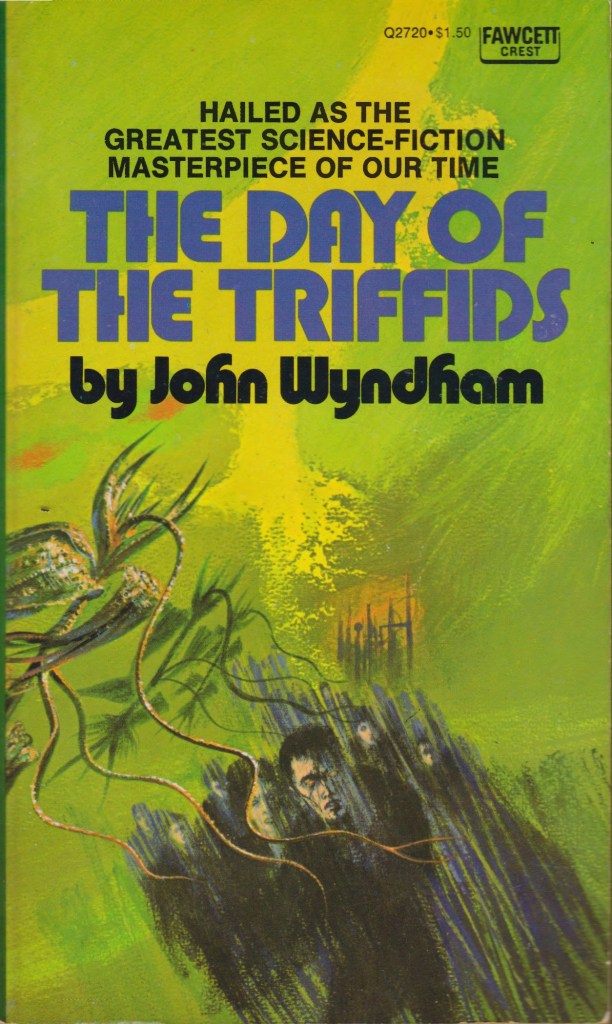
1. The Day of the Triffids, John Wyndham (1951)
Richard Powers’ cover for the 1964 edition
From the back cover: “WHAT WERE THEY–
THESE HIDEOUS TRIFFIDS ROAMING THE RUINS OF THE EARTH?
Until a few short hours ago–before the sky exploded into a shower of flaming green hell–triffids had been regarded as merely a curious and profitable form of plant life. Now these shadowy vegetable creatures became crawling, killing nightmare of pain and horror.
Madness hung in the air, fear lurked in every side street, death hovered in every doorway. Stripped of civilized veneer by terror and desperation, the handful of surviving humans began to turn on each other.
Which books/covers/authors intrigue you? Which have you read? Disliked? Enjoyed?
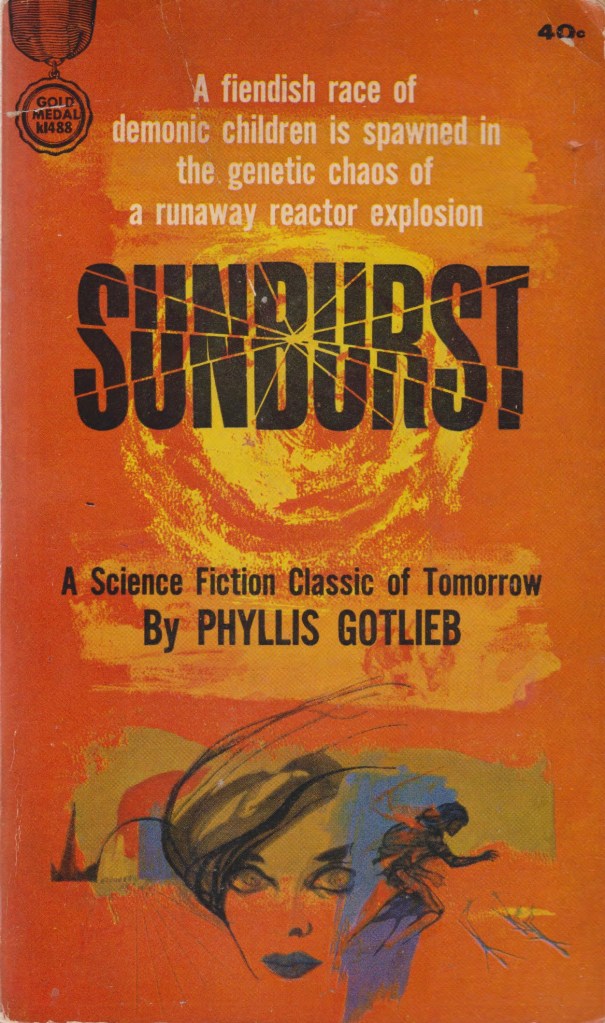
1. Sunburst, Phyllis Gotlieb (1964)
Richard Powers’ cover for the 1st edition
From the back cover: “In the hideous aftermath of the atomic sunburst. The people of Sorrel Park had been written off. Now they were nothing but a kind of human garbage, festering and hopeless.
In the center of town lived the worst of the human garbage–and by far the most dangerous. They were a breed of terrible children, possessed by terrifying supernormal powers. They were a new race of monster bred out of the sunburst, and if they ever broke loose they would destroy the world…”