Adventures in Science Fiction Cover Art: An Assortment of Mysterious Spheres, Part II

(David Bergen’s cover for the 1978 edition of Sea-Horse in the Sky (1969), Edmund Cooper)

Here’s Part II of my cover art series on the delightfully nebulous theme of mysterious spheres (Part I).  I’ve selected a variety of spheres: including spheres elevated in the air (balloon representations of the sun? planets? large scale planetary orbit models?), spherical eggs hatching men?, alien warships, alien (and human) transportation devices, strange atomic technology, obvious Death Star ripoffs, fields littered with the perplexing shapes….

… and even the simple unadorned sphere held aloft to indicate the pure delight of Continue reading

Updates: Recent Science Fiction Acquisitions No. LVI (Herbert + Pohl + Kornbluth + Harrison + Wouk)

More Christmas gifts and winter break purchases….

Another Herbert non-Dune novel with a great vat baby fetus cover by the indomitable Lehr…

Another Pohl + Kornbluth 50s satire about worlds sunk into savage degeneration….

A lesser known illustrated utopian space fable by the Pulitzer Prize winning Herman Wouk…  I really have no idea what to expect from this one.

And an alternate history sci-fi adventure by Harry Harrison.

1.  Tunnel Through the Deeps (variant title: A Transatlantic Tunnel, Hurrah!), Harry Harrison (1972)

(Richard Powers’ cover for the 1974 edition) Continue reading

Adventures in Science Fiction Cover Art: Easter Island Heads

(Ray Kalfus’ cover for the May 1963 issue of Amazing Stories)

The Easter Island heads have long been explained away by conspiracy theorists as the work of aliens!  Apparently there are a few short stories and novels that derive not only their cover art but entire stories from such hilariously awful material…. Regardless, the covers are giggle inducing, and in the case of the uncredited cover for William Tenn’s Of All Possible Worlds (1955) rather striking.  I’ve included one cover from the 40s, an Arkham house novel that might be more “horror” than “sci-fi.”  Regardless, the idea that the Easter Island heads evoke dread, is well, laughable.

If you know of any others please let me know — I could only round up these five Continue reading

Updates: Recent Science Fiction Acquisitions N. XLV (Heinlein + Farmer + Shaw + Lanier)

My San Antonio, TX haul….

I’ve read multiple of Shaw’s books in the past — they are often intriguing on the conceptual level but fall apart during delivery (Ground Zero Man, One Million Tomorrows)….  But, the back cover of Shadow of Heaven (1969) was intriguing enough to grab a copy.

The multiple Farmer novels I’ve read (most of the Riverworld series and Traitor to the Living) were trash.  But, I’m willing to give him another go — against my better judgement.

Heinlein is overrated but readable and Stephen Lanier’s Hiero’s Journey (1973) is supposed to be an intriguing post-apocalyptical tale….

1. Shadow of the Heaven, Bob Shaw (1969)

(George Underwood’s cover Continue reading

Adventures in Science Fiction Cover Art: The Statue of Liberty on Pre-1968 Magazine and Novel Covers

pota-statue-of-liberty-2.jpeg

(Still from the 1968 film Planet of the Apes, dir. Franklin J. Schaffner)

For more covers on the same theme see Part II

I suspect that virtually all science fiction fans and film cineastes recall the vivid sequence near the end of the 1968 film Planet of the Apes where the Statue of Liberty lies half-buried in the sands.  Franklin J. Schaffner’s film draws on a rich tradition in pulp science fiction cover art.  I’ve included six cover from 1941-1965, all before the film was released, that depict the Statue of Liberty submerged by apocalyptical floods and excavated by future spacemen.  I have a large catalogue of covers that show various landmarks destroyed by mechanical monsters, ogled at by aliens, and wrecked by a variety of world ending disasters.  The Hollywood penchant for destroying as many national landmarks as possible in movies is deeply rooted in existing visual traditions.

My favorite is by far Blanchard’s (does anyone know his full name) cover for the 1959 edition of John Bowen’s After The Rain (1958).  The dark skies, the stormy waters reaching up to her nose, the survivors of the flood perched near the flame, the boats and roofs of houses floating about, perfectly evoke the extent of the disaster — and, “elements gone wild!”

Enjoy!

(if I’ve missed any pre-1968 covers please let me know.  I know that there are multiple later covers but they might be purposefully referencing Planet of the Apes)
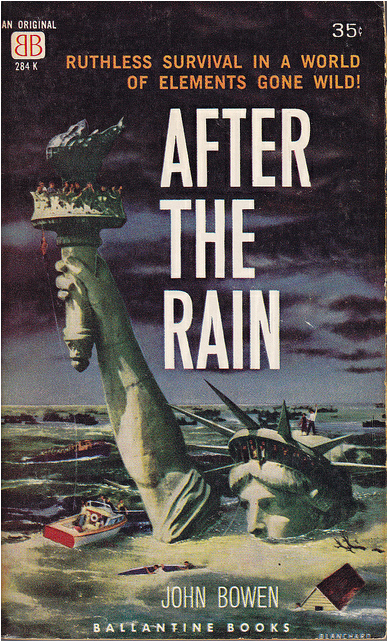
(Blanchard’s cover for the 1959 edition of After The Rain (1958), John Bowen) Continue reading

Adventures in Science Fiction Cover Art: Spacewomen of the Future (fixing spaceships + fighting aliens + charging across barren landscapes)

(Don Sibley’s cover for the November 1950 issue of Galaxy)

When we conjure the image of a 40s/50s science fiction pulp heroine we often imagine a character who has to be rescued by men from aliens, shrieks and clings to any man nearby, and is always in a state of undress.  I’ve included one cover, for the sake of comparison, that I find to be an exemplar of this type of sexist (and racist) depiction below (Alex Schomburg’s cover for the January 1954 issue of Future Science Fiction): white woman wrapped in only a towel stalked by an evil alien obviously painted with African-American facial characteristics (heavy on the sexual predation vibe) — the reader is supposed to buy into the racial stereotypes and thus be titillated by the fear she must feel.

I’ve selected a wide range of mostly pulp magazine covers depicting spacewomen of the future (I’ve loosely decided that this means women in space, in spacesuits) that tend to buck the trend Continue reading

Adventures in Science Fiction Cover Art: Alien Friends

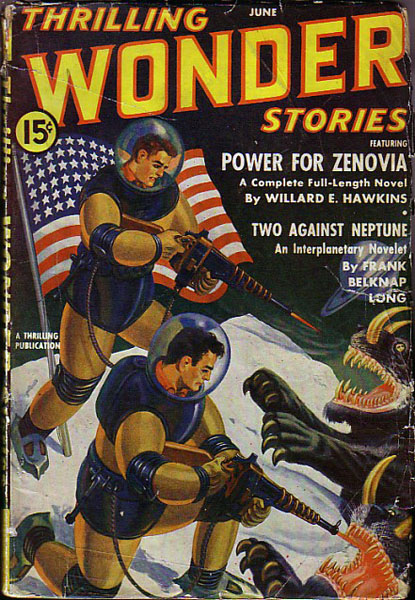
(H. W. Wesso’s June 1941 issue of Thrilling Wonder Stories)

In science fiction aliens are usually evil and generally end up dead — killed by our human heroes via pseudo-videogames (Ender’s Game), guns of endless variety, nuclear weapons detonated on their home worlds, horrific  diseases (Deep Space Nine), tossed into the vacuum of space, tossed into wormholes, etc etc.  They are rarely “humanized” — their families, societies, and history ignored by their human enemies — they are often depicted as “true” evil.  I’ve included the above cover, shooting aliens under the American flag (it is a wartime 40s issue so such overt jingoism is explainable), in order to highlight the attitude towards space fauna which we are all familiar with.

Sometimes “friendship” is feigned.  C. M. Kornbluth’s short story ‘Friend To Man’ (1951) (in this collection) is a disturbing example — the maternal feeling felt by the alien towards our antihero is just a ploy to lure him into her den where she implants him with eggs, which Continue reading

Adventures in Science Fiction Cover Art: Underwater Expeditions (futuristic submarines + underwater labs + sea monsters + cities), Part II

(Roger Stine’s cover for the 1979 edition of On The Run (variant title: Mankind on the Run) (1955), Gordon R. Dickson)

Part II of my Underwater Expeditions Series (Part I) is a veritable deluge of undersea wonders.  Unusual monsters/aliens proliferate the seascapes — snapping at our aquatic heroes.  A vast array of submersibles and submarines — including a mechanical whale equipped with a harpoon (Jack Coggins’ cover for the April 1957 issue of Galaxy Science Fiction) — trek across the oceanic expanses.  Cities, ruins, hidden scientific facilities are all to be discovered amongst the seaweed and deep water trenches…

There is something so mysterious about the ocean depths — almost as alienating and frightening as space.  Although due to our recent deep sea explorations increasingly less Continue reading

Adventures in Science Fiction Cover Art: Chess/Checkers (with people + planets)

(Ed Valigursky’s cover for the 1962 edition of Cosmic Checkmate (1962), Charles V. DeVet and Katherine MacLean)

Queue Ed Valigursky’s cover for the Cosmic Checkmate (1962): a chessboard arrayed against a background of stars, men stand on different colored squares, as much pawns of some distant player as the pieces nearby.  Spaceships flash across the vast expanse of space — remember, the game has galactic ramifications — with our characters arrayed, the game opens, and the battle (of wits and secret weapons) begins.  Although I have not (yet) read Charles V. DeVet and Katherine MacLean (whose later novel Missing Man (1975) I highly recommend) is explicitly about Chess, or more precisely, a similar alien game, and the ramifications are indeed, galactic in scope.  Other covers are more metaphoric Continue reading