The following review is the 20th installment of my series searching for “SF short stories that are critical in some capacity of space agencies, astronauts, and the culture which produced them.” Some stories I’ll review in this series might not fit. Many are far from the best. And that is okay. I relish the act of literary archaeology.
I turn now to an author, Harlan Ellison (1934-2018), whom I’ve only marginally explored considering his prodigious output. I am completely ignorant of his 50s visions. I’d previously read and reviewed his collection Approaching Oblivion (1974) and a handful of other stories including “A Boy and His Dog” (1969). The first story in this post–“Psycho at Mid-Point” (1956)–exemplifies the theme at its most brutal and nihilistic. As a bonus, I’ve paired it with one of Ellison’s better known 50s tales of mutants and prison ships–“The Discarded” (variant title: “The Abnormals”) (1959). If you know of any other Ellison stories that might fit the theme, let me know.
As always, feel free to join the conversation and read along with me on the search for the depressed astronaut.
Previously: Alfred Coppel’s “The Hunters” (1952, “The Dreamer” (1952), and “Double Standard” (1952).
Up Next: George R. R. Martin’s “The Second Kind of Loneliness” (1972) and Tom Godwin’s “The Nothing Equation” (1957)
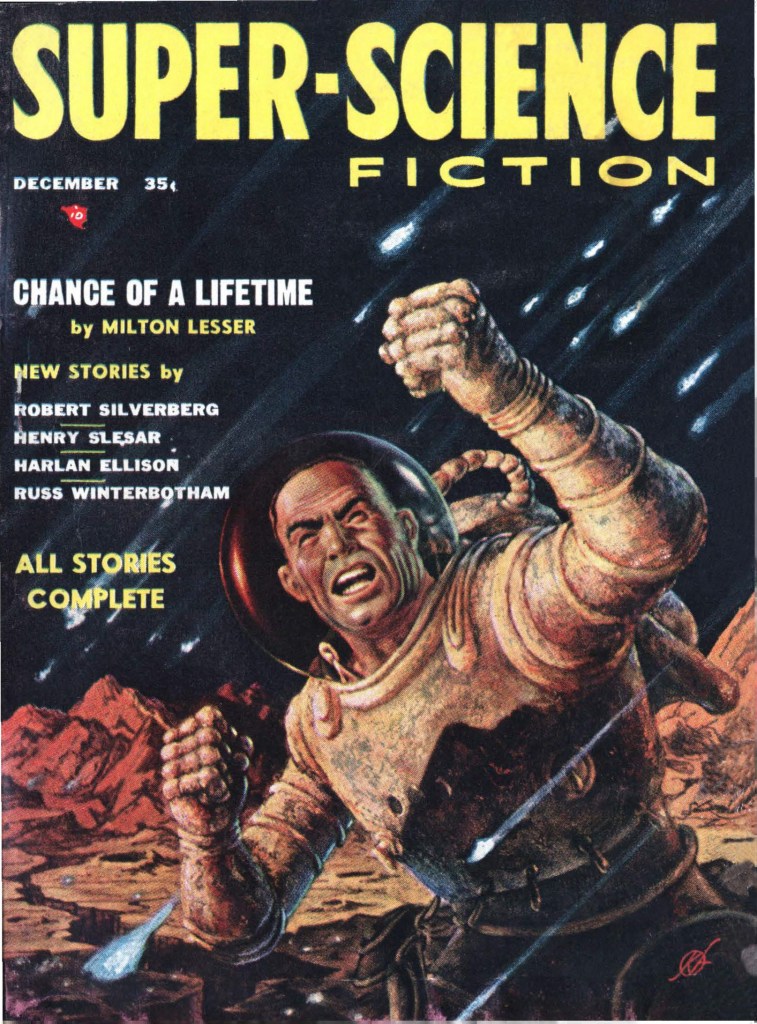
Frank Kelly Freas’ cover for Super-Science Fiction, ed. W. W. Scott (December 1956)
3.25/5 (Above Average)
Harlan Ellison’s “Psycho at Mid-Point” first appeared in Super-Science Fiction, ed. W. W. Scott (December 1956). You can read it online here. It was not collected or anthologized.
Mike Ashley in Transformations: The Story of the Science Fiction Magazines from 1950 to 1970 (2005) does not have kind words for the three-year run of the magazine Super-Science Fiction (1956-1959). He describes the editor W. W. Scott as utterly out of his depth with a misguided reliance on “instant impact” without substance or cohesion or knowledge of the field. That said, Scott accidentally published a few solid short stories before the magazine’s demise in the market collapse in the late 50s even if the overall issues tended to be poor (168-169) and pandered to whatever craze filled the air (187). I’d classify Harlan Ellison’s “Psycho at Mid-Point” as a solid early work that fits the theme of this series perfectly!
“After fifteen months, Wallace went mad” (54).
Continue reading




 Science Fiction and Other Suspect Ruminations