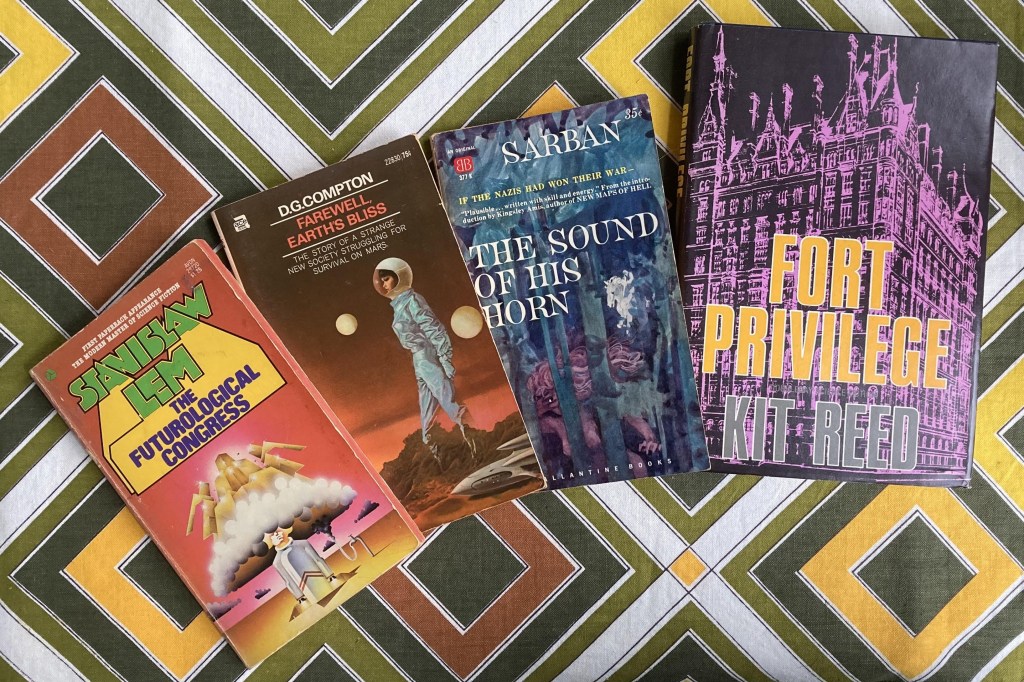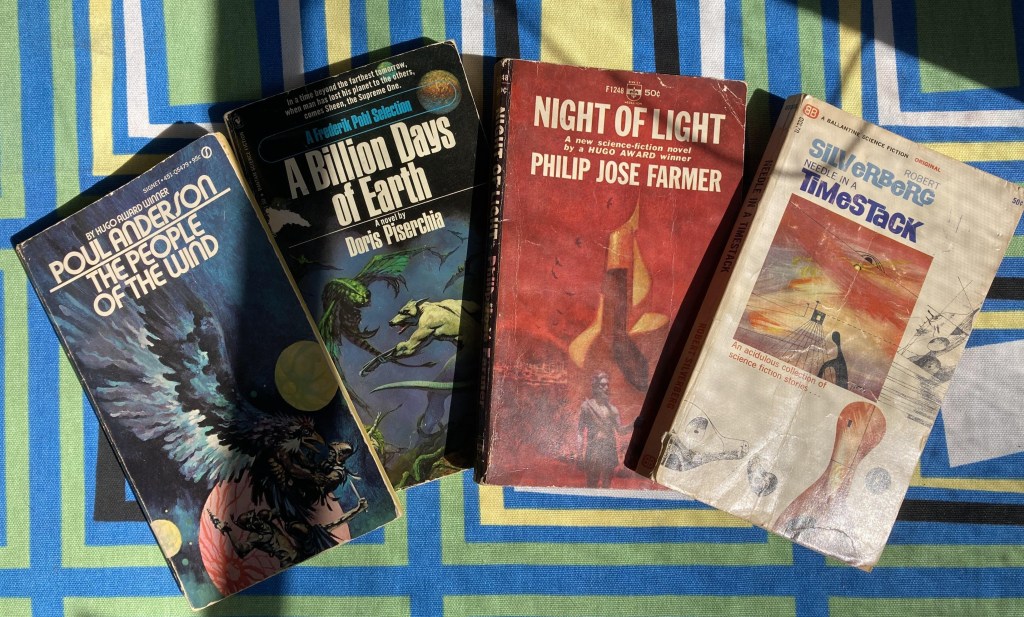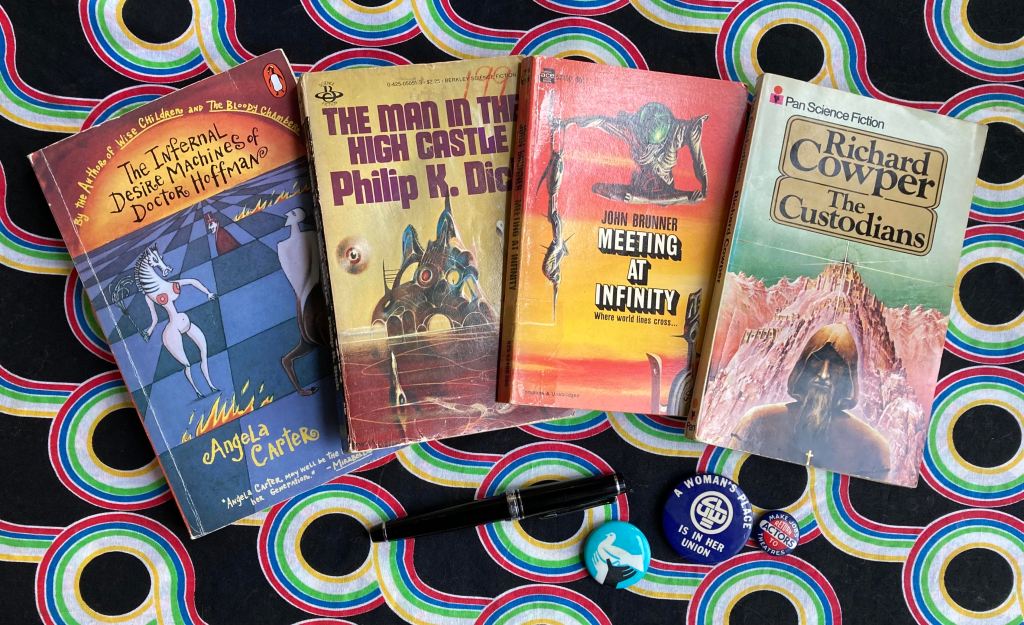
Updates: Recent Science Fiction Purchases No. CCCXLII (Robert Silverberg, C. L. Moore, Henry Kuttner, Peter Tate, and Thomas Burnett Swann)

Which books/covers/authors intrigue you? Which have you read? Disliked? Enjoyed?

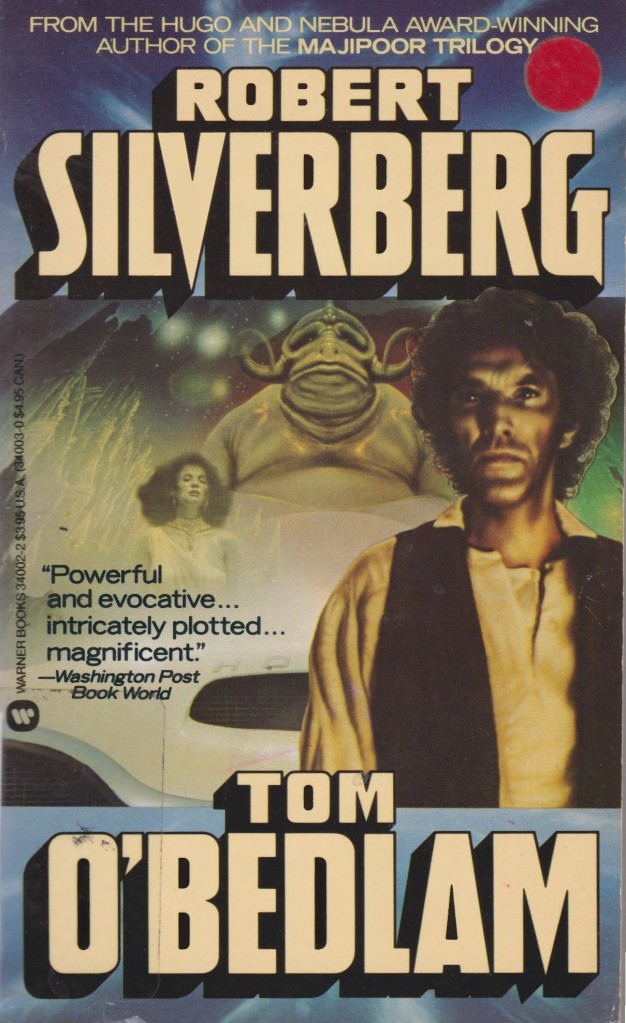
1. Tom O’Bedlam, Robert Silverberg (1985)

From the back cover: “MESSIAH OR MADMAN? It is 2103 and Tom O’Bedlam, madman, prophet, and visionary, wanders through California, dwelling place of the last humans on a continent decimated by radioactive dust. Tom, caught up in a living vision of distant worlds ruled by godlike beings, is the herald of a new age, a herald no one wants to hear until others too begin to dream of salvation beyond the stars. Yet while many dream, only tom has the power to make the wondrous visions real, to give people the ultimate escape they desire. Across the universe they must go… if Tom is humanity’s last hope–and not its final destroyer.”

Continue reading

What pre-1985 science fiction are you reading? + Update No. XX

What pre-1985 science fiction are you reading or planning to read this month? Here’s the January installment of this column (sorry I missed a month).

Before John W. Campbell, Jr. (1910-1971) attempted to raise the “standards and thinking in magazine SF,” David Lasser (1902-1996) attempted his own brief (1929-1933) program to improve science fiction as managing editor of Hugo Gernsback’s Science Wonder Stories, Wonder Stories, and Wonder Stories Quarterly. According to Mike Ashley’s The Time Machine: The Story of the Science-Fiction Pulp Magazine from the Beginning to 1950 (2000), Lasser is a “much neglected revolutionary in science fiction” and through his efforts the genre “started to mature” (66).

Ashley highlights Lasser’s letter of instruction mailed to his regular contributors on the 11th of May, 1931, in which he “exhorted them to bring some realism to their fiction” (72). He also outlawed common tropes like the giant insect story and space opera (73). He emphasized the need to focus on characters that “should really be human” — not everything needs to be a “world-sweeping epic” (73). Stories in this vein, according to Ashley, include Clifford D. Simak’s religiously themed “The Voice in the Void” (1932), P. Schuyler Miller and Walter Dennis’ “The Red Spot on Jupiter” (1931) and “The Duel on the Asteroid” (1974), which featured a grim realism and character development (74).

Continue reading

Book Review: Star Science Fiction Stories No. 3, ed. Frederik Pohl (1955)

3.5/5 (collated rating: Good)

Ballantine Books’ illustrious science fictional program started with a bang–Star Science Fiction Stories. According to Mike Ashley’s Transformations: The Story of Science-Fiction Magazines from 1950 to 1970 Frederik Pohl’s anthology series of original (mostly) stories was “intended as both a showcase of Ballantine’s authors and a lure to new writers.” Paying better rates than magazines, the Star series foreshadowed the explosion of original anthologies that would provide a sustained challenge to the eminence held in the 50s by the magazine.

I’ve selected the third volume of the six-volume series.1 It contains an illustrative cross-section of 50s science fiction. Philip K. Dick’s “Foster, You’re Dead” (1955), Richard Matheson’s “Dance of the Dead” (1955), and Jack Williamson’s “Guinevere for Everybody” (1955) are not to be missed.

Continue reading

What pre-1985 science fiction are you reading? + Update No. XIX

What pre-1985 science fiction are you reading or planning to read this month? Here’s the December installment of this column.

Lost texts, and the act of reconstructing the fragments, fascinates. The questions pile up. Would the contents reveal a pattern in an author’s work? Intriguing personal details? A startling modus operandi? At the 11th World Science Fiction Convention (Philcon 2), Philadelphia (September 1953), Philip José Farmer gave a speech titled “SF and the Kinsey Report.” Considering Farmer’s recent publication of “The Lovers” (1952), this is not surprising. Alfred Kinsey, the famous sexologist and founder of the Kinsey Institute for Research in Sex, Gender, and Reproduction on Indiana University’s campus, published his controversial Sexual Behavior in the Human Male in 1948. Sexual Behavior in the Human Female appeared in 1953. Like many of Farmer’s earliest speeches, he did not keep copies.

Deeply intrigued by what the speech might have contained, Sanstone and I (on Bluesky) managed to piece together a few general responses from fanzines and magazine con reports.

Continue reading

Short Fiction Reviews: Philip K. Dick’s “Explorers We” (1959) and James Tiptree, Jr.’s “Painwise” (1972)

The following reviews are the 31st and 32nd installments of my series searching for “SF short stories that are critical in some capacity of space agencies, astronauts, and the culture which produced them.” Some stories I’ll review in this series might not fit. And that is okay. I relish the act of literary archaeology.

Philip K. Dick’s “Explorers We” (1959) reframes the triumphant astronaut’s return home as the ultimate horror.

James Tiptree, Jr.’s “Painwise” (1972) imagines the hallucinogenic journey of a post-human explorer severed from the experience of physical pain.

As always, feel free to join the conversation.

Previously: Clifford D. Simak’s “Founding Father” (1957)

Up Next: E. C. Tubb’s “Without Bugles” (1952), “Home is the Hero” (1952), and “Pistol Point” (1953)

A brief note before we dive into the greater morass of things: This series grew from my relentless fascination with the science fiction of Barry N. Malzberg (1939-2024), who passed away last month. Malzberg wrote countless incisive visions that reworked America’s cultic obsession with the ultra-masculine astronaut and his adoring crowds. As I am chronically unable to write a topical post in the moment, I direct you towards “Friend of the Site” Rich Horton’s obituary in Black Gate. If you are new to his fiction, I proffer my reviews of Revelations (1972), Beyond Apollo (1972), The Men Inside (1973), and The Gamesman (1975). The former two are relevant to this series.


4.5/5 (Very Good)

Philip K. Dick’s “Explorers We” first appeared in The Magazine of Fantasy and Science Fiction, ed. Robert P. Mills (January 1959). You can read it online here.

Continue reading

Updates: Recent Science Fiction Purchases No. CCCXL (Philip José Farmer, L. Sprague de Camp, George Alec Effinger, and an Anthology of SF by Women)

A selection of SF volumes acquired over winter break!

Which books/covers/authors intrigue you? Which have you read? Disliked? Enjoyed?

1. Flesh, Philip José Farmer (1960)

From the back cover: “Spaceman by DAY… MONSTER by night!

Peter Stagg was caught in the vilest trap ever devised–his own lust-driven body! For FLESH is the pulse-stirring story of a space explorer’s return from the strangest voyage man had ever made–to the strangest world the universe had ever seen–his own Earth!

Continue reading

Exploration Log 7: Interview with Jordan S. Carroll, author of Speculative Whiteness: Science Fiction and the Alt-Right (2024)

Over the last few years, I have attempted to incorporate a smattering of the vast range of spectacular scholarship on science fiction into my reviews and highlight works with my Exploration Log series that speak to me.1 Today I have an interview with Jordan S. Carroll about his brand-new book, Speculative Whiteness: Science Fiction and the Alt-Right (2024). In the book, he examines the ways the alt-right uses classic science fiction imagery and authors to mainstream fascism and advocate for the overthrow of the state.

You can buy an inexpensive physical copy ($10) directly from the University of Minnesota Press website or an eBook version ($3.79) on Amazon.


Thank you so much for agreeing to this interview. First, can you introduce yourself and research interests?

Continue reading

My 2024 in Review (Best Science Fiction Novels and Short Fiction, Articles/Podcasts, Reading Initiatives, and Bonus Categories)

Here’s to a happy reading in 2025! I hope you had a successful reading year. Whether you are a lurker, occasional visitor, a regular commenter, a follower on Bluesky or Mastodon, thank you for your continued support. It’s hard to express how important (and encouraging) the discussions that occur in the comments, social media, and via email are to me. This was the third year running of record-breaking numbers of viewers and views in the 13-year history of my site. What were your favorite vintage SF reads–published pre-1985–of 2024? Let me know in the comments.

Clifford D. Simak defined my 2024. Starting with a February review of his collection Worlds Without End (1964), I embarked on a fiction and non-fiction reading extravaganza that culminated in my article for Journey Planet, which I spent most of the summer writing, titled “‘We Must Start Over Again and Find Some Other Way of Life’”’: The Role of Organized Labor in the 1940s and ’50s Science Fiction of Clifford D. Simak.” Despite his Grand Master status, there’s little scholarship on Simak’s work and so much more to be done. As expected, there was little response to the article outside of my website. I also wrote two Exploration Logs on six of his interviews and his 1971 Worldcon speech and contributed to a podcast on “The Huddling Place” (1944) (the second City story). Sometimes you find a little niche that you never expected to inhabit which you feel there’s so much more to explore and say. I hope my Simak focus continues into 2025.

Continue reading

Book Review: Future Power, ed. Jack Dann and Gardner Dozois (1976) (Ursula K. Le Guin, Damon Knight, James Tiptree, Jr., Gene Wolfe, etc.)

4/5 (collated rating: Good)

What a way to finish 2024! Future Powers, ed. Jack Dann and Gardner Dozois (1976) is a well-crafted thematic anthology with seven original stories and two older classics. Other than R. A. Lafferty’s average contribution, all the tales effectively engage with the theme of the complexities of future control both in everyday and the macropolitical contexts.

A few tantalizing fragments: Ursula K. Le Guin’s “The Diary of the Rose” (1976) explores the operations of dystopic control through the eyes of a neophyte doctor (“scopist”); Damon Knight ruminates on the nature and treatment of the psychopath in “The Country of the Kind” (1956); and A. K. Jorgensson’s “Coming-of-Age-Day” (1965) takes the reader through all the unnerving and confusing moments of a child in a strange future attempting to understand the nature of sex.

Continue reading