Book Review: Godling, Go Home!, Robert Silverberg (1964)

(Uncredited cover for the 1964 edition)

3.25/5 (Average)

Before Robert Silverberg wrote his late 60s and early 70s New Wave masterpieces (A Time of Changes, Dying Inside, The World Inside, etc), he produced a vast quantity of pulp science fiction novels and short stories.  Godling, Go Home! (1964) is a surprisingly solid collection of 50s shorts that can, at times, be surprisingly meditative (on death, exploration, civilization).  That said, expect rather naive messages — à la “we travel in space because we can!” or “Alien contact requires out-of-the-box thinking” — grafted onto a by the numbers pulp plot.

A fun collection — recommended for fans of slightly more intelligent than normal pulp SF, Silverberg completes, and 50s SF.  “Godling, Go Home!” (1957), “Why?” (1957), and Continue reading

Adventures in Science Fiction Cover Art: The Statue of Liberty on Pre-1968 Magazine and Novel Covers, Part II

THMNTRSHGP1968

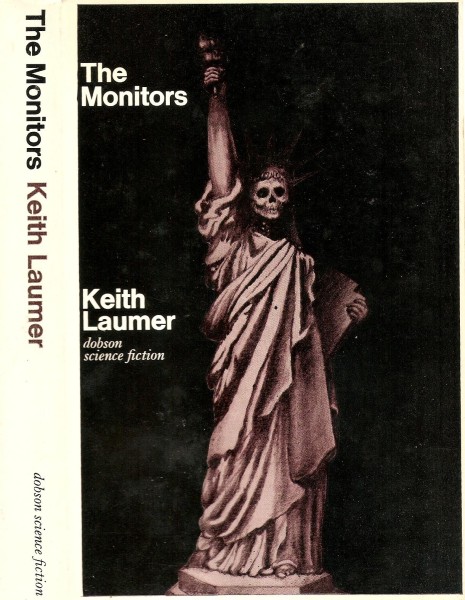
(Richard Weaver’s cover for the 1968 edition of The Monitors (1966), Keith Laumer)

Here’s an evocative collection of SF Statue of Liberty covers from before and after WWII…

Make sure to take a peek at Part I if you have not already. In Part I, I discussed the rationale for my dating restriction i.e. covers on the theme published pre-1968.  After Franklin J. Schaffner’s movie Planet of the Apes (1968) became a cultural phenomena, multiple covers paid homage to the famous scene in the film.  Hopefully, by examining the ten covers I’ve found depicting the Statue of Liberty from before the movie was released — often in scenes similar to the iconic one in Planet of the Apes (Part I contains a comparison) — the purposeful reference to earlier magazine art is clear…

The Statue of Liberty was not only deployed in some post-apocalyptical Continue reading

Updates: Recent Science Fiction Acquisitions No. LXVIII (Varley + Cherryh + Cummings + et. al)

Some fun finds!  Perhaps surprisingly, I still haven’t read Clarke’s “The Sentinel” (1951) so I was happy to find it in a collection collated by Kingsley Amis and Robert Conquest — Spectrum 3 (1963).  Even more appealing are the famous Poul Anderson, J. G. Ballard, and Murray Leinster tales in the same volume…  The entire Spectrum collection (I-V) brings together some fantastic works.

John Varley is one of the important 70s writers that I still haven’t read. Thus, despite the egregious cover, I snatched his collection of 70s stories, The Persistence of Vision (1978)…  I look forward to diving into this one.

Also, C. J. Cherryh was one of my favorite authors as a teen so it’s always nice to come across one of her works I hadn’t devoured yet — in this case, her second novel Brothers of Earth (1976).

1. The Persistence of Vision, John Varley (1978)

(Jim Burns’ cover for Continue reading

Adventures in Science Fiction Cover Art: Future Archaeology and Mysterious Artifacts (Alien + Human)

SPCSCNCFCC1953

(Hannes Bok’s cover for the  Space Science Fiction [UK], Volume 1 No. 4 (1953), ed. unlisted)

A spaceship arrives on Mars…  After a cursory initial exploration, the human astronauts conclude that the planet has always been barren and uninhabited.  But in some chasm or scattered in desolate plain, a column is found, and rows of mysterious buildings, and a pulsating crystal…  An abandoned outpost of an alien society?  Or, Earth’s mysterious forebearers…  Summaries such as this one proliferate the dusty SF paperbacks on back shelves of used book stores and the closets of SF fans — the variations are countless.

Queue my cover art theme: The future discovery of mysterious ruins/artifacts Continue reading

Book Review: Brain Wave, Poul Anderson (magazine publication 1953)

(Richard Powers’ cover for the 1954 edition)

3.25/5 (Vaguely Good)

I have long been a fan of Poul Anderson’s functionalist yet engaging SF adventures.  He is one of the masters at integrating social commentary (often on the impact of future technology) into the framework of the early Cold War influenced SF story without unduly weighing it down.  Brain Wave (1954) is  a good example of both his virtues and faults.

Brain Wave in a nutshell: a fascinating premise,  a somewhat frustrating ending, dubious social commentary, while the incredibly brief length (even for the 50s)  and uneven pacing suggest heavy cuts by editor…  That said, I suspect other famous works — such as the Daniel Keyes’ Flowers of Algernon (novelette: 1959, novel: 1966) and perhaps even Continue reading

Adventures in Science Fiction Cover Art: Domed Cities (and Outposts) of the Future, Part IV

Screen shot 2013-01-25 at 9.47.21 PM

(Ley Kenyon’s cover for the 1953 edition of Adventures in Tomorrow (1951), ed. Kendell F. Crossen)

Since the release of the TV series Under the Dome (2013-), based on Stephen King’s 2009 novel by the same name, there has been a resurgence of interest in domed cities.  And for good reason — the trope is one of the most popular of science fiction artists and authors since the 30s (and probably earlier).  Not only do the societal implications and visual allure of the trope of a domed outpost on a harsh planet or a domed city amidst the ruins of Earth arouse the creative authorial juices but also generate some fantastically Continue reading

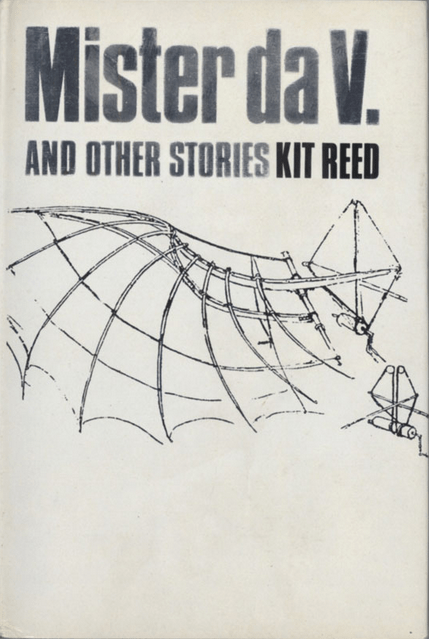
Book Review: Mister Da V. and Other Stories, Kit Reed (1967)

Screen shot 2013-07-16 at 10.06.04 AM

(Uncredited cover for the 1967 edition)

4.25/5 (collated rating: Good)

Kit Reed has been publishing literary, thought-provoking, and darkly satirical sci-fi + speculative fiction + non-genre fiction since the late 50s… And she is still going strong — her most recent novel Son of Destruction (2012) came out last year.  Reed’s collection Mister Da V. and Other Stories (1967) contains three stories from the late 50s including her first published work, ‘The Wait’ (variant title: ‘To be Taken to a Strange Country’) (1958) and ten others from the 60s.  A few of the stories in the collection are not overtly science fiction — regardless, one could argue that all but ‘I am Through with Bus Trips’ (1967) contain speculative and/or sci-fi elements.

There are superficial differences between the 1967 Faber and Faber edition and the 1973 Berkley Medallion edition.  Because I own the Berkley paperback I’ve gone ahead and followed its chronological story order and page numbers.

A few of the themes/topics of the volume:  Paranoia.  Post-apocalyptic Landscapes.  Youth  Continue reading

Book Review: Big Planet, Jack Vance (magazine publication 1952)

Screen shot 2013-06-01 at 6.18.27 PM

(Ed Emshwiller’s cover for the 1952 edition)

3.25/5 (Good)

After Jack Vance’s recent passing I decided that as an informal remembrance I’d review one of his novels.  However Big Planet (1952), the only unread novel of his I had on my shelf, is from early in his career and far from the level of his best works.  Of his novels I’ve read, Wyst: Alastor, 1716 (1978) and the loose sequel to Big Planet, Showboard World (1975) were the most satisfying.  The Blue World (1966), Marune: Alastor, 933 (1975), and City of the Chasch (1968) were all enjoyable adventure tales set in fantastic worlds.  I recommend those — along with his more famous novels — before picking up a copy of Big Planet.

Over the course of its publication history Big Planet was cut and modified multiple times from its original magazine form.  A restored text was published in 1978…  Unfortunately, I read the 1957 Ace Continue reading

Adventures in Science Fiction Cover Art: The Space Station, Part III

8fb71adc43d8c6f43977b5522a534504(Graham Kaye’s cover for the 1955 edition of Tom Swift and his Outpost in Space (1955), Victor Appleton II)

This is Part III of my series on space stations (Part I + Part II).  Ever since I watched 2001: A Space Odyssey (1968) as a teen I’ve been fascinated by space stations — platforms for further space exploration!  I can only imagine how exciting it was for fans of science fiction who read about stations before they existed to see them finally constructed. The fact that they became reality — well, perhaps not (yet) as a launching point for space going exploration vessels — almost vindicates the scientific extrapolation of some of these early visions.  Also, Arthur C. Clarke’s Islands in the Sky (1952) happened to be one of my first science fiction novels…..  And C. J. Cherryh’s Downbelow Station (1981) Continue reading