Adventures in Science Fiction Cover Art: Domed Cities of the Future, Part III

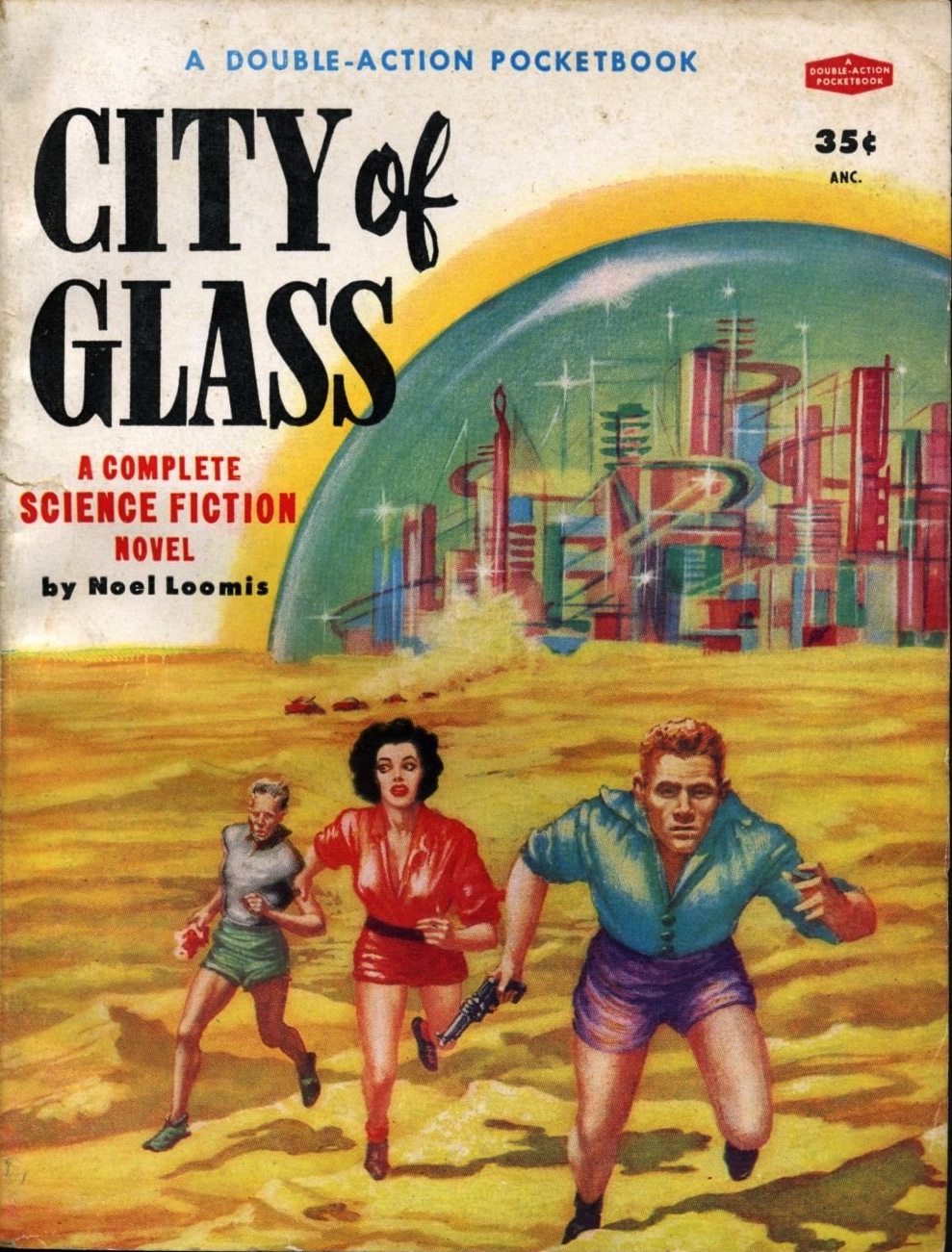
(Kelly Freas’ cover for the 1955 edition of City of Glass (1942 magazine), Noel Loomis)

Part I, Part II of my series on domed cities of the future.

Bob Watkin’s cover for the 1955 issue of If Magazine depicts an old man regaling stories of futuristic domed cities.  His fantastic visions are reduced to their key elements in sketch form — a translucent dome, buildings.  I’ve selected a variety of images from pulp 50s works until the late 70s depicting more fantastic/futuristic domed cities than the old man’s imagination conjures.  Ed Emshwiller’s cover for the  1953 edition of City at World’s End (1950) depicts two futuristic metropoli — a trend in future city development?  The first is a planned circular city spreading horizontally across the plain.  The other, an incredibly stylized “futuristic complex” Continue reading

Updates: Recent Science Fiction Acquisitions N. XLII (Malzberg + Roshwald + Clement + Moorcock)

A nice selection of books from my fellow book reviewer at Potpourri of Science Fiction Literature and a few from a recent trip to Indianapolis — the fried chicken and waffles at Maxine’s were far superior to their used book stores….

My trilogy of dark/brilliant/disturbed Malzberg novels dealing with the space program, The Falling Astronauts (1971), Revelations (1972), and Beyond Apollo (1972) is now complete!  When I get around to reading The Falling Astronauts I will put together a special post with a series of intriguing space program documents given to me by my fiancé — including a hilarious 1965 publication, The Astronauts & Their Families, where real life astronauts pose with their happy families, play with puppies, teach their children to shoot rifles, pose with their cars, pretend to play at the piano, etc — i.e. the oposite of Malzberg’s vision of the “manliest” of American heroes…

The Moorcock novel, The Ice Schooner (1969) was a rather impulsive buy — I’ve yet to read any of his works, but voyagers to cities wreathed in ice is always a fun trope.

Level 7 (1959) is generally considered a Cold War masterpiece…

Clement’s Through the Eye of the Needle (1978) is the sequel to Needle (magazine 1949) — I’ll probably want to find a copy of the first in the series before I give the sequel a shot….

1. The Falling Astronauts, Barry N. Malzberg (1971) (MY REVIEW)
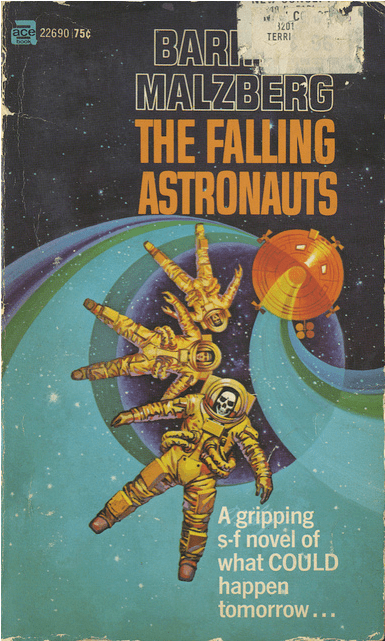
(Davis Meltzer’s cover Continue reading

Adventures in Science Fiction Cover Art: Visualizing Time

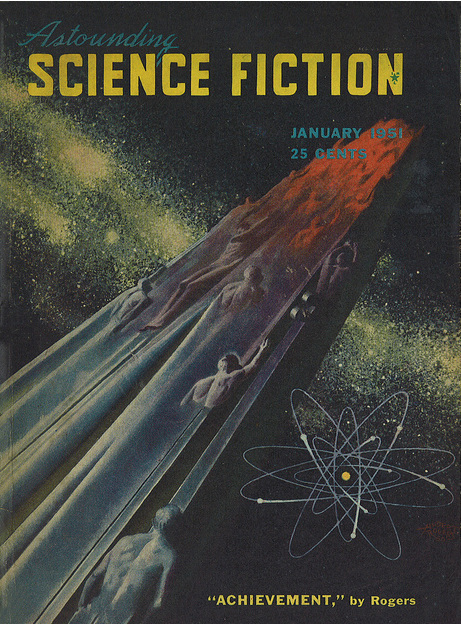
(Hubert Rogers’ cover for the January 1951 issue of Astounding Science Fiction)

In Hubert Rogers’ fascinating cover (titled ‘Achievement’) for the January 1951 issue of Astounding Science Fiction, mankind appears pulled upward, as if against their will, towards an undefined future goal.  Rogers’ cover encapsulates David Hume’s notion of historical time relentlessly moving towards improvement — improvement as something measurable and observable by the historian, and anyone who studies history.  Obviously, this historiographical framework has long been debunked (although it crops up in virtually all of my undergraduate students’ work in intro level courses) — it favors Western conceptions of progress, dismisses the achievements of non-European Continue reading

Updates: Recent Science Fiction Acquisitions N. XLI (Sheckley + Sohl + Cooper + Silverberg)

A selection of gems sent to me by one of my friends 2theD at Potpourri of Science Fiction Literature…  Don’t worry at least eight books are being sent his way….  And a few left over Marx book purchases…  I have two of Sheckley’s short story collection — now I have one of his short satirical novels!  Sohl’s Costigan’s Needle (1953) has spectacular early Powers cover art AND Sohl isn’t supposed to be half bad either.

Enjoy.

1. The Status Civilization, Robert Scheckley (1960) (MY REVIEW)

(Uncredited cover for the 1960 edition) Continue reading

Book Review: Galaxies Like Grains of Sand, Brian Aldiss (1960)

(Paul Lehr’s cover for the 1960 edition)

3/5 (collated rating: Average)

The concept behind Brian Aldiss’ short story collection Galaxies Like Grains of Sand (1960) is intriguing.  Take previously published stories (in this case from magazines in the late 50s), graft them together by means of mini-introductions, and arrange them so they fit into a future history framework à la Olaf Stapledon’s Last and First Men (1930) or Isaac Asimov’s Foundation Trilogy (1951-1953).

The quality of the stories makes the format less than successful.   Only three stories are worth reading — ‘Secret of a Mighty City’ (1958), ‘Out of Reach’ (1957), and ‘All Continue reading

Updates: Recent Science Fiction Acquisitions N. XL (Miller, Jr + Cogswell + Pohl/del Rey + Kornbluth/Merril)

A couple from my father + a few left over Marx Book purchases….

Three delightfully gorgeous Powers covers.  And one stunning John Schoenherr cover despite the unknown quality of the short stories within….

A short story collection and a three novella collection by Walter M. Miller, Jr., the author of A Canticle for Leibowitz (1959)…  A scathing, and hilarious satire by Frederik Pohl and Lester del Rey…  Among others.

1.  The View from the Stars, Walter M. Miller, Jr. (1965) (MY REVIEW)

(Richard Powers’ cover for the 1965 edition) Continue reading

Adventures in Science Fiction Cover Art: The Statue of Liberty on Pre-1968 Magazine and Novel Covers

pota-statue-of-liberty-2.jpeg

(Still from the 1968 film Planet of the Apes, dir. Franklin J. Schaffner)

For more covers on the same theme see Part II

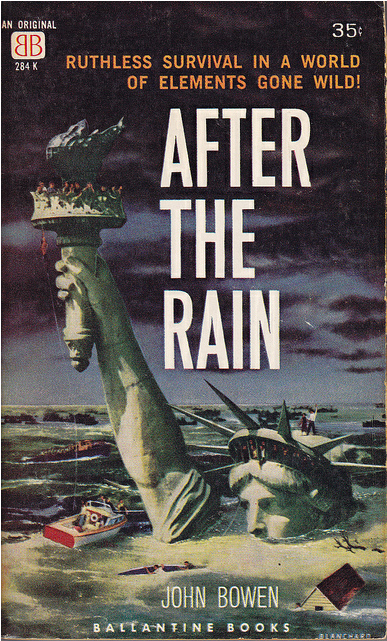
I suspect that virtually all science fiction fans and film cineastes recall the vivid sequence near the end of the 1968 film Planet of the Apes where the Statue of Liberty lies half-buried in the sands.  Franklin J. Schaffner’s film draws on a rich tradition in pulp science fiction cover art.  I’ve included six cover from 1941-1965, all before the film was released, that depict the Statue of Liberty submerged by apocalyptical floods and excavated by future spacemen.  I have a large catalogue of covers that show various landmarks destroyed by mechanical monsters, ogled at by aliens, and wrecked by a variety of world ending disasters.  The Hollywood penchant for destroying as many national landmarks as possible in movies is deeply rooted in existing visual traditions.

My favorite is by far Blanchard’s (does anyone know his full name) cover for the 1959 edition of John Bowen’s After The Rain (1958).  The dark skies, the stormy waters reaching up to her nose, the survivors of the flood perched near the flame, the boats and roofs of houses floating about, perfectly evoke the extent of the disaster — and, “elements gone wild!”

Enjoy!

(if I’ve missed any pre-1968 covers please let me know.  I know that there are multiple later covers but they might be purposefully referencing Planet of the Apes)

(Blanchard’s cover for the 1959 edition of After The Rain (1958), John Bowen) Continue reading

Updates: Recent Science Fiction Acquisitions N. XXXIX (Priest + Brunner + Crowley + Wallace + Duncan)

Ah, what a delightful group! A few from my father, a few from Marx books which I hadn’t posted yet….  Priest and Crowley’s novels involve fascinating worldscapes — a world winched across the horizon, a world at the top of a pillar…  Both are considered among the better stylists in science fiction and fantasy.

And, my 22nd (?) Brunner novel!  The Stone That Never Came Down (1973) — from his glory period of the late 60s-early 70s (this period produced Stand on Zanzibar, The Sheep Look Up, Shockwave Rider, The Jagged Orbit).

And two more impulsive finds — Ian Wallace’s Croyd (1967) — a reader claimed it was one of the best sci-fi novels of the 60s, and thus due to my intense curiosity, I had to find a copy.  And Dark Dominion (1954), I know little about David Duncan — he wrote only three sci-fi novels in the 50s.  His work is described by SF encyclopedia as “quietly eloquent, inherently memorable, worth remarking upon.”

And the covers!

1. The Inverted World, Christopher Priest (1974)

(Jack Fargasso’s cover for the 1975 edition) Continue reading

Book Review: The Joy Makers, James Gunn (1961, magazine publication 1955)

(William Hofmann’s cover for the 1961 edition)

4.25/5 (collated rating: Good)

The three parts of James Gunn’s fix-up novel The Joy Makers (1961) were originally published in magazine form in 1955 as ‘Name Your Pleasure,’ ‘The Naked Sky’, and ‘The Unhappy Man.’  I have not read the originals so I’m unsure of how much was added or subtracted or completely re-conceptualized.  Largely a satire — Gunn pushes his point to the logical, and terrifying extreme — each part is a further chronological progression of a society whose chief aim is to make people happy.  It is hard not to read Part I as a satirical take on some aspects of Scientology,  a movement that was gaining force in the early 1950s.

Because each part is only linked thematically to the others

Continue reading