Short Story Reviews: Philip K. Dick’s “Precious Artifact” (1964) and Henry Slesar’s “Mr. Loneliness” (1957)

The following reviews are the 25th and 26th installments of my series searching for SF short stories that are critical in some capacity of space agencies, astronauts, and the culture which produced them. Some stories I’ll review in this series might not fit. Many are far from the best. And that is okay. I relish the act of literary archaeology.

I’ve paired two stories, one by Philip K. Dick (1928-1982) and another by prolific but forgotten Henry Slesar (1927-2007), that puncture the grandiose illusion of humanity’s progress.

Thank you Richard Fahey, “Friend of the Site,” for the PKD recommendation.

Previously: Philip K. Dick’s “The Infinites” (1953) and James Causey’s “Competition” (1955)

Up Next: Kate Wilhelm’s “Planet Story” (1975) and Clark Ashton Smith’s “Master of the Asteroid” (1932)
4/5 (Good)

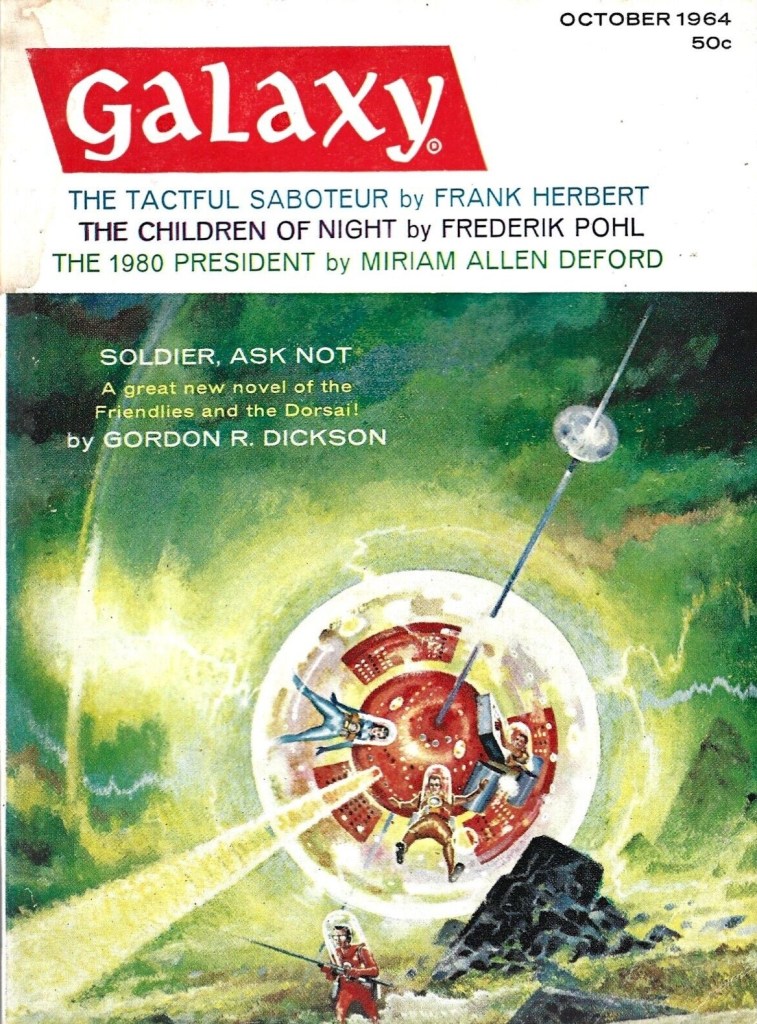
Philip K. Dick’s “Precious Artifact” first appeared in Galaxy, ed. Frederik Pohl (October 1964). You can read it online here.

A vast array of scholarship charts the continuing allure Mars holds in the popular imagination [1]. David Seed writes that “since the late nineteenth century Mars has tantalized the literary imagination with the possibility that life might exist on that planet” [2]. The visions of Edgar Rice Burroughs, Leigh Brackett, Ray Bradbury, and countless others created a seductive and sometimes complex vista of longing and conquest. Brackett, for example, evocated a Mars that was “more complex and varied” than Burrough’s “imperial triumphalism” [3]. In Brackett’s “The Beast-Jewel of Mars” (1948) (scheduled for this series), Mars becomes the location for the revenge perpetrated by the colonized [4].

Continue reading
Short Story Review: Henry Kuttner’s “Year Day” (1953)

Today I’ve reviewed the 28th story in my series on the science fictional media landscape of the future. In Henry Kuttner’s masterpiece “Year Day” (1953), a couple attempts to rekindle their relationship in the midst of a sonic deluge of advertising that threatens to blot out their thoughts.

Previously: Kate Wilhelm’s “Ladies and Gentlemen, This Is Your Crisis” (1976) and Langdon Jones’ “The Empathy Machine” (1965)

Up Next: Sydney J. Van Scyoc’s “Shatter the Wall” (1962)

5/5 (Masterpiece)

Henry Kuttner’s “Year Day” first appeared in his collection Ahead of Time (1953). Some of the other stories in the collection were co-written with his wife C. L. Moore. You can read the story online here.

The Air, Throbbing with Electronic Breath

Continue reading

Book Review: Mission: Manstop, Kris Neville (1971)

3.25/5 (Collated Rating: Above Average)

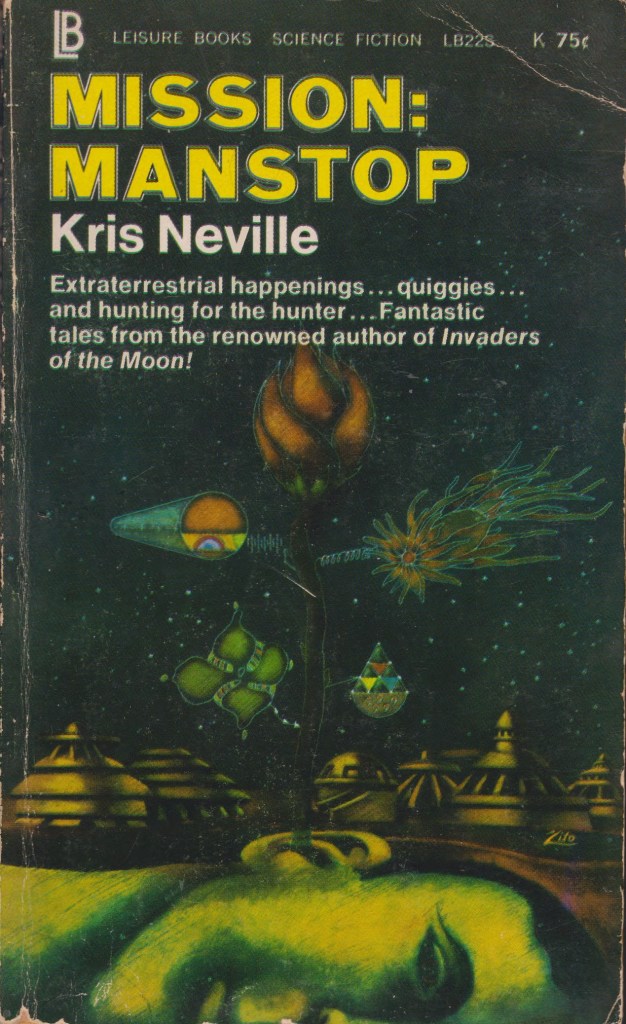
The career of Kris Neville (1925-1980) can be divided broadly into two parts. In his most productive period (1949-1957), Neville’s SF appeared in all the major magazines of the day, The Magazine of Fantasy and Science Fiction in particular. Afterwards, while he continued to publish short stories at a far reduced clip until his death, he wrote a handful of fix-up novels between 1964-1970. This trajectory neatly maps onto the restriction of magazine markets in the late 50s and the growing importance of the SF novel.

Continue reading

Updates: Recent Science Fiction Purchases No. CCCXXII (John Brunner, Leigh Kennedy, Poul Anderson, Salman Rushdie)

I’ve returned from my expedition abroad. It’s time to get back to writing about science fiction! But first, there are always new books that have accumulated at my doorstep…

Which books/covers/authors intrigue you? Which have you read? Disliked? Enjoyed?

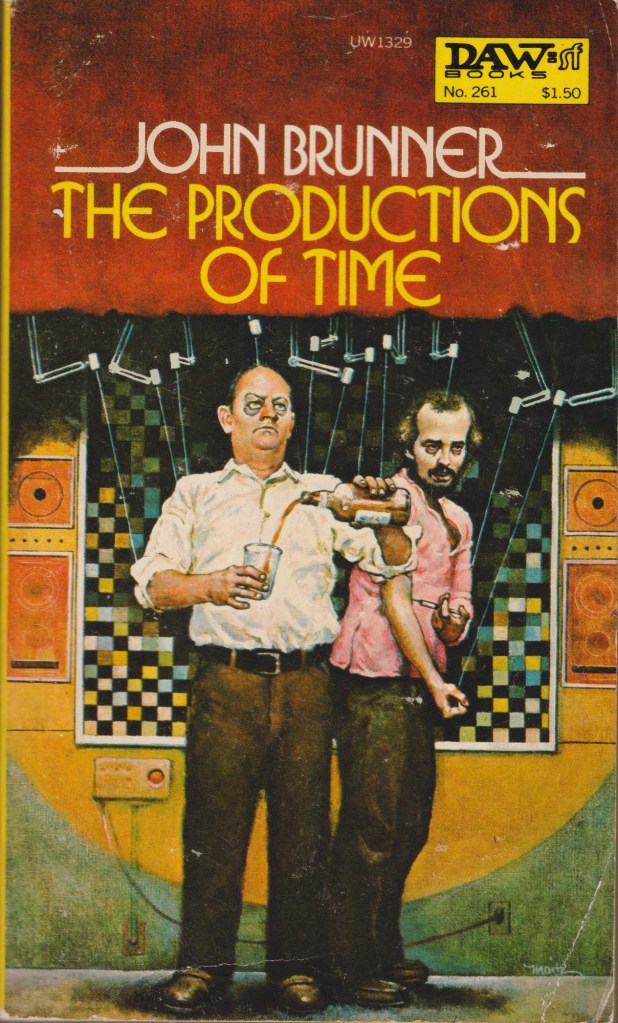
1. The Productions of Time, John Brunner (serialized 1966)

From the back cover: “Murray Douglas had been a theatrical star until he’d hit the bottle once too often. But now he had broken the habit, and, handsome and fit, was ready for a comeback. The most challenging opening available was an avant-garde play where the actors themselves would make up the drama as they went along.

But out at an isolated country estate where the rehearsals were going on, Murray found himself trapped on a real-life day-and-night stage in which nothing was as it seemed, in which inexplicable devices monitored everything and eerie lures attracted each actor’s psychological weakness.

Who then was the real sponsor of this terrifying play–and to what alien audience was it to be presented?

By the Hugo-winning author of STAND ON ZANZIBAR, this is the first unabridged American edition of this John Brunner classic.”

Continue reading

Updates: Recent Science Fiction Purchases No. CCCXXI (Connie Willis, John Varley, David F. Bischoff, Dennis R. Bailey, Wilson Tucker)

Which books/covers/authors intrigue you? Which have you read? Disliked? Enjoyed?

1. The City in the Sea, Wilson Tucker (1951)

From the inside flap: “Who knows whether the strange events of this story might not one day occur?

This is the story of an expedition—a strange and exciting expedition of one man and an army of women.

He had come into the land of the women suddenly—and without warning. Tall, bronzed, muscular, he stood out among their pale skins and meek spirits. And when they learned of the land from which he had come–the land they hadn’t even known existed—they had to follow him to it.

Continue reading

Short Book Reviews: John M. Ford’s The Princes of the Air (1982), Keith Roberts’ The Furies (1966), and John D. MacDonald’s Wine Of the Dreamers (1951)

Note: My read but “waiting to be reviewed pile” is growing. Short rumination/tangents are a way to get through the stack before my memory and will fades. My website partially serves as a record of what I have read and a memory apparatus for any larger project I might conduct in the future. I rather have a short review than none at all! Stay tuned for more detailed and analytical reviews.


1. The Princes of the Air, John M. Ford (1982)

3.5/5 (Good)

John M. Ford (1957-2006) is one of those authors I’ve read a lot about but never sat down and read. As if often my strategy, I decided to explore around the edges a bit before reading his best-known novels Web of Angels (1980) and The Dragon Waiting (1983). I settled on his second novel The Princes of the Air (1982)….

The first layer of The Princes of the Air reads as a traditional space opera. Three young men from rough poverty-filled pasts–Orden Obeck, David Kondor/Koleman, and Theodor Thorn/Norne–aspire to serve the Queen of Humankind. On the dusty planet Riyah Zain, the three friends scam the unwary and while away their days in the Asterion Arcade playing military games in which they imagine how they will serve the queen—Obeck will be the Ambassador-Global, Kondor the Admiral of the Fleet, and Theodor Norn the best Pilot and writer of the book on piloting. Obeck, indentured to the state as he voluntarily went on the government dole, trains to be a diplomat. He brushes up against the classist views of the students, who look down on Obeck’s achievements as an indentured man. Soon his accomplishments mean that he, and his friends, can leave the planet. Eventually, they find themselves embroiled in the machinations of the state and the powers that bind everything together.

Continue reading

Short Story Reviews: Philip K. Dick’s “The Infinites” (1953) and James Causey’s “Competition” (1955)

The following reviews are the 23rd and 24th installments of my series searching for SF short stories that are critical in some capacity of space agencies, astronauts, and the culture which produced them. Some stories I’ll review in this series might not fit. Many are far from the best. And that is okay. I relish the act of literary archaeology.

I’ve paired two 1950s stories, by Philip K. Dick and the far lesser-known James Causey, that explore the inability to understand the universe outside our Earth. Explorers find themselves at each others throats caught up in paranoid delusions of grandeur.

Previously: George R. R. Martin’s “The Second Kind of Loneliness” (1972) and Tom Godwin’s “The Nothing Equation” (1957)

Up Next: Philip K. Dick’s “Precious Artifact” (1964) and Henry Slesar’s “Mr. Loneliness” (1957)

3.5/5 (Good)

Philip K. Dick’s “The Infinites” first appeared in Planet Stories, ed. Jack O’Sullivan (May 1953). You can read it online here.

A preliminary note: I dislike writing about Philip K. Dick. As I mentioned in my 2021 review of “A Little Something for Us Tempunauts” (1974) for this series, “I find it far more enjoyable and liberating to write about lesser-known authors.” Or at least those whose works and lives are less encyclopedically covered by fans and academics alike. There are and will be far superior takes on this story. I don’t have the will or focus. And that’s okay. I rather focus my obsessive eye on others. To be clear, I love Philip K. Dick. Along with C. J. Cherryh, Frank Herbert, and Stanislaw Lem, he was one of the authors of my early twenties–right before I started this website.

A few observations on “The Infinites” (1953)….

Continue reading

Book Review: Dimension Thirteen, Robert Silverberg (1969)

3.25/5 (Collated rating: Above Average)

Robert Silverberg (1935-) was one of the authors of the first decade of my site. I’ve reviewed twelve of his novels and thirty-two of his short stories. I also consumed with relish Tower of Glass (1970) and A Time of Changes (1971) as audiobooks and thus couldn’t review them. While an occasional story crops up here and there in an anthology, it’s about time I return to a Silverberg-specific volume. Dimension Thirteen (1969) collects six 50s stories and five from the 60s. The collection charts the moment when Silverberg’s career profoundly shifted from workman adventure to exemplary texts of the New Wave. They range from humorous commentaries on peccadillos and lusts to sinister ruminations on egotism and power.

Continue reading

Short Fiction Reviews: George R. R. Martin’s “The Second Kind of Loneliness” (1972) and Tom Godwin’s “The Nothing Equation” (1957)

The following reviews are the 21st and 22nd installments of my series searching for SF short stories that are critical in some capacity of space agencies, astronauts, and the culture which produced them. Some stories I’ll review in this series might not fit. Many are far from the best. And that is okay. I relish the act of literary archaeology.

I’ve paired a take by Tom Godwin (1915-1980) and George R. R. Martin (1948-) on the psychiatric impact of isolation in the bleak emptiness of space. Both explore the interior landscape of the mind alone with itself and all its memories, and delusions, and terrors. There are no heroes in these pages.

Previously: Harlan Ellison’s “Psycho at Mid-Point” (1956) and “The Discarded” (variant title: “The Abnormals”) (1959)

Up Next: Philip K. Dick’s “The Infinites” (1953) and James Causey’s “Competition” (1955)

4/5 (Good)

George R. R. Martin’s “The Second Kind of Loneliness” first appeared in Analog Science Fiction/Science Fact, ed. Ben Bova (December 1972). You can read it online here.

At the Edge of the Vortex We Tell So Many Lies

The location: the Cerberus Star Ring, six million miles beyond Pluto (10). The manmade station, “a circle whose diameter is more than a hundred miles” (12), surrounds a nullspace vortex (think wormhole) to an unknown location across the universe. Humanity sends ships through the brightly colored swirling eddies of the portal to establish colonies somewhere beyond. A single man operates the machinery on the ring from a featureless white control room via a holograph helmet (11). The story follows the journal entries of an unreliable narrator ostensibly counting down the days until his relief arrives from Earth: “It will be at least three months before he gets here, of course. But he’s on his way” (10). It’s a mantra he tells himself. Relief is on its way. Relief is on its way. But does he want relief?

Continue reading