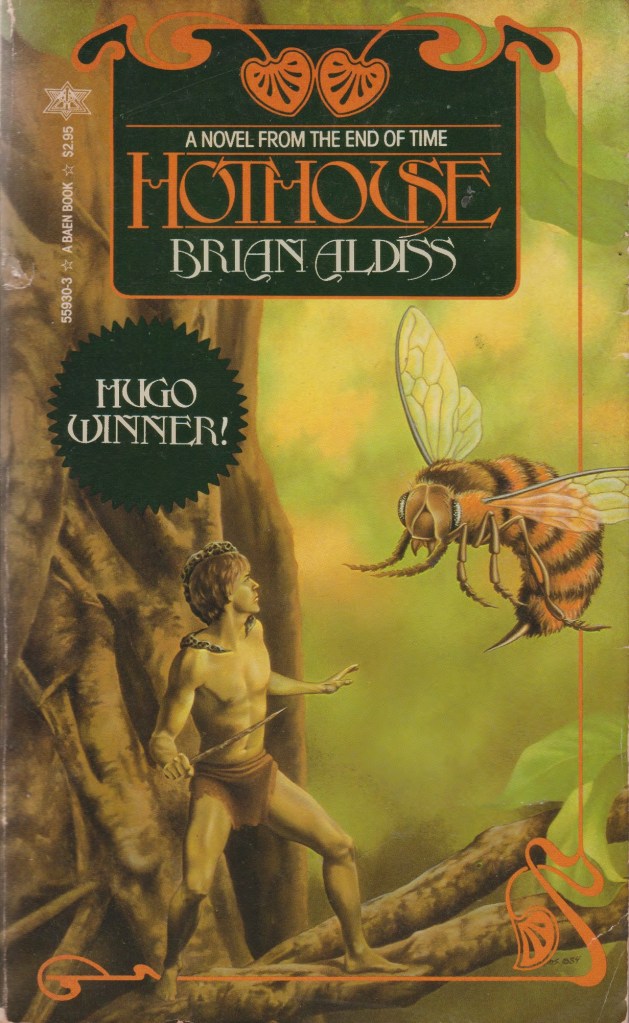
Brian W. Aldiss’ Hugo-winning Hothouse (1962) imagines an oppressive, violent, and alien Earth transformed by “the long age of the vegetable” (187). The surviving humans live–“more by instinct than intelligence” (54)– in a continent-encompassing banyan tree in constant fear of killer flora and fauna. Aldiss succeeds in constructing a profoundly unsettling worldscape encyclopedic in its details with unusual rituals of survival. There’s the existential sense throughout that the humans, detached from any memory of their past, who attempt to survive are but frantic movements of an apocalyptic paroxysm. Inventive, relentless, hallucinogenic.
Which books/covers/authors intrigue you? Which have you read? Disliked? Enjoyed?
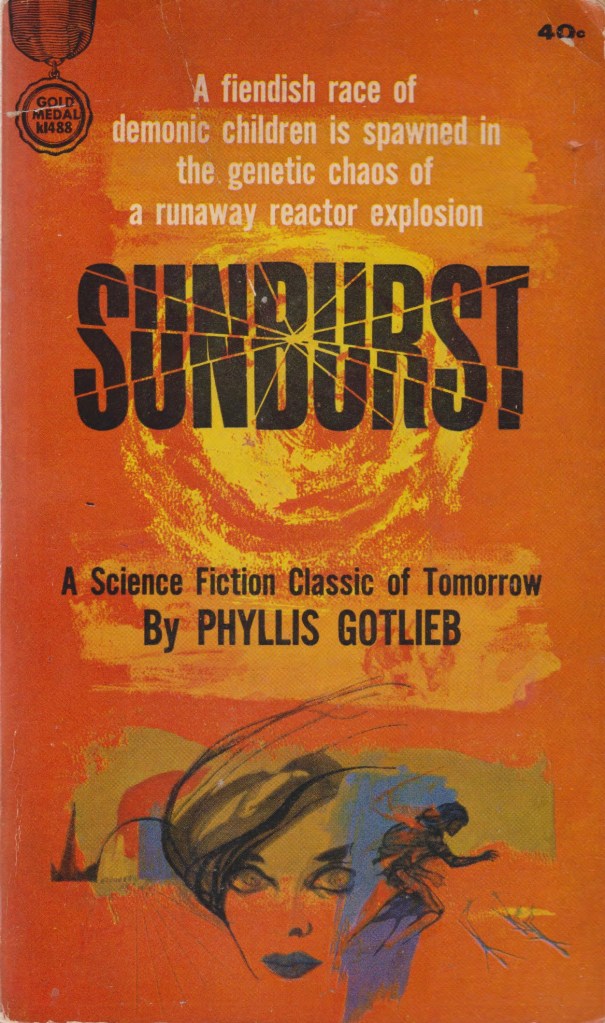
1. Sunburst, Phyllis Gotlieb (1964)
Richard Powers’ cover for the 1st edition
From the back cover: “In the hideous aftermath of the atomic sunburst. The people of Sorrel Park had been written off. Now they were nothing but a kind of human garbage, festering and hopeless.
In the center of town lived the worst of the human garbage–and by far the most dangerous. They were a breed of terrible children, possessed by terrifying supernormal powers. They were a new race of monster bred out of the sunburst, and if they ever broke loose they would destroy the world…”
This is the 15th post in my series of vintage generation ship short fiction reviews. Today I have an unusual take on the subgenre–a young scavenger couple encounter a mysterious blip on their radar!
As a reminder for anyone stopping by, all of the stories I’ll review in the series are available online via the link below in the review.
You are welcome to read and discuss along with me as I explore humanity’s visions of generational voyage. And thanks go out to all who have joined already. I also have compiled an extensive index of generation ship SF if you wish to track down my earlier reviews on the topic and any that you might want to read on your own.
Paul E. Wenzel’s cover for Galaxy Magazine, ed. H. L. Gold (June 1961)
3/5 (Average)
Fred Saberhagen’s “The Long Way Home” first appeared in the June 1961 issue of Galaxy Magazine, ed. H. L. Gold. You can read it online here.
Among the Asteroids out Near Pluto
Marty and Laura–recently married and very much in love–form the crew of the Clementine, a robotic mining, ore refining, and hauling vessel. They spend their isolated existence identifying prospective asteroids out near Pluto. Laura, on her very first space voyage, remains his liaison in the control room when Marty scoots off in his space bike to investigate a blip on the radar. If it’s a wrecked hull of “a ship dead for decade, or a century, or a thousand years” if theirs by right of salvage if they could tow it into a port (181). The robotic librarian indicates that no such vessel has ever existed! Marty’s investigation reveals that the thirty-mile long hull is part of a two-thousand-year-old larger vessel that has suffered a possibly cataclysmic disaster.
Which books/covers/authors intrigue you? Which have you read? Disliked? Enjoyed?
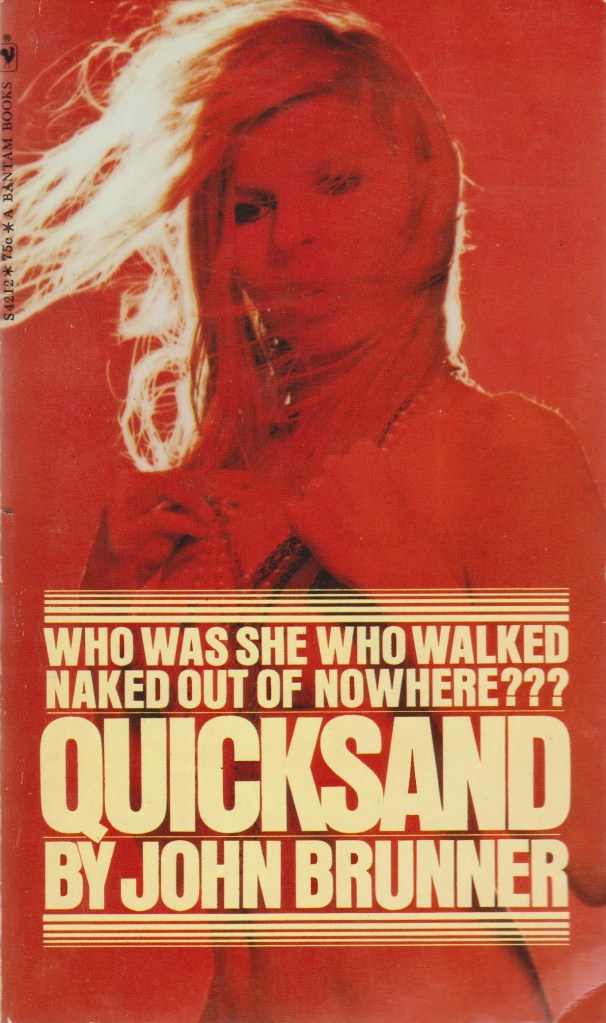
1. Quicksand, John Brunner (1967)
Uncredited cover for the 1969 edition
From the back cover: “She had nearly killed a man who tried to assault her. She spoke a language no one could understand. Commonplace objects like clothing and cars were a mystery to her.
Paul was haunted and entranced by her. He licked at the secrecy that surrounded her until, inevitably, his fate became linked to hers. And she gave him a vision of a world more beautiful than any he had ever known.
THEY LIVED IN A PARADISES OF SENSUAL ECSTACY… UNTIL IT WAS TOO LATE. BECAUSE HER LOVE WAS LIKE QUICKSAND.”
Initial Thoughts: My Brunner obsession in my early 20s generated a packed few years of reading as many novels–the good and the bad–that I could get my hands on. This one escaped my grasp.
Today I’ve selected two post-apocalyptic visions by female authors. I needed an antidote to the creepy last man/woman stories I’ve been reading recently. Alice Eleanor Jones spins a masterpiece about a housewife attempting to keep the entropy of a crumbling world and an abusive husband at bay. Katherine MacLean imagines a moment where the last representative of the American Empire, after all the rhetoric of progress and exceptionalism came crashing down in a nuclear war, interacts with a persistent and well-meaning native girl.
The links to the stories can be found in the reviews. Both are recommended reads for fans of 50s and 60s science fiction.
Uncredited cover for the 1968 edition of The Best from Fantasy and Science Fiction: Fifth Series, ed. Anthony Boucher (1956)
5/5 (Masterpiece)
Alice Eleanor Jones’ “Created He Them” first appeared in The Magazine of Fantasy and Science Fiction, ed. Anthony Boucher (June 1955). You can read it online here.
Sometimes there are stories that transcend their short length with lasting power. This story has resided within me as if freshly read for weeks. Like some corrosive lozenge of love and hate, “Created He Them” eats you up from the inside.
Which books/covers/authors intrigue you? Which have you read? Disliked? Enjoyed?
I planned to have a review up today. Unfortunately, August is always my least productive month writing as it marks the return to work after a much needed summer break. It’s been a rough few weeks! Stay tuned.
1. The Squares of the City, John Brunner (1965)
Murray Tinkelman’s cover for the 1978 edition
From the back cover: CHECHMATE IN PARADISE. Ciudad de Vados was a Latin-American showplace, a paradise…a flourishing supercity designed and run nearly to perfection.
Which books/covers/authors intrigue you? Which have you read? Disliked? Enjoyed?
1. The Lovers, Philip José Farmer (1961)
Mati Klarwein’s cover for the 1972 edition
From the back cover: “In 1952, Philip José Farmer excited instant acclaim in the science fiction field with the publication of a short story, THE LOVERS.
In 1961, he wrote and published the full-length novel based on that short story.
And in 1972, Ballantine Books is proud to bring this classic work back into print.
Mr. Farmer, who is known for his explorations into the psychological byways of odd relationships, here postulates a love affair which might well have surprised even Haverlock Ellis. but words such as ‘normal’ or ‘abnormal’ simply have no application in the original concepts to which Mr. Farmer’s imagination gives rise. The book remains unique and fascinating.”
In the past year or so I’ve put together an informal series on the first three published short fictions by female authors who are new(ish) to me and/or whose most famous SF novels fall mostly outside the post-WWII to mid-1980s focus of my reading adventures. So far I’ve featured Carol Emshwiller (1921-2019), Nancy Kress (1948-), Melisa Michaels (1946-2019), Lee Killough (1942-), and Eleanor Arnason (1942). I do not expect transformative or brilliant things from first stories. Rather, it’s a way to get a sense of subject matter and concerns that first motivated authors to put pen to paper.
Today I’ve selected Josephine Saxton (1935-), an author whom I’ve long known about–I reviewed The Hieros Gamos of Sam and An Smith (1969) back in 2012–but never read any more of her work. Due to Rich Horton’s review of Saxton’s Vector for Seven (1970), my interest in an important voice of the English New Wave movement suddenly rekindled. Her 60s and 70s stories appeared in many of the influential New Wave (and adjacent) anthologies–including Judith Merril’s England Swings SF (1969), Harlan Ellison’s Again, Dangerous Visions (1972), Robert Silverberg’s New Dimensions 1 (1971), Samuel R. Delany and Marilyn Hacker’s Quark/3 (1971), and Damon Knight’s Orbit 9 (1971).
In her first three stories, Saxton deploys sculpted landscapes as metaphysical traps that allegorize the internal struggles of her characters. In the language of the New Wave, inner space manifests as a nightmarish landscape that one must try to traverse. Her prose, even in her weakest tales, is measured and poetic. See SF Encyclopedia for discussion of her later fiction.
Let me know which Josephine Saxton fictions–perhaps from much later in her career–resonate with you.
Keith Roberts’ cover for Science Fantasy, ed. Kyril Bonfiglioli (November 1965)
4/5 (Good)
“The Wall” first appeared Science Fantasy, ed. Kyril Bonfiglioli (November 1965). You can read it online here. It also appeared in Saxton’s collection The Power of Time (1985), which is where I read it.



 Science Fiction and Other Suspect Ruminations