Short Story Reviews: Philip K. Dick’s “Precious Artifact” (1964) and Henry Slesar’s “Mr. Loneliness” (1957)

The following reviews are the 25th and 26th installments of my series searching for SF short stories that are critical in some capacity of space agencies, astronauts, and the culture which produced them. Some stories I’ll review in this series might not fit. Many are far from the best. And that is okay. I relish the act of literary archaeology.

I’ve paired two stories, one by Philip K. Dick (1928-1982) and another by prolific but forgotten Henry Slesar (1927-2007), that puncture the grandiose illusion of humanity’s progress.

Thank you Richard Fahey, “Friend of the Site,” for the PKD recommendation.

Previously: Philip K. Dick’s “The Infinites” (1953) and James Causey’s “Competition” (1955)

Up Next: Kate Wilhelm’s “Planet Story” (1975) and Clark Ashton Smith’s “Master of the Asteroid” (1932)
4/5 (Good)

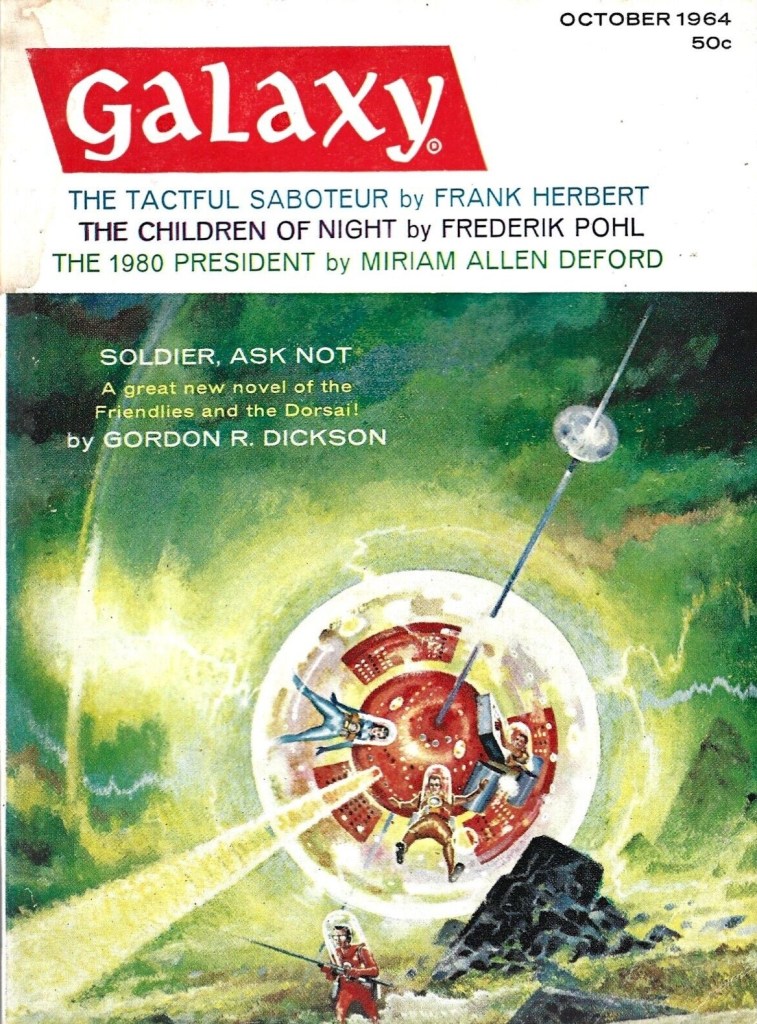
Philip K. Dick’s “Precious Artifact” first appeared in Galaxy, ed. Frederik Pohl (October 1964). You can read it online here.

A vast array of scholarship charts the continuing allure Mars holds in the popular imagination [1]. David Seed writes that “since the late nineteenth century Mars has tantalized the literary imagination with the possibility that life might exist on that planet” [2]. The visions of Edgar Rice Burroughs, Leigh Brackett, Ray Bradbury, and countless others created a seductive and sometimes complex vista of longing and conquest. Brackett, for example, evocated a Mars that was “more complex and varied” than Burrough’s “imperial triumphalism” [3]. In Brackett’s “The Beast-Jewel of Mars” (1948) (scheduled for this series), Mars becomes the location for the revenge perpetrated by the colonized [4].

Continue reading
Updates: Recent Science Fiction Purchases No. CCCXXII (John Brunner, Leigh Kennedy, Poul Anderson, Salman Rushdie)

I’ve returned from my expedition abroad. It’s time to get back to writing about science fiction! But first, there are always new books that have accumulated at my doorstep…

Which books/covers/authors intrigue you? Which have you read? Disliked? Enjoyed?

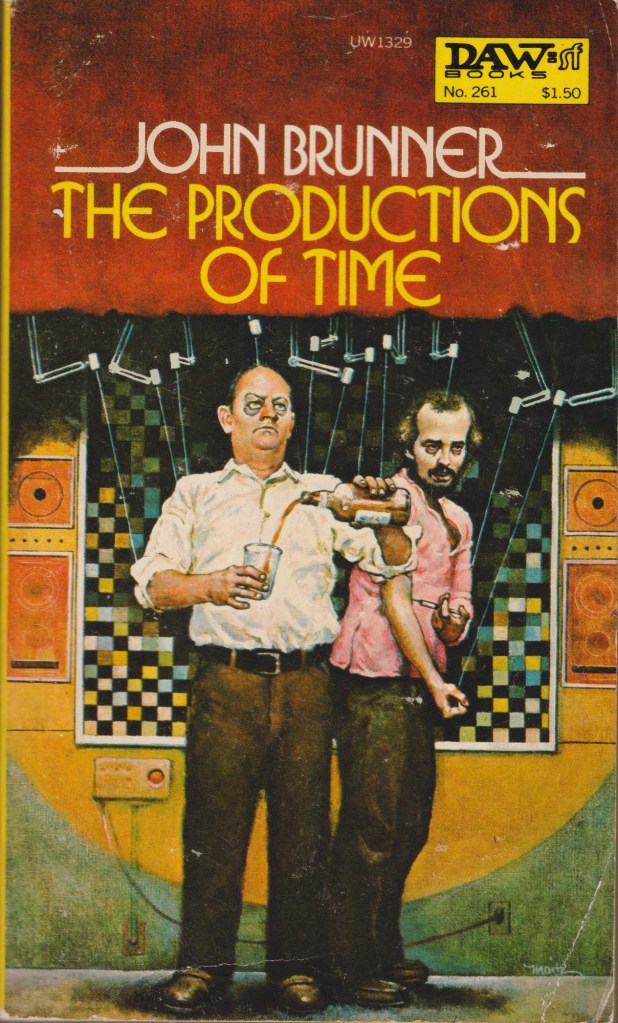
1. The Productions of Time, John Brunner (serialized 1966)

From the back cover: “Murray Douglas had been a theatrical star until he’d hit the bottle once too often. But now he had broken the habit, and, handsome and fit, was ready for a comeback. The most challenging opening available was an avant-garde play where the actors themselves would make up the drama as they went along.

But out at an isolated country estate where the rehearsals were going on, Murray found himself trapped on a real-life day-and-night stage in which nothing was as it seemed, in which inexplicable devices monitored everything and eerie lures attracted each actor’s psychological weakness.

Who then was the real sponsor of this terrifying play–and to what alien audience was it to be presented?

By the Hugo-winning author of STAND ON ZANZIBAR, this is the first unabridged American edition of this John Brunner classic.”

Continue reading

Short Story Reviews: Kate Wilhelm’s “Ladies and Gentlemen, This Is Your Crisis” (1976) and Langdon Jones’ “The Empathy Machine” (1965)

Today I’ve reviewed the twenty-sixth and twenty-seventh story in my series on the science fictional media landscape of the future. In Kate Wilhelm’s masterpiece of blue-collar drama “Ladies and Gentlemen, This Is Your Crisis” (1976), reality TV serves both as domestic irritant and therapy. Langdon Jones, in “The Empathy Machine” (1965), also speculates on the therapeutic aspects of “viewing” the crisis of another in a media-drenched future.

As always, if you know of other stories connected to this series that I haven’t reviewed, then let me know in the comments!

Previously: Richard Matheson’s “Through Channels” (1951) and Robert F. Young’s “Audience Reaction” (1954)

Up Next: Henry Kuttner’s “Year Day” (1953)

5/5 (Masterpiece)

Kate Wilhelm’s “Ladies and Gentlemen, This Is Your Crisis” first appeared in Orbit 18, ed. Damon Knight (1976). You can read it online here if you have an Internet Archive account. I read it in her collection Somerset Dreams and Other Fictions (1979).

Lottie comes home from the factory Friday afternoon with “frozen dinners, bread, sandwich meats, beer” to prepare for the weekend watching reality TV with her husband Butcher (121). As predicted, Butcher comes home mad, “mad at his boss because the warehouse didn’t close down early, mad at traffic, mad at everything” (123). He pulls up his recliner–they’ll sleep in front of the softly flickering screens–Lottie microwaves the dinners and brings her husband beer. The ritual commences.

Continue reading

Updates: Recent Science Fiction Purchases No. CCCXX (Michael Moorcock, Dean Ing, Vonda N. McIntyre, John Hersey)

Which books/covers/authors intrigue you? Which have you read? Disliked? Enjoyed?

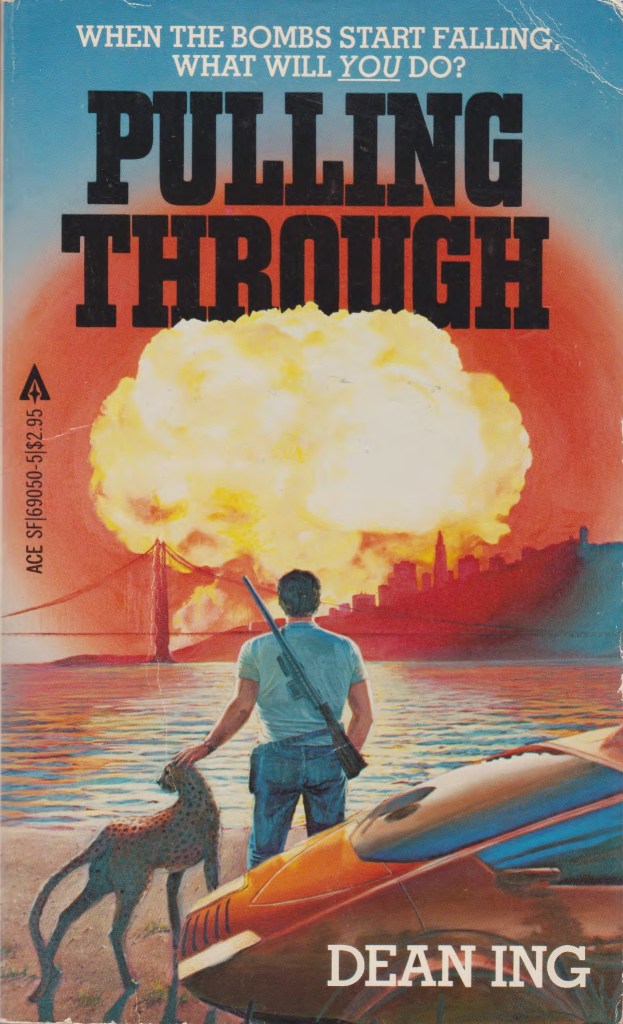
1. Pulling Through, Dean Ing (1983)

From the back cover: “DOOMSDAY. ARE YOU READY?

HARE RACKHAM, bounty hunter, race-car driver. His best friend is a hunting cheetah. Harve has turned his California home into a survival shelter. He intends to pull through.

SHAR MCKAY, Harve’s little sister. Shar’s latest fad is nuclear survival. She intends for her husband and kids to all pull through.

ERNEST MCKAY, engineer. He has the knowledge and skills to save his family. With his help they’ll all pull through.

KATE GALLOW, runaway, forger, a tough street survival. She’s trouble–but when real troubles come down, Kate will always pull through.

Dean Ing has thought a lot about survival, and he wants as many of you as possible to pull through inevitable disaster of nuclear war. That’s why he’s written this more-than-a-novel. Dean Ing lays all the cards on the table in this one. The story tells why. The articles and blue-prints tell how. PULLING THROUGH won’t save your hide all by itself, but it sure will give you a head start on pulling through by yourself.”

Continue reading

Short Book Reviews: John M. Ford’s The Princes of the Air (1982), Keith Roberts’ The Furies (1966), and John D. MacDonald’s Wine Of the Dreamers (1951)

Note: My read but “waiting to be reviewed pile” is growing. Short rumination/tangents are a way to get through the stack before my memory and will fades. My website partially serves as a record of what I have read and a memory apparatus for any larger project I might conduct in the future. I rather have a short review than none at all! Stay tuned for more detailed and analytical reviews.


1. The Princes of the Air, John M. Ford (1982)

3.5/5 (Good)

John M. Ford (1957-2006) is one of those authors I’ve read a lot about but never sat down and read. As if often my strategy, I decided to explore around the edges a bit before reading his best-known novels Web of Angels (1980) and The Dragon Waiting (1983). I settled on his second novel The Princes of the Air (1982)….

The first layer of The Princes of the Air reads as a traditional space opera. Three young men from rough poverty-filled pasts–Orden Obeck, David Kondor/Koleman, and Theodor Thorn/Norne–aspire to serve the Queen of Humankind. On the dusty planet Riyah Zain, the three friends scam the unwary and while away their days in the Asterion Arcade playing military games in which they imagine how they will serve the queen—Obeck will be the Ambassador-Global, Kondor the Admiral of the Fleet, and Theodor Norn the best Pilot and writer of the book on piloting. Obeck, indentured to the state as he voluntarily went on the government dole, trains to be a diplomat. He brushes up against the classist views of the students, who look down on Obeck’s achievements as an indentured man. Soon his accomplishments mean that he, and his friends, can leave the planet. Eventually, they find themselves embroiled in the machinations of the state and the powers that bind everything together.

Continue reading

Updates: Recent Science Fiction Purchases No. CCCXIX (Kim Stanley Robinson, Pamela Sargent, Greg Bear, and René Barjavel)

Which books/covers/authors intrigue you? Which have you read? Disliked? Enjoyed?

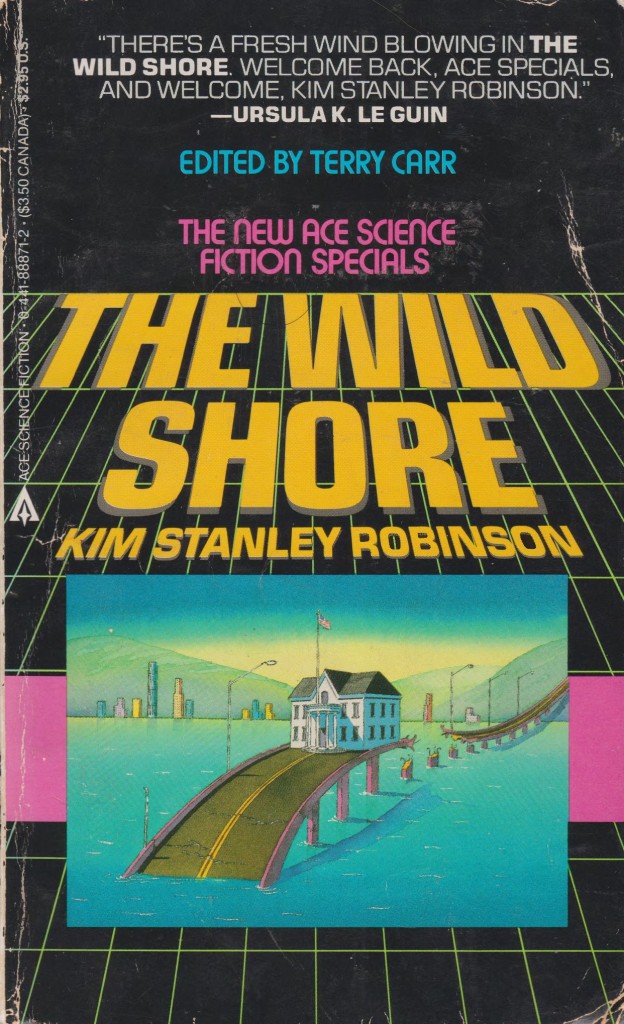
1. The Wild Shore, Kim Stanley Robinson (1984)

From the back cover: “Seventeen-year-old Henry wanted to help make America great again, like it had been sixty years ago, before all the bombs went off. But for the people of Onofre Valley, just surviving was challenge enough. Then one day the world came to Henry, in the shape of two men who said they represented the American Resistance…”

Continue reading

Book Review: Dimension Thirteen, Robert Silverberg (1969)

3.25/5 (Collated rating: Above Average)

Robert Silverberg (1935-) was one of the authors of the first decade of my site. I’ve reviewed twelve of his novels and thirty-two of his short stories. I also consumed with relish Tower of Glass (1970) and A Time of Changes (1971) as audiobooks and thus couldn’t review them. While an occasional story crops up here and there in an anthology, it’s about time I return to a Silverberg-specific volume. Dimension Thirteen (1969) collects six 50s stories and five from the 60s. The collection charts the moment when Silverberg’s career profoundly shifted from workman adventure to exemplary texts of the New Wave. They range from humorous commentaries on peccadillos and lusts to sinister ruminations on egotism and power.

Continue reading

Updates: Recent Science Fiction Purchases No. CCCXVII (Roger Zelazny, Philip José Farmer, Steve Wilson, and an anthology with Ursula K. Le Guin)

Which books/covers/authors intrigue you? Which have you read? Disliked? Enjoyed?

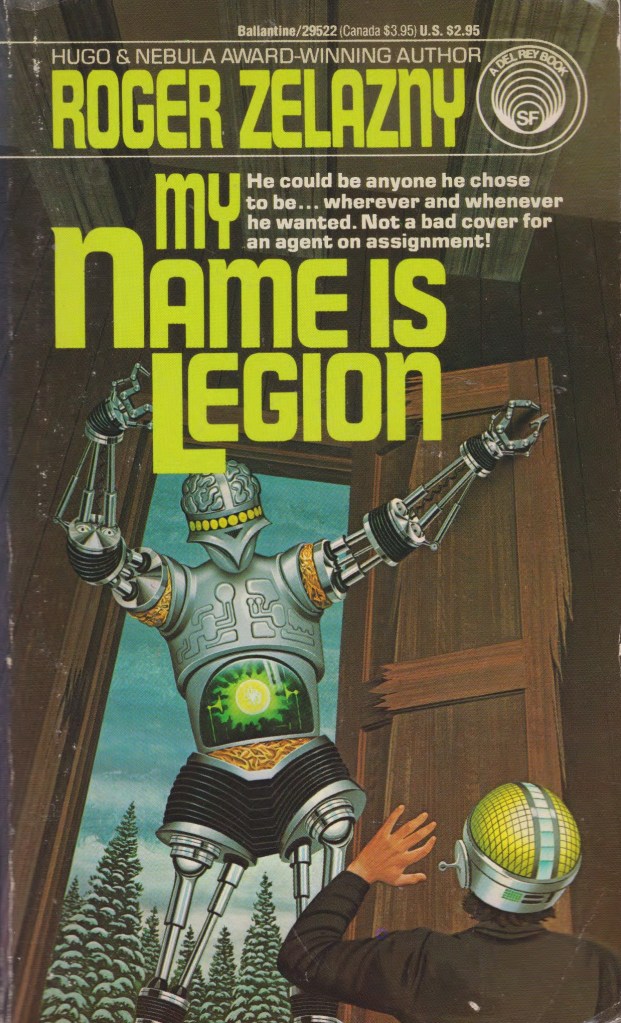
1. My Name is Legion, Roger Zelazny (1976)

From the back cover: “HE DID NOT EXIST… OR DID HE? He had destroyed his punch cards and changed his face. There was no credit card, birth record, or passport for him in the International Data Bank.

His names were many… any he chose.

His occupation was taking megarisks in the service of a vast global detective agency.

His interworld assignments were highly lucrative, incalculably vital, and terrifyingly deadly.

And more often than not, his life was a living hell!”

Contents: “The Eve of RUMOKO” (1969),” “‘Kjwalll’kje’k’koothaïlll’kje’k” (1973), “Home Is the Hangman” (1975)

Initial Thoughts: In the early days of my site read I reviewed the first in the Nemo sequence–“The Eve of RUMOKO” (1969). At the time I did not care for it. However, I recently read F. Brett Cox’s monography Roger Zelazny (2021) and retrospectively I’m not sure that I understood the character or what Zelazny was trying to accomplish with the story sequence. Often after I read a monograph, I end up making a few impulsive purchases and this is one of them! I hope, at the very least, it gives me a deeper understanding of Zelazny’s SF project. And “Home Is the Hangman” (1975) is a Hugo and Nebula-winning novella that I have not read.

Continue reading

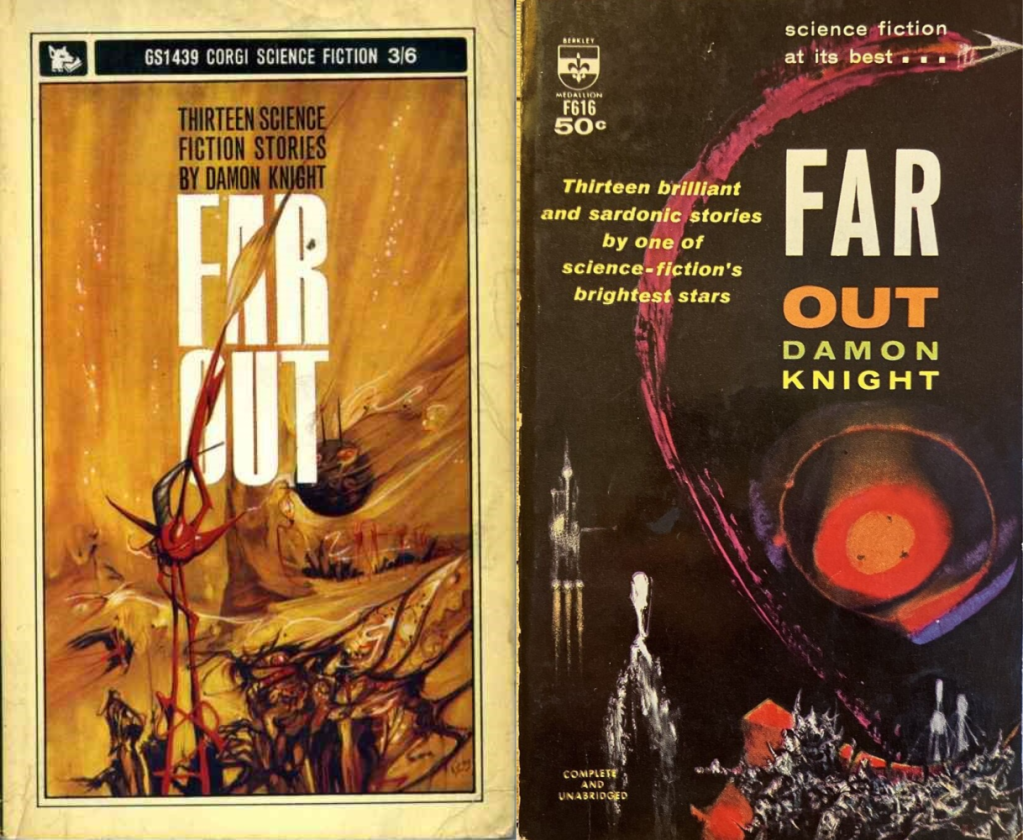
Book Review: Far Out, Damon Knight (1961)

Today I’ve reviewed the twenty-second and twenty-third story in my series on the science fictional media landscape of the future. In “Thing of Beauty” (1958) Damon Knight speculates on something very similar to AI art. And in “You’re Another” (1960) Knight conjures a delirious manifestation of reality TV unlike any other. I’ve gone ahead and included reviews of the rest of the stories in Knight’s collection Far Out (1961).

Previously: Ray Bradbury’s “Almost the End of the World”  (1959).

Up Next: Richard Matheson’s “Through Channels” (April 1951).

Robert F. Young’s “Audience Reaction” (February 1954).


3.5/5 (Collated rating: Good)

Damon Knight’s impact on the science fiction field can be felt to this day. He founded the Science Fiction and Fantasy Writers of America and co-founded two influential science fiction workshops (Milford and Clarion). Knight also edited the Orbit series of anthologies, notable for their larger-than-average number of female science fiction authors and overall quality–I’ve reviewed Orbit 1 (1966), Orbit 3 (1968), Orbit 4 (1968), and Orbit 8 (1970) so far. I can’t help but notice that his fiction, on the other hand, has faded a bit from popular knowledge. I struggle to identify a masterpiece Knight novel. Did he write one?

I’ve enjoyed his short fiction, notably “Down There” (1973) and “I See You” (1976), immensely. With that in mind, I consumed my first collection of his short stories. I can add “The Enemy” (1958), “You’re Another” (1955), and “Cabin Boy” (1951) to my list of favorite Knight visions.

Continue reading