Updates: Recent Science Fiction Acquisitions No. CXLVII (Women of Wonder Anthology + Eklund + Watson + Franke)

IMG_0799

(Inside illustration by Vincent Di Fate for the 1973 edition of The Orchid Cage (1961), Herbert W. Franke)

Part II of my SF acquisitions from Dawn Treader Books in Ann Arbor, MI– Part I.  In my attempt to acquire more foreign SF (still haven’t managed to read that much of it—but the mood will strike eventually), I found a nice copy with a wonderful interior illustration and cover by Vincent Di Fate of one of Herbert W. Franke’s novels.

Also, another Ian Watson novel—I’ve read the Jonah Kit (1975) but never got around to reviewing it as well as his collection (must read for fans of 70s SF) The Very Slow Time Machine (1979).  Jesse over at Speculiction raves about his other Continue reading

Updates: Recent Science Fiction Acquisitions No. CXLVI (Holdstock + Howard + Guin + Anthology with Zelazny, Pohl, Dick, Aldiss, et al.)

An eclectic range of books from my annual pilgrimage to Ann Arbor, MI.  Unfortunately, the anthology series I was most excited about—Best of New Worlds and Orbit—were lacking from the shelves of Dawn Treader Books….

….but!

World’s Best Science Fiction: 1967 (1967) contains stories famous stories by Philip K. Dick, Roger Zelazny (2xs), R.A. Lafferty, Michael Moorcock, Frederick Pohl, Brian W. Aldiss, and lesser known stories by Dannie Plachta, Paul Ash, Bob Shaw, A. A. Walde….

Also, I also procured a 1967 Nebula-nominated novel by Hayden Howard, more Richard Holdstock, and a collection containing the famous short story “Beyond Bedlam” (1951).  Over the next few weeks I’ll post the rest of my acquisitions.

Thoughts/comments?

1. The Eskimo Invasion, Hayden Howard (1967)

THSKMNVSNN1967

(Stephen Miller’s (?) cover for the 1967 edition) Continue reading

Book Review: The Eye of the Lens, Langdon Jones (1972)

Richard Jones1972

(Richard Jones’ cover for the 1972 edition)

4/5 (collated rating: Good) (*see note below)

Langdon Jones is best known for his involvement in New Worlds Magazine: he contributed stories (published 16 in various New Worlds venues), cover art, and edited the April-July 1969 issues.  One of his stories, “To Have and To Hold,” was slated to appear in the never published Last Dangerous Visions, and languishes unread and unknown.  Why Ellison doesn’t relinquish control of the copyright is beyond me…  Sadly, Jones’ output had all but dried up by 1969.  If anyone knows why, please let me know.

Three of the seven stories in the collection—“The Hall of Machines” (1968), “The Coming of the Sun” (1968), and “The Eye of the Lens” (1968)—form a loose triptych (the religious connotations of the term is purposeful).

*NOTE: Recommended only for fans of the most radical New Wave SF that graced the pages of New Worlds magazine.  Experimental, allegorical, and occasionally Borgesian, all the stories revolve around our perception of time and memory.  Even in the collection’s weakest moments—the Continue reading

Update: Recent Science Fiction Acquisitions No. CXLV (Platt + Cowper + Gawron + Pfeil)

An eclectic collection of 70s SF…. Two virtually unknown authors (Gawron + Pfeil) and two authors slightly better known by SF fans (Platt + Cowper).

I’ve not been impressed with Platt in the past—for example, maybe you all remember my review for Garbage World (1966) or Planet of the Voles (1971)?  But, nothing peeks my interest more than future urbanization gone amok… [2theD’s review: here].

Richard Cowper’s work intrigues but I often find it on the slight side. See my reviews of The Custodian and Other Stories (1976) and Profundus (1979).  The book I procured below is considered his most famous although the premise does little to inspire….

Donald J. Pfeil wrote three novels (SF encyclopedia is somewhat dismissive of all three) and remains best known for editing the short-lived Vertex magazine: according to SF encyclopedia, “in quality [Vertex] was the strongest of the new sf magazines from the first half of the 1970s.”  Unfortunately, it ran into financial problems and folded after only a few years…. Might be worth collecting!

Thoughts? Comments?

1. An Apology for Rain, Jean Mark Gawron (1974)

Screen Shot 2016-04-25 at 7.59.14 AM

(Margo Herr’s cover for the 1974 edition) Continue reading

Book Review: The Dream Millennium, James White (serialized 1973, novel 1974)

THDRMMLLNN1974

( John Berkey’s cover for the 1974 edition)

4.75/5 (Very Good)

“The thought of the vast, utterly silent ship stretching away on all sides of his cubicle, guarded and guided by silent computers, was paralyzing his own ability to make sounds […]” (3)

The crew of a seed ship sent to find a new habitable planet dream the same dreams, dreams of unnatural clarity plagued by pain and death.  As a young woman lies dying in her cold cubicle, her final meal at her lips and unaware of her predicament, she whispers to our reluctant hero (Devlin), “All I seem to dream about is being a lady dinosaur” (32).  Devlin’s dreams follow some pseudo-evolutionary schema, first he dreams he’s a trilobite in some Silurian sea crushed by the tentacles of a cephalopod, “he went on feeding while the hot, constant flame of hunger was punctuated by explosions of pain as his appendages were twisted and crushed and torn away […]” (10).  Then he dreams he’s a brontosaurus, and then an early primate…

Periodically, the automated machines that tend the colonists in cold storage awake their charges, “BASIC INSTRUCTIONS. SPEAK. EXERCISE. REMEMBER” (2).  The Continue reading

Adventures in Science Fiction Cover Art: Max Ernst and his landscapes of decay (on SF/F covers)

barbarians-marching-to-the-west-1937.jpg!Blog

Max Ernst’s Barbarians Marching to the West

Max Ernst (1891-1976) has long been one of my favorite artists.  I had no idea, until browsing through the Penguin SF cover images from the 60s, that his art appeared on a variety of SF/F novels and related literature/nonfiction….  Yes, I had seen the memorable cover for J. G. Ballard’s The Crystal World (1966) [below] but I had not put the two together.

My favorite is without a doubt the use of Ernst’s awe-inspiring Europe After the Rain II (1940-42) for J. G. Ballard’s collection of stories, Memories of the Space Age (1988).  The malaise generated by his landscapes of decay combined with the sheer power of Ballard’s visions evoke are almost palpable shudders of joy…

There are a handful more but I have included most of the 50s to early 80s examples.

And today, April 2nd, is Max Ernst’s birthday!  So, share, if you are so inclined, your favorite of his works of art.  And, feel free to identify any that might appear on the covers below…  Too bad more publishers don’t latch onto the joy that are his collages (do a google search and you will understand).

Enjoy!

MMRSSPCG1988

(Max Ernst, Europe After the Rain, cover for the 1988 edition of J. G. Ballard’s Memories of the Space Age, 1988) Continue reading

Updates: Recent Science Fiction Acquisitions No. CXLIV (Farmer + Anderson + Two Anthologies including Aldiss, Wilhelm, Priest, Disch, etc.)

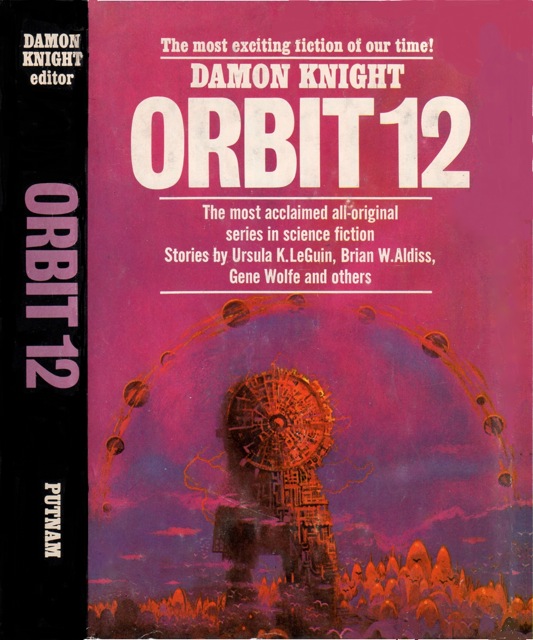
I have been on a short story kick as of late! Three of the following volumes are short story collections (two anthologies).  I want to complete the Orbit series, ed. Damon Knight….

And, well, I have a soft spot for Philip José Farmer’s 50s/60s SF after Strange Relations (1960).

Thoughts? Comments?

  1. Orbit 12, ed. Damon Knight (1973)

RBTDBDGFSX1973

(Paul Lehr’s cover for the 1973 edition) Continue reading

Updates: Recent Science Fiction Acquisitions No. CXLIII (Two themed anthologies: Election Day 2084 and TV: 2000 + Harrison + Gary)

Two themed anthologies—one in “honor” of the election [*cough* I mean, well, I won’t go all political] year cycle…  Another on one of my favorite SF themes, television of the future!

That said, both Asimov edited collections (from the 80s but with stories from only earlier decades) have a serious fault: out of the combined 35 stories there is not a single story by a woman author.  I’ve read a vast number of 60s/70s collections which do not fall into this trap…. Orbit 1 (1966) almost manages gender parity!  I can think of numerous stories by women authors that fit both themes.  For example, Kit Reed’s wonderful “At Central” (1967) fits the TV anthology!

A hard to find for cheap early M. John Harrison novel…. Unfortunately I only found a much uglier edition that the one I show below as the rest were out of my price range….

And, a complete shot in the dark—a SF novel by the mainstream French/Lithuanian novelist/screenwriter Romain Gary, the author of White Dog (1970)..

As always, I’d love to hear your thoughts + comments.

1. The Committed Men, M. John Harrison (1971)

THCMMTTDMB1971-1

(Chris Yates’ cover for the 1971 edition) Continue reading

Updates: Recent Science Fiction Acquisitions No. CXLII (The Soviet SF special: Strugatsky + Shefner + Bilenkin +Savchenko)

In the late 70s and early 80s a wide range of Soviet SF—from the famous Strugatsky brothers to lesser known authors—was translated and introduced to the American market.  As I have decided to start collecting the Best of Soviet Science Fiction Collier Books series of paperbacks (hardbacks were published by Macmillan), my dad gave me three for my birthday.  My first collecting experiment!  I want to read more SF from outside of the USA and the UK…  This batch is in addition to the only other one I have acquired so far: Half a Life, Kirill Bulychev (USSR 1975, USA 1977).  Unfortunately, the vast majority of the series fetch hefty prices (especially those by the two Strugatsky brothers) online.  And, other than The Ugly Swans (below), I have never encountered them in used book stores… and The Ugly Swans was not cheap (I have my wife to thank!).

The back cover of The Unman/Kovrigin’s Chronicles provides a blurb about the series that I thought I would reproduce: “In the Soviet Union, as in the U.S.A., the fascination with the possibilities of science and technology has led to a rich and long tradition of science fiction.  Macmillan’s BEST OF SOVIET SCIENCE FICTION is now presenting the major works in lively, readable translations, allowing the American reader to explore—for the first time—the wide range of visions of space, time and man’s future in the other major SF tradition.”

As always, thoughts?

1. The Ugly Swans, Arkady and Boris Strugatsky (USSR 1972, USA 1979)

The Ugly Swans

(Richard Powers’ cover for the 1979 edition) Continue reading