Book Review: The Eden Cycle, Raymond Z. Gallun (1974)

(Kelly Freas’ cover for the 1974 edition)

4/5 (Good)

Raymond Z. Gallun is best known for his pulp sci-fi from the 1930s-50s.  From the 50s onward he wrote a handful of novels of varying quality.  The Eden Cycle (1974), probably his single best science fiction work, is a successful integration of pulp ideas and lush environments with a poignant and often haunting depiction of the social ramifications of a future world where everyone, “blessed” with immortality, can “live” in any virtual reality of their choice, shift  from simulation to simulation at will, and spontaneously conjure new ones.

Brief Plot Summary/Analysis

In the near future mankind receives mysterious signals from space.  Gallun is careful to slowly reveal the main backstory over the course of the first third of the novel.  After Continue reading

Updates: Recent Science Fiction Acquisitions N. XXXVIII (Spinrad + Harrison + Kavan + Effinger)

Ah, when I have access to a massive inexpensive catalogue (Marx Books) the quality of my finds goes up and up…..  Finally a copy of Norman Spinrad’s metafictional The Iron Dream (1972) (if Hitler lived in America and wrote a sci-fi novel AND a commentary on said piece of science fiction).  Unfortunately, I own a later edition (with a hideous cover) than the one below.  Geo. Alec Effinger’s bizarre What Entropy Means to Me (1972) — again, about writing, and interpreting writing, and inventing interpretation…  Anna Kavan’s drug inspired underrated and underread sci-fi parable Ice (1976).  AND, a futuristic fantasy of the highest caliber, M. John Harrison’s The Pastel City (1971) — yes, I could have purchased the multi-novel sequence (and related short stories) in one volume but I like having the original paperbacks.

1. The Iron Dream, Norman Spinrad (1972)

(Uncredited cover for the 1972 edition) Continue reading

Adventures in Science Fiction Cover Art: Spacewomen of the Future (fixing spaceships + fighting aliens + charging across barren landscapes)

(Don Sibley’s cover for the November 1950 issue of Galaxy)

When we conjure the image of a 40s/50s science fiction pulp heroine we often imagine a character who has to be rescued by men from aliens, shrieks and clings to any man nearby, and is always in a state of undress.  I’ve included one cover, for the sake of comparison, that I find to be an exemplar of this type of sexist (and racist) depiction below (Alex Schomburg’s cover for the January 1954 issue of Future Science Fiction): white woman wrapped in only a towel stalked by an evil alien obviously painted with African-American facial characteristics (heavy on the sexual predation vibe) — the reader is supposed to buy into the racial stereotypes and thus be titillated by the fear she must feel.

I’ve selected a wide range of mostly pulp magazine covers depicting spacewomen of the future (I’ve loosely decided that this means women in space, in spacesuits) that tend to buck the trend Continue reading

Updates: Recent Acquisitions XXXVI (Malzberg + Gallun + Harrison + Silverberg)

More Marx Book purchases along with some random 99 cent thrift store finds (Raymond Z. Gallun + M. John Harrison)  that seemed intriguing enough.  I will eventually get to M. John Harrison’s magnum opus series of novels, Virconium– beginning with The Pastel City (1971) — but, as always, I approach an author’s masterpieces through an often circuitous manner.  I suspect my Malzberg find will be of a lesser quality than either Beyond Apollo (1972) or Revelations (1972).

I reviews I’ve found online of Gallun’s The Eden Cycle (1974) proclaim it an underrated masterpiece — with layers of virtual reality, etc.  I’ll read it soon…

As always, have you read any of these?  If so, what did you think?

1. The Day of the Burning, Barry N. Malzberg (1974)

(Don Ivan Punchatz’s cover Continue reading

Adventures in Science Fiction Cover Art: Inside the Skull (rats + women + sword fights + robotic circuits + space)

(Ebel’s cover for the 1953 issue of Space Science Fiction)

Previous art explorations which looked at disembodied brains and visualizations of the ultra-intelligent set the stage for this post.  Imagine skulls without brains: sometimes metaphorically, but often, literally hollow skull cavities that hold a vast array of mechanical devies and living captives.  Or, the reader is gifted a voyeuristic peek into the skulls of bodies masquerading as humans but in reality, a mesh of circuits or a metal sheen operates those beautiful limbs and terrifying weapons….

My favorite is by far the pulp goodness of Ebel’s cover (if anyone knows the full name of this artist please let me know) for the 1953 issue of Space Science Fiction.  The gorgeous heroine is held captive in gigantic stone heads with partially glass skulls — a robot that fails to conjure any menace stomps Continue reading

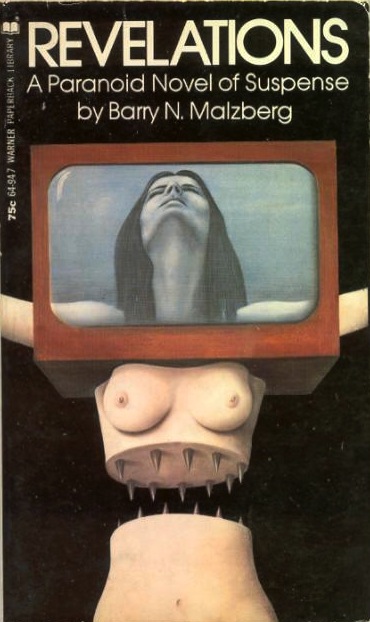
Book Review: Revelations, Barry N. Malzberg (1972)

(Michael Presley’s cover for the 1977 edition)

5/5 (Masterpiece)

Revelations (1972) is the second in a thematically linked group of Malzberg’s novels — published in-between its siblings, The Falling Astronauts (1971) and Beyond Apollo (1972) (from now on BA).  Each deals with insane astronauts, and in Malzberg’s own words, “sexual dysfunction as representing the necessary loss of energy of the machine age,” and each contains a character desperately attempting to speak out.  But, as with most of Malzberg’s novels, it is unclear whether there is truth in these cries.

Revelations is less rigorously structured than BA, which was characterized by 67 short tellings/retellings/scenes/dream moments all from the perspective of a single insane character.  As with BA, our anti-hero is an unreliable narrator, but due to the variety of diaristic, epistolary, and interrogatory fragments that comprise  Continue reading

Updates: Recent Science Fiction Acquisitions XXXV (Malzberg + Compton + Silverberg)

Books and short story collections from three of my favorite science fiction authors — Barry N. Malzberg, D. G. Compton, and Robert Silverberg…  A review of Malzberg’s masterpiece Revelations (1972) — almost as good as Beyond Apollo (1972) — is forthcoming.

I’ve recently discovered Marx Books — an online bookstore run by a retired professor (at Texas Tech University) and avid science fiction collector.  His collection is substantial and most importantly, he only bills you for the exact shipping (not sure if he ships internationally).  So, no $3.99 a book as Amazon does!  Instead, $3 shipping total for seven books!  Because Malzberg novels, and his short story collections, are so hard to find in used book stores it’s always nice to know I can pick up a copy quite cheaply online.

Another Richard Powers cover for my collection….

1. Revelations, Barry N. Malzberg (1972) (MY REVIEW)

(Uncredited cover for the 1972 edition)

From the back cover of the 1977 edition: “REVELATIONS is Continue reading

Adventures in Science Fiction Cover Art: Alien Friends

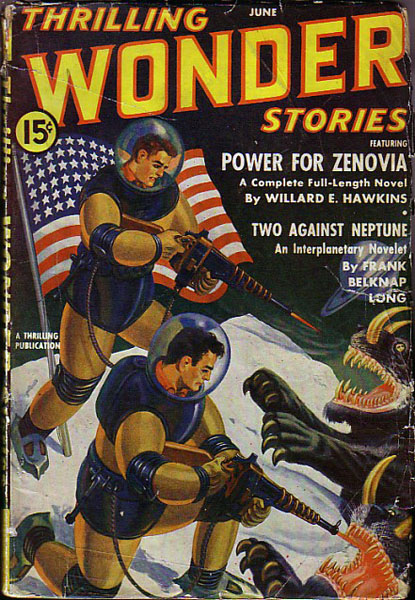
(H. W. Wesso’s June 1941 issue of Thrilling Wonder Stories)

In science fiction aliens are usually evil and generally end up dead — killed by our human heroes via pseudo-videogames (Ender’s Game), guns of endless variety, nuclear weapons detonated on their home worlds, horrific  diseases (Deep Space Nine), tossed into the vacuum of space, tossed into wormholes, etc etc.  They are rarely “humanized” — their families, societies, and history ignored by their human enemies — they are often depicted as “true” evil.  I’ve included the above cover, shooting aliens under the American flag (it is a wartime 40s issue so such overt jingoism is explainable), in order to highlight the attitude towards space fauna which we are all familiar with.

Sometimes “friendship” is feigned.  C. M. Kornbluth’s short story ‘Friend To Man’ (1951) (in this collection) is a disturbing example — the maternal feeling felt by the alien towards our antihero is just a ploy to lure him into her den where she implants him with eggs, which Continue reading

Adventures in Science Fiction Cover Art: Underwater Expeditions (futuristic submarines + underwater labs + sea monsters + cities), Part II

(Roger Stine’s cover for the 1979 edition of On The Run (variant title: Mankind on the Run) (1955), Gordon R. Dickson)

Part II of my Underwater Expeditions Series (Part I) is a veritable deluge of undersea wonders.  Unusual monsters/aliens proliferate the seascapes — snapping at our aquatic heroes.  A vast array of submersibles and submarines — including a mechanical whale equipped with a harpoon (Jack Coggins’ cover for the April 1957 issue of Galaxy Science Fiction) — trek across the oceanic expanses.  Cities, ruins, hidden scientific facilities are all to be discovered amongst the seaweed and deep water trenches…

There is something so mysterious about the ocean depths — almost as alienating and frightening as space.  Although due to our recent deep sea explorations increasingly less Continue reading