Short Book Reviews: Kim Stanley Robinson’s Icehenge (1984) and Peter Vansittart’s The Game and the Ground  (1956)

Note: My read but “waiting to be reviewed pile” is growing. Short rumination/tangents/impressions are a way to get through the stack before my memory and will fades. My website partially serves as a record of what I have read and a memory palace for future projects. Stay tuned for more detailed and analytical reviews.

You’ll soon understand why I haven’t posted regularly. There’s a substantial article (mostly complete) with original (and laborious) research on the horizon. Stay tuned!

1. Kim Stanley Robinson’s Icehenge (1984)

4.5/5 (Very Good)

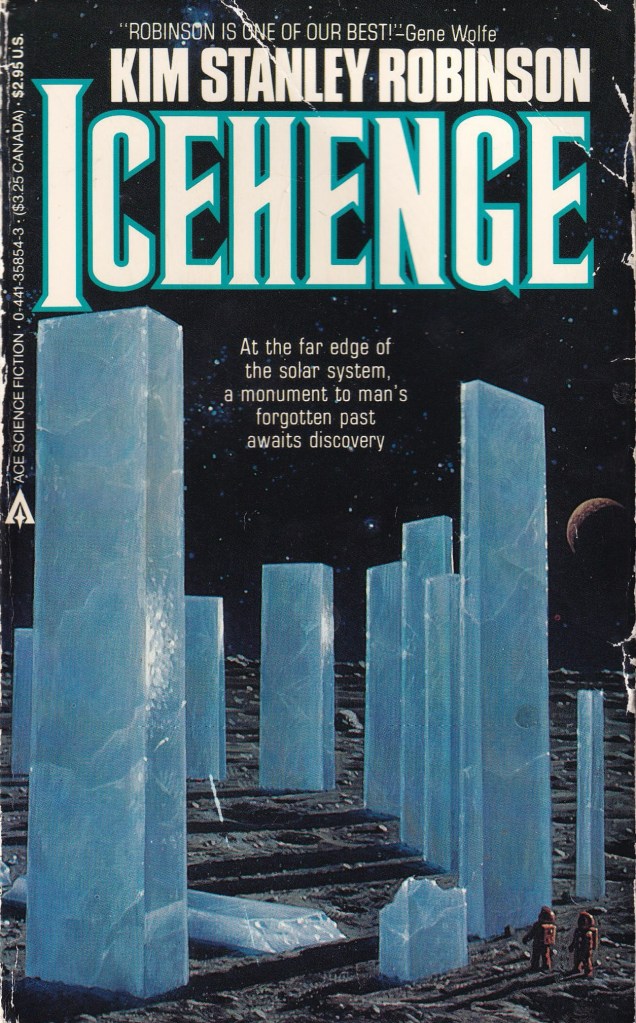
Kim Stanley Robinson’s Icehenge (1984), a fix-up from two previously published stories “To Leave a Mark” (1982) and “On the North Pole of Pluto” (1980), tells three interconnected tales that all connect to a mysterious monolith left on Pluto (the titular Icehenge).

In part I (2248 A.D.), hydroponics specialist Emma Weil, stationed on a mining ship in the asteroid belt, finds herself caught up in a radical act of defiance to coincide with a revolt on Mars–the creation of a spaceship for a voyage outside the solar system. She must confront the pull of home and the multitude of ways the power of the state informs and manipulates her life. In part II (2547 A.D.), historian and archaeologist Hjalmar Nederland discovers evidence of the revolt on Mars long covered up by authorities, the diary of Emma Weil, and the monolith on Pluto — a testament to the act of defiance? In so doing, he too, must reckon with Mars’ bureaucratic dictatorship and its amorphous ability to claim narratives of resistance as its own. In part III (2610 A.D.), Edmond Doya, a descendant of Nederland, spins his own conspiracy theory casting all that went before into question. As the threads intersect and split and cross, a voyage sets off, again, for Pluto and its icy pillars—a testament to our desire to find meaning in a disenchanted world.

Continue reading

Short Story Review: Izumi Suzuki’s “Terminal Boredom” (1984, trans. by Daniel Joseph 2021)

Today I’m joined again by Rachel S. Cordasco, the creator of the indispensable website and resource Speculative Fiction in Translation, for the sixth installment of our series exploring non-English language SF worlds. Last time we covered Arkady and Boris Strugatsky’s ruminative “Wanderers and Travellers” in International Science Fiction, ed. Frederik Pohl (November 1967).

Please note that Rachel and I are interested in learning about a large range of authors and works vs. only tracking down the best. That means we’ll encounter some stinkers. Thankfully, not this time! We got a powerful one.

Unfortunately, Izumi Suzuki’s “Terminal Boredom” (1984, trans. by Daniel Joseph 2021) does not exist online. A large range of her SF stories were translated and published in two volumes by Verso books with various translators. You can acquire Terminal Boredom (2021) and Hit Parade of Tears (2023) at relatively inexpensive prices online. Despite my substantial qualms with the editions (see my review below), I recommend acquiring them.

“Terminal Boredom” (1984) does double duty as the 35th installment of my review series on media landscapes of the future.

Previously:  George H. Smith’s “In the Imagicon” (1966).

Up Next: TBD

Enjoy!


Rachel S. Cordasco’s Review

In an article on the “iconoclast” Japanese sf writer Izumi Suzuki, Andrew Ridker distills her stories down to three words: “Ambivalence, disappointment, resignation: Suzuki’s stories speak so eloquently to our burnt-out moment that it’s easy to forget the importance of her cultural context” (LitHub, 5/7/21). We are indeed burnt out, more burnt out even than when Ridker was writing just four years ago. It’s now 2025 and time to face the fact that Facebook and YouTube have been around for over twenty years. The iPhone has been around for nearly that long, and for an entire year, the world was turned upside down during a pandemic, during which time we were even more closely connected to our devices. We’re burnt out by phones, by the rapidly-developing world of AI, by the streaming services that offer us so many choices that it’s nearly impossible to pick something to watch.

Continue reading

Updates: Recent Science Fiction Purchases No. CCCXLVI (Kim Stanley Robinson, Miriam Allen DeFord, Keith Laumer, and Jack Dann)

Which books/covers/authors intrigue you? Which have you read? Disliked? Enjoyed?

Finally acquired a new scanner!

1. The Memory of Whiteness, Kim Stanley Robinson (1985)

From the back cover: “In the 33rd century humanity is scattered among the planets of the Solar System. Millions of lives depend on the revolutionary physics of Arthur Holywelkin; millions of hears are moved by the music created by the strange, eerie instrument he built in the last years of his life: the Orchestra. Johannes Wright is the Ninth–and youngest–Master of the Orchestra. But as he sets out on his first Grand Tour of the Solar System, unseen foes are at his heel, ready to reveal all but the meaning of their enmity. In confronting them, Wright must redefine the Universe–for himself and all humanity.”

Continue reading

Book Review: Octavia E. Butler’s Clay’s Ark (1984)

4.5/5 (Very Good)

Octavia E. Butler’s Clay’s Ark (1984) is the final published volume of her Patternist sequence (1976-1984).1 It is the third novel according to the internal chronology of the series. Clay’s Ark is, without doubt, the most horrifyingly bleak science fiction novel I have ever read.2 It’s stark. It’s sinister. It’s at turns deeply affective before descending into extreme violence and displaced morality. The moral conundrum that underpins the central problem, the spread of an extraterrestrial disease, unfurls with an unnerving alien logic. Butler’s characters are trapped by the demands of the alien microbes, scarred by the pervasive sense that their humanity is slipping away, and consumed by the fear of starting an epidemic. A true confrontation of the moment cannot lead to anything other than suicide or the first steps towards an apocalyptic transformation.

Continue reading

Updates: Recent Science Fiction and Fantasy Purchases No. CCCXLV (Ursula K. Le Guin, Alan Garner, Burt Cole, and a Cyberpunk Anthology)

Which books/covers/authors intrigue you? Which have you read? Disliked? Enjoyed?

I apologize for the photos of my copies instead of my normal hi-res scans. My scanner died suddenly. Goodbye Dutiful and Dedicated Recorder of the SF Volumes.

1. Always Coming Home, Ursula K. Le Guin (1985)

From the back cover: “Ursula K. Le Guin’s Always Coming Home is a major work of the imagination from one of America’s most respected writers of science fiction. More than five years in creation, it is a novel unlike any ever written. A rich and complex interweaving of story and fable, poem, artwork and music, it totally immerses the reader in the culture of the Kes, a peaceful people of the far future who inhabit a place called the Valley on the Northern Pacific coast.”

Continue reading

Exploration Log 11: Interview with Chukwunonso Ezeiyoke, author of Nigerian Speculative Fiction: The Evolution (2025)

Over the last few years, I have highlighted a smattering of the vast range of spectacular scholarship on science fiction in my reviews and Exploration Log series that intrigue me.1 Today I have an interview with Chukwunonso Ezeiyoke about his brand new book Nigerian Speculative Fiction: The Evolution (2025), the first ever monograph on Nigerian speculative fiction (science fiction, fantasy, and horror) (SF). Due to the focus of my site and research interests, I focused my questions primarily on the historical portions of his book.

You can buy a copy directly from Routledge here or on Amazon. As academic works aren’t the cheapest, can also request your library procure a copy.

Let’s get to the interview and the fascinating world of Nigerian SF!

Continue reading

What pre-1985 science fiction are you reading? + Update No. XXII

What pre-1985 science fiction are you reading or planning to read next month? Here’s the April installment of this column.

As readers of the site know, I am obsessed with the machinations of Cold War nuclear logic—historical and science fictional. In Ira Chernus’ brilliant Apocalypse Management: Eisenhower and the Discourse of National Insecurity (2008), he dives into the Manichean ideoscape that dominated Eisenhower’s thinking. In short, he posits that Eisenhower interpreted the Soviet threat as an apocalyptic struggle in which the traditional outcome, eliminating the treat, is impossible. Instead the best hope is “to contain and manage it forever” (2)–hence “apocalypse management.” This “new linguistic paradigm” profoundly influenced their policymaking process and dominated American public discourse.

According to Chernus, Eisenhower was obsessed with Americans practicing voluntary self-control in their consumption in order shoulder the taxes needed to fund the perpetual struggle. With this paradigm, Eisenhower’s gestures towards peace–for example his “The Chance for Peace” (April 16th, 1953) speech–were acts of calibrated psychological warfare designed to put the burden of action on the Soviets and score points with the American public and American allies. The United States, on the other hand, could wage the conflict with perpetual, safe, and managed inaction in which peace is never the ultimate objective.

Continue reading

Exploration Log 9: Three More Interviews with Clifford D. Simak (1904-1988)

Back in July 2024, I posted six interviews with Clifford D. Simak (1904-1988). Since then I’ve tracked down three more. As in that post, I’ll provide a rundown of each interview and provide quotes of interesting passages. In the interviews, Simak comes across as an author deeply suspicious of rigorous generic distinctions, passionate about all life, and open to science fiction as an ever-changing and evolving entity.

As readers of the site know, I have a substantial interest in Simak’s SF that culminated last year in my September article “‘We Must Start Over Again and Find Some Other Way of Life’: The Role of Organized Labor in the 1940s and ’50s Science Fiction of Clifford D. Simak” (2024) in Journey Planet . Since then I’ve posted an Exploration Log on his 1971 Worldcon speech, reviewed Best Science Fiction Stories of Clifford D. Simak (1957), and contributed to a podcast on “The Huddling Place” (1944) (the second City story).

Enjoy! And if you know of more interviews (or are able to update the Internet Speculative Fiction Database entry as it only includes five of the nine interviews I’ve covered) let me know.


THE INTERVIEWS

Continue reading

Updates: Recent Science Fiction Purchases No. CCCXLII (Robert Silverberg, C. L. Moore, Henry Kuttner, Peter Tate, and Thomas Burnett Swann)

Which books/covers/authors intrigue you? Which have you read? Disliked? Enjoyed?

1. Tom O’Bedlam, Robert Silverberg (1985)

From the back cover: “MESSIAH OR MADMAN? It is 2103 and Tom O’Bedlam, madman, prophet, and visionary, wanders through California, dwelling place of the last humans on a continent decimated by radioactive dust. Tom, caught up in a living vision of distant worlds ruled by godlike beings, is the herald of a new age, a herald no one wants to hear until others too begin to dream of salvation beyond the stars. Yet while many dream, only tom has the power to make the wondrous visions real, to give people the ultimate escape they desire. Across the universe they must go… if Tom is humanity’s last hope–and not its final destroyer.”

Continue reading