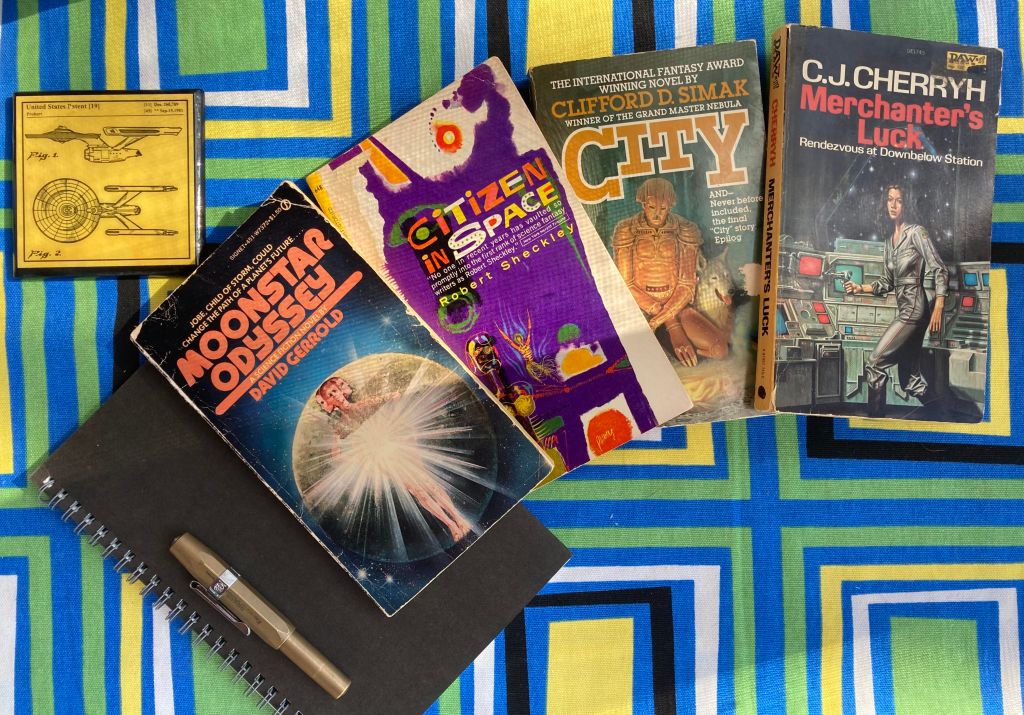
Exploration Log 4: Six Interviews with Clifford D. Simak (1904-1988)

Clifford D. Simak (1904-1988) published science fiction steadily between 1931 and his death in the late 80s. His work–from City (1952) to the Hugo-winning Way Station (1963)–often demonstrates a fascination with the rural environment and the lives of “ordinary” people confronted with the alien. As I am currently working on a mini-project related to Simak,1 I thought I’d give a rundown of six of the seven interviews I’ve found reference to. I’ll also provide quotes of interesting passages, and a scanned version of one that isn’t available online. In the interviews, Simak comes across as an author deeply suspicious of rigorous generic distinctions, passionate about all life, and open to science fiction as an ever-changing and evolving entity.

The Internet Speculative Fiction Database lists five interviews on science fiction conducted with Clifford D. Simak–all published between 1975-1980. Muriel R. Becker’s indispensable Clifford D. Simak: A Primary and Secondary Bibliography (1980) includes two more: a video interview from 1971 and another from 1976 in the Minneapolis Tribune.2 I cannot find a copy of the latter. I provide links to the others in the post.

Obviously, which interview you want to read depends on your interests or questions you have about Simak. That said, I found Paul Walker’s the most fascinating (and frequently references in the little scholarship on the grandmaster).

Continue reading

Updates: Recent Science Fiction Purchases No. CCCXXXV (Damien Broderick, Brian W. Aldiss, Sydney J. Van Scyoc, and D. G. Barron)

Back from Norway! Time to acquire more science fiction.

Which books/covers/authors in the post intrigue you? Which have you read? Disliked? Enjoyed?

1. The Dreaming Dragons, Damien Broderick (1980)

From the back cover: “TO THE PLACE WHERE SECRETS LIE SLEEPING. Alf Dean, an aborigine trained as an anthropologist, knew that his tribesmen, for centuries beyond memory, had warned of a dreadful secret in the mountains of Australia.

His ‘slow-witted’ nephew led him to the secret spot–the same spot where men were claimed by deaths that were secret to the world.

Continue reading

Updates: Recent Science Fiction Purchases No. CCCXXXIII (Keith Laumer, Vernor Vinge, Mack Reynolds, Daphne du Maurier)

Which books/covers/authors in the post intrigue you? Which have you read? Disliked? Enjoyed?

1. It’s A Mad, Mad, Mad Galaxy, Keith Laumer (1968)

Back cover: “This frenetic collection of science fiction stories–often disturbing, always entertaining–comes from outstanding and unpredictable SF author Keith Laumer.

Tingle your imagination: In ‘The Planet Wreckers,’ Jack Waverly goes to bed an ordinary mortal and wakes up a movie star. But the trouble is, his life is the price.

Tired of being a 97-pound weakling? “The Body Builders” has the answer for you: Just buy yourself the Body Beautiful.

Exorcise your hostility! A Certain Powers plans to obliterate “the greatest menace in the world today”–coast-to-coast television, better known as ‘The Big Show.'” [I think the last description is not for a story in the collection. Laumer always had a story title “The Big Show” that appeared in 1968. Maybe they were planning on including it in this collection but substitute something else at the last minute?]

Continue reading

What pre-1985 science fiction are you reading? + Update No. XI

What pre-1985 science fiction are you reading or planning to read this month. Here’s March’s installment of this column.

Before we get to books and birthdays and writing plans…

Continue reading

What pre-1985 science fiction are you reading? + Update No. X

What pre-1985 science fiction are you reading or planning to read this month? Here’s February’s installment of this column.

Before we get to books and birthdays and writing plans…

Do you have the inner strength to survive the panic of a nuclear attack? Take a test in the August 21st 1953 issue of Collier’s and find out! Sample question: “HOW DO YOU FEEL WHEN: […] You are alone in an automatic elevator when it stalls between floors?” Possible answers: “I’m not bothered,” “I become tense,” “It jars me badly,” and “I blow up.”

Continue reading

Updates: Recent Science Fiction Purchases No. CCCXXXI (Iain M. Banks, Mike Resnick, Sydney J. Van Scyoc, and David J. Skal)

Which books/covers/authors in the post intrigue you? Which have you read? Disliked? Enjoyed?

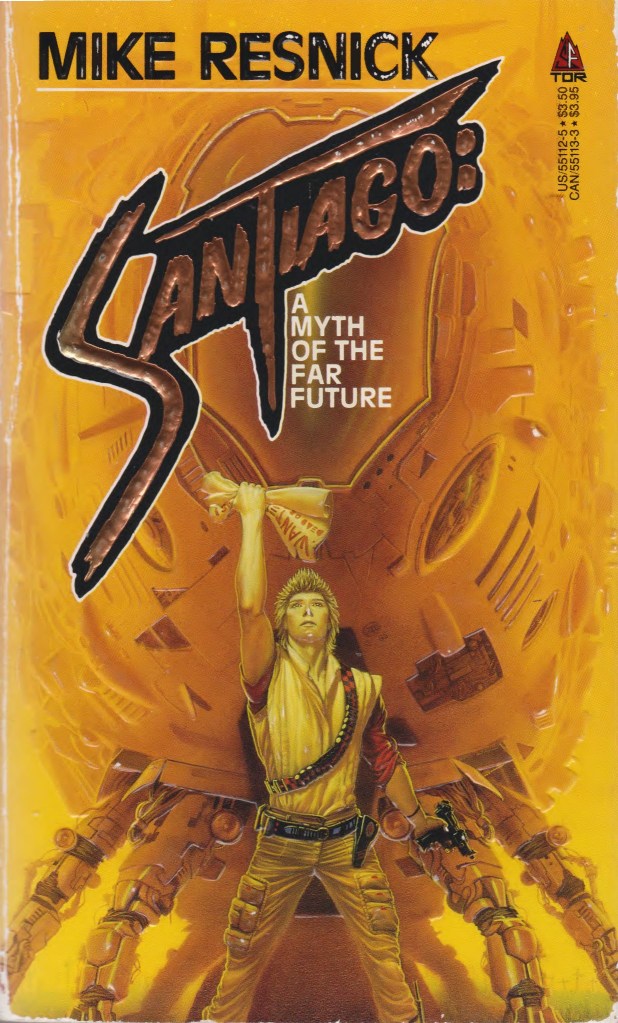
1. Santiago: A Myth of the Far Future, Mike Resnick (1986)

From the back cover: “SEBASTIAN NIGHTINGALE CAIN: County hunter. You can call him Songbird–but only once. He’s after Santiago.

VIRTUE MECKENZIE: Freelance reporter. She never give up. She wants an interview… with Santiago.

THE SWAGMAN: He collects art–at gun point. He wants a few pieces currently in the hands of Santiago.

Continue reading

What pre-1985 science fiction are you reading? + Update No. IX

What pre-1985 science fiction are you reading or planning to read this month? Here’s January’s installment of this column.

When I’m not reading science fiction, I’m more often than not devouring history that touches on my decades of focus: 1945-1985. Recently that’s meant lots and lots of monographs on Cold War culture: from fallout shelters, suburbia, to analysis of the drama of morality and terror that characterized nuclear deterrence. And in Guy Oakes’ transfixing The Imaginary War: Civil Defense and American Cold War Culture (1994), I came across a fascinating collision of science fictional thought and public policy.

A few months into Dwight D. Eisenhower’s presidency, the Public Affairs Office of the Federal Civil Defense Administration released a short pamphlet that analyzed the “relation between national will and nuclear terror” under the ridiculous title “Civil Defense Implications of the Psychological Impact and Morale Effect of Attacks on the People of the United States” (April 1953). In this pamphlet, the authors imagine the effects of nuclear war. They suggest that some survivors would “isolate themselves from the terrifying consequences of nuclear war by effecting a pseudo-escape into an interior psychological reality.” I thought immediately of Richard Matheson’s brilliant “Pattern for Survival” (1955), in which a SF author reenacts the process of writing and publishing a story to escape the reality in which he lives. The pamphleteers further imagine a political reality dominated by “mystical sects and cults, enthralled by the vision of an immeasurably happier future in an inner fantasy life of an extramundane kingdom of bliss that transcended the brutal empirical reality of nuclear destruction” (41). Early Cold War policy makers and consultants as science fiction authors!

50s paranoid future visions aside, let’s turn to the books in the photo and what I’ve been reading and writing about.

Continue reading

Updates: Recent Science Fiction Purchases No. CCCXXX (Tim Powers, Octavia E. Butler, George Alec Effinger, and Tom Purdom)

Which books/covers/authors intrigue you? Which have you read? Disliked? Enjoyed?

1. Dinner at Deviant’s Palace, Tim Powers (1985)

From the inside flap: “The civilized world had come to an end more than a century earlier, but in California life and society went on… taking strange, often horrifying forms.

Gregorio Rivas was a survivor–a proud, resourceful man who had, most recently, made his way from the corrupt, crumbling city of Venice to carve out a successful career as a musician within the walls of Ellay. He played his pelican with raw energy and flashy style, and people came from all over to hear him. But Greg’s real claim to fame had nothing to do with music. It was a part of his past he wanted to forget. And it had come back to haunt him…

Continue reading

Updates: Holiday Purchases! No. CCCXXIX (George Alec Effinger, Margot Bennett, anthology on Nuclear War, and Michael Conner)

Time for more holiday finds!

Which books/covers/authors intrigue you? Which have you read? Disliked? Enjoyed?

1. When Gravity Fails, George Alec Effinger (1986)

From the back cover: “In a decadent world of cheap pleasures and easy death, Marîd Audran has kept his independence and his identity the hard way. Still, like everything else in the Budayeen, he is available …for a price.

Continue reading