Which books/covers/authors intrigue you? Which have you read? Disliked? Enjoyed?
1. The Escape Orbit (variant title: Open Prison), James White (1964)
Jack Gaughan’s cover for the 1965 edition
From the back cover: “STRANDED ON A PLANET OF MONSTERS. When the survivors of the his starship were taken prisoner by the insec-creatures against whom Earth had fought a bitter war for nearly a century, Sector Marshal Warren expected to be impounded in a prison camp like those the Earthmen maintained. But the “Bugs” had a simpler method of dealing with prisoners–they dumped them on an uninhabited planet, without weapons or tools, and left them to fend for themselves against the planet’s environment and strange monsters. A “Bug” spaceship orbited above, guarding them.
Which books/covers/authors intrigue you? Which have you read? Disliked? Enjoyed?
1. The Darfsteller and Other Stories, Walter M. Miller, Jr. (1982)
Peter Jones’ cover for the 1st edition
From the back cover: “Walter M. Miller, Jr., wrote A CANTICLE FOR LEIBOWITZ, and changed the nature of science fiction, forever. Now, collected together for the first time are some of his most gripping masterpieces, including the Hugo Award-winning ‘The Darfsteller’ and ‘Crucifixius Etiam.'”
Which books/covers/authors intrigue you? Which have you read? Disliked? Enjoyed?
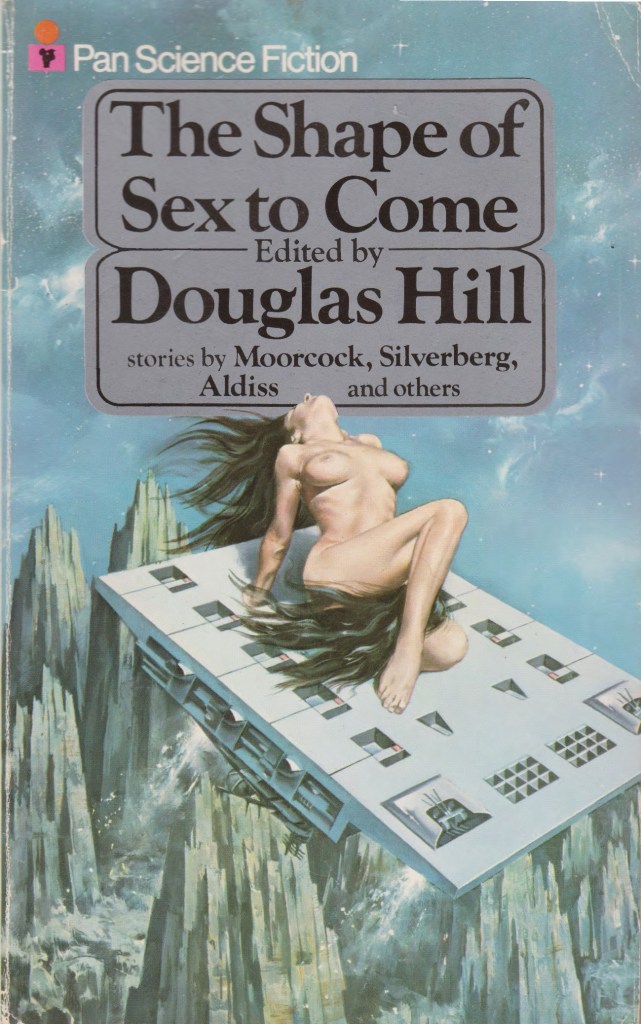
1. The Shape of Sex to Come, ed. Douglas Hill (1978)
Uncredited cover for the 1st edition
From the back cover: “Eight stories from SF names as highly-respected as Aldiss, Moorcock and Silverberg explore the strange and bizarre possibilities for sexuality in the furthest reaches of tomorrow.”
Contents: Robert Silverberg’s “In the Group” (1973), Thomas M. Disch’s “Planet of the Rapes” (1977), A. K. Jorgensson’s “Coming-of-Age Day” (1965), Anne McCaffrey’s “The Thorns of Barevi” (1970), Brian W. Aldiss’ “A One-Man Expedition Through Life” (1974), Brian W. Aldiss’ “The Taste of Shrapnel” (1974), Brian W. Aldiss’ “Forty Million Miles from the Nearest Blonde” (1974), Hilary Bailey’s “Sisters” (1976), John Sladek’s “Machine Screw” (1975), and Michael Moorcock’s “Pale Roses” (1974).
Which books/covers/authors intrigue you? Which have you read? Disliked? Enjoyed?
1. Where is the Bird of Fire?, Thomas Burnett Swann (1970)
John Schoenherr’s cover for the 1st edition
From the back cover: “Were the mythical monsters our ancestors spoke of so often more than fantasy? Is it not probable that these semi-human races existed–and that only human vanity has blurred their memory?
Note: My read but “waiting to be reviewed pile” is growing. Short rumination/tangents are a way to get through the stack before the new year and my memory/will fades. Unfortunately, I left two of my favorite reads of the year for last. Stay tuned for more detailed and analytical reviews.
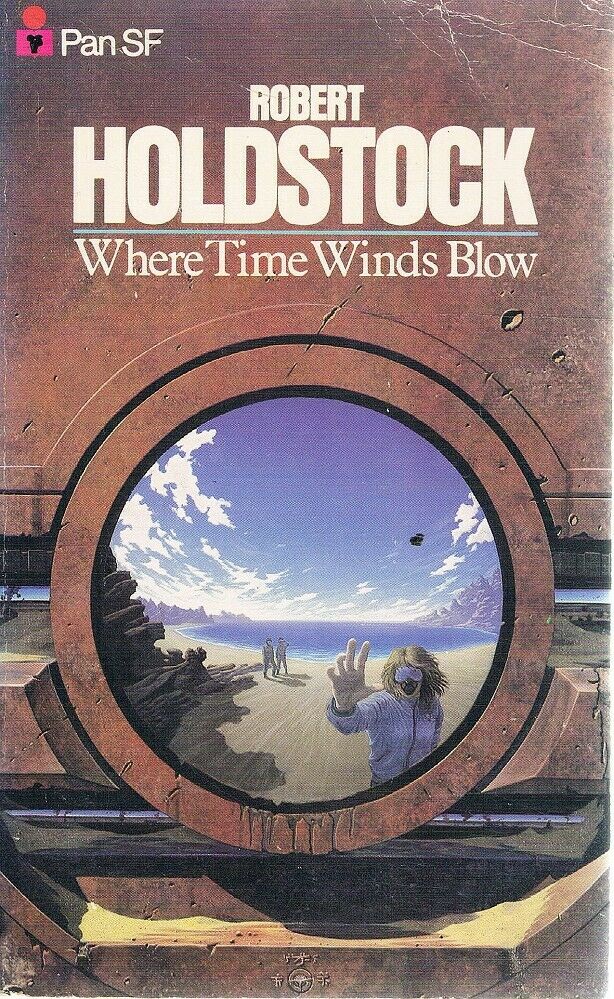
1. Where Time Winds Blow, Robert Holdstock (1981)
Mick Van Houten’s cover for the 1982 edition
5/5 (Masterpiece)
I cannot properly review Where Time Winds Blow (1981). Sometimes, while perambulating the interwebs, I encounter a singular encapsulation of a text’s brilliance that defeats all my own attempts to write constructively about a book. I blame Andrew Darlington’s brilliant review/article on Robert Holdstock contextualizing the novel within his early oeuvre. The short paragraph below–an attempt to convince you to procure a copy–is indebted to his review. Please read his review! There are fan writers and then there are fan writers. Darlington should receive a Hugo nod.
Which books/covers/authors intrigue you? Which have you read? Disliked? Enjoyed?
1. The Martian Chronicles, Ray Bradbury (1950)
Ian Miller’s cover for the 1979 edition
From the back cover: “A MAGNIFICANCTLY ILLUSTRATED EDITION OF THE MARTIAN CHRONICLES WHICH MASTERFULLY ENHANCES THE CLASSIC WONDER AND TERROR BY THE WORLD-RENOWNED AUTHOR OF THE ILLUSTRATED MAN RAY BRADBURY.
Note: My read but “waiting to be reviewed pile” is growing. Short rumination/tangents are a way to get through the stack before my memory and will fades. Stay tuned for more detailed and analytical reviews.
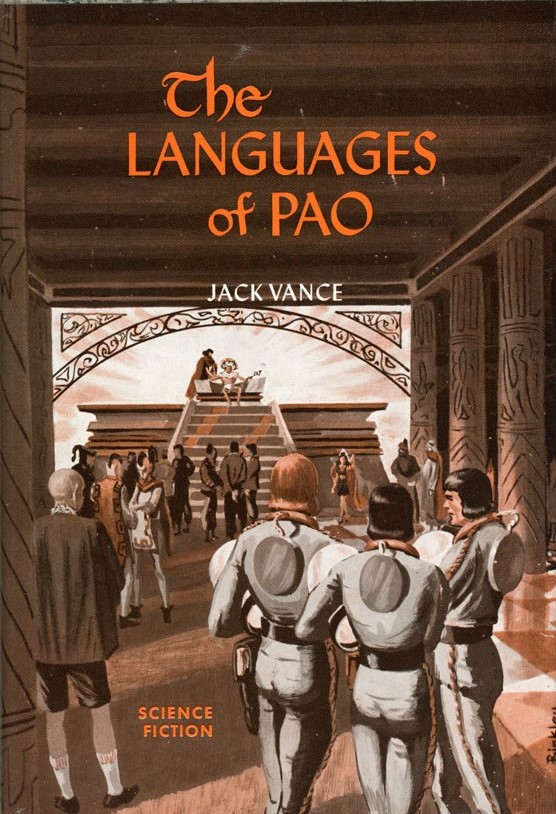
1. The Languages of Pao, Jack Vance (1958)
Ric Binkley’s cover for the 1958 1st edition
3.25/5 (Vaguely Good)
Since I started my site in 2011, I’ve soured a bit on Jack Vance’s brand of planetary adventure in richly realized and exotic worlds. I doubt I’d currently rate novels like Showboat World(1975) or The Blue World (1966) as highly as I did back then. One of more appealing elements of having a single project for so long is my ability to track my evolving views on genre. That said, I’d classify Wyst: Alastor 1716(1978) and The Languages of Pao (1958) amongst his most conceptually ambitious novels I’ve read so far and worth tracking down. For a full list consult my index. Note: I read but never reviewed Dying Earth (1950).
Enki Bilal’s art for the 1st edition of La Foire aux immortels (1980)
Collated Rating: 4/5 (Good)
Art: 5/5 (Masterpiece) + Story: 3/5 (Average)
Enki Bilal’s La Foire aux immortels (trans. The Carnival of Immortals) (1980) is the first volume in The Nikopol Trilogy. All three bande dessinée received a 2016 single-volume English translation by Titan Comics. Due to the limited chronological reach of my site, I’ve chosen to only review the 1st volume as the sequels, Le Femme Piège (trans. The Woman Trap) and Froid Equateur (trans. Equator Cold), were published in 2005.
Of the SF graphic novels I’ve read, The Carnival of Immortals proved by far the most successful. Bilal blends his terrifying depictions of decadence and decay with an oblique, if a bit clunky, story that hints at surrealism and otherworldliness. For what I’m comparing Bilal’s vision to, check out Howard V. Chaykin and Samuel R. Delany’s Empire (1978), Paul Gillon’s La survivante (1985), and Gene Day’s collection Future Day(1979).
Every morning for the last few years, I post on Twitter the birthdays (pre-1955) of artists, authors, and editors involved in some way with science fiction. In the last year, a singular compulsion has hit and I’ve started to include even more obscure figures like Gabriel Jan (1946-) and Daniel Drode (1932-1984). On May 31st, while perusing the indispensable list on The Internet Speculative Fiction Database, I came across an author unknown to me–Melisa Michaels (1946-2019) (bibliography). She’s best known for the five-volume Skyrider sequence (1985-1988) of space operas “depicting the growth into maturity of its eponymous female Starship-pilot protagonist” (SF Encyclopedia).
As I’m always willing to explore the work of authors new to me, I decided to review the first three of her six published SF short stories. Two of the three stories deal with my favorite SF topics–trauma and memory.
Karl Kofoed’s interior art illustrating Melisa Michaels’ “In the Country of Blind, No One Can See” in Isaac Asimov’s Science Fiction Magazine (January 1979)
“In the Country of the Blind, No One Can See” (1979), 3.5/5 (Good): First appeared in Isaac Asimov’s Marvels of Science Fiction (1979). It was reprinted in Isaac Asimov’s Science Fiction Magazine (January 1979). You can read it online here.
On a terraformed Mars, Allyson Hunter and her two clone sisters, Rebecca and Kim, are societal outcasts. They spent their lives trying to be “real people” yet were “reminded, every day in a dozen little ways, that they weren’t real people” (87). Clones retain their first usage as replacement body parts. Permitted to live only due to indications of telepathic potential (needed to guide spaceships), the sisters attempt to live meaningful lives and develop useful skills. The sisters charter two identical twins, Frank and Todd, to convey them across the Martian landscape. A horrific crash kills Kim and forces the survivors to work together and move past the deep resentment and hatred the brothers hold.






 Science Fiction and Other Suspect Ruminations