Adventures in Science Fiction Cover Art: Josh Kirby’s Astronauts (1957-1976)

THRPRDCTVS1970

(Josh Kirby’s cover for the 1970 edition of The Reproductive System (variant title: Mechasm) (1968), John Sladek)

It has been too long since I collated a cover art post…  I have a love hate relationship with Josh Kirby’s work.  He tends to be on the comedic side, for example, he provided covers for a large percentage of Ron Goulart’s DAW titles (The Wicked Cyborg, etc) and Prachett’s Discworld novels.

However, for a brief window of time in the 60s and 70s he produced some gorgeously surreal depictions of astronauts and and astronaut transformations.  His cover for the 1970 edition of The Reproductive System (variant Continue reading

Guest Post: “Allegiances,” Michael Bishop (1975)

Screen shot 2014-05-24 at 9.00.39 AM

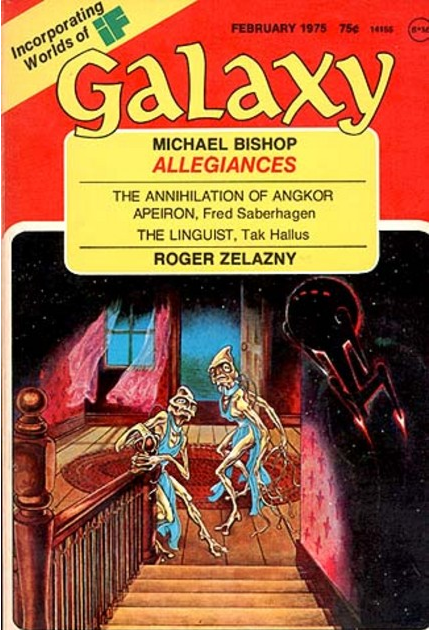
(Jack Guaghan’s cover for the February 1975 issue of Galaxy, where “Allegiances” was first published)

The tenth and final (at least for now) installment in my guest post series on the science fiction of Michael Bishop comes via Peter S. a longtime commentator on my site.  He should start his own SF review site….  His comments (and this review) are greatly appreciated!

He selected the novella “Allegiances” (1975) from the anthology The 1976 Annual World’s Best SF (1976), ed. Donald A. Wollheim he owned (image below)–DOMED CITIES!

The novella was included in Catacomb Years (1979) reviewed by 2thD recently.

Thanks everyone for a successful series.  All the comments and contributions are greatly appreciated.  I have more plans along these lines for the future!

~

michael bishop,header,02

“Allegiances” (1975) — Michael Bishop

Jack Gaughan’s cover for the 1976 edition of The 1976 Annual World’s Best SF (1976), ed. Donald A. Wollheim

When I come across a Science Fiction anthology, I first check the contents to see if there is anything unusual such as a story by a favorite author that I have not seen before, or maybe a lost gem from an author I was not previously aware of. I also check to see who the editor is, since each editor has their own distinctive way of putting together a collection.

My impression of the many anthologies that Donald Wollheim (1914 – 1990) worked on is that they are always of interest. I expect the majority of the stories in any given collection to be very good, most will be mainstream Hard Science Fiction Continue reading

Guest Post: Catacomb Years, Michael Bishop (1979)

CTCMBYRS5E1979

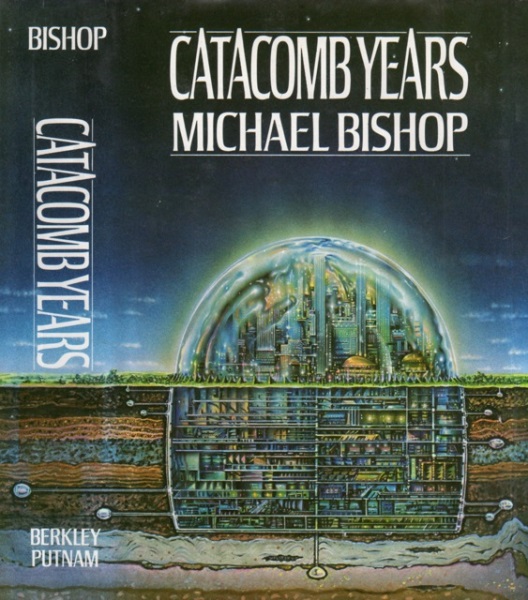
(Ron Walotsky’s cover for the 1979 edition)

The eighth (!) installment in my Michael Bishop Guest post series comes via my longtime fellow SF blogger/friend (well, multiple years) 2theD (twitter:@SFPotPourri) at PotPourri of Science Fiction Literature.  And this is a darn good linked collection of Bishop stories.

I highly recommend you check out 2theD’s blog, follow him on twitter, peruse his large collection of reviews…

michael bishop,header,02

All cities are built on voiceless narratives

Collated rating: 5/5

Buying Michael Bishop’s Catacomb Years was a wise investment, albeit an impulse buy at the second-hand bookstore. This is the only Bishop novel, or collection, I own. Originally, it was going to stay stacked in my to-be-read pile for 3-4 years in the future (hey, I have a lot of catching up to do in my library) but the alluring cover proved  too much… that and Joachim Boaz manhandled me from 8,700 miles away into reading it for his collection of guest posts on the work of Michael Bishop.

You’d be a dullard if you weren’t initially struck by either the premise or the cover art: As history barrels forward in a the manner of a drunkard, American cities like Atlanta eventually cap themselves in domes under the idea of Preemptive Isolation, only to suffer the pangs of dying from its onset Continue reading

Book Review: The Empty People, Barry N. Malzberg (as K. M. O’Donnell) (1969)

P1050045

(Howard Winters’ cover for the 1969 edition)

3.5/5 (Good)

“Inspecting a few she found that they were about what she had expected: the science-fiction books seemed to be full of nonsense about extraterrestrials or flights into space, the damnedest silliest stuff imaginable, and the sex part was sheer filth.  There was no question about it; there was no other way to describe those books” (12).

Science fiction as delusion.  More specifically, chapters replete with SF plots with evil aliens with interchangeable names and megalomaniacal claims to power culled straight from the pulps are delusions.  Imagined (perhaps?) by an average American man with “metastases” (14) growing in his brain while a concerned, albeit cheating, normal American housewife waits at his bedside.  The Empty People (1969) is considered Barry N. Malzberg’s (writing at K. M. O’Donnell) first SF novel.  However in the vein of his more famous Herovit’s World (1973), the most convincing interpretation of the novel suggests that the SF elements (purposefully clichéd and vaguely explained) are mere manifestations and torments of a diseased mind.

Originally Malzberg had aspirations to become a playwright and was even awarded multiple university playwright fellowships but was unable to break into the literary market.  Thus, he tried his hand at science fiction in the late 60s with some success (his most famous work would be published in the early 70s).  I would suggest that Malzberg’s palpable frustration writing SF can be found throughout the novel.  In The Empty People pulp science fiction plots, in their most general formulations, serve as instruments of repression Continue reading

Guest Post: A Little Knowledge, Michael Bishop (1977)

(Dean Ellis’ cover for the 1978 edition)

The sixth installment of my The Science Fiction of Michael Bishop guest post series was graciously provided by Heloise over at Heloise Merlin’s Weblog.  She is a long time fan of Michael Bishop’s work and we have engaged in numerous (fruitful) discussions of his work—including whether or not the first version of A Funeral for the Eyes of Fire (1975) is superior to his complete rewrite Eyes of Fire (1980).

Heloise purposefully chose one of Bishop’s lesser known novels.  But, from the review, A Little Knowledge (1977) has been wrongly ignored: “even though [A Little Knowledge] never leaves this single place on Earth, in the end Bishop’s novel manages to give more of a sense of what it means for humans to live in a vast, largely unexplored universe than most novels that are filled with large spaceships and far-future technologies.”

I plan acquiring a copy ASAP.

Visit Heloise’s site! Enjoy!  Comment!

michael bishop,header,02

A Little Knowledge (1977)—Michael Bishop

Michael Bishop’s Urban Nucleus sequence (consisting of the novel A Little Knowledge and the stories collected in Catacomb Years) is unusual among his early works in that it is not an anthropological Science Fiction novel; unlike books like A Funeral for the Eyes of Fire or And Strange at Ecteban the Trees, while reading A Little Knowledge, one is not so much reminded of Ursula K. LeGuin but it rather seems influenced by Philip K. Dick – and not by his largely consensual novels like Ubik or The Man in the High Castle, but his Continue reading

Guest Post: Brighten to Incandescence (selections), Michael Bishop (2003)

(Jamie Bishop’s cover for the 2003 edition)

The fourth installment of my The Science Fiction of Michael Bishop guest post series was written by MPorcius (twitter: @hankbukowsi) at MPorcius Fiction Log—a valued and longtime commentator on my site.  I have procured quite a few books due to his quality reviews which I highly recommend perusing.  Check out his site (especially if you like classic SF)!

Over the course of this series we moved from Michael Bishop’s most well known novella (“Death and Designation Among the Asadi“) to his novels (Brittle Innings, No Enemy but Time) and now to an intriguing collection of lesser known short SF and non-genre stories.

MPorcius decided to only focus on the SF in Brighten to Incandescence but points out that all the stories in the collection are worth reading!

Enjoy!

~~~

michael bishop,header,02

Brighten to Incandescence (2003) — Michael Bishop

Brighten to Incandescence, published by Golden Gryphon Press in 2003, is Michael Bishop’s seventh collection of stories. In the final chapter of the book, a series of notes on the stories, Bishop explains that he and the people at Golden Gryphon initially were thinking of putting out a Best Of volume, then decided to publish a collection of previously uncollected pieces instead. What we have in Brighten to Incandescence, then, are 17 stories, many of which were passed over for inclusion in previous collections for years or even decades; these stories probably do not represent Bishop’s best or most salable work.

Happily, the stories are all worth Continue reading

Updates: Recent Science Fiction Acquisitions No. CII (Disch 2xs + Anderson + Pollack)

My fiancé picked these up for me as she perambulated through Dallas, TX—the birthplace of Half Price Books.  And, easily the best one in the country.

Two more Disch novels to add to my collection (I only owned Camp Concentration).  The cover and cover blurb for On Wings of Song (1979) is terrifyingly bad—the contents are supposedly magisterial.

I have no idea if Rachel Pollack’s Golden Vanity (1980) will be any good—looks like average space opera.

And, who can resist Poul Anderson?

Thoughts?

1. Echo Round His Bones, Thomas M. Disch (1966)

ECHORB1967

(Uncredited cover for the 1967 edition) Continue reading

Guest Post: “Death and Designation Among the Asadi,” Michael Bishop (1973)

michael bishop,header,02

The first installment in my Guest Post Series on The Science Fiction of Michael Bishop was written by Jesse over at the remarkable SF review site Speculiction… Not only is he incredibly prolific (and has a large back catalog of reviews to browse) but his reviews are also a joy to read.  If you are interested in both classic and contemporary SF, and the occasional post on Chinese poetry, make sure to check out his site.

Jesse has previously posted on his site about Bishop’s  “The Samurai in the Willows” (1976) and “Cri de Coeur” (1994).  Both reviews are worth reading.  

“Death and Designation Among the Asadi” (1973) is one of Michael Bishop’s more well known novellas that was nominated for both the Hugo and Nebula in 1974.  It was first published in the magazine Worlds of If January-February 1973, ed. Ejler Jakobsson.  If you are interested in finding a copy the story can be found in multiple later collections and forms the first part of his novel Transfigurations (1979) [listing here].

Enjoy!

~

“Death and Designation Among the Asadi,” Michael Bishop (1973)

The alien is perhaps the most recognized, if not the most used trope of Continue reading

Book Review: The Crystal Ship (three novellas by Vonda N. McIntyre + Marta Randall + Joan D. Vinge), ed. Robert Silverberg (1976)

MLO4230

(Norman Adams’ cover for the 1977 edition)

3.25/5 (collated rating: Good)

According to a list compiled by Ian Sales [here] only a handful of SF anthologies have hit print solely featuring women authors—none were published before 1972 and, surprisingly, few after 1980 (there seems to be a resurgence in the last few years).  The Crystal Ship (1976) ed. Robert Silverberg, is one of these.  It contains the three novellas by three important SF authors who got their start in the 70s: Marta Randall, Joan D. Vinge, Vondra McIntyre.  The latter two achieved critical success: Joan D. Vinge won the Hugo for her novel The Snow Queen (1980) and Vonda N. McIntyre won the Hugo for her novel Dreamsnake (1978).  Marta Randall, on the other hand, despite her Nebula nomination for the intriguing Islands (1976) remains to this day lesser known.

All three of the novellas feature impressive female protagonists and narratives that subvert many of SF’s traditional Continue reading