Short SF Book Reviews: If All Else Fails…., Craig Strete (1980), My Petition for More Space, John Hersey (1974), and All Judgement Fled, James White (serialized 1967)

[Preliminary Note: This year saw a massive drop off in the number of reviews I’ve managed to put together due to professional pressures etc.  I wish I had been able to write fuller reviews–especially as much of the SF I read is lesser known and deserves a wider audience.  In some cases, I waited too long to write and thus loss the necessary momentum.  I have ten or so more waiting in the wings–hopefully they will allow me “to catch up” so to speak.]

1. If All Else Fails…, Craig Strete (1980)

FLLLSFLSDC1980

(Margo Herr’s cover for the 1980 edition)

4.75/5 (collated rating: Very Good)

Craig Strete, one of the few Native American SF authors, picked up three Nebula Award nominations for short SF over the 70s and early 80s (“The Bleeding Man” in 1976, “Time Deer” in 1976, and “A Sunday Visit With Great-Grandfather” in 1981 although it was withdrawn).  The first two are in If All Else Fails… (1980).   They are both far from the best of the collection.

Favorites: “All My Statues Have Stone Wings” (1980), “To See the City Sitting on Its Buildings” (1975), and “A Horse of a Different Technicolor” (1975).

The pages reek with despair at the loss of Native American culture ….  The narrator of the “All My Statues” is reminded of his “grandfather who died humming all the songs he had kept silent because there was no one left to sing them” (11).  In “To See the City” the dead try to escape the concrete prisons of the cities that desecrate the holy places: “Buried animal and ground Continue reading

Book Review: Walk to the End of the World, Suzy McKee Charnas (1974)

5/5 (Masterpiece)

“The men heard, and they rejoiced to find an enemy they could conquer at last.  One night, as planned, they pulled all the women from sleep, herded them together, and harangued them, saying, remember, you caused the Wasting” (3).

Suzy McKee Charnas’ Walk to the End of the World (1974) is the first of four novels in The Holdfast Chronicles sequence (1974-1999) that charts the slow forces of change in a post-apocalyptical future where women (“fems”) are chattel.  Kate Macdonald, in her wonderful review of Ammonite (1993) characterized Nicola Griffith’s novel as “instantly […] feminist: not stealth, or muted, or sub-conscious.”  Walk to the End of the World falls squarely, and powerfully into this category.  Told with intensity and vigor, Charnas brands the reader with her vision, a searing and festering landscape where white men have either exterminated the remaining “unmen” (the “Dirties”) or subjugated them (the “fems”) after a manmade cataclysm.  Complex societal institutions maintain control in a mostly illiterate world via appeals to collective memory, intensive drug facilitated indoctrination, and the deconstruction of the family unit in favor of exclusively homosocial relationships.

Continue reading

Updates: Recent Science Fiction Acquisitions No. CXXXII (Longyear + Wilhelm + Anderson et al. + Raphael)

Carl V. Anderson over at Stainless Steel Droppings often picks up books for me when he peruses the used book stores in his region (I pay for them of course! haha).  Thanks again! Over the next few months or so I’ll be posting a range of the ones he acquired for me—three of the four here.

I always want more Kate Wilhelm….

Poul Anderson’s invented world “shared” by other SF authors…

A collection (masquerading as a fix-up novel?) by Barry B. Longyear—whose work I have never read…

And Rick Raphael’s most well known work—another “new” author…

Thoughts?

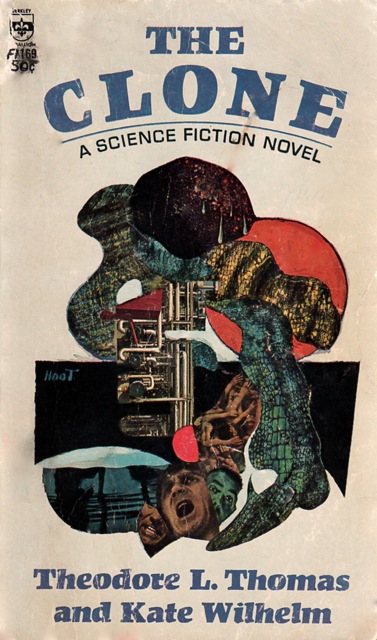
1. The Clone, Theodore L. Thomas and Kate Wilhelm (1965)

THECLONE1965

(Hoot von Zitzewitz’s cover for the 1965 edition) Continue reading

Guest Post: The Killer Thing, Kate Wilhelm (1967)

The sixth in my Kate Wilhelm’s SF Guest Post Series (original announcement and post list) comes via 2theD (twitter) over at Potpourri of Science Fiction Literature and Tongues of Speculation. He is a prolific blogger of vintage, translated, and newer science fiction.  Unfortunately, and much to my frustration (he knows!), he is on something of a hiatus (other than short story summaries and ratings).  Thus, when I approached him about participating in this series he volunteered one of his older reviews.  As I remembered it fondly, I agreed.

Thanks so much for contributing!

~

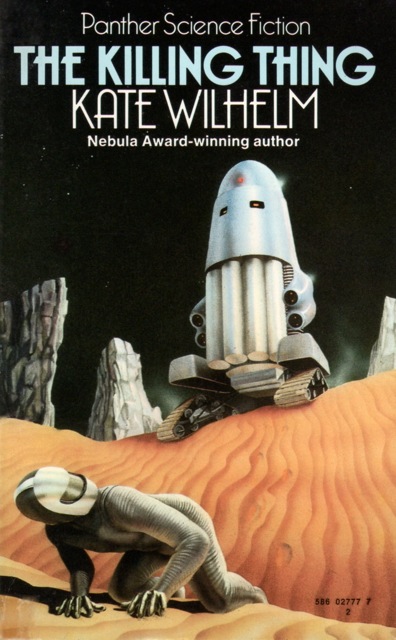
THKLLNGTHN1972

(Patrick Goodfellow’s (?) cover for the 1972 edition)

Kate Wilhelm is among a handful of female science fiction writers who need no introduction. She’s authored scores of short stories, about thirty-six genre novels, and eleven collections. She’s probably more prolific than many common and respectable male authors, yet she receives very little of the limelight that’s due to her (outside of SFMistress’s occasional posting on her work). Of her novels, I read her most popular work Where Late the Sweet Birds Sang (1976) and the much lesser popular Let the Fire Fall (1969), their respective popularity very much reflecting their quality. The two-story collection in Abyss (1971) had some Continue reading

Guest Post: Year of the Cloud, Kate Wilhelm and Theodore L. Thomas (1970)

The third in my Kate Wilhelm’s SF Guest Post Series (original announcement and post list) comes via Mike White (twitter)—a research biologist at Washington University in St. Louis, MO—who blogs on mostly early SF (pre-1920) and a variety of science topics with a whole cast of other writers at The Finch and the Pea (a “public house for science”).  This is his first contribution to one of my guest post series and it is greatly appreciated (and won’t be his last).

He selected, on purpose (in very Joachim Boaz fashion I might add), what might be Kate Wilhelm’s least known SF novel.  Early in her career she wrote two novels with Theodore L. Thomas: the Nebula-nominated The Clone (1965) and Year of the Cloud (1970).

~

RFTHCLDXVQ1971

(Francois Colos’ cover for the 1970 edition)

Post-apocalyptic stories do many things, one of which is to question our mastery of nature. We’re used to relying on technology to bend the world to our will — science stands between us and the brute forces of nature. Extinction is for lesser species. But post-apocalyptic stories remind us of all the ways that nature could wipe us out: the Earth could collide with a comet or pass through a toxic cloud of space gas, the sun could fade or go nova, or some pandemic plague could arise that kills us directly, wipes out our food supply, or turns us into the walking dead.

As horrifying as these events would be in real life, there is a strain of post-apocalyptic fiction that doesn’t see these disasters as all bad. Killing off most of humanity offers, in fiction anyway, a chance to wipe the slate clean and start over. With the post-holocaust world much less crowded, noisy, and Continue reading

Updates: Recent Science Fiction Acquisitions No. CXXIV (Jakes + Anthology + Malzberg + Zelazny)

Roger Zelazny’s most radical (according to some critics) novel…

A fun Ace Double with a rather disturbing face imprisoned in a skull cover by Kelly Freas….

More Malzberg (one can never have enough)…

And another anthology from the single best year of SF — 1972!  (my opinion of course).

Thoughts?

1. Tonight We Steal The Stars / The Wagered World, John Jakes / Laurence M. Janifer and S. J. Treibich (1969) (Ace Double)

(Kelly Freas’ cover for the 1969 edition) Continue reading

Book Review: Friends Come in Boxes, Michael G. Coney (1973)

(John Holmes’ cover for the 1973 edition)

4.25/5 (Good)

“KEEP A CLEAN SHEET OR YOU’LL END UP AS MEAT” (72)

Michael G. Coney’s focus on everyday struggles—the normal minutiae of life—reached wonderful heights in the lyrical paean to youth and youthful travails Hello Summer, Goodbye (variant title: Rax) (1975).  While the true import of Hello Summer, Goodbye‘s narrative only slowly unfurls as the young man comes of age and perceives more about his world, the world of  Friends Come in Boxes (1973) relentlessly writhes and boils as each main character is compelled to commit a crime Continue reading

Updates: Recent Science Fiction Acquisitions No. CXXVIII (Malzberg + Robinson + Berk + Ball)

A few more books from Carl V. Anderson‘s gift + two acquisitions of my own.  Including my first Spider Robinson novel, an unknown post-apocalyptical quantity via Howard Beck, and more pulp by Brian N. Ball—not going to lie, Singularity Station (1973) was fun!

I now own a nearly complete Barry N. Malzberg collection of his SF solo works (i.e. no co-written novels with Bill Pronzini).  What I am missing: his first two novels which are more speculative rather than SF, Oracle of a Thousand Hands (1968), Screen (1968), his SF novel Scop (1976), his movie novelization Phase IV (1973) which I have held off buying despite seeing it for cheap in used stores, and his non-SF novel Underlay (1974).  I have all his collections of short fiction pre-1994 other than Final War and Other Fantasies (1969), The Best of Barry N. Malzberg (1976), and Down Here in Dream Quarter (1976).

Thus, I own a grand total of 28 Malzberg novels and collections!

Thoughts?

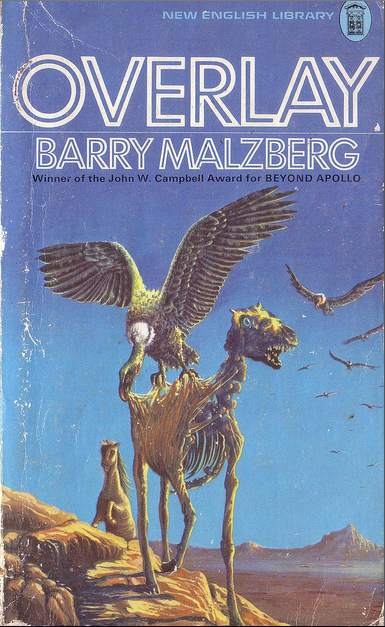
1. Overlay, Barry N. Malzberg (1972)

Screen shot 2015-03-11 at 10.14.49 AM

(Ray Feibush’s cover for the 1975 edition) Continue reading