SF Article: Barry N. Malzberg (b.1939): Metafiction and the Demystification of the Cult of the Astronaut

This was my recent guest post on Little Red Reviewer.

For those who didn’t see it I decided to post it here….

——-

 Barry N. Malzberg (b. 1939): Metafiction and the Demystification of the Cult of the Astronaut

Screen shot 2013-01-14 at 1.55.20 PM

In the World Book Encyclopedia Science Service publication The United States Astronauts and their Families: A Pictorial Presentation (1965), each astronaut is allotted a two-page spread replete with staged photos of their family life and hobbies.  Otis L. Wiese, the editor of the volume, proclaims grandiosely “Man’s reach for the world of space is born of his insatiable curiosity about the unknown… his indomitable drive for accomplishment… his instinctive response to a challenge. Astronauts-Husbands-Fathers: these men are the men featured here but it’s essentially as family men that we portray them” (i).

The photographs are fascinating.  Roger B. Chaffee’s wife Martha teaches him lunar geography (22), L. Gordon Cooper, Jr. sits at the helm of his speedboat Bluebonnet which is capable of reaching 80 knots (28), in another photo him and his family spend time with their German shepherd (29), Donn F. Eisele teaches his daughter “the finer points of marksmanship” (35), while Alan B. Shepard, Jr. plays piano tunes for his daughters (61) and in the facing image shakes hands with John F. Kennedy (61).

Their families illustrate the epitome of the American family: the ultra-masculine man with his cars and boats, the supportive wife facilitating Continue reading

Updates: Recent Science Fiction Acquisitions No. XLVIV (Crowley + Strete + McAllister + Bond)

Christmas presents!

Intriguing literary sci-fi by Craig Strete and John Crowley…

Works of unknown quality, Bruce McAllister’s Humanity Prime (1971) and Nelson Bond’s collection No Time Like the Future (1954)…

And one of my favorite Powers’ covers.

1. Humanity Prime, Bruce McAllister (1971)

(David Meltzer’s cover for the 1971 edition) Continue reading

Book Review: What Entropy Means to Me, George Alec Effinger (1972)

(Stanislaw Hernandez’s cover for the 1973 edition)

5/5 (Masterpiece) (*caveats below*)

Nominated for the 1973 Nebula Award (lost to Asimov’s disappointing The Gods Themselves)

“She was Our Mother, so she cried.  She used to sit out there, under that micha tree, all day as we worked cursing in her fields.  She sat there during the freezing nights, and we pretended that we could see her through the windows in the house, by the light of the moons and the hard, fast stars.  She sat there before most of us were born; she sat there until she died.  And all the time she shed her tears.  She was Our Mother, so she cried” (11)

What Entropy Means to Me (1972) is one of the more satisfying products of the New Wave science fiction movement of the 60s and 70s that I’ve read.  I place it in the pantheon of Malzberg’s Revelations (1972), Samuel Delany’s Nova (1968), and Brunner’s Stand on Zanzibar (1968).  Effinger revels, and I mean gloriously revels, in metafictional Continue reading

Adventures in Science Fiction Cover Art: Visualizing Time

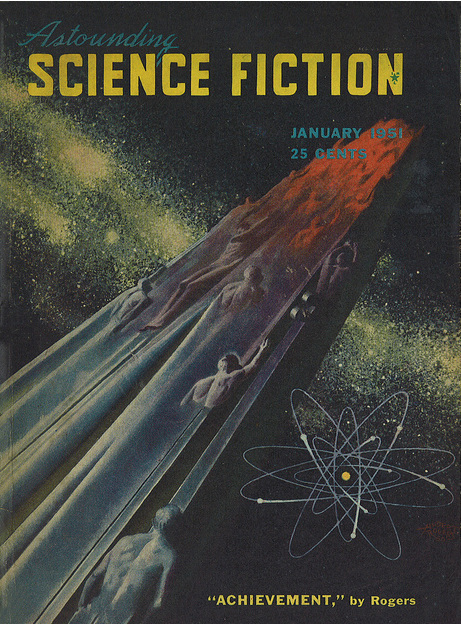
(Hubert Rogers’ cover for the January 1951 issue of Astounding Science Fiction)

In Hubert Rogers’ fascinating cover (titled ‘Achievement’) for the January 1951 issue of Astounding Science Fiction, mankind appears pulled upward, as if against their will, towards an undefined future goal.  Rogers’ cover encapsulates David Hume’s notion of historical time relentlessly moving towards improvement — improvement as something measurable and observable by the historian, and anyone who studies history.  Obviously, this historiographical framework has long been debunked (although it crops up in virtually all of my undergraduate students’ work in intro level courses) — it favors Western conceptions of progress, dismisses the achievements of non-European Continue reading

Updates: Recent Science Fiction Acquisitions N. XXXIX (Priest + Brunner + Crowley + Wallace + Duncan)

Ah, what a delightful group! A few from my father, a few from Marx books which I hadn’t posted yet….  Priest and Crowley’s novels involve fascinating worldscapes — a world winched across the horizon, a world at the top of a pillar…  Both are considered among the better stylists in science fiction and fantasy.

And, my 22nd (?) Brunner novel!  The Stone That Never Came Down (1973) — from his glory period of the late 60s-early 70s (this period produced Stand on Zanzibar, The Sheep Look Up, Shockwave Rider, The Jagged Orbit).

And two more impulsive finds — Ian Wallace’s Croyd (1967) — a reader claimed it was one of the best sci-fi novels of the 60s, and thus due to my intense curiosity, I had to find a copy.  And Dark Dominion (1954), I know little about David Duncan — he wrote only three sci-fi novels in the 50s.  His work is described by SF encyclopedia as “quietly eloquent, inherently memorable, worth remarking upon.”

And the covers!

1. The Inverted World, Christopher Priest (1974)

(Jack Fargasso’s cover for the 1975 edition) Continue reading

Updates: Recent Science Fiction Acquisitions N. XXXVIII (Spinrad + Harrison + Kavan + Effinger)

Ah, when I have access to a massive inexpensive catalogue (Marx Books) the quality of my finds goes up and up…..  Finally a copy of Norman Spinrad’s metafictional The Iron Dream (1972) (if Hitler lived in America and wrote a sci-fi novel AND a commentary on said piece of science fiction).  Unfortunately, I own a later edition (with a hideous cover) than the one below.  Geo. Alec Effinger’s bizarre What Entropy Means to Me (1972) — again, about writing, and interpreting writing, and inventing interpretation…  Anna Kavan’s drug inspired underrated and underread sci-fi parable Ice (1976).  AND, a futuristic fantasy of the highest caliber, M. John Harrison’s The Pastel City (1971) — yes, I could have purchased the multi-novel sequence (and related short stories) in one volume but I like having the original paperbacks.

1. The Iron Dream, Norman Spinrad (1972)

(Uncredited cover for the 1972 edition) Continue reading

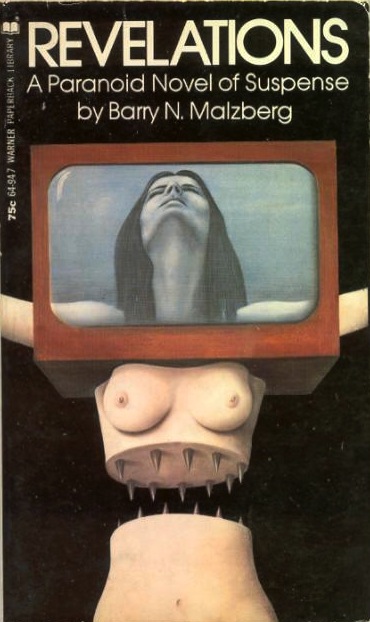
Book Review: Revelations, Barry N. Malzberg (1972)

(Michael Presley’s cover for the 1977 edition)

5/5 (Masterpiece)

Revelations (1972) is the second in a thematically linked group of Malzberg’s novels — published in-between its siblings, The Falling Astronauts (1971) and Beyond Apollo (1972) (from now on BA).  Each deals with insane astronauts, and in Malzberg’s own words, “sexual dysfunction as representing the necessary loss of energy of the machine age,” and each contains a character desperately attempting to speak out.  But, as with most of Malzberg’s novels, it is unclear whether there is truth in these cries.

Revelations is less rigorously structured than BA, which was characterized by 67 short tellings/retellings/scenes/dream moments all from the perspective of a single insane character.  As with BA, our anti-hero is an unreliable narrator, but due to the variety of diaristic, epistolary, and interrogatory fragments that comprise  Continue reading

Updates: Recent Science Fiction Acquisitions XXXV (Malzberg + Compton + Silverberg)

Books and short story collections from three of my favorite science fiction authors — Barry N. Malzberg, D. G. Compton, and Robert Silverberg…  A review of Malzberg’s masterpiece Revelations (1972) — almost as good as Beyond Apollo (1972) — is forthcoming.

I’ve recently discovered Marx Books — an online bookstore run by a retired professor (at Texas Tech University) and avid science fiction collector.  His collection is substantial and most importantly, he only bills you for the exact shipping (not sure if he ships internationally).  So, no $3.99 a book as Amazon does!  Instead, $3 shipping total for seven books!  Because Malzberg novels, and his short story collections, are so hard to find in used book stores it’s always nice to know I can pick up a copy quite cheaply online.

Another Richard Powers cover for my collection….

1. Revelations, Barry N. Malzberg (1972) (MY REVIEW)

(Uncredited cover for the 1972 edition)

From the back cover of the 1977 edition: “REVELATIONS is Continue reading

Adventures in Science Fiction Cover Art: Models, Dolls, Mannequins

(David Davies’ cover for the 1968 edition of The Syndic (1953), C. M. Kornbluth)

Occasionally I dabble in the incredibly esoteric and artistically painful.  Apparently in the 60s and the early 70s — heralded by the artist David Davies — there was momentary interest in sci-fi covers constructed from manipulated photographs of store window mannequins, dolls, wire contraptions vaguely suggesting spaceships, toy spacemen, wooden artist mannequins dressed in clothes/wigs, and copyright violating models of the Star Trek: The Original Series Enterprise NCC-1701.

Unfortunately, most of the covers I’ve discovered are uncredited — they might all be the work of David Davies.  Internet Speculative Fiction Database has seventeen of his covers listed but I suspect that he made many many more — I’ve gone ahead and credited a few Continue reading