Adventures in Science Fiction Art: Rampant Machines, The 60s Covers of Jerome Podwil

I’ve never been a fan of A. E. van Vogt.  A while back, having just finished his “masterpiece” The World of Null-A (1948), I headed to the used book store and saw Jerome Podwil’s cover for Vogt’s sequel, The Players of Null-A (1966) and had to pick it up.  Simply put, it is a spectacular piece of art.  Discovering Podwil’s Calder-esque machine extending its limbs across the plain made me pay more attention to the covers as art and the artists who made them.  Hence this series of posts! (Adventures in Science Fiction Art Index)

(Are any of the books worth reading? What’s your favorite of his work (perhaps one I haven’t listed)?)

(Cover for the 1966 edition of The Players of Null-A (1966), A. E. van Vogt)

Continue reading

Adventures in Science Fiction Cover Art: The Art of Robert Foster, Part I

Robert Foster produced only a handful of science fiction covers.  The most inventive graced a span of Frederik Pohl novels and short story collections released by Ballantine Books in the late 60s.  Sadly, I can find no information about the artist himself online (if you do please let me know).  Here’s a selection of the most interesting, haunting, and spectacular…

Part II (here)

Mechanical man — a bedraggled simulacra. Nude woman — embodiment of flesh.  A lunar landscape greets them…

(ranks among my favorite covers of all time)

(Cover for the 1969 edition of Turn Left at Thursday (1961), Frederik Pohl) Continue reading

Adventures in Science Fiction Cover Art: Assorted 1970s Surrealistic Faces by Richard Powers

This is the second post in a potential series of posts showcasing the science fiction cover art by Richard Powers (1921-1996). My first post discussed a few surrealist cityscape covers from the 1950s.  Here I’ve selected a variety of surrealistic, composite, conglomerated, and masked faces from his 1970s covers.

A delightful green human shape — mouthless — replete with translucent hollows?  emerging occupants or surfacing memories?

(Cover for the 1973 edition of All Flesh is Grass (1965), Clifford D. Simak)

The Eternal Frontiers utilizes another Continue reading

Adventures in Science Fiction Cover Art: The 1950s Surrealist Cityscapes of Richard Powers

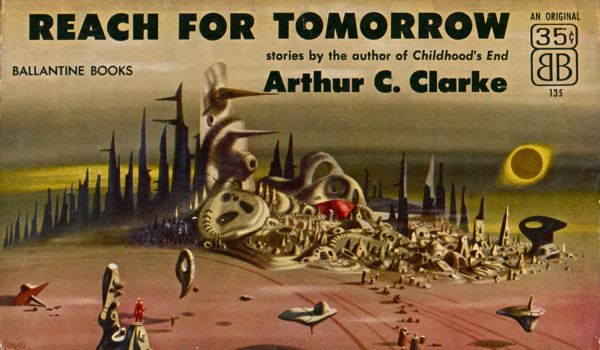
Richard Powers (1921-1996) is one of my favorite science fiction cover artists.  Heavily influenced by the likes of Yves Tanguey and Picasso, his delightful vein of surrealism graced the covers of multiple classics of the genre (for example, Simak’s City, Clarke’s Earthlight and The City and the Stars, Norton’s Sky Gate, Vonnegut’s The Sirens of Titan, Sturgeon’s More Than Human).  His covers are unmistakable and extremely easy to identify.  I’ve decided to showcase a few of his surrealist cityscapes.

(cover for 1956 edition of Reach for Tomorrow (1956), Arthur C. Clarke)

The cover for Reach for Tomorrow achieves a wonderful Continue reading

(mini) Film Ruminations: The Tree of Life (2011), Super 8 (2011), A Serious Man (2010), etc.

I do not write reviews for the majority of films I watch.  My reasons are somewhat nebulous considering it’s the summer and I certainly have time.  I see my blog more as a way to re-examine and bring to the forefront sci-fi books and films generally more esoteric and infrequently reviewed.  But certain winds shift direction for brief windows of time.  So here we go, a rundown of the more popular films I’ve seen in theater or re-watched recently.

The Tree of Life (2011), dir. Terrence Malick, rating 7.75/10 (Good)

tree_of_life_poster-xlarge

Terrence Malick’s The Tree of Life (2011) juxtaposes extensive sequences Continue reading

Update: Recent Science Fiction Acquisitions N. V

I promised not to buy any more books over the summer unless I ran out — alas, Memorial Day Sale at one of the best Half Price Books in the country (Austin) is a “bad” combination.  I had to reduce my gigantic pile by half before I dared approach the buy counter….

I’m proud of this haul!

1. Hawksbill Station (1968), Robert Silverberg (MY REVIEW)

I’ve wanted to procure Hawksbill Station for quite a while — the premise is fantastic, five dangerous prisoners are held at Hawksbill Station located in the Cambrian era… One bizarre use of time travel!  I hope Silverberg is at his best à la The World Inside and Downward to the Earth.

2. Master of Life and Death, Robert Continue reading

Book Review: And Chaos Died, Joanna Russ (1970)

4.5/5 (Very Good)

Nominated for the 1970 Nebula Award for Best Novel

“The ground was covered with old names…” (76)

Joanna Russ, famous for her feminist sci-fi novel The Female Man (1975), weaves together a bizarre (and difficult) novel filled with strange images, peculiar characters, and a fragmented/layered/bewildering narrative structure.  And Chaos Died (1970) is a startlingly original take on the staple sci-fi Continue reading

Update: Recent Science Fiction Acquisitions N. IV

I’ve finally acquired enough science fiction books to hold me (hopefully) over the summer YET few enough that I’ll clear out 90% of previous unread novels languishing in dark forgotten corners of my bookshelves….  A valiant statement I know.  Most likely more will arrive mysteriously in the mail — when I sleepwalk I buy books (books in the mail = evidence of sleepwalking)…

1. The Time Hoppers, Robert Silverberg (1967) (MY REVIEW)

https://i0.wp.com/www.isfdb.org/wiki/images/b/b4/THTMHPPRSC1968.jpg

Another overpopulation themed novel!  From the few reviews I’ve read this pales in Continue reading

Update: Sci-fi about the social ramifications of overpopulation, a call for suggestions


I need reading suggestions.

After reading John Brunner’s Hugo winning masterpiece Stand on Zanzibar (1968) a few years back I became entranced by science fiction exploring social themes (intelligently) extrapolated from a future Earth condition of extreme overpopulation.  In the recent months I’ve read and reviewed a glut of similarly themed works of uneven quality.  Many of these works were inspired by Paul and Anne Ehrlich’s non-fiction The Population Bomb (1968) which warned of the mass starvation of humans in the 1970s and 1980s as a result of overpopulation. Continue reading