Book Review: Herovit’s World, Barry N. Malzberg (1973)

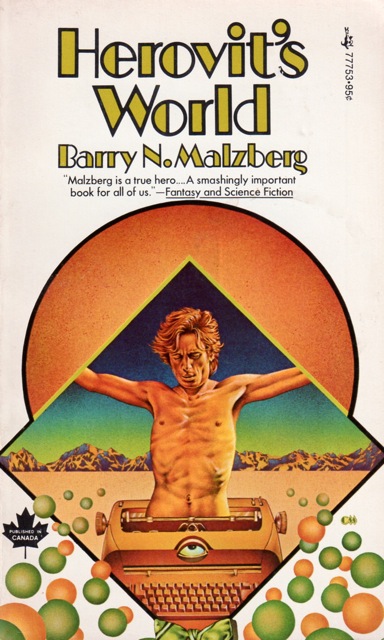
(Charles Moll’s cover for the 1974 edition)

3.5/5 (Good)

Note: Today is Barry N. Malzberg’s birthday!

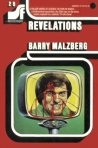
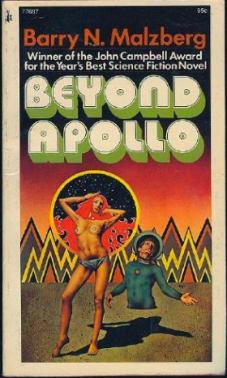
Upon reading In the Enclosure (1973) I was immediately seduced by Barry N. Malzberg’s metafictional brand of science fiction — best illustrated by his masterpieces Beyond Apollo (1972) and Revelations (1972).  Although Herovit’s World (1973) contains many of the same metafictional trademarks of Malzberg’s best work, it should be noted that the novel is not science fiction and more a work about writing (pulp) science fiction.  In this case, the mental collapse of a pulp writer whose life may or may not contain “true” autobiographical kernels from Malzberg’s own experience Continue reading

Updates: My 7 Favorite Metafictional Science Fiction Novels

Here are my seven favorite metafictional science fiction novels. By metafiction I’m referring to devices such as breaking the fourth wall (characters addressing the audience), the author addressing the reader, a story about a writer writing a story, a story containing another work of fiction within it, a work where the narrator reveals himself or herself as the author of the story, narrative footnotes, etc….

I’d love to hear your favorites (they don’t have to be novels)!

Obviously, these types of experimental works only appeal to some readers (especially fans of the sci-fi New Wave movement of the late 60s and early 70s) but I personally love seeing experimentation in an often — dare I say — stylistically stale genre.  Often, the metafictional aspects do not prevent authors from deploying traditional narratives.

 71nOA-QfpuL NSTNINT1967 RVLTNSXKSK1977

 THIRNDRM1972 MNINTHCST1974

My top seven (and an honorable mention):

1. Beyond Apollo, Brian N. Malzberg (1972) (REVIEW) — what you read is most likely the novel written by the main character. However, he’s most likely insane so attempting to get AT the true nature of his voyage to Venus is purposefully layered… Complicating the matter is how unreliable of a narrator he is and the fact that he’s tells many versions of the same story. Malzberg pokes fun at pulp science fiction throughout — which he clearly enjoyed as a child.

2. Stand on Zanzibar, John Brunner (1968) — the metafictional aspects are rather hidden in this New Wave masterpiece (my single favorite sci-fi novel).  Brunner’s vast (in scope and depth) mosaic of invented book fragments, advertising jingles, and narrative portions are interspersed with news articles taken from his own day — including the school shooting at the University of Texas in 1966.  Of course, as readers we’re geared to imagining that everything Continue reading

Adventures in Science Fiction Cover Art: On the Cross and Other Prophetic Imagery

Screen shot 2012-11-21 at 1.36.13 PM(Michael Whelan’s cover for the 1977 edition of The Gameplayers of Zan (1977), M. A. Foster)

On the cross, a future prophet (or false one)?  A martyr for a lost cause?  Or, some future priestly emissary of the Catholic church dispensing law on those gathered…. Perhaps some transformation of man to a godly state all hallowed and arrayed with religious accouterments of faith?  I’ve gathered a fun collection of science fiction prophets mostly decked out / depicted in distinctly Christian style.  

My favorite is Robert Foster’s cover for the 1970 edition of Behold the Man (1969) by Michael Moorcock…. And Gray Morrow’s cover for the 1970 edition of This Immortal (variant title: And Call Me Conrad) (1965) contains a fascinating color scheme — although there isn’t any mold on the figure’s face as Zelazny Continue reading

Updates: An Incomplete List of Worthwhile Classic Science Fiction Blogs/Resources

I love the idea of a community of science fiction reviewers — so I’ve put together a list of a handful of book review blogs focused on classic/slightly more esoteric science fiction.  Obviously there are plenty of great blogs I’ve omitted that have reviews of new releases or only occasional vintage science fiction….  Or, blogs that refrain from reviews of vintage science fiction unless participating in certain reading challenges….

Please visit them, comment on their reviews, and browse through their back catalogues.

1] Speculiction….: An under visited /commented on blog with quality book reviews of classic science fiction — however, the reviewer, Jesse, is limited by the lack of older science fiction available to him in Poland.  I especially enjoyed his reviews of Ballard’s “beautifully strange enigma” that is The Crystal World (1966) and of course, my favorite science fiction novel of all time, John Brunner’s magisterial Stand on Zanzibar (1968).  An index of his reviews can be found here.  He also has a good mix of newer science fiction reviews as well.

2] The PorPor Books Blog: SF and Fantasy Books 1968-1988: I find this blog Continue reading

Adventures in Science Fiction Cover Art: The Composite Cover (illustrating a multiplicity of scenes, stories, thematic elements) Part II

THTHRSDFTM1975

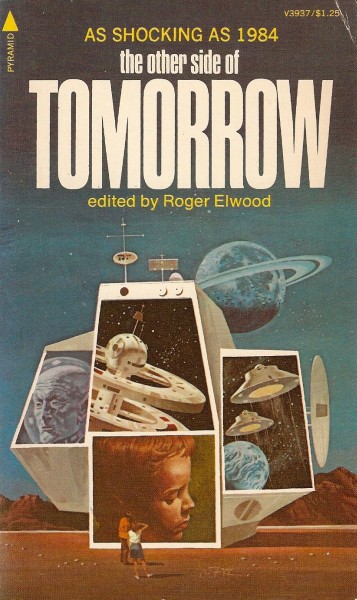
(Vincent di Fate’s cover for the 1975 edition of The Other Side of Tomorrow (1973), ed. Roger Elwood)

My second composite cover post — here’s a link to Part I if you missed it.  I’ve included a few covers by Vincent di Fate who has always been one of my favorite illustrators of the 1970s.  His cover for The Other Side of Tomorrow (1973) is top-notch.  A conglomerations of screens are placed on a barren stylized landscape where two figures gaze intently at them.  Each screen shows a different scene, a space station, spaceships, a boy’s contemplative face, an old man — and, a ringed planet looms in the background.  Whether or not the screens illustrate individual stories in the collection is unclear — regardless, the composite nature of the illustration is  Continue reading

Book Review: The Falling Astronauts, Barry N. Malzberg (1971)


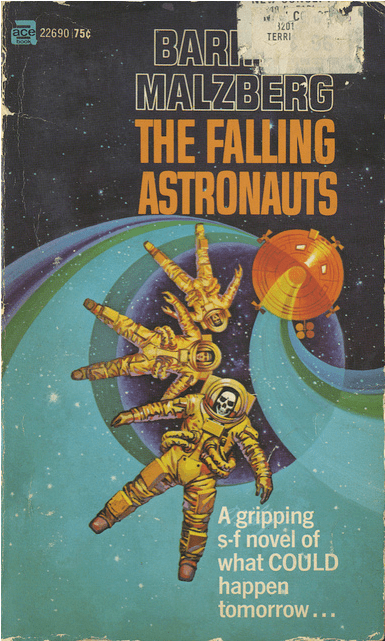
(Davis Meltzer’s cover for the 1971 edition)

4.25/5 (Good)

The Falling Astronauts (1971) (from now on FA) is the first in Barry N. Malzberg’s thematic trilogy on the American space program.  Although not as engaging or experimental as the other two masterpieces in the sequence — Beyond Apollo (1972) and Revelations (1972), FA is highly readable and a notable work in Malzberg’s extensive corpus.  FA attempts to debunk the so-called cult (in part propagated by the media) of the astronaut (and his ideal family) and in so doing questions the ultimate purpose of the space Continue reading

SF Article: Barry N. Malzberg (b.1939): Metafiction and the Demystification of the Cult of the Astronaut

This was my recent guest post on Little Red Reviewer.

For those who didn’t see it I decided to post it here….

——-

 Barry N. Malzberg (b. 1939): Metafiction and the Demystification of the Cult of the Astronaut

Screen shot 2013-01-14 at 1.55.20 PM

In the World Book Encyclopedia Science Service publication The United States Astronauts and their Families: A Pictorial Presentation (1965), each astronaut is allotted a two-page spread replete with staged photos of their family life and hobbies.  Otis L. Wiese, the editor of the volume, proclaims grandiosely “Man’s reach for the world of space is born of his insatiable curiosity about the unknown… his indomitable drive for accomplishment… his instinctive response to a challenge. Astronauts-Husbands-Fathers: these men are the men featured here but it’s essentially as family men that we portray them” (i).

The photographs are fascinating.  Roger B. Chaffee’s wife Martha teaches him lunar geography (22), L. Gordon Cooper, Jr. sits at the helm of his speedboat Bluebonnet which is capable of reaching 80 knots (28), in another photo him and his family spend time with their German shepherd (29), Donn F. Eisele teaches his daughter “the finer points of marksmanship” (35), while Alan B. Shepard, Jr. plays piano tunes for his daughters (61) and in the facing image shakes hands with John F. Kennedy (61).

Their families illustrate the epitome of the American family: the ultra-masculine man with his cars and boats, the supportive wife facilitating Continue reading

Updates: Recent Science Fiction Acquisitions N. XLII (Malzberg + Roshwald + Clement + Moorcock)

A nice selection of books from my fellow book reviewer at Potpourri of Science Fiction Literature and a few from a recent trip to Indianapolis — the fried chicken and waffles at Maxine’s were far superior to their used book stores….

My trilogy of dark/brilliant/disturbed Malzberg novels dealing with the space program, The Falling Astronauts (1971), Revelations (1972), and Beyond Apollo (1972) is now complete!  When I get around to reading The Falling Astronauts I will put together a special post with a series of intriguing space program documents given to me by my fiancé — including a hilarious 1965 publication, The Astronauts & Their Families, where real life astronauts pose with their happy families, play with puppies, teach their children to shoot rifles, pose with their cars, pretend to play at the piano, etc — i.e. the oposite of Malzberg’s vision of the “manliest” of American heroes…

The Moorcock novel, The Ice Schooner (1969) was a rather impulsive buy — I’ve yet to read any of his works, but voyagers to cities wreathed in ice is always a fun trope.

Level 7 (1959) is generally considered a Cold War masterpiece…

Clement’s Through the Eye of the Needle (1978) is the sequel to Needle (magazine 1949) — I’ll probably want to find a copy of the first in the series before I give the sequel a shot….

1. The Falling Astronauts, Barry N. Malzberg (1971) (MY REVIEW)

(Davis Meltzer’s cover Continue reading

Updates: Recent Acquisitions XXXVI (Malzberg + Gallun + Harrison + Silverberg)

More Marx Book purchases along with some random 99 cent thrift store finds (Raymond Z. Gallun + M. John Harrison)  that seemed intriguing enough.  I will eventually get to M. John Harrison’s magnum opus series of novels, Virconium– beginning with The Pastel City (1971) — but, as always, I approach an author’s masterpieces through an often circuitous manner.  I suspect my Malzberg find will be of a lesser quality than either Beyond Apollo (1972) or Revelations (1972).

I reviews I’ve found online of Gallun’s The Eden Cycle (1974) proclaim it an underrated masterpiece — with layers of virtual reality, etc.  I’ll read it soon…

As always, have you read any of these?  If so, what did you think?

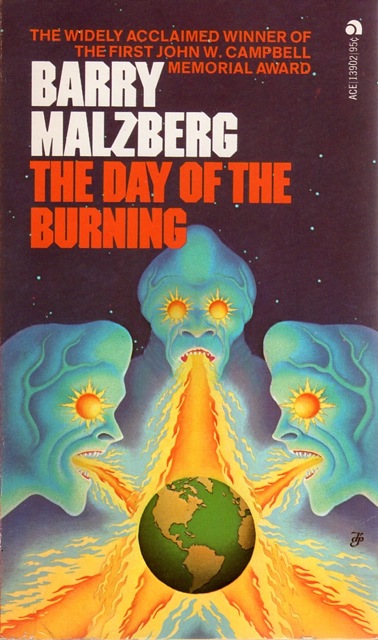
1. The Day of the Burning, Barry N. Malzberg (1974)

(Don Ivan Punchatz’s cover Continue reading