Science Fiction in Dialogue with The Great Depression: Frank K. Kelly’s “Famine on Mars” (1934)

Sherwood Anderson (1876-1941) confides in the introduction to his travel memoir Puzzled America (1935) that the Great Depression was inescapable: “I was a writer of tales. It might be that I should have remained just that, but there is difficulty. There are, everywhere in America, these people now out of work. There are women and children hungry and others without enough clothes.”1 Edgar Albion Lyons, in the author’s note to his science fiction novel The Chosen Race: A Novel Based on the Depression and Machine Age (1936), echoes this sentiment: “The following chapters were written during the months of 1932 when the words ‘Depression’ and ‘Unemployment’ were on everyone’s lips.”2 Magazine science fiction, with its eye towards the marvelous technological future, likewise could not escape contemporary economic, political, and societal convulsions.3 Science, “in the form of a hypothesized device or theory,” enabled exciting adventures but also the exploration of “diverse and dire social implications.”4

On May 9th, 1934, a massive two-day dust storm caused by severe drought and human-made factors, removed massive amounts of Great Plains topsoil. The Dust Bowl unleashed its fury. The dust clouds reached Chicago and cities in the east, blotted out the Statue of Liberty and the United States Capitol. Red snow fell in New England.5 In the September 1934 issue of Astounding, a twenty-year-old Frank K. Kelly published “Famine on Mars” (1934) about a desperate attempt to assist Martians dying of thirst and starvation after a drought. In Kelly’s vision, The Combine, Earth’s government, deliberately caused the genocide and refuses to provide assistance.6

Continue reading

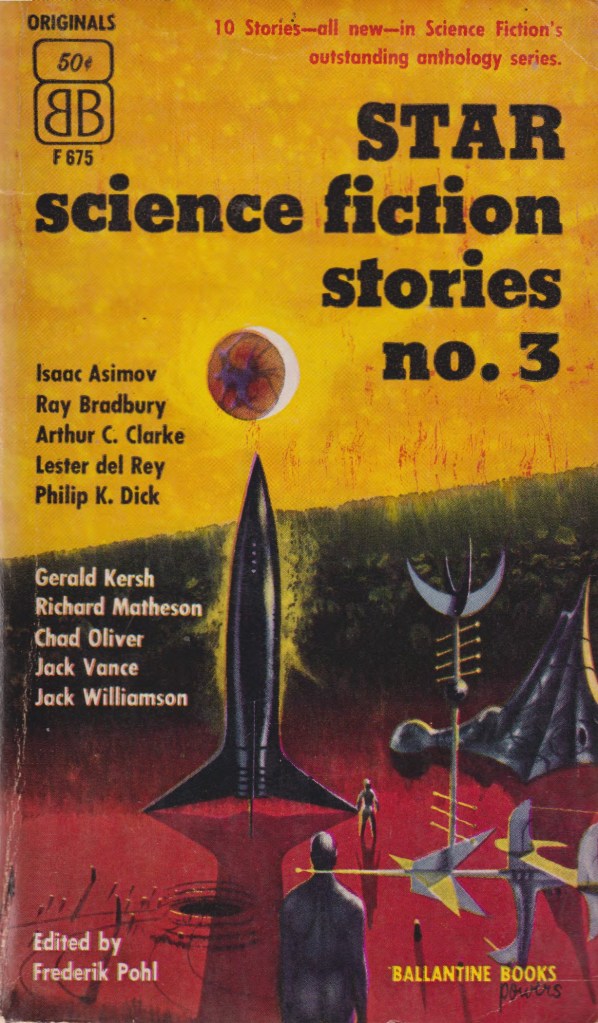
Book Review: Star Science Fiction Stories No. 3, ed. Frederik Pohl (1955)

3.5/5 (collated rating: Good)

Ballantine Books’ illustrious science fictional program started with a bang–Star Science Fiction Stories. According to Mike Ashley’s Transformations: The Story of Science-Fiction Magazines from 1950 to 1970 Frederik Pohl’s anthology series of original (mostly) stories was “intended as both a showcase of Ballantine’s authors and a lure to new writers.” Paying better rates than magazines, the Star series foreshadowed the explosion of original anthologies that would provide a sustained challenge to the eminence held in the 50s by the magazine.

I’ve selected the third volume of the six-volume series.1 It contains an illustrative cross-section of 50s science fiction. Philip K. Dick’s “Foster, You’re Dead” (1955), Richard Matheson’s “Dance of the Dead” (1955), and Jack Williamson’s “Guinevere for Everybody” (1955) are not to be missed.

Continue reading

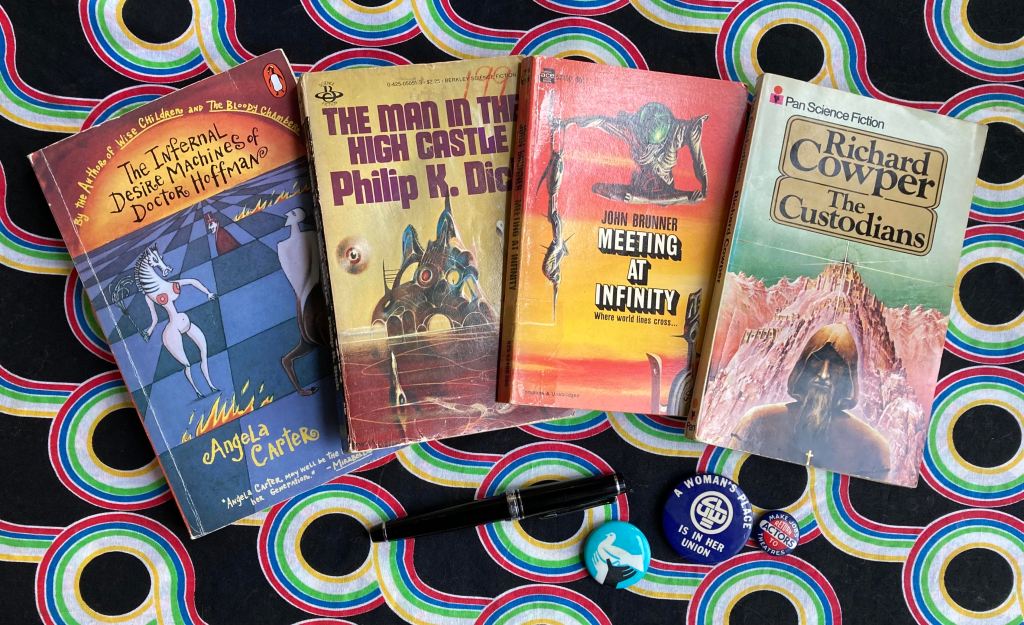
What pre-1985 science fiction are you reading? + Update No. XIX

What pre-1985 science fiction are you reading or planning to read this month? Here’s the December installment of this column.

Lost texts, and the act of reconstructing the fragments, fascinates. The questions pile up. Would the contents reveal a pattern in an author’s work? Intriguing personal details? A startling modus operandi? At the 11th World Science Fiction Convention (Philcon 2), Philadelphia (September 1953), Philip José Farmer gave a speech titled “SF and the Kinsey Report.” Considering Farmer’s recent publication of “The Lovers” (1952), this is not surprising. Alfred Kinsey, the famous sexologist and founder of the Kinsey Institute for Research in Sex, Gender, and Reproduction on Indiana University’s campus, published his controversial Sexual Behavior in the Human Male in 1948. Sexual Behavior in the Human Female appeared in 1953. Like many of Farmer’s earliest speeches, he did not keep copies.

Deeply intrigued by what the speech might have contained, Sanstone and I (on Bluesky) managed to piece together a few general responses from fanzines and magazine con reports.

Continue reading

My 2024 in Review (Best Science Fiction Novels and Short Fiction, Articles/Podcasts, Reading Initiatives, and Bonus Categories)

Here’s to a happy reading in 2025! I hope you had a successful reading year. Whether you are a lurker, occasional visitor, a regular commenter, a follower on Bluesky or Mastodon, thank you for your continued support. It’s hard to express how important (and encouraging) the discussions that occur in the comments, social media, and via email are to me. This was the third year running of record-breaking numbers of viewers and views in the 13-year history of my site. What were your favorite vintage SF reads–published pre-1985–of 2024? Let me know in the comments.

Clifford D. Simak defined my 2024. Starting with a February review of his collection Worlds Without End (1964), I embarked on a fiction and non-fiction reading extravaganza that culminated in my article for Journey Planet, which I spent most of the summer writing, titled “‘We Must Start Over Again and Find Some Other Way of Life’”’: The Role of Organized Labor in the 1940s and ’50s Science Fiction of Clifford D. Simak.” Despite his Grand Master status, there’s little scholarship on Simak’s work and so much more to be done. As expected, there was little response to the article outside of my website. I also wrote two Exploration Logs on six of his interviews and his 1971 Worldcon speech and contributed to a podcast on “The Huddling Place” (1944) (the second City story). Sometimes you find a little niche that you never expected to inhabit which you feel there’s so much more to explore and say. I hope my Simak focus continues into 2025.

Continue reading

Book Review: Future Power, ed. Jack Dann and Gardner Dozois (1976) (Ursula K. Le Guin, Damon Knight, James Tiptree, Jr., Gene Wolfe, etc.)

4/5 (collated rating: Good)

What a way to finish 2024! Future Powers, ed. Jack Dann and Gardner Dozois (1976) is a well-crafted thematic anthology with seven original stories and two older classics. Other than R. A. Lafferty’s average contribution, all the tales effectively engage with the theme of the complexities of future control both in everyday and the macropolitical contexts.

A few tantalizing fragments: Ursula K. Le Guin’s “The Diary of the Rose” (1976) explores the operations of dystopic control through the eyes of a neophyte doctor (“scopist”); Damon Knight ruminates on the nature and treatment of the psychopath in “The Country of the Kind” (1956); and A. K. Jorgensson’s “Coming-of-Age-Day” (1965) takes the reader through all the unnerving and confusing moments of a child in a strange future attempting to understand the nature of sex.

Continue reading

Short Story Review: Poul Anderson’s “The Troublemakers” (1953)

This is the 20th post in my series of vintage generation ship short fiction reviews. You are welcome to read and discuss along with me as I explore humanity’s visions of generational voyage. And thanks go out to all who have joined already. I also have compiled an extensive index of generation ship SF if you wish to track down my earlier reviews on the topic and any that you might want to read on your own.

Previously: Fred Saberhagen’s “Birthdays” (1976)

Next Up: George Hay’s Flight of the “Hesper” (1952)

3.25/5 (Above Average)

Poul Anderson’s “The Troublemakers” (1953) first appeared in Cosmos Science Fiction and Fantasy Magazine, ed. L. B. Cole (September 1953). You can read it online here.

Anderson’s tale is a fascinating collision of two of my recurring interests in post-WWII science fiction: generation ships and organized labor. Due to my love of Ursula K. Le Guin’s “Paradises Lost” (2002) and Brian W. Aldiss’ Non-Stop (variant title: Starship) (1959), I started a review series on generation ship short fiction in 2019. The series has languished recently as I am running out of pre-1985 depictions of the theme available in English to read. I read Anderson’s vision last year but could not muster a review. However, my recent focus on organized labor caused me to reread Anderson’s account of generational conflict, the working class experience, and the contours of power and government.

Continue reading

Book Review: In the Drift, Michael Swanwick (1985)

3.25/5 (Above Average)

In The Drift (1985), a fix-up novel comprised of two Nebula-nominated short works–“Mummer Kiss” (1981) and “Marrow Death” (1984), maps a new way forward in an ecologically and genetically ravaged post-apocalyptic age. The entire concoction decays with a sense of grim unease and cavorts around piles of dead that would make a triumvir from the Late Roman Republic proud. It’s a violent, erotic, and disquieting experience that can’t entirely hide its flaws behind the decadent panache.

Continue reading

What pre-1985 science fiction are you reading? + Update No. XVIII

What pre-1985 science fiction are you reading or planning to read this month? Here’s the November installment of this column.

Last week I wrote a post about Clifford D. Simak’s delightfully inclusive 1971 speech at the height of the New Wave in which he celebrated science fiction as a “forum of ideas” open to all voices. While reviewing the various snarky comments leveled at the movement by “classic authors” like Asimov, a faint memory of James Blish’s own anti-New Wave sentiments tickled my memory. I randomly opened up a book on my desk to figure out a fascinating SF tidbit to start this post, and voilà, the James Blish story.

Jacqueline Foertsch’s Reckoning Day: Race, Place, and the Atom Bomb in Postwar America (2013) contains a sustained analysis of Samuel R. Delany’s various post-apocalyptic novels. She includes a discussion of the response to Delany’s Nebula-winning The Einstein Intersection (1967). At the 1968 Nebula Awards Banquet, moments after Delany received his prize for Einstein (and where moments later he’d collected another award for “Aye, and Gomorrah”), Blish lambasted the New Wave. Blish complained about the “loosening of the genre’s parameters” and the “re-christening of the genre” as “speculative fiction” (98). I find all of this hilarious as Blish himself wrote fantasy novels like Black Easter (1968) (that would also nab a 1969 Nebula nomination) and far earlier oblique proto-New Wave speculative fictions like “Testament of Andros” (1953). I wonder if Blish aimed such vitriol at a figure like Simak, who took the loosening of the genre’s parameters to extremes during the New Wave–i.e. novels like The Goblin Reservation (1968), Destiny Doll (1971), and Out of Their Minds (1970). Unfortunately, I don’t think it’s surprising that Blish took especial issue with one of the few black SFF authors of the day.

And let me know what pre-1985 science fiction you’ve been reading!

Continue reading

Short Fiction Reviews: Leigh Kennedy’s “Salamander” (1977), “Whale Song” (1978), “Detailed Silence” (1980), and “Speaking10 to Others2; Speaking3 to Others20” (1981)

In the past few years, I’ve put together a series on the first three published short fictions by female authors who are completely new to me or whose most famous SF novels fall mostly outside the post-WWII to mid-1980s focus of my reading adventures.

Today I’ve selected the first four stories by an author I’ve only recently started to read–Leigh Kennedy (1951-). I’d previously reviewed “Helen, Whose Face Launched Twenty-Eight Conestoga Hovercraft” (1982) and placed her on the list for this series. According to SF Encyclopedia, Kennedy’s “writing is succinct, polished, lucent, and her stories are emotionally penetrating; it is unfortunate that she has fallen from the world of novel publishing, though continuing to work as a professional indexer.” And I can’t agree more! Her first four stories show great promise and moments of refined vision. I can’t help but think the backlash to her Nebula-nominated (and best-known work) “Her Furry Face” (1983) might have had some effect on her trajectory.

So far I’ve featured Alice Eleanor Jones (1916-1981), Phyllis Gotlieb (1926-2009), Sydney J. Van Scyoc (1939-2023), Josephine Saxton (1935-), Carol Emshwiller (1921-2019), Wilmar H. Shiras (1908-1990), Nancy Kress (1948-), Melisa Michaels (1946-2019), Lee Killough (1942-), Betsy Curtis (1917-2002), and Eleanor Arnason (1942-). To be clear, I do not expect transformative or brilliant things from first stories. Rather, it’s a way to get a sense of subject matter and concerns that first motivated authors to put pen to paper.

Let’s get to the stories!


Continue reading