What pre-1985 science fiction are you reading? + Update No. XXVII

What pre-1985 science fiction are you reading or planning to read next month? Here’s the October installment of this column.

If I’m feeling a bit unmotivated to write about science fiction, I always end up on Fanac or another online repository of fanzines/newspapers exploring all the old historical fannish debates. I especially enjoy their reports on various conventions and the community (from accepting to reactionary) that emerges. For example, the details I uncovered about a lost Philip José Farmer speech titled “SF and the Kinsey Report at the 11th World Science Fiction Convention (Philcon 2) in Philadelphia (September 1953) and Pat M. Kuras and Rob Schmieder’s article “When It Changed: Lesbians, Gay Men, and Science Fiction Fandom” (1980) on the first Worldcon panel with an openly LGBTQ topic: “The Closed Open Mind: Homophobia in Science Fiction Fantasy Stories” moderated by Jerry Jacks, one of the “early openly gay fans.” I recently edited a friend’s article for academic publication on the role of conventions in forming feminist and political activism. Conventions sound like fascinating places, at least from my historically-minded vantage point and lens.

Continue reading

Short Story Review: Izumi Suzuki’s “Terminal Boredom” (1984, trans. by Daniel Joseph 2021)

Today I’m joined again by Rachel S. Cordasco, the creator of the indispensable website and resource Speculative Fiction in Translation, for the sixth installment of our series exploring non-English language SF worlds. Last time we covered Arkady and Boris Strugatsky’s ruminative “Wanderers and Travellers” in International Science Fiction, ed. Frederik Pohl (November 1967).

Please note that Rachel and I are interested in learning about a large range of authors and works vs. only tracking down the best. That means we’ll encounter some stinkers. Thankfully, not this time! We got a powerful one.

Unfortunately, Izumi Suzuki’s “Terminal Boredom” (1984, trans. by Daniel Joseph 2021) does not exist online. A large range of her SF stories were translated and published in two volumes by Verso books with various translators. You can acquire Terminal Boredom (2021) and Hit Parade of Tears (2023) at relatively inexpensive prices online. Despite my substantial qualms with the editions (see my review below), I recommend acquiring them.

“Terminal Boredom” (1984) does double duty as the 35th installment of my review series on media landscapes of the future.

Previously:  George H. Smith’s “In the Imagicon” (1966).

Up Next: TBD

Enjoy!


Rachel S. Cordasco’s Review

In an article on the “iconoclast” Japanese sf writer Izumi Suzuki, Andrew Ridker distills her stories down to three words: “Ambivalence, disappointment, resignation: Suzuki’s stories speak so eloquently to our burnt-out moment that it’s easy to forget the importance of her cultural context” (LitHub, 5/7/21). We are indeed burnt out, more burnt out even than when Ridker was writing just four years ago. It’s now 2025 and time to face the fact that Facebook and YouTube have been around for over twenty years. The iPhone has been around for nearly that long, and for an entire year, the world was turned upside down during a pandemic, during which time we were even more closely connected to our devices. We’re burnt out by phones, by the rapidly-developing world of AI, by the streaming services that offer us so many choices that it’s nearly impossible to pick something to watch.

Continue reading

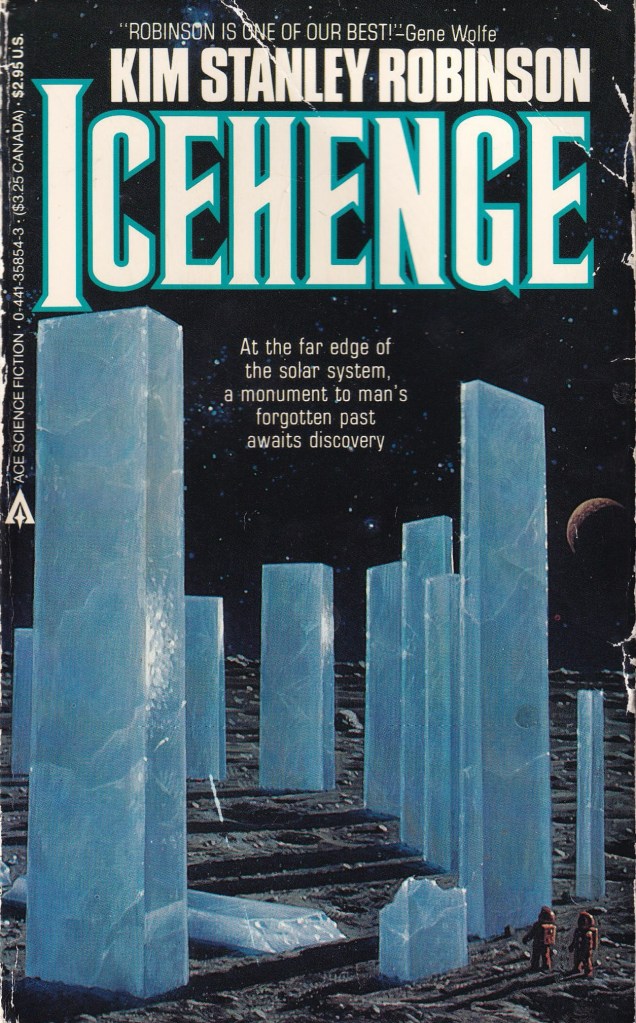
Updates: Recent Science Fiction Purchases No. CCCXLVI (Kim Stanley Robinson, Miriam Allen DeFord, Keith Laumer, and Jack Dann)

Which books/covers/authors intrigue you? Which have you read? Disliked? Enjoyed?

Finally acquired a new scanner!

1. The Memory of Whiteness, Kim Stanley Robinson (1985)

From the back cover: “In the 33rd century humanity is scattered among the planets of the Solar System. Millions of lives depend on the revolutionary physics of Arthur Holywelkin; millions of hears are moved by the music created by the strange, eerie instrument he built in the last years of his life: the Orchestra. Johannes Wright is the Ninth–and youngest–Master of the Orchestra. But as he sets out on his first Grand Tour of the Solar System, unseen foes are at his heel, ready to reveal all but the meaning of their enmity. In confronting them, Wright must redefine the Universe–for himself and all humanity.”

Continue reading

Book Review: Octavia E. Butler’s Clay’s Ark (1984)

4.5/5 (Very Good)

Octavia E. Butler’s Clay’s Ark (1984) is the final published volume of her Patternist sequence (1976-1984).1 It is the third novel according to the internal chronology of the series. Clay’s Ark is, without doubt, the most horrifyingly bleak science fiction novel I have ever read.2 It’s stark. It’s sinister. It’s at turns deeply affective before descending into extreme violence and displaced morality. The moral conundrum that underpins the central problem, the spread of an extraterrestrial disease, unfurls with an unnerving alien logic. Butler’s characters are trapped by the demands of the alien microbes, scarred by the pervasive sense that their humanity is slipping away, and consumed by the fear of starting an epidemic. A true confrontation of the moment cannot lead to anything other than suicide or the first steps towards an apocalyptic transformation.

Continue reading

What pre-1985 science fiction are you reading? + Update No. XXVI

What pre-1985 science fiction are you reading or planning to read next month? Here’s the August installment of this column.

The Power of the List. I adore lists. I’ve compiled lists of science fiction stories on my site about generation ship stories, immortality (abandoned), overpopulation (abandoned), and sports and games (abandoned). I religiously update my SF Novel and Short Story Review index and the Best SF Novels I’ve reviewed index. In your exploration of genre, I imagine you’ve encountered a “Best Of” list that horrified you — they tend to generate controversy, argument, and all sorts of impulsive takes. Lists can be dangerous. Lists can suggest canon. Lists exclude. Lists can be incomplete. Lists can motivate. Ian Sales, a long-time critic, author, and visitor to my site, created the SF Mistressworks (unfortunately, also abandoned) website in response to an egregious list that demonstrate utter ignorance about the wonderful SF written by women.

Continue reading

Short Fiction Reviews: George H. Smith’s “The Last Days of L.A.” (1959) and “In the Imagicon” (1966)

Back in 2021, I reviewed and adored George H. Smith’s “The Last Crusade” (1955), a scathing take-down of modern war (replete with confused soldiers in mech suits). While a good portion of Smith’s science fictional output was comedic smut with titles like Those Sexy Saucer People (1967) and Flames of Desire (1963), he clearly could craft an effective short fiction in the best genre magazines of the day.

I appeared recently on a podcast about Philip K. Dick’s masterpiece “Foster, You’re Dead” (1955) and felt the urge to track down story about nuclear terror. Smith’s drunk whirlwind of a story “The Last Days of L. A.” (1959) fits the bill. In addition, I selected “In the Imagicon” (1966), an intriguing take on a personal virtual reality machine, as the 34th story in my series on media landscapes of the future.

Previously in my future media series: Russell Bates’ “Hello, Walls and Fences” (1973) and “Warning: The Surgeon General Has Determined…:” (1977)

Up Next: Izumi Suzuki’s “Terminal Boredom” (1984)

Let’s get to the stories!


4/5 (Good)

“The Last Days of L. A.” first appeared in If, ed. Damon Knight (February 1959). You can read it online here.

Continue reading

Short Book Reviews: Joe Haldeman’s All My Sins Remembered (1977) and Burt Cole’s Subi: The Volcano (1957)

Note: My read but “waiting to be reviewed pile” is growing. Short rumination/tangents/impressions are a way to get through the stack before my memory and will fades. My website partially serves as a record of what I have read and a memory palace for future projects. Stay tuned for more detailed and analytical reviews.

1. Joe Haldeman’s All My Sins Remembered (1977)

4/5 (Good)

The vast Confederación is comprised of radically distinct worlds ruled by the entire spectrum of political systems with both alien and non-alien inhabitants. There are few rules: don’t take advantage of indigenous populations and don’t wage wars on neighboring planets. At 22, the naive Otto McGavin, an Anglo-Buddhist, joins the Confederación as an agent to “protect the rights of humans and non-humans” (1). But there’s a twist. Under “deep hypnosis” (6) a “construct” of Otto McGavin will be created for each mission. He’ll take on the identity–under a sheath of plasticine flesh–of whatever person he needs to be depending on the task. Otto, and all his training, will only kick in when his life is at risk.

Continue reading

What pre-1985 science fiction are you reading? + Update No. XXV

What pre-1985 science fiction are you reading or planning to read next month? Here’s the July installment of this column.

One of my favorite forms of SF scholarship is careful identification of a intellectual genealogy–tracing what an author read and engaged in dialogue with. Authors are readers. They also can’t escape references and textual traces of what they’ve consumed (or, of course, engagement with the world in which they lived).

I’ve read two interesting examples recently. The first, Carol McGuirk’s “J. G. Ballard and American Science Fiction” in Science Fiction Studies, vol. 49 (2022), is the perfect example of this type of scholarship. She traces Ballard’s engagement with SF, his earliest stories, and the various parallels an interactions between his work and American SF that he read (Galaxy Magazine, Theodore Sturgeon, Fritz Leiber, Robert Heinlein, Frederik Pohl, C. M. Kornbluth, Ray Bradbury, Judith Merril, Federic Brown, Henry Kuttner, C. L. Moore, etc.). She argues that Ballard engaged in “retelling with a twist” (476). She writes that “early Ballard stories rework prior sf in moods ranging from measured homage to barbed repose to parodic photo-bomb” (483).

Continue reading

Book Review: Jack Dann’s Timetipping (1980)

3.75/5 (collated rating: Good)

Alien sex dolls. Carpet stain entities constructing love-nests. Underground retirement community entertainment. Jack Dann’s stories obsessively chart the new rituals of survival in a blasted, irradiated, and decayed future. His characters attempt to identify their place in the world, or, at the very least, stay alive as the world shifts. If you do not care for anti-heroes, a good dose of dystopian perversity, and moments of metaphysical descent, Timetripping (1980) might not be for you. Four of the fourteen stories in the collection were nominated for the Nebula Award.

If you are a fan of the New Wave (and Barry N. Malzberg and Robert Silverberg in particular), and haven’t yet explored Dann’s nightmares, don’t wait as long as I did. Also, go ahead and snag a copy of his later masterpiece The Man Who Melted (1984). I’ve acquired copies of two early fix-up novels Junction (1981) and Starhiker (1976).

My 20 best short story reads of 2025 will undoubtedly include a handful of stories from Timetripping (1980). I found his best works—“The Dybbuk Dolls” (1975), “A Quiet Revolution for Death” (1978), “I’m with You in Rockland” (1972), and “Camps” (1979)—remain cohesive despite moments of metaphysical rumination and deluge of surreal image. Even at his least effective moments of narrative wander, Dann adeptly conjures image and turn of phrase.

Continue reading