John Brunner’s The Squares of the City (1965) transposes the moves of a 1892 chess game between Wilhelm Steinitz (1836-1900) and Mikhail Chigorin (1850-1905) onto a near future landscape of political intrigue. Inspired by Brazil’s planned capital Brasília (founded in 1960), the action takes place in Ciudad de Vados, the capital city of the imaginary Latin American nation of Aguazul.1 Conjured out of a “barren, rocky stretch of land,” Ciudad de Vados contains all the homogenized trappings of an ultra-modern metropolis (170). It’s sterile. Planned. Mechanized. Quickly the monumental urban regularity fades into the background and the intricate game across its squares takes over.
I’m a compulsive list maker. In the past few years I’ve gathered and submitted older science fiction short stories that depict worker unions–from Robert Silverberg’s “Guardian Devil” (1959) to Mari Wolf’s “Robots of the World! Arise!” (1952)–to the Hugo Book Club’s fantastic index. It’s about time I finally get around to reviewing a few of my submissions!1
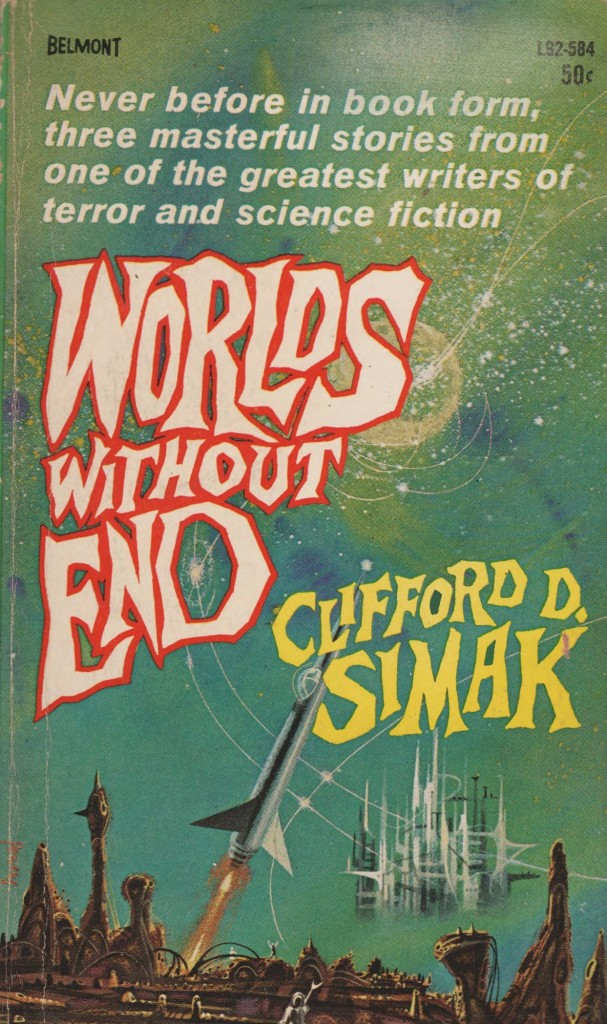
Clifford D. Simak’s collection Worlds Without End (1964) contains two novellas and one short story that appeared in Robert W. Lowndes’ magazines (second/third tier SF markets in the 50s). Two of three–“Worlds Without End” (1956) and “Full Cycle” (1955)–speculate on evolution of the trade union after the breakdown of the state.
Please note that I have not read enough to identify their best work and a negative review is not intended to be a statement about their entire oeuvre and impact on the genre. If you have any fond memories, recommendations for stories, or other tangents related to the three authors, let me know in the comments.
Terry Bisson (1942-2014) also passed away this year but did not publish any short fiction until the 90s. I’ll make sure to review one of his 80s novels—Wyrldmaker (1981) or Talking Man (1986)–this year instead. I’ve also procured novels by Purdom and Skal to feature later this year.
Now let’s get to the stories!
David Plourde’s cover art detail for the 1978 edition of Best Science Fiction Stories of the Year: Sixth Annual Collection, ed. Gardner Dozois (1977)
4.5/5 (Very Good)
Howard Waldrop’s “Mary Margaret Road-Grader” first appeared in Orbit 18, ed. Damon Knight (1976). If you have an Internet Archive account, you can read it online here.
Nominated for the 1977 Nebula Award for Best Short Story. Lost to Charles L. Grant’s “A Crowd of Shadows” (1976).
A selection of science fiction novels from my shelves
I hope you’ve gotten off to a great reading start to 2024! What pre-1985 science fiction are you reading this month?
If you’re new and curious about my rationale for the perimeters of my site, check out this recent interview and podcast. And follow me on Mastodon if you don’t already as I no longer post on my Twitter account. Also make sure to check out the previous installment of this monthly column
And, most importantly, let me know what pre-1985 SF you’ve been reading!
The Photograph (with links to reviews and brief thoughts)
Adrian Mitchell’s The Bodyguard (1970) might be one of the oddest dystopias ever written.
Kate Wilhelm’s Where Late the Sweet Birds Sang (1976) is a fascinating peek into her vast oeuvre of disquieting visions. While I read it before I started my site, a friend reviewed it for my guest post series on Wilhelm’s fiction. As I recently covered Wilhelm’s far lesser known anti-Vietnam War novel The Killing Thing (1967), her work was on my mind.
M. John Harrison is rightly famous for his Viriconium Nights sequence: The Pastel City(1971), A Storm of Wings(1980), and In Viriconium (1982). If you enjoyed them, I highly recommend tracking down his first novel — The Committed Men(1971). From my review: “Possessed by destructive melancholy, the inhabitants of a post-apocalyptical UK–where political powers have sunk into oblivion–attempt to recreate a semblance of normalcy. Clement St John Wendover, teeth long since rotted, still administers to the skin diseases and ailments of his one-time patients although he cannot cure them. […] Gathering together a troop of “committed men” (and a woman!), Wendover sets off across the corroded landscape with a newborn mutant child: a new species for an altered Earth or an accidental abnormality….”
I recently covered a Barrington J. Bayley short story in my cities of the future series and it reminded me of his most extreme moments of off-the-wall invention — The Garments of Caean (1976) immediately came to mind.
To quote a much younger me: “I’ve always been fascinated by imaginary and historical cities: the utopian (Tommaso Campanella’s 1602 work The City of the Sun), the allegorical (Calvino’s Invisible Cities), the multi-layered (Ancient, Medieval, and Renaissance Rome), the planned (Palmanova), the [fantastically] decaying (Jeff VanderMeer’s Ambergris), the multi-tiered (Tolkein’s Minas Tirith)…”
The science-fictional examples–from the urban gestalt of San Francisco in John Shirley’s City Come A-Walkin’(1980) to the arcologies of an overpopulated world in Robert Silverberg’s The World Inside (1971)–hold special appeal. As manifestations of societal decadence and vice or vibrant communities of interaction and discovery, they often become characters—changing and evolving over the course of the narrative.
To inaugurate my brand new short story review series on The Urban Landscape in Science Fiction, I’ve selected one of my favorite SF short stories: Michael Bishop’s “The Windows in Dante’s Hell” (1973). Bishop adeptly renders a human drama in a future Atlanta, replete with soaring dome and nine subterranean levels. I’ve paired it with two stories entirely new to me: Barrington J. Bayley’s “Exit from City 5” (1971) and A. J. Deutsch’s “A Subway Named Mobius” (1953). Bayley depicts a city as generation ship. A. J. Deutsch imagines a mathematical mystery within a rapidly expanding metro system underneath a future Boston.
Let me know if you have any favorite city-centric short stories that I haven’t covered on the site published pre-1985 that I could include in this series.
Michael Bishop’s “The Windows in Dante’s Hell” first appeared in Orbit 12, ed. Damon Knight (1973). If you have an Internet Archive account, you can read it online here.
Here’s to a happy 2024! I hope you had a successful reading year. Maybe you pulled down some dusty tome that you’ve wanted to dive into for a decade. I’d like to imagine you finally picked up a book I raved about in years past that you acquired with great anticipation but never opened. Whether you are a lurker, occasional visitor, or a regular commenter, thank you for your continued support and wonderful conversation.
What were your favorite vintage SF reads–published pre-1985–of 2023? Let me know in the comments.
Continuing a trend, I read only a handful of novels this year. Instead, my obsessions focused on my science short story review initiatives (listed below), collections, and histories of the science fiction genre. Without further ado, here are my favorite novels and short stories I read in 2023 with bonus categories. I made sure to link my longer reviews where applicable if you want a deeper dive into the rich seam of science fictional gems.
Check out last year’s rundown if you haven’t already for more spectacular reads. I have archived all my annual rundowns on my article index page if you wanted to peruse earlier years.
My Top 5 Science Fiction Novels of 2023
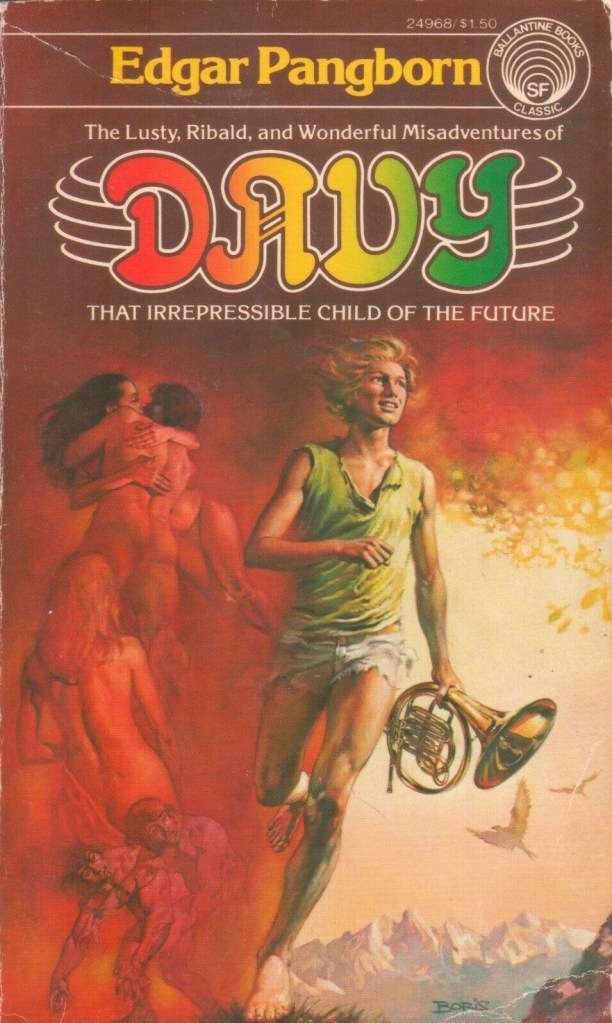
Boris Vallejo’s cover for the 1976 edition
1. Edgar Pangborn’s Davy(1964), 5/5 (Masterpiece): Nominated for the 1965 Hugo Award for Best Novel. Full review.
"There is a world of experience and culture that is exclusively Amerindian that has never been told. That I have set out to try to relate what I can of this world is audacious, perhaps. But there was simply no way I could have done otherwise, even if I had consciously tried" -- Russell Bates' intro to "Rite of Encounter" (May 1973)
With this post I complete my micro-series covering the short fiction of Kiowa author Russell Bates (1941-2018), one of a handful of Native American science fiction authors active in the 1970s. In Part I, I provided a short biography and what I could find about his writing career including contributing to Star Trek: The Animated Series (1973-1974), and reviewed his first three short stories.
In this post, I’ll cover his three remaining published non-franchise science fiction stories. He also wrote “The Patient Parasites” anthologized in Star Trek: The New Voyages 2, ed. Myrna Culbreath and Sondra Marshak (1978) that I won’t feature. Unfortunately, his submission–“Search Cycle: Beginning and Ending 1. The Last Quest; 2. Fifth and Last Horseman”–to Harlan Ellison’s infamous Last Dangerous Visions, slated for 1973, still has not seen the light of day.
“Hello, Walls and Fences” (1973) and “Warning: The Surgeon General Has Determined…:” (1977) also serve as the 32nd and 33rd story in my media landscapes of the future series.
Previously: Edmond Hamilton’s “Requiem” (1962) and John Anthony West’s “George” (1961)
“Hello, Walls and Fences” first appeared in Infinity Five, ed. Robert Hoskins (1973). You can read it online here.
A bleak allegory of the societal forces that compel the creative to sell their souls, “Hello, Walls and Fences” follows a nameless narrator attempting to find work from a mysterious tycoon named Thornton, who spends his days on a technologically advanced estate playing wickets and eating cheese. The work itself isn’t entirely clear: it might concern computer programing for massive one-time military “hologrammers” that Thornton places across his oasis (70).
What pre-1985 science fiction are you reading this week?
I’ve settled on a monthly schedule for this column. Check out the previous installment!
If you’re new and curious about my rationale for the perimeters of my site, check out this recent interview and podcast. And follow me on Mastodon if you don’t already as I no longer post on my Twitter account.
And, most importantly, let me know what pre-1985 SF you’ve been reading!
The Photograph (with links to reviews and brief thoughts)
Judith Merril’s collection contains one of the feminist visions of the 50s — “Daughters of Earth” (1952). Reworking a standard pulp plot of alien contact, Merril recasts the encounter through multiple generations of women in one family. She adeptly inverts the Old Testament trope of tracing generations through fathers. Simultaneously, the story itself is a metatextual collection of rewritten family documents containing the lessons necessary for future daughters in the family. Brilliant and heady stuff.
Barry N. Malzberg’s The Men Inside(1973) remains one of his strangest works. A perverse (and Freudian) metafictional (and literary) retelling of Otto Klement and Jerome Bixby’s Fantastic Voyage replete with filmic flashbacks… For Malzberg fans only — if you’ve missed this one, track it down.
And now for something completely different: Murray Leinster’s S.O.S From Three Worlds (1967). I am unsure why I enjoy Leinster’s Med Service so much. Sometimes positivist stories about spacemen devoted to selfless service solving medical crises–and reigning in rampant unchecked capitalism–with their friendly tormals (think furry mobile petri dishes) bring a bit of warmth to my bitter heart.
I sneakily consumed Joe Haldeman’s masterpiece The Forever War (1975) while working my first job as an oil change cashier. In-between angry customers and running domestic incidents, I relished every moment of Haldeman’s defiant Vietnam War satire. As I’ve only reviewed Mindbridge (1976) on the site (I’ve read a bunch more), I’ve been meaning to return his work — maybe a resolution for 2024.