Adventures in Science Fiction Interior Art: Monday Maps and Diagrams (Science Fiction) 1/21/19 — Larry Niven’s The Integral Trees (1984)

Monday Maps and Diagrams 1/21/19

Larry Niven’s output often revolves around “hard” (and often scientifically impossible–*cough* Ringworld) SF premises. The Integral Trees (serialized 1983) is no different. The action in this Nebula and Hugo Award-nominated novel takes place within a “gas torus, a ring of air around a neutron star.” In my Larry Niven period (late teens) I’m convinced I read this one — and possibly its sequel The Smoke Ring (1987), but I remember little. Same thing goes for Ringworld, which, other than its basic premise, was incredibly bland….

As with last week’s installment, Shelly Shapiro created the interior diagram.

The Diagram (click to enlarge):

Continue reading

Updates: Recent Science Fiction Acquisitions No. CCI (Le Guin + Van Herck + Leinster + High + Analog Anthology)

1. I’ve acquired quite a few vintage SF novels and short story collections in translation over the last few weeks–here’s one from Paul Van Herck, a Belgian author who wrote in Dutch. Not the cheapest DAW books edition I’ve encountered….

2. I always want more Le Guin…. Here, a series of linked short stories set in a fantasy world.

3. This Analog Annual anthology contains the only publication of P. J. Plauger’s novel Fighting Madness. Plauger won the John Campbell Award for Best New Science Fiction Writer before fading from the scene.

4. I love vintage SF. I do not love Ace Doubles. Yes, they published a few PKD novels that are worth reading, but, on the whole, I find their quality quite low. This was a gift from a family friend and one of the very few Ace Doubles I’ve been looking for — mostly due to Philip E. High’s city-themed novel.

As always, enjoy the covers! (they are hi-res scans of my personal copies — click for larger image)

Are any other the works worth reading? Let me know in the comments!

EDIT: I was too harsh on my Ace Doubles comment. I realized, and mentioned in the post and comments below, that they also published early PKD, Samuel Delany, and Barry N. Malzberg novels and short story collections, etc. Due to my low tolerance of pulp, I still find the vast majority of them uninteresting.

1. Where Were You Last Pluterday?, Paul Van Herck (1968, trans. 1973)

(Karel Thole’s cover for the 1973 edition) Continue reading

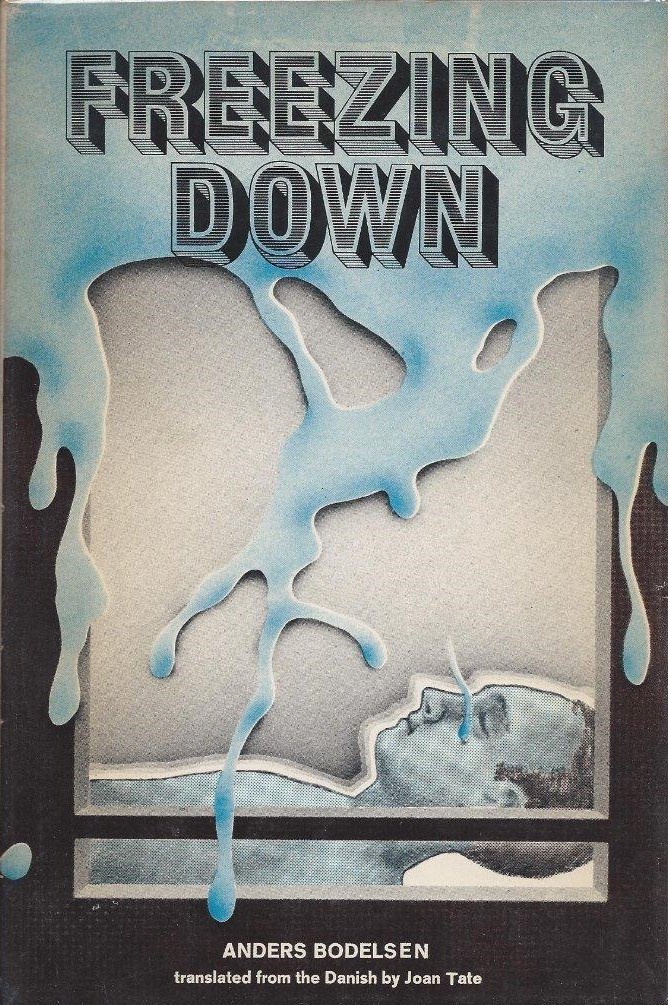
Book Review: Freezing Down, Anders Bodelsen (1969, trans. 1971)


(Cloud Studio’s cover for the 1971 edition)

4.5/5 (Very Good)

Anders Bodelsen’s Freezing Down (1969, trans. 1971) is a harrowing collision of SF tropes and the emotional landscape of Scandinavian noir. Bodelsen, “primarily associated with 1960s New-Realism in Danish literature,” might be best known to English-speaking audiences for writing the source material for the 1978 heist film The Silent Partner, starring Christopher Plummer and Elliott Gould.

Freezing Down, Bodelsen’s lone SF work, is an icy and complex (despite its brief length) speculation on the promise of immortality.  Continue reading

Updates: Recent Science Fiction Acquisitions No. CC “Foreign Vintage SF Edition” (Dutch SF Anthology + World SF Anthology + Non-English Language European SF Anthology + and a Czech Collection)

(Gianni Benvenuti’s back cover art detail for the 1978 edition of View from Another Shore (1973), ed. Franz Rottensteiner)

A Vintage Foreign SF Acquisitions Post!

Over the last few weeks, I’ve acquired three anthologies that gather vintage SF in translation from Japan to Denmark. I’ve also included in this post a single author collection of Czech 50s/60s science fiction. In addition to my initial thoughts, I’ve noted the non-English language countries covered in each volume. This is an incredibly exciting group of books as I know little to nothing about the individual authors and their works and can’t wait to explore….

1. Fantastic ruined city cover with exploring spaceman…. At first glance, this collection contains a substantial number of fantasy stories–I wish I knew which ones were SF!

Countries: Denmark and Belgium (specifically, the Dutch-speaking regions).

2. Maxim Jakubowski’s anthology deliberately gathers stories from a range of countries (many are English-speaking) including a few famous English-speaking authors (Brian W. Aldiss, Michael Moorcock, Cherry Wilder, John Sladek, etc.). In a humorous touch, he includes one of his own stories under the name Adam Barnett-Foster from the country of San Serriffe. As I knew immediately that this wasn’t a real country, a quick Wikipedia search reveals it was a fictional island nation created by Britain’s Guardian for April Fools’ Day 1977!

(Real) Countries: Romania, West Germany, France, USSR, The Netherlands, Japan, Spain, Sweden, Poland.

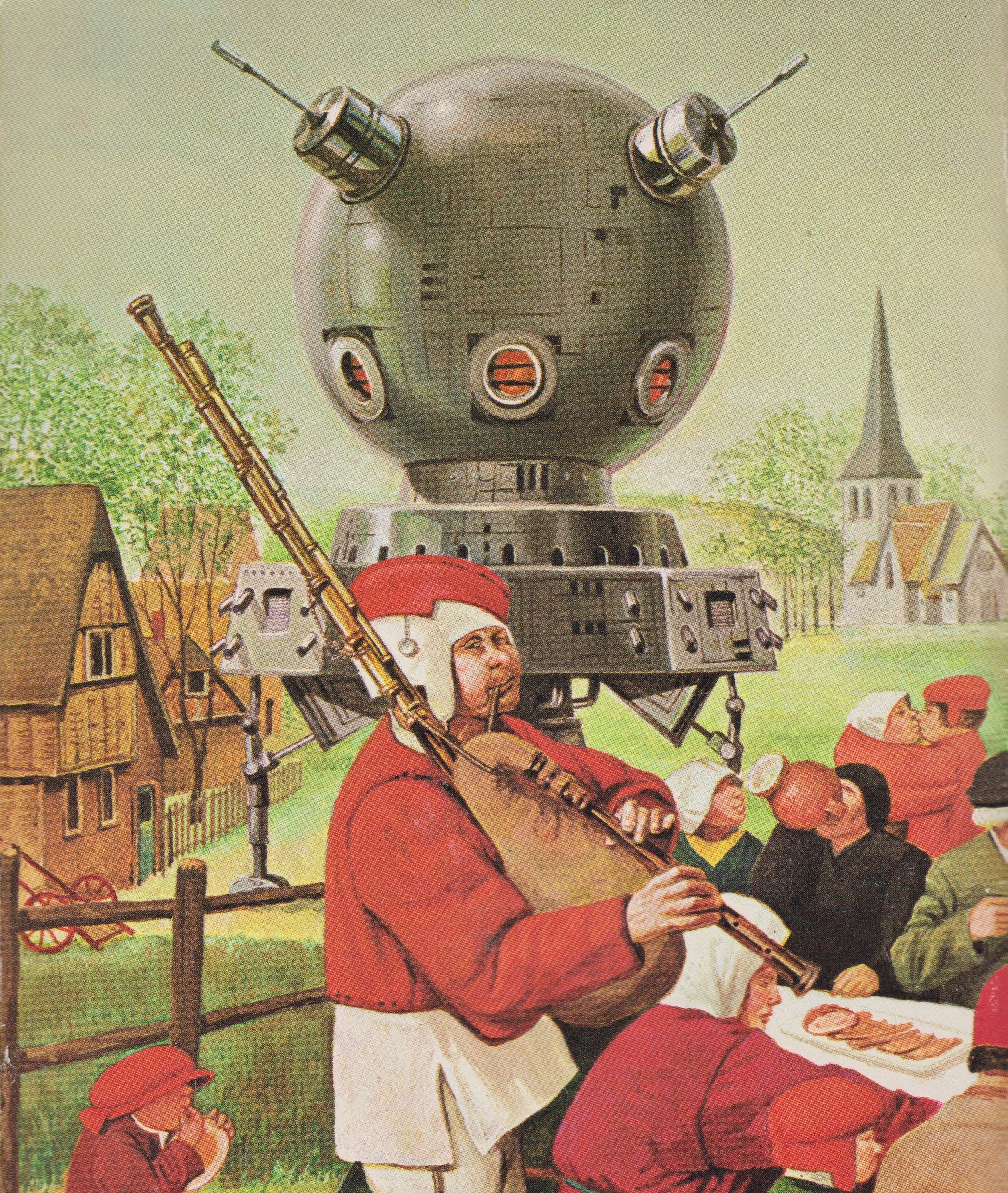
3. Entirely non-English language European SF in translation… I enjoyed the humorous cover.

Countries: Poland, France, Denmark, West Germany, Czechoslovakia, Romania, Italy, USSR.

4. One of the few non-Soviet single-language vintage SF collections I’ve encountered–Josef Nesvadba, Czechoslovakia (modern day Czech Republic). Of the four included in the collection, Nesvadba’s collection beckons most seductively.

All scans are of my personal copies (click to enlarge). Continue reading

Adventures in Science Fiction Cover Art: Yves Tanguy and Penguin SF Cover Art


(Yves Tanguy’s cover for the 1963 edition of Mission of Gravity (1954), Hal Clement)

On the birthday of French-American surrealist Yves Tanguy (1900-1955) (January 5th), I always take a minute to browse his art online. I faintly recalled seeing his art on various 1960s Penguin edition covers…. And lo and behold, J. G. Ballard’s  New Wave masterpiece The Drowned World (1962) and Hal Clement’s pioneering work of hard SF, Mission of Gravity (1954) were both graced with Tanguy’s canvases. Penguin regularly used the work of famous mainstream artists–for example, Max Ernst (I identified ten covers). China Miéville’s novella “The Last Days of New Paris” (2018) also uses a Tanguy/Lamba/Breton exquisite corpse collage (I’m focusing primarily on earlier covers in this post).   Continue reading

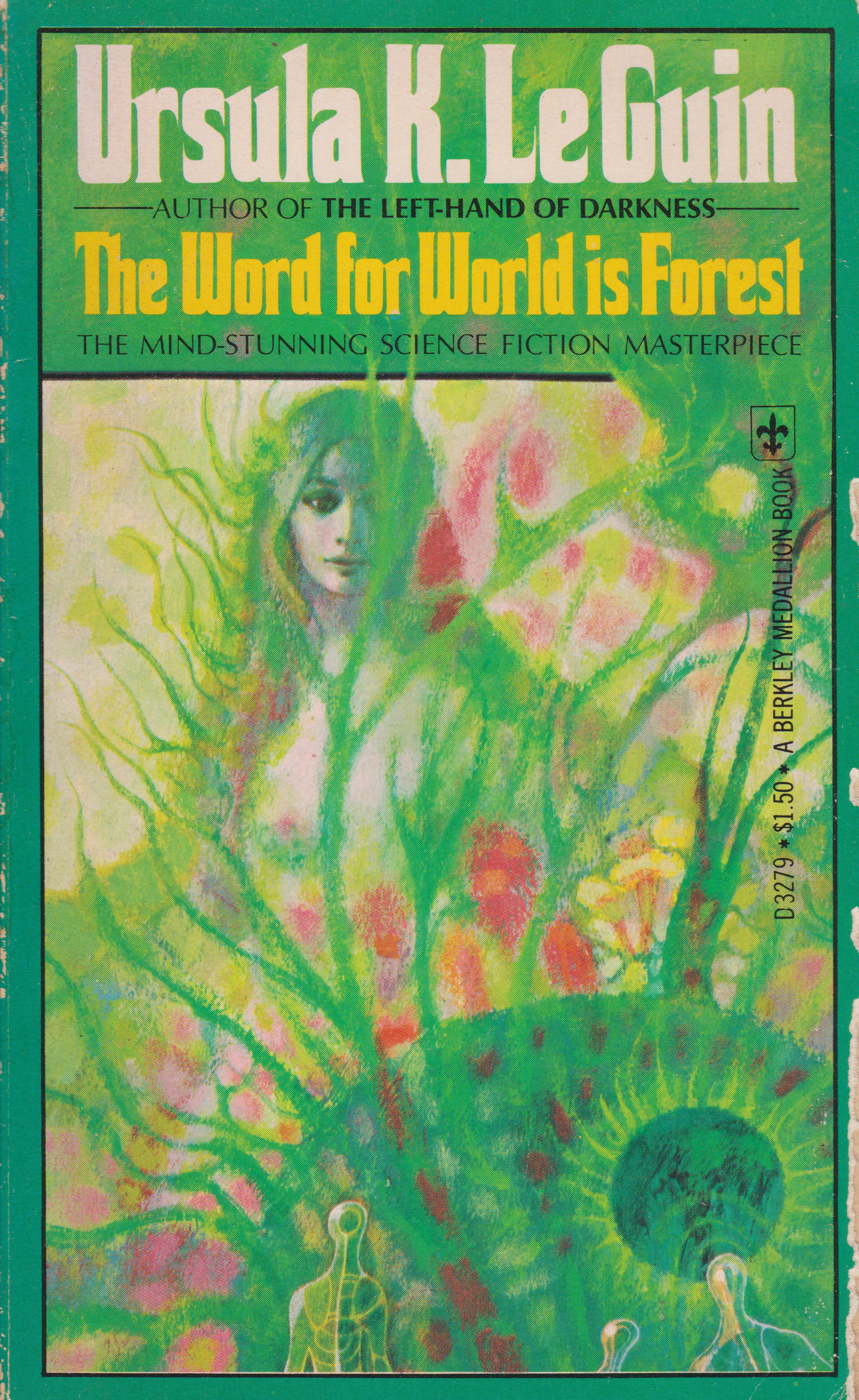
Updates: Recent Science Fiction Acquisitions No. CXCIX (Ursula K. Le Guin + Cordwainer Smith + M. P. Shiel + John Varley)

1. Ursula K. Le Guin’s novella, The Word for World is Forest, first appeared in Harlan Ellison’s Again, Dangerous Visions (1972) anthology before a stand-alone publication. I seem to remember reading it as a kid…. But…. the memories are vague.

2. Cordwainer Smith and I have never really seen eye to eye (I wanted to rhyme). I’m all for acquiring more of his collections just in case!

3. From Wikipedia:  “H. G. Wells lauded [M. P. Shiel’s] The Purple Cloud as ‘brilliant’ and H. P. Lovecraft later praised the novel as exemplary weird fiction, ‘delivered with a skill and artistry falling little short of actual majesty.'”

The Richard Powers cover is one of his best of the 60s.

4. John Varley, another author whom I’ve yet to read despite owning numerous of his collections and novels…. Millennium (1983) seems, well, suspicious? Time travel, airplanes, dystopic futures, love affairs across time. We shall see!

…and it was turned into a film in 1989.

Note: the images are hi-res scans. Click to enlarge.

As always, comments and tangents are welcome!

Enjoy.

1. The Word for World is Forest, Ursula K. Le Guin (anthology publication 1972) (MY REVIEW)

(Richard Powers’ cover for the 1976 edition) Continue reading

Updates: My 2018 in Review (Best SF Novels, Best SF Short Fiction, and Bonus Catagories)

Post-academia depression hits hard…. While completing my PhD (defended in the summer of 2017), reading SF and writing about SF was the way I kept sane. After multiple mostly unsuccessful years on the academic market, I have changed gears career-wise (although I’m still affiliated with a university and teaching college-level history courses but without the research component) and it has been a liberating experience. My history obsessions remain, even stronger in many ways, and academic monographs on all the topics that I wanted to read about but never could—Hellenistic successor states to Alexander, Early Islam, Late Antique and Medieval Persia, etc.–have dominated my time and pocketbook 2018 (don’t ask how much I’ve spent). I have included a “Best Academic History Reads of 2018” section for the curious.

At the beginning of November, I was moments from announcing that I was on hiatus for the foreseeable future. However, I have fallen back in love with SF and writing about SF and the new year beckons!

All of this is to say, I read little SF this year–until last month. However, there were a handful of stand-out SF novels and short stories that I managed to squeeze in.

And please list your favorite vintage (or non-vintage) SF reads of the year. I look forward to reading your comments.

Enjoy!

…and read lots of good books in 2019. I will.

Best SF Novels Continue reading

Adventures in Science Fiction Interior Art: The Power of a Good Introduction (Judith Merril’s 1968 New Wave Anthology England Swings SF)


(Ron Walotsky’s cover for the 1970 Ace edition)

I must confess, I generally skip the introductions to anthologies—even if they are written by my favorite authors who happen to be notable anthologists (Judith Merril, Robert Silverberg, Barry N. Malzberg, etc.). While paging through various collections hunting for stories, I encountered Judith  Merril’s micro-introduction to her famous New Wave anthology England Swings SF (1968). Here’s a list of the contents.

Although it is spread across three pages, it is only a few lines of text–a poetic beckoning, itself a condensed version of what the New Wave embodied. Merril’s intro as poem demonstrates literary invention, the blend of old (“scout ship”) and new (“heading out of sight into the multiplex mystery of inner/outer space”) images, and references to both high (“surrealism) and pop culture (“Beatles”). Continue reading

Book Review: New Dimensions 3, ed. Robert Silverberg (1973) (Le Guin + Tiptree, Jr. + Lafferty + Malzberg + Effinger + et al.)


(Dennis Anderson’s cover for the 1973 edition)

4/5 (Collated rating: Good)

For an anthology, bound to contain a filler story or two, this one is spectacular. Robert Silverberg’s New Dimensions 3 (1973) lives up to his claim to contain “stories that demonstrate vigorous and original ways [often experimental] of approaching the body of ideas, images, and concepts that is science fiction” yet do not sacrifice “emotional vitality, or clarity of insight.” Ursula K. Le Guin, with her rumination on utopias, and James T. Tipree, Jr.’s proto-cyberpunk tale of commercialism and performing gender, deliver some of their best work.

Continue reading