Magazine Review: Galaxy Science Fiction, ed. H. L. Gold (November 1950) (Brown, Asimov, Boucher, Leiber, Knight, Simak)

Preliminary Note: I plan on reading all 116 issues of the influential, and iconic, SF magazine Galaxy under H. L. Gold’s editorship (October 1950-October 1961) in chronological order. How long this project will take or how seriously/systematically I will take it remain complete unknowns.

See my inaugural post in this series for my reasoning behind selecting Galaxy under H. L. Gold.

Previously: the October 1950 issue.

Up Next: the December 1950 issue.

Let’s get to the stories. We have the first Galaxy masterpiece!


You can read the entire issue here.

Fredric Brown’s “Honeymoon in Hell” (1950), 3/5 (Average): The year is 1962. The Cold War heats up. The race for a permanent presence on the Moon takes center stage. Each side “had landed a few men” and claimed it as their own (4). Each side races to construct a space station in orbit to facilitate the construction of a permanent base on the moon. But there’s another worrying world-wide trend–a massive gender imbalance in new births! Not enough boys! Riots. Cults. What’s the plan?

Continue reading

Magazine Review: Galaxy Science Fiction, ed. H. L. Gold (October 1950) (Simak, Sturgeon, MacLean, Matheson, Leiber, Brown, Asimov)

Preliminary Note: I plan on reading all 116 issues of the influential, and iconic, SF magazine Galaxy under H. L. Gold’s editorship (October 1950-October 1961) in chronological order. How long this project will take or how seriously/systematically I will take it are complete unknowns. I am a reader of whim. I will choose whether to reread certain stories that I’ve previously covered. Serialized novels will only be reviewed after I complete the entire work and posted as separate reviews. Why Galaxy, you might ask?

First, I can’t escape the pull of 1950s science fiction focused on social commentary and soft science. Second, I am obsessed with 50s American politics during a time of affluence, the rise of TV and mass culture, and the looming terror of the Cold War. Third, there are a legion of well-known 50s authors I’ve yet to address in any substantial manner on the site who appeared behinds its illustrious covers. Fourth, H. L. Gold was interested in all different types of stories.

As SF Encyclopedia explains, Galaxy was an “immediate success” in part because “Astounding was at this time following John W Campbell Jr’s new-found obsession with Dianetics and was otherwise more oriented towards technology.” Gold’s interests, on the other hand, “were comparatively free-ranging: he was interested in psychology, sociology and satire and other humor, and the magazine reflected this.”

I hope you enjoy this series! Feel free to join.

Up Next: the November 1950 issue.


You can read the entire issue here.

Clifford D. Simak’s Time Quarry (variant title: Time and Again) (1950). Serialized over three issues. I will post an individual review after I complete the serialization.

Continue reading

Exploration Log 9: Three More Interviews with Clifford D. Simak (1904-1988)

Back in July 2024, I posted six interviews with Clifford D. Simak (1904-1988). Since then I’ve tracked down three more. As in that post, I’ll provide a rundown of each interview and provide quotes of interesting passages. In the interviews, Simak comes across as an author deeply suspicious of rigorous generic distinctions, passionate about all life, and open to science fiction as an ever-changing and evolving entity.

As readers of the site know, I have a substantial interest in Simak’s SF that culminated last year in my September article “‘We Must Start Over Again and Find Some Other Way of Life’: The Role of Organized Labor in the 1940s and ’50s Science Fiction of Clifford D. Simak” (2024) in Journey Planet . Since then I’ve posted an Exploration Log on his 1971 Worldcon speech, reviewed Best Science Fiction Stories of Clifford D. Simak (1957), and contributed to a podcast on “The Huddling Place” (1944) (the second City story).

Enjoy! And if you know of more interviews (or are able to update the Internet Speculative Fiction Database entry as it only includes five of the nine interviews I’ve covered) let me know.


THE INTERVIEWS

Continue reading

Exploration Log 6: Clifford D. Simak’s 1971 Worldcon Guest of Honor Speech

In an August 1967 editorial in Galaxy titled “S.F. as a Stepping Stone”, Isaac Asimov (1920-1992) voiced his extreme disapproval of the New Wave movement as “‘mainstream’ with just enough of a tang of the not-quite-now and the not-quite-here to qualify it for inclusion in the genre” (4). He concludes: “I hope that when the New Wave has deposited its forth and receded, the vast and solid shore of science fiction will appear once more and continue to serve the good of humanity” (6). The implication is clear: there is an Platonic science fiction form that exists (and that he writes) that must be rediscovered.

Fellow “classic” author Clifford D. Simak (1904-1988) offered a different, and far more inclusive, take at his Guest of Honor speech at Norescon 1 (Worldcon 1971). In an environment of “shrill” disagreement between various New Wave and anti-New Wave camps, Simak celebrated science fiction as a “forum of ideas” open to all voices (148).

Preliminary note: I read the speech in Worldcon Guest of Honor Speeches, ed. Mike Resnick and Joe Siclari (2006). You can listen to the speech (at the 28:00 min. mark) here. For a wonderful range of photographs of Simak at the convention, check out this indispensable photo archive.

As I did with six Simak interviews earlier this year, I will paraphrase his main points and offer a few thoughts of my own.

Let’s get to the speech!

Continue reading

Exploration Log 5: “We Must Start Over Again and Find Some Other Way of Life”: The Role of Organized Labor in the 1940s and ’50s Science Fiction of Clifford D. Simak

My article on organized labor in the 1940s and ’50s science fiction of Clifford D. Simak went live! I’d love to hear your thoughts. I’ve spent the last half year researching and reading religiously for this project–from topics such as Minnesota’s unique brand of radical politics to the work of contemporary intellectuals like C. Wright Mills (1916-1962) whom Simak most likely read.

Please check out the complete issue edited by Olav Rokne and Amanda Wakaruk over at Journey Planet. I have also embedded the PDF below.

The issue contains great work on the depiction of labor rights in a vast variety of other SF mediums. There are four articles that touch on vintage SF. The first two listed are by wonderful community members and official “Friends of the Site.”

Continue reading

Short Story Reviews: Clifford D. Simak’s “City” (1944), “Ogre” (1944), and “Spaceship in a Flask” (1941)

I’ve finally completed my article for Journey Planet on depictions of organized labor in the 40s and 50s science fiction of Clifford D. Simak. I plan on adding to it over the next few months as I read more. After it appears for Journey, I’ll post it on my site in whatever version is current. The project lead me to read a vast range of Simak short fictions, a small slice of which I’ve reviewed on my site, including the first two stories revised for his iconic masterpiece City (1952). I’ll cover “Huddling Place” (1944) soon as well.

Enjoy!


4.25/5 (Very Good)

“City” first appeared in Astounding Science Fiction, ed. John Campbell, Jr. (May 1944). You can read it online here.

This is a good one! I read the 1952 novelized version of the City stories in my late teens. At the time, logically, I was fascinated by the sentient dogs and the slow apocalypse of humanity that unfolds across the generations. For whatever reason, the earliest stories without dogs, for example “City” (1944) and “Huddling Place” (1944), faded from the culminative aura the novel generated all these years later. This project compelled me to break my deep-seated compulsion to read what I haven’t read before.

Continue reading

Short Story Reviews: Clifford D. Simak’s “Conditions of Employment” (1960), “Retrograde Evolution” (1953), and “‘You’ll Never Go Home Again!'” (variant title: “Beachhead”) (1951)

Bizarre alien civilizations. Homesickness as psychiatric treatment. The dangers of space travel. Capitalism unleashed. Utopian possibilities? Welcome to the strange wonders of Clifford D. Simak.

Today I’ve gathered together three more fascinating Simak tales that chart his deeply critical views of American business ethic. As in my previous post on the theme, the Grandmaster creates a future in which colonization goes hand-in-hand with the exploitation of resources, workers, and threatens the often bizarre alien intelligences they encounter.1

Two of the three rank among my best reads of the year. And now, to the stories!


4.75/5 (Near Masterpiece)

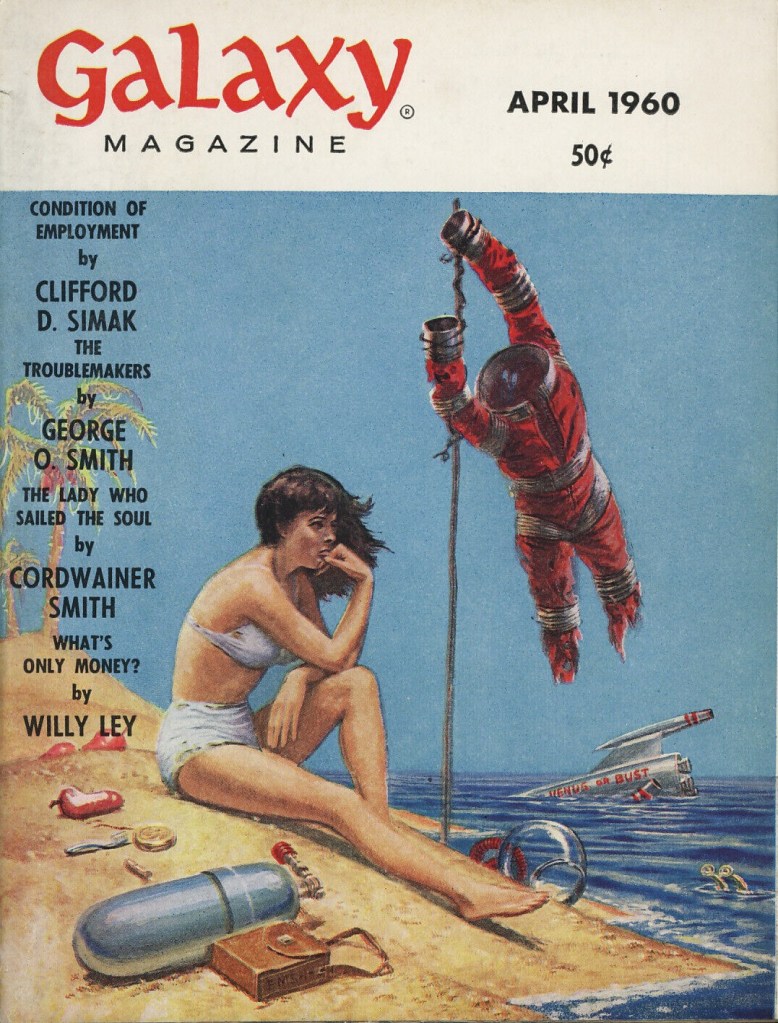
“Conditions of Employment” first appeared in Galaxy, ed. H. L. Gold (April 1960). You can read it online here.

Continue reading

Exploration Log 4: Six Interviews with Clifford D. Simak (1904-1988)

Clifford D. Simak (1904-1988) published science fiction steadily between 1931 and his death in the late 80s. His work–from City (1952) to the Hugo-winning Way Station (1963)–often demonstrates a fascination with the rural environment and the lives of “ordinary” people confronted with the alien. As I am currently working on a mini-project related to Simak,1 I thought I’d give a rundown of six of the seven interviews I’ve found reference to. I’ll also provide quotes of interesting passages, and a scanned version of one that isn’t available online. In the interviews, Simak comes across as an author deeply suspicious of rigorous generic distinctions, passionate about all life, and open to science fiction as an ever-changing and evolving entity.

The Internet Speculative Fiction Database lists five interviews on science fiction conducted with Clifford D. Simak–all published between 1975-1980. Muriel R. Becker’s indispensable Clifford D. Simak: A Primary and Secondary Bibliography (1980) includes two more: a video interview from 1971 and another from 1976 in the Minneapolis Tribune.2 I cannot find a copy of the latter. I provide links to the others in the post.

Obviously, which interview you want to read depends on your interests or questions you have about Simak. That said, I found Paul Walker’s the most fascinating (and frequently references in the little scholarship on the grandmaster).

Continue reading

Short Book Reviews: Clifford D. Simak’s They Walked Like Men (1962) and Jacques Sternberg’s Sexualis ’95 (1965, trans. 1967)

Note: My read but “waiting to be reviewed pile” is growing. Short rumination/tangents are a way to get through the stack before my memory and will fades. My website partially serves as a record of what I have read and a memory apparatus for future projects. Stay tuned for more detailed and analytical reviews.


1. They Walked Like Men, Clifford D. Simak (1962)

3/5 (Average)

In a confrontation with maleficent alien land prospectors in Clifford D. Simak’s They Walked Like Men (1962), the main character ruminates that “it was almost if [we] were acting out an old morality play, with the basic sins of mankind enlarged a millionfold to prove a point by exaggeration” (113). Simak’s moment of meta-commentary on his own narrative and tonal choices gives shape to odd conjuration of juvenile comedy and apocalyptic extrapolation of capitalism unleased.

Continue reading