Updates: Recent Science Fiction Acquisitions No. C (Bishop + A. E. Van Vogt + Pangborn + Pratt)

Another Michael Bishop novel for my upcoming guest post series (announcement coming soon)!  Irresistible after the brilliant Stolen Faces (1977) and his masterpiece A Funeral for the Eyes of Fire (1975)….

The rest are fun but not high on my list of must reads.  I’ve never been a fan of A. E. Van Vogt (could not tolerate the inarticulate labyrinth of a novel The World of Null-A) but the Powers cover on The War Against the Rull (1959) was fun.

I’ve heard good things about Edgar Pangborn, although people seldom discuss West of Eden (1953), perhaps with good reason.

Fletcher Pratt’s Invaders from Rigel (1932) is one of those AMAZING covers but incredibly dubious reads.  Even the back cover is rather non-sensical.

Thoughts?

1. Transfigurations, Michael Bishop (1979) (MY REVIEW)
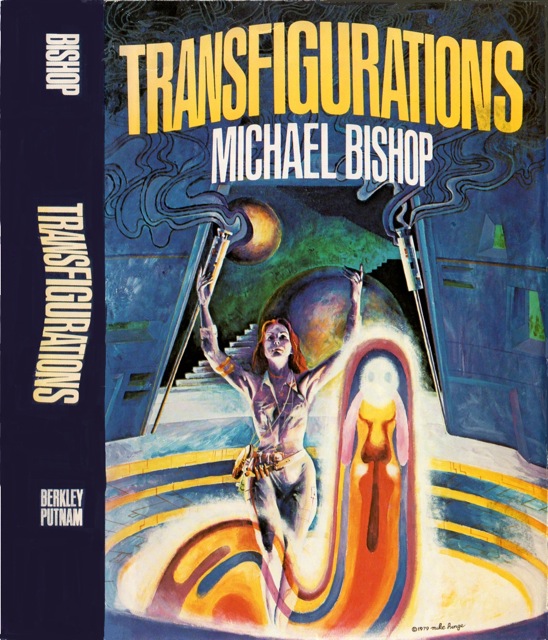
TRNSFGRTND1980

(Mike Hinge’s cover for the 1979 edition) Continue reading

Book Review: Ancient, My Enemy, Gordon R. Dickson (1974)

(Peter Rauch’s cover for the 1974 edition)

2.75/5 (collated rating: Vaguely Average)

Between 1974 and 1990 Gordon R. Dickson’s collection Ancient, My Enemy (1974) was reprinted eleven times.  The reason for this “popularity” is beyond me considering I found that a grand total of three of the nine stories were solid while the rest were poorly written cliché-ridden magazine filler…  Dickson had the ability to write some great short SF—for example, Mike at Potpourri of SF Literature adores his collection In the Bone (1987).  But Ancient, My Enemy gives little indication of his talent and generally lacks the insight that his novels such as The Alien Way (1965) possess.

Recommended only for Gordon R. Dickson completists.  I suggest acquiring later more discerning collections of his 50s/60s SF such as Continue reading

Updates: Year in Review (Top Ten SF Novels + Top Ten Short Stories/Novelettes/Novellas + other categories)

Everyone likes lists!  And I do too….  This is an opportunity to collate some of my favorite (and least favorite) novels and shorter SF works I read this year.  Last year I discovered Barry N. Malzberg and this year I was seduced by…. Well, read and find out.


Top Ten Novels

1. We Who Are About To…, Joanna Russ (1976): A scathing, and underread, literary SF novel by one of the more important feminist SF writers of the 70s (of The Female Man fame).

2. A Funeral for the Eyes of Fire, Michael Bishop (1975): A well-written anthropological clash of cultures novel.  Slow, gorgeous, emotionally engaging….

3. Level 7, Mordecai Roshwald (1959): A strange satire of the bomb shelter…  Everyday surrealism. Continue reading

Updates: Recent Science Fiction Acquisitions No. LXXVI (Effinger + Morgan + deFord + Bishop)

A nice haul from the local used book store and various internet sources….  After Effinger’s masterpiece What Entropy Means to Me (1972) I was desperate to get my hands on another one of his novels (or short story collections — Relatives is not supposed to be as good but, perhaps it will prove the critics (well, namely John Clute) wrong.

Miriam Allen deFord was a prolific 50s short story writer.  Xenogenesis (1969) is the only published collection solely of her stories — thankfully it’s graced with a wonderful Richard Powers cover.

Despite the hideous cover, Michael Bishop’s first novel A Funeral for the Eyes of Fire (1975) is generally considered quite good.  I’ve already read and reviewed Dan Morgan’s average but inventive SF thriller Inside (1971) but included it in this post anyway because I had yet to reach my four new acquisitions for a post.

Have you read any of these novels?  If so, what did you think?

1. Relatives, George Alec Effinger (1973)

(Uncredited cover for the 1976 edition) Continue reading

Book Review: Inside, Dan Morgan (1971)

(Richard Powers’ cover for the 1974 edition)

3/5 (Average)

Dan Morgan’s output appears to have been mostly forgotten even by the most dedicated fans of the genre.  And unfortunately, no collections of his short stories (he published around 40) were released in his lifetime.  John Clute’s assessment of his work — “Though he was not a powerful writer, and though he never transcended the US action-tale conventions to which he was so clearly indebted, it is all the same surprising that Morgan has been ignored” — rings true in regards to the sole novel of his I have read, Inside (1971).

Inside is a tightly-plotted action tale that plays out layered (almost painfully entropic) levels of delusion.  The neatly packaged premise never goes beyond the strictures Continue reading

Book Review: The View from the Stars, Walter M. Miller, Jr. (1965)

(Richard Powers’ cover for the 1965 edition)

3.75/5 (Collated rating: Good)

Almost all SF fans have read Walter M. Miller, Jr.’s masterpiece A Canticle for Leibowitz (1959) but few indulge in his shorter works.  By 1957 Miller had virtually quit publishing new SF (A Canticle is comprised of novellas published between 1955-1957).  His only work published later was Saint Leibowitz and the Wild Horse Woman (1997) completed by Terry Bisson and released posthumously.

The View From the Stars (1965) — containing five short stories, two novelettes, and one novella — is a cross section of his most productive decade.  Although I found that none of the works included should be considered masterpieces, “I, Dreamer” (1953), “Dumb Waiter” (1952),  “Big Joe and the Nth Generation” (1952), and “The Big Hunger” (1952) were wonderful.  All the others are readable Continue reading

Adventures in Science Fiction Cover Art: Crashed Spaceships, Part II

SFA53-02

(Earle Bergey’s cover for the February 1953 issue of Science Fiction Adventures, ed. Philip St. John — i.e. Lester del Rey)

Make sure to take a peek at Part I if you haven’t already.

Crashed spaceships!  Our heroes forced to trek across desolate landscapes, fight giant robots, and evil aliens….  Or, aliens stumble from the wreckage of their flying saucers — unusual green matter emanates while the flames reach ever upward.  I suspect that if I were a kid in the era of pulp SF magazines I would have snatched everyone with a crashed spaceship regardless of the often dubious contents.

I am generally no fan of Kelly Freas but his cover for the July 1957 issue of Science Fiction Stories, is one of my favorite action/adventure type SF covers.  Unusual aliens on the back of a massive turtle alien swimming through lava Continue reading

Book Review: Of Men and Monsters, William Tenn (1968)

MNNDMN1968

(Stephen Miller’s cover for the 1968 edition)

4/5 (Good)

There’s a small pile of novels on my shelf that wait ever so patiently to be reviewed months and months after I’ve read them — J.G. Ballard’s The Drowned World (1962), Robert Silverberg’s The Masks of Time (1968) and Dying Inside (1972), David R. Bunch’s Moderan (1972) (among others), and, until now, William Tenn’s Of Men and Monsters (1968).  Perhaps I was put off by the three mysterious pages filled with small chicken scratch composed by some earlier reader– “224 PKNY, 248 MINCED, 219 M in OKST” — that hinted at some arcane undercurrents or masonic messages that had alluded me.  Perhaps it was my confusion over Tenn’s Heinlein-esque female character, who, in a work of satire, could indicate something so much more progressive than Continue reading

Adventures in Science Fiction Art: Spacewomen of the Future (flying spaceships + exploring alien landscapes + delivering galactic mail), Part II

1951_02_spacestories_emsh

(Ed Emshwiller’s cover for the February 1953 issue of Space Stories, ed. Samuel Mines)

Part II of my Spacewomen of the Future series — Part I.

In my first installment I discussed the stereotype of the 40s/50s SF pulp heroine — for example, she shrieks at the evil alien while the man has to rescue her or despite her education, she spends her time serving the men coffee on the spaceship (there’s a cringeworthy scene along these lines in It! The Terror From Beyond Space (1958), dir. Edward L. Cahn).  Hopefully these cover art depictions will complicate the stereotype.  Of course, I have not read all the contents of magazines/novels bellow so I can not speak for the portrayals within the texts.  In the stories they could potentially be astronauts in the service, scientists, civilian love interests, colonists, partners of the male astronauts, etc…

I have somewhat arbitrarily decided for thematic reasons that “Spacewomen”  is a woman in a space uniform of the future or Continue reading