What pre-1985 science fiction are you reading? + Update No. IX

What pre-1985 science fiction are you reading or planning to read this month? Here’s January’s installment of this column.

When I’m not reading science fiction, I’m more often than not devouring history that touches on my decades of focus: 1945-1985. Recently that’s meant lots and lots of monographs on Cold War culture: from fallout shelters, suburbia, to analysis of the drama of morality and terror that characterized nuclear deterrence. And in Guy Oakes’ transfixing The Imaginary War: Civil Defense and American Cold War Culture (1994), I came across a fascinating collision of science fictional thought and public policy.

A few months into Dwight D. Eisenhower’s presidency, the Public Affairs Office of the Federal Civil Defense Administration released a short pamphlet that analyzed the “relation between national will and nuclear terror” under the ridiculous title “Civil Defense Implications of the Psychological Impact and Morale Effect of Attacks on the People of the United States” (April 1953). In this pamphlet, the authors imagine the effects of nuclear war. They suggest that some survivors would “isolate themselves from the terrifying consequences of nuclear war by effecting a pseudo-escape into an interior psychological reality.” I thought immediately of Richard Matheson’s brilliant “Pattern for Survival” (1955), in which a SF author reenacts the process of writing and publishing a story to escape the reality in which he lives. The pamphleteers further imagine a political reality dominated by “mystical sects and cults, enthralled by the vision of an immeasurably happier future in an inner fantasy life of an extramundane kingdom of bliss that transcended the brutal empirical reality of nuclear destruction” (41). Early Cold War policy makers and consultants as science fiction authors!

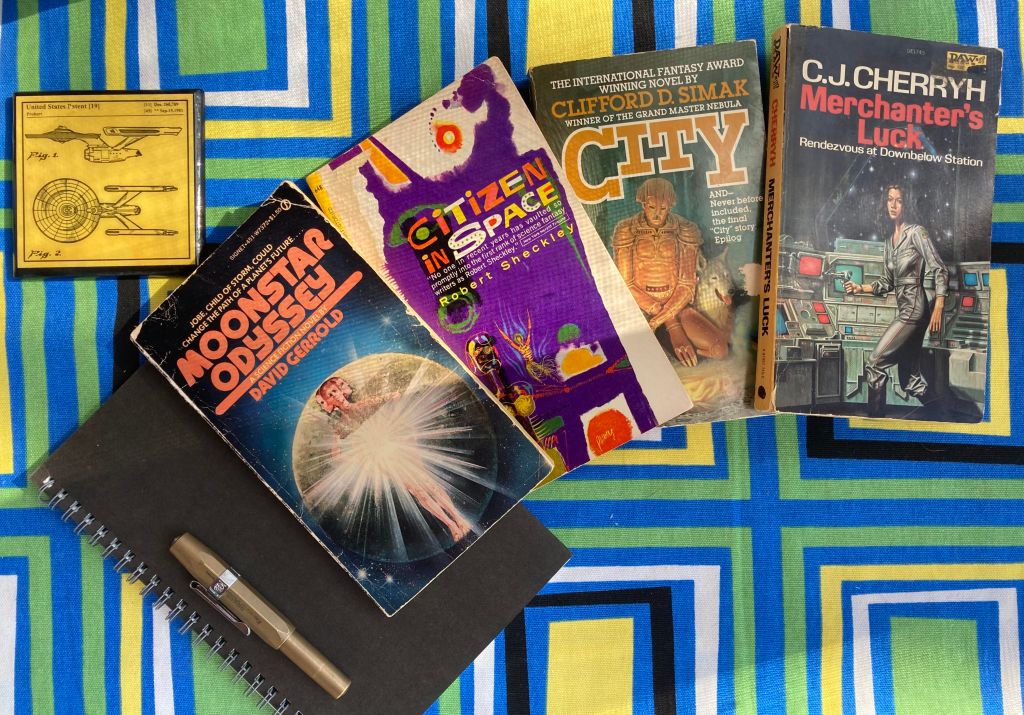
50s paranoid future visions aside, let’s turn to the books in the photo and what I’ve been reading and writing about.

Continue reading
Updates: Recent Science Fiction Purchases No. CCCVII (Jack Williamson, William E. Cochrane, a Groff Conklin anthology, and an anthology of gay and lesbian SF)

Which books/covers/authors intrigue you? Which have you read? Disliked? Enjoyed?

1. 6 Great Short Novels of Science Fiction, ed. Groff Conklin (1954)

From the back cover: “THE BLAST: STUART CLOETE envisions New York City under atomic attack, and tells the story of the lone survivor.

COVENTRY: ROBERT HEINLEIN shows what happens to one of the last individualists, who request a sentence to purgatory.

THE OTHER WORLD: MURRAY LEINSTER reveals a savage, feudal civilization which lives off the sweat of slaves kidnapped from our world.

BARRIER: ANTHONY BOUCHER writers of a time traveler, and his strange encounters with the people who will come after us.

SURFACE TENSION: JAMES BLISH traces a race of microscopic men that works out its destiny under water on a planet somewhere far out of the galaxy.

MATURITY: THEODORE STURGEON depicts the agonizing plight of a super man born in our midst.

Continue reading

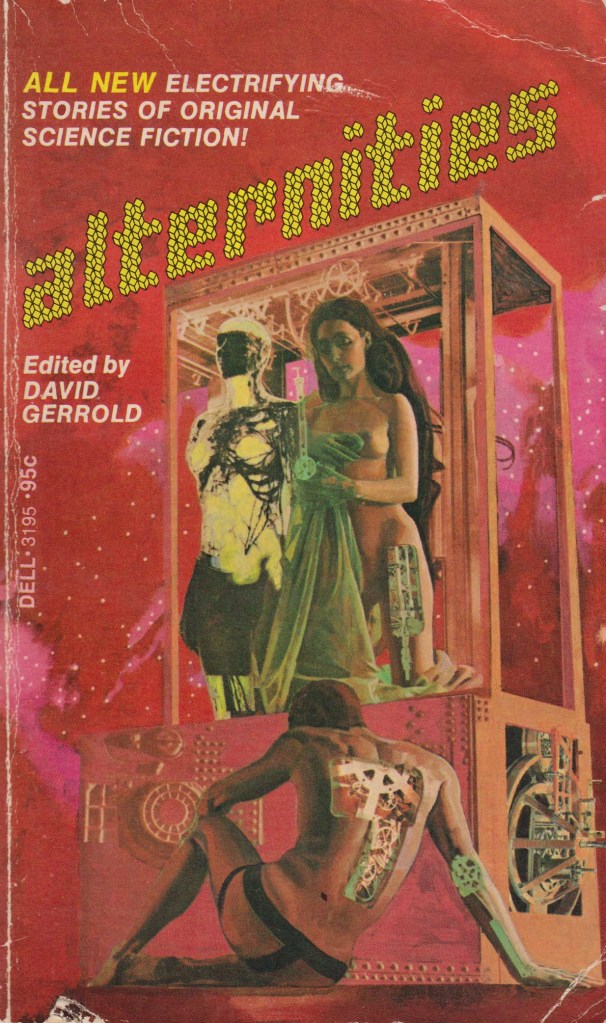
Book Review: Alternities, ed. David Gerrold and Stephen Goldin (1974) (Malzberg, McIntyre, Bunch, Bear, Sallis, et al.)

2.5/5 (collated rating: Bad)

David Gerrold and his associate editor Stephen Goldin collect a bizarre range of SF oddities including an epistolary nightmare from Vonda N. McIntyre’s pen and a one-sentence “sign” by Duane Ackerman. Gerrold argues that he wants “science fiction to be fun again” without “literary inbreeding and incestuous navel-studying” (8). With a more than pungent hint of hypocrisy, he spouts “I’m tired of the kind of bullshitting that creates false images in the readers’ minds” (8). Alternities (1974) reads like the cast off stories from a New Wave (i.e. deliberately literary) Judith Merril or Harlan Ellison anthology with heavy dose of erotic comedy and shock value. A few–including E. Michael Blake’s “The Legend of Lonnie and the Seven-Ten Split,” Vonda N. McIntyre’s “Recourse, Inc.,” and Edward Bryant’s “Cowboys, Indians”–rise above the dross.

To be clear, I enjoy devouring anthologies like Alternities. The stories are originals and few are anthologized elsewhere. I adore reading authors I wouldn’t otherwise encounter (Robert Wissner, E. Michael Blake, et al.). Gerrold’s nonsense of an introduction aside, the anthology with its deliberate attempts at the “literary” (Greg Bear’s “Webster” and James Sallis’ “The First Few Kinds of Truth”) and “edgy” (Steven Utley’s “Womb, with a View”) firmly fit in the passing mid-70s foam of the New Wave movement.

Continue reading

Updates: Recent Science Fiction Acquisitions No. CCXII (Martin + Jeter + Lee + Gerrold)

I told you I had a glut of SF acquisitions! My reading hasn’t slowed although reviewing, I’ll confess, has taken a back seat. However, my summer holiday begins today–I have multiple book reviews partially finished and scheduled.

In the meantime–> new books.

1. I have not read a single Tanith Lee short story or novel. I bought three to rectify that gaping hole in my knowledge. MPorcius, over at MPorcius’ Fiction Log (one of the few vintage SF review sites still publishing out reviews at a delightful pace), regularly celebrates her work. Check out his review of Don’t Bite The Sun (1976).

2. The surprising Half Price find of the last few years of browsing was the near complete publication series of Laser Books (see photo below). They are notorious for being mostly low quality (even the better authors in the series such as Gordon Eklund). However, K.W. Jeter–of Dr. Adder (written 1972, published 1984) fame–published his first novel in the series — I snagged it.

Note: if there are ANY other lesser known gems in the Laser books publication series PLEASE let me know. I suspect that vast majority of books will still be on the shelf if I were to return.

3. I finally have my hands on two early George R. R. Martin SF novels. Dying of the Light (1977) seems to have a fantastic premise. I look forward to it.

4. David Gerrold’s Moonstar Odyssey (1977) was nominated for the 1978 Nebula Award and then promptly forgotten…. online reviews indicate the challenging subject material (child sexuality) and the lack of a distinct plot. Some reviews made comparisons to Ursula Le Guin… Gerrold’s fiction has not satisfied me in the past. My knowledge, however, is limited to the following two books I reviewed on my site:

The Space Skimmer (1972)

Yesterday’s Children (variant title: The Space Hunt) (1972)

Tangent: Moonstar Odyssey contains a fantastic map. I’ll feature it on Monday in my soon-to-be-revived Monday Maps and Diagrams series.

Let me know what you think of the books/covers in the comments!

~

1. Don’t Bite the Sun, Tanith Lee (1976) (MY REVIEW)

(Brain Froud’s cover for the 1st edition) Continue reading

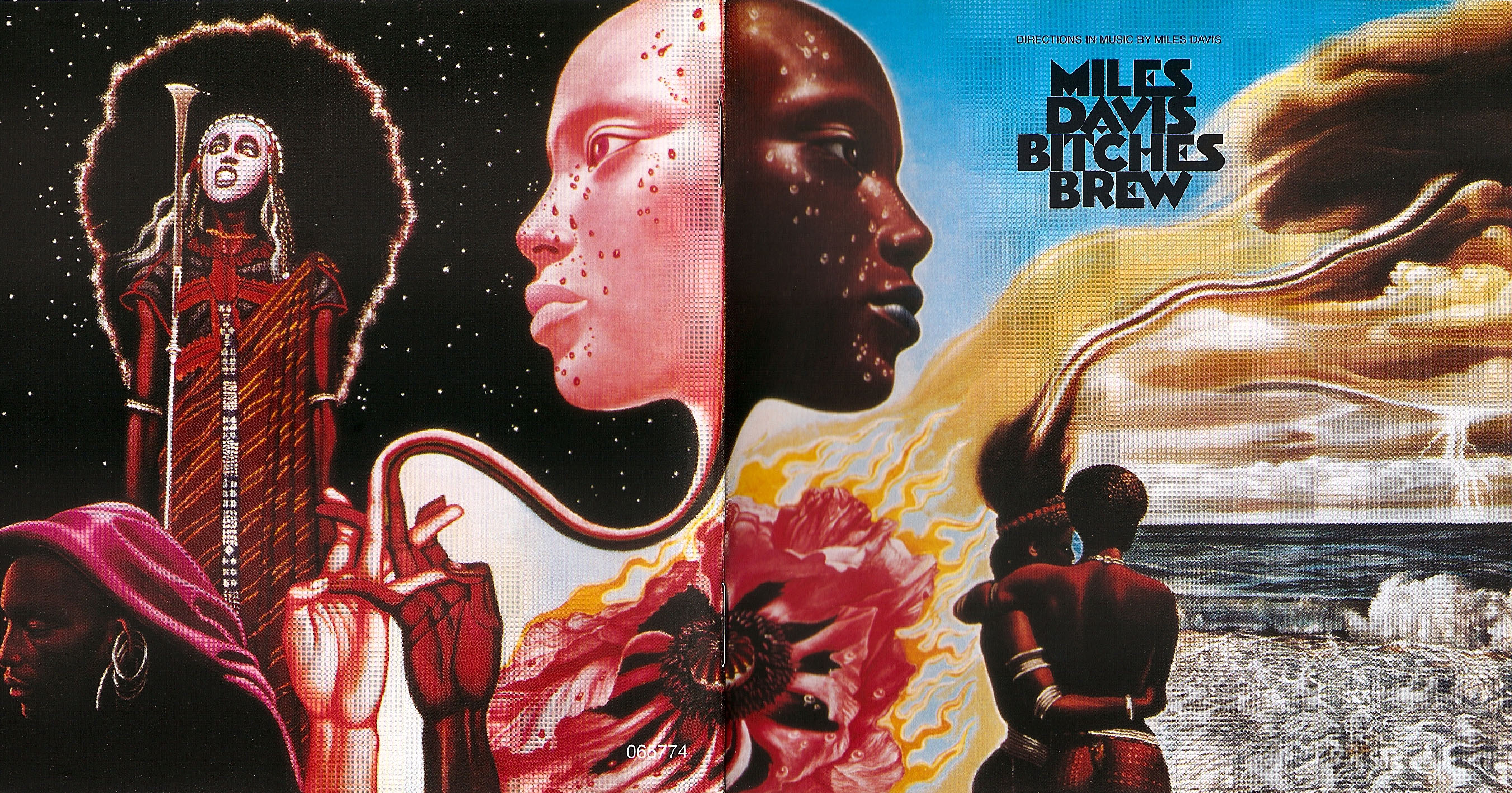
Adventures in Science Fiction Cover Art: The SF art of Mati Klarwein–the artist behind Miles Davis’ Bitches Brew (1970)

bitches-brew

(Mati Klarwein’s 1970 cover for Miles Davis’ album Bitches Brew)

Mati Klarwein (wikipedia link) was a German artist of Jewish origin who fled the Nazis to British Palestine. After the fall of the Nazis, he received an art education in Paris and gained French citizenship. Famous for his album covers—notably Miles Davis’ famous Bitches Brew (1970) (above) and Santana’s Abraxas (1969) (below)—Klarwein also created (or his art was used for) SF covers. Characterized by an obsessive eye for the detail (click and zoom in on Lafferty’s Arrive at Easterwine scan I included from my collection), Klarwein’s almost mandalic covers draw on a wide range of artistic influences. Unfortunately, quite a few are uncredited or credited to the incorrect artist—his cover for the 1972 edition of The World’s Desire (1890) by H. Rider Continue reading

Updates: Recent Science Fiction Acquisitions No. CXXI (Zelazny + White + Daventry + Gerrold)

A nice grab bag of used book store finds…  I’m nearing completion of my collection of Zelazny’s pre-1980 novels (I do not own nor really want to read any of his purely fantasy works).  Also, I couldn’t help but pick up David Gerrold’s 1974 Hugo and Nebula Award nominated novel The Man Who Folded Himself (1973) although I have been utterly underwhelmed with his work in the past—for example, Space Skimmer (1972) and Yesterday’s Children (1972).

I also found the first volume of a trilogy by Leonard Daventry—owned only the third one for some reason.  And, who can resist another James White novel.  I desperately want to recreate the joy that was White’s The Watch Below (1966).

Thoughts?

1. Damnation Alley, Roger Zelazny (1969) (MY REVIEW)

(Alan Gutierrez’s cover for the 1984 edition) Continue reading

Updates: Recent Science Fiction Acquisitions No. CXVI (Le Guin + MacApp + Farmer + Anthology)

In my youth I read Ursula Le Guin like a madman—somewhere in the intervening years I misplaced my copies of her short story collections.  So, while voyaging to a nearby city (with Half Price Books) I decided to snag one—The Compass Rose (1982) contains mostly 70s short stories.  Excited.

I have been presently impressed with *some* of Philip José Farmer’s work—namely, Strange Relations (1960)—-so I could not resist a “best of” collection.

I am perhaps most excited about David Gerrold’s edited collection Generation: An Anthology of Speculative Fiction (1972).  Contains a wide range (and almost equal ratio of male/female authors) of fascinating stories.

 I bought C. M. MacApp’s Secret of the Sunless World (1969) due to the title and the amazing Berkey cover.  Now that I sat down and transcribed the back cover I rather dissuaded from picking it up anytime soon…

1. The Book of Philip José Farmer, Philip José Farmer (revised 1982, 1973)

(James Warhola’s cover for the 1982 edition) Continue reading

Book Review: Yesterday’s Children (variant title: Starhunt*), David Gerrold (1972)

(Paul Lehr’s cover for the 1972 edition)

3/5 (Average)

*The 1980 edition, still under the title Yesterday’s Children, was substantially rewritten.  In 1985 David Gerrold released it under a new title, Starhunt.  This is a review for the original 1972 edition.  I have not read the later rewrite so I am unsure how much was modified.

David Gerrold, best known for writing the famous Star Trek: The Original Series episode “The Trouble With Tribbles” (1967), has continuously produced SF novels since the early 70s.  I had previously read the disappointing Space Skimmer (1972) which combined a fascinating premise with puff-puppies, annoying princes, and bad poetry.  Yesterday’s Children (1972) (variant title: Starhunt) likewise combines a fascinating premise with a less than satisfactory delivery, numerous narrative hiccups, and uneven tone and characterization.  I am not surprised that the novel was rewritten due to the slightly rough Continue reading

Updates: Recent Science Fiction Acquisitions No. LXXXI (Vinge + Gerrold + Zelazny + White)

Part 1 of many: Half Price Books in Dallas, TX (the second best bookstore, after Dawn Treader Books in Ann Arbor, MI for SF I have ever come across).  Gift card courtesy of fiancé’s mother = LOTS OF SCIENCE FICTION.  There could not be a better gift….

Everyone reads Robert Zelazny’s This Immortal (1966) and Lord of Light (1967), but who has read Isle of the Dead (1969)?  Thematically it seems similar to Lord of Light…  I have high hopes.  James White’s SF is always above average — and a fund cover from Dean Ellis makes that an auto-buy.  Although I disliked David Gerrold’s Space Skimmer (1972) my father swears Yesterday’s Children (1972) is somewhat readable.

I enjoyed Joan D. Vinge’s The Summer Queen (1980), tolerated her first novel The Outcasts of Heaven Belt (1978), so I suspect her two novella collection Fireship (1978) will be worthwhile…

Thoughts?

1. Isle of the Dead, Robert Zelazny (1969)

(Leo and Dianne Dillon’s cover for the 1969 edition) Continue reading