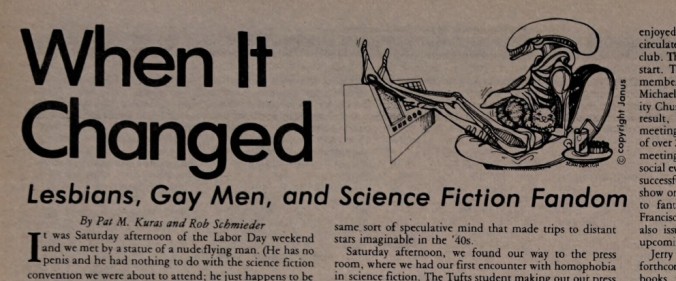
Exploration Log 8: Pat M. Kuras and Rob Schmieder’s “When It Changed: Lesbians, Gay Men, and Science Fiction Fandom” (1980)

“We also encountered many gay people, feminists and progressives of every stripe. These people were at the convention because present day science fiction has much to offer them. Science fiction is the fiction of ideas, and the ideas coming from the minds of the new writers more and more concern progressive analyses of social issues.”

— Pat M. Kuras and Rob Schmieder (1980)

At the 38th World Science Fiction Convention (29th August–1st September, 1980) held in Boston, MA, organizers scheduled the first Worldcon panel with an openly LGBTQ topic: “The Closed Open Mind: Homophobia in Science Fiction Fantasy Stories” moderated by Jerry Jacks, one of the “early openly gay fans.”1 Around 200 fans attended to hear Elizabeth A. Lynn (SFF author), Samuel R. Delany (SFF author), Frank M. Robinson (SF author and activist), and Norman Spinrad (SFWA President and SF author) (“the token straight”) discuss issues of representation.
Continue reading

Updates: Recent Science Fiction Purchases No. CCCXVII (Roger Zelazny, Philip José Farmer, Steve Wilson, and an anthology with Ursula K. Le Guin)

Which books/covers/authors intrigue you? Which have you read? Disliked? Enjoyed?

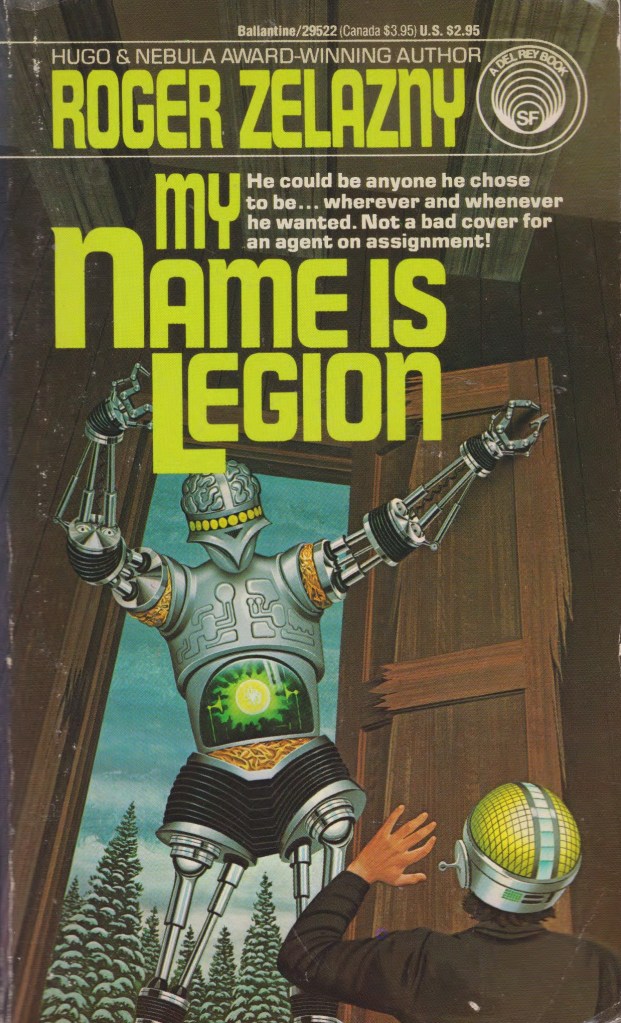
1. My Name is Legion, Roger Zelazny (1976)

From the back cover: “HE DID NOT EXIST… OR DID HE? He had destroyed his punch cards and changed his face. There was no credit card, birth record, or passport for him in the International Data Bank.

His names were many… any he chose.

His occupation was taking megarisks in the service of a vast global detective agency.

His interworld assignments were highly lucrative, incalculably vital, and terrifyingly deadly.

And more often than not, his life was a living hell!”

Contents: “The Eve of RUMOKO” (1969),” “‘Kjwalll’kje’k’koothaïlll’kje’k” (1973), “Home Is the Hangman” (1975)

Initial Thoughts: In the early days of my site read I reviewed the first in the Nemo sequence–“The Eve of RUMOKO” (1969). At the time I did not care for it. However, I recently read F. Brett Cox’s monography Roger Zelazny (2021) and retrospectively I’m not sure that I understood the character or what Zelazny was trying to accomplish with the story sequence. Often after I read a monograph, I end up making a few impulsive purchases and this is one of them! I hope, at the very least, it gives me a deeper understanding of Zelazny’s SF project. And “Home Is the Hangman” (1975) is a Hugo and Nebula-winning novella that I have not read.

Continue reading

Updates: Recent Science Fiction Purchases No. CCCVII (Jack Williamson, William E. Cochrane, a Groff Conklin anthology, and an anthology of gay and lesbian SF)

Which books/covers/authors intrigue you? Which have you read? Disliked? Enjoyed?

1. 6 Great Short Novels of Science Fiction, ed. Groff Conklin (1954)

From the back cover: “THE BLAST: STUART CLOETE envisions New York City under atomic attack, and tells the story of the lone survivor.

COVENTRY: ROBERT HEINLEIN shows what happens to one of the last individualists, who request a sentence to purgatory.

THE OTHER WORLD: MURRAY LEINSTER reveals a savage, feudal civilization which lives off the sweat of slaves kidnapped from our world.

BARRIER: ANTHONY BOUCHER writers of a time traveler, and his strange encounters with the people who will come after us.

SURFACE TENSION: JAMES BLISH traces a race of microscopic men that works out its destiny under water on a planet somewhere far out of the galaxy.

MATURITY: THEODORE STURGEON depicts the agonizing plight of a super man born in our midst.

Continue reading

Updates: Recent Science Fiction Purchases No. CCLXIII (Elizabeth A. Lynn, Romanian SF Anthology, Eastern European SF Anthology, and Barry N. Malzberg)

As always which books/covers/authors intrigue you? Which have you read? Disliked? Enjoyed?

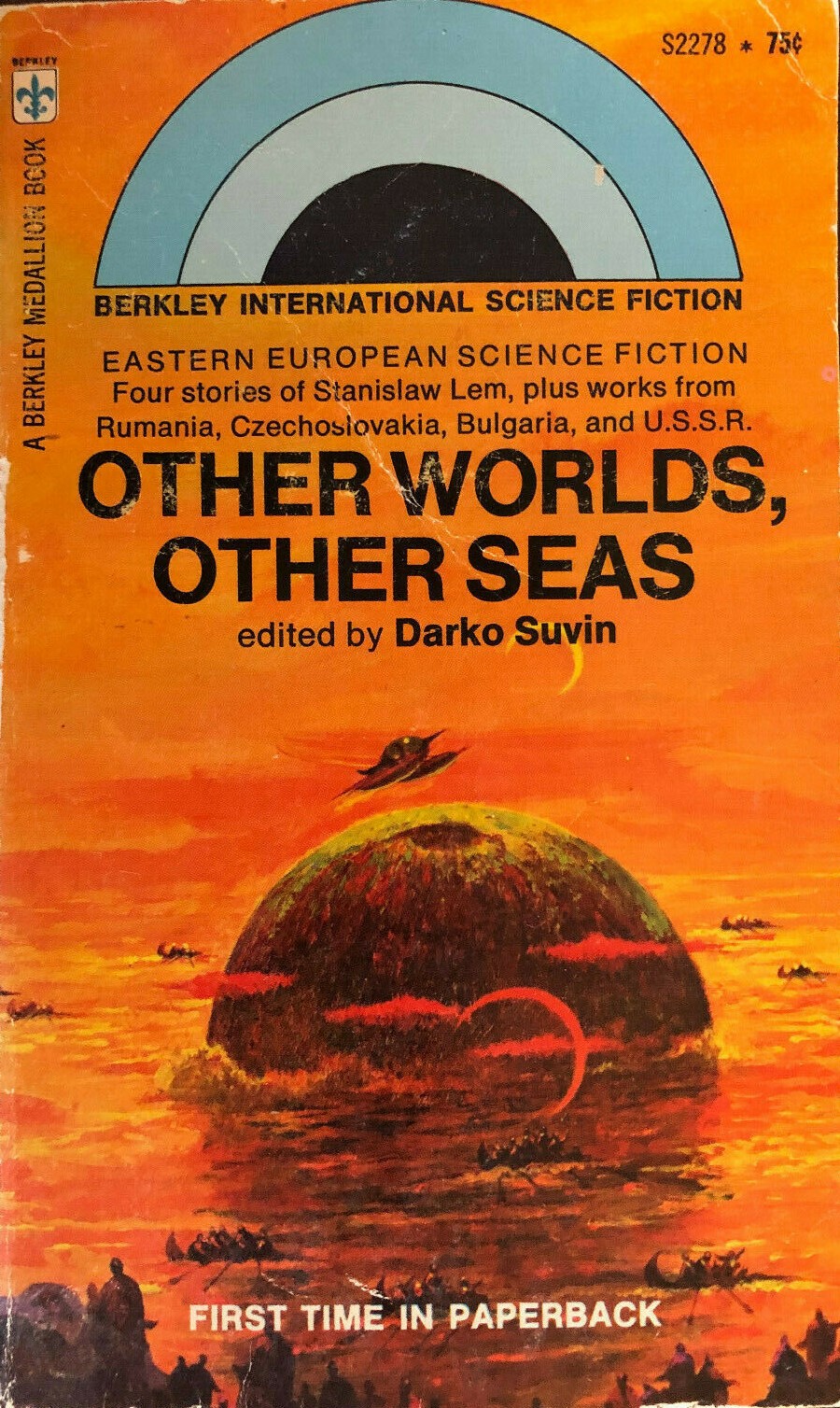
1. Other Worlds, Other Seas, ed. Darko Suvin (1970)

Paul Lehr’s cover for the 1972 edition

From the back cover: “Darko Suvin was born in Zagreb, Yugoslavia in 1930. An internationally known critic of literature and theater, he is the author of seven books of criticism including POSSIBLE WORLDS—An outline of Science-Fiction and Utopias.

Stanislaw Lem of Poland, author of SOLARIS, is only the most famous of a burgeoning group of Eastern European writers. His contribution to OTHER WORLDS, OTHER SEAS—four brilliant stories—is a treat to his hundreds of thousands of American admirers. But a whole body of first rate s-f is now being produced in the socialist countries by equally gifted writers such as Josef Nesvadba, Anatoliy Dneprov, and Anton Continue reading