Book Review: Universe Day, Barry N. Malzberg (as K. M. O’Donnell) (1971)

(Uncredited—but looks like Paul Lehr—cover for the 1971 edition)

4.5/5 (Very Good)

“…I see no reason why we shouldn’t go to Mars in 1982…” Vice President of the U.S. July, 1969

Barry N. Malzberg’s fourth SF novel Universe Day (1971) is comprised of numerous previously published short stories as well as new material.* It might be best to think of the novel as a thematically linked sequence—in what might be termed a “future history” but unlike any you have ever read—of impressions and snippets of “what really happened” paired with what we want to happen or delude ourselves into thinking happened.  All his major themes are on display, the space program as a manifestation of humankind’s delusions of grandeur, the dehumanizing power of technology, space as playground of existential nightmares, etc.

One of Malzberg’s most appealing qualities is the sheer variety of existential situations he conjures.  Yes, many of the themes are repeated story to story (and novel to novel) but the black comedy elements are so often overlooked.  The chapter/short story “Touching Venus, 1999” encapsulates Malzberg’s absurdist brilliance.  In moments of metafictional delight, he acknowledges the artifice of the array of scenarios he constructs, the Continue reading

Updates: My Top 10 SF works (pre-1980) for inclusion in the Gollancz Masterwork series

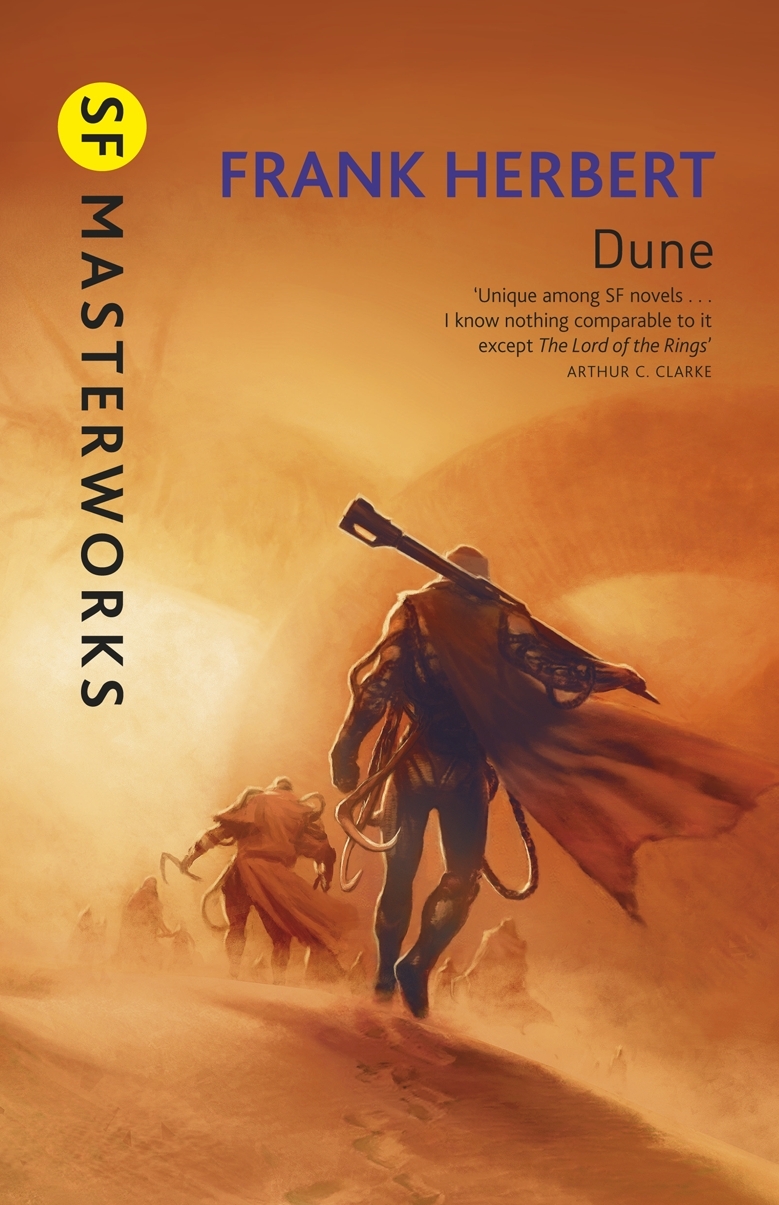
Long-Tomorrow dune

The Gollancz Masterwork series [list] ranges from famous novels such as Ursula Le Guin’s The Left Hand of Darkness (1969) to lesser known short story collections such as The Caltraps of Time (1968) by David I. Masson.  The Masterwork series has the power to introduce readers to the canonical “best of SF” and works that should be considered classics.  Many of the second group have not seen print for decades.  Although I have some qualms about certain inclusions, I was genuinely blown away that they recently chose one of my favorite novels The Continuous Katherine Mortenhoe (variant title: The Unsleeping Eye) (1973) by D. G. Compton—an underread and unjustly forgotten author.

Over the course of the next week or so a handful of my fellow SF bloggers (most of whom have a focus on earlier SF) will release lists on their sites of SF they would like to see featured by Gollancz.  I have not given them any guidelines so the lists should be varied and hopefully will generate some discussion.  I highly recommend you head over to their sites (I will post the links as they come in) and comment.

Thoughts + comments are always welcome (as well as your own lists!).

More “What to Include in the Gollancz Masterwork Series” Lists (blog friends)

Chris over at Battered, Tattered, Yellowed, and Creased 

Megan over at From Couch to Moon

2theD over at Potpourri of Science Fiction Literature

Ian Sales over at It Doesn’t Have to be Right…

Jesse over at Speculiction…

2theD over at Tongues of Speculation (his votes regarding translated SF)

Martin over at Martin’s Booklog

My guidelines for inclusion

1. My frequent readers know that I prefer (passionately) SF from the 50s-70s Continue reading

Book Review: Picnic on Paradise, Joanna Russ (1968)

(Diane and Leo Dillon’s cover for the 1968 edition)

4/5 (Good)

Nominated for the 1969 Nebula Award for Best Novel

Joanna Russ’ first published novel Picnic on Paradise (1968) delightfully subverts traditional SF pulp adventure tropes.  Although not as finely wrought as The Female Man (1975), And Chaos Died (1970), or her masterpiece We Who Are About To… (1976), Picnic is worthwhile for all fans of feminist SF and the more radical visions of the 60s.

Unfortunately, the metafictional implications/literary possibilities of the Alyx sequence Continue reading

Book Review: Eye Among the Blind, Robert Holdstock (1976)

(Peter Goodfellow’s cover for the 1977 edition)

3.25/5 (Vaguely Good)

Robert Holdstock’s first science fiction novel, the anthropologically inclined Eye Among the Blind (1976), contains kernels of his later genius.  His abilities, according to critics such as John Clute, are fully manifested in works such as his fantasy novel Mythago Wood (1984).

At first glance Eye Among the Blind has the trappings of intellectually inclined “heavy” anthropological SF in the vein of Ursula Le Guin and Michael Bishop.  It tackles themes such as colonization, alien collaboration with the colonizers, aliens who do not choose to engage with the colonizers, humans who choose to live among the aliens, humans who study the aliens but are reluctant to appreciate (or take seriously) those whom they study, Continue reading

Updates: Recent Science Fiction Acquisitions No. CXVIII (Anthologies: Again Dangerous Visions, Vol. 2, Orbit 8; Schmitz, Malzberg)

Nearing the end of my undocumented purchases… A great series of coves — including Richard Powers and Paul Lehr.  Again, Dangerous Visions Vol. 2 (1972) (did not realize it was in two volumes, but alas) and another Malzberg novel, The Last Transaction (1977) to add to my nearly complete collection of his solo written novels.

Thoughts?

1. The Eternal Frontiers, James H. Schmitz (1973)

(Richard Powers’ cover for the 1973 edition) Continue reading

Book Review: The Last Hurrah of the Golden Horde, Norman Spinrad (1970)

(Dean Ellis’ cover for the 1970 edition)

4/5 (collated rating: Good)

A solid collection of seventeen short stories and one novelette by one of my favorite New Wave authors, Norman Spinrad.  Although the collection seldom reaches the heights of his inventive and original alt-history novel The Iron Dream (1972)The Last Hurrah of the Golden Horde (1970) is still a wonderful showcase of his earliest short fiction. However, Spinrad’s relentlessly bleak outlook on Earth’s future will not appeal to all SF readers.  I only recommend the collection for fans of experimental late 60s SF, the New Wave movement, and bleak satires of societal ills (count me in!).

The best include: “Technicality” (1966), a war against pacifist aliens who wield horrific but non-lethal weapons; “The Last Hurrah of the Golden Horde” (1969), an absurdist pastiche of the bastardization of ideology and societal decadence; and “Dead Continue reading

Updates: Recent Science Fiction Acquisitions No. CXVII (Lafferty + Malzberg + Cowper + Anthology)

A strange bunch….

Another Barry N. Malzberg novel—Chorale (1978)—to add to my nearly complete collection of his SF novels + short story collections.

Another Richard Cowper novel—purchased months ago mainly due to the gorgeous Paul Lehr cover.  The whimsical subject matter of the work unfortunately does not match the profound and surreal stillness of Lehr’s vision.

A short story collection containing a nice range of nebula-nominated (and winning) short SF from 1970: Sturgeon, Laumer, Wolfe, Fritz Leiber, Lafferty, Harrison, Russ.

And finally what is supposedly one of Lafferty’s oddest experiments: Annals of Klepsis (1983).

Thoughts?

1. Phoenix, Richard Cowper (1968)

(Paul Lehr’s cover for the 1970 edition) Continue reading

Book Review: Memoirs of a Spacewoman, Naomi Mitchison (1962)

(Vincent Di Fate’s cover for the 1973 edition)

4.5/5 (Very Good)

Naomi Mitchison’s first science fiction novel, Memoirs of a Spacewoman (1962), is a brilliant episodic rumination on the nature of non-violent interaction with alien species that challenge (and transform) conceptions of ourselves and others.  Although R. S. Lonati’s cover for the 1964 Four Square edition suggests a pulp adventure—replete with flashy spaceships, explosions, and traditional adventure—Memoirs is cut from an altogether different cloth.

The first sentence of the novel narrows in on Mitchison’s central themes:

“I think about my friends and the fathers of my children.  I think about my children, and I think less about my four dear normals than I think about Viola.  And I think about Ariel.  And the other.  I wonder sometimes how old  would be if I counted the years of time blackout during exploration (5).”

Continue reading

Updates: Recent Science Fiction Acquisitions No. CXVI (Le Guin + MacApp + Farmer + Anthology)

In my youth I read Ursula Le Guin like a madman—somewhere in the intervening years I misplaced my copies of her short story collections.  So, while voyaging to a nearby city (with Half Price Books) I decided to snag one—The Compass Rose (1982) contains mostly 70s short stories.  Excited.

I have been presently impressed with *some* of Philip José Farmer’s work—namely, Strange Relations (1960)—-so I could not resist a “best of” collection.

I am perhaps most excited about David Gerrold’s edited collection Generation: An Anthology of Speculative Fiction (1972).  Contains a wide range (and almost equal ratio of male/female authors) of fascinating stories.

 I bought C. M. MacApp’s Secret of the Sunless World (1969) due to the title and the amazing Berkey cover.  Now that I sat down and transcribed the back cover I rather dissuaded from picking it up anytime soon…

1. The Book of Philip José Farmer, Philip José Farmer (revised 1982, 1973)

(James Warhola’s cover for the 1982 edition) Continue reading