Updates: Year in Review (Top Ten SF Novels + Top Ten Short Stories/Novelettes/Novellas + other categories)

Everyone likes lists!  And I do too….  This is an opportunity to collate some of my favorite (and least favorite) novels and shorter SF works I read this year.  Last year I discovered Barry N. Malzberg and this year I was seduced by…. Well, read and find out.


Top Ten Novels

1. We Who Are About To…, Joanna Russ (1976): A scathing, and underread, literary SF novel by one of the more important feminist SF writers of the 70s (of The Female Man fame).

2. A Funeral for the Eyes of Fire, Michael Bishop (1975): A well-written anthropological clash of cultures novel.  Slow, gorgeous, emotionally engaging….

3. Level 7, Mordecai Roshwald (1959): A strange satire of the bomb shelter…  Everyday surrealism. Continue reading

Book Review: The Men Inside, Barry N. Malzberg (1973)

(Ron Walotsky’s cover for the 1973 edition)

4.5/5 (Very Good)

Caveat: If a perverse (and Freudian) metafictional (and literary) retelling of Otto Klement and Jerome Bixby’s Fantastic Voyage replete with filmic flashbacks does not intrigue you then stay away….

There are few SF authors who utilize metafictional elements as gleefully and effectively as Barry N. Malzberg.  Beyond Apollo (1972), his masterpiece, is a labyrinthine sequence of 67 short chapters of a novel written by the main character who may or may not be recounting real (imagined?) events.  While in In the Enclosure (1973) the excruciating paranoia that permeates the pages and the impossible escapes that transpire, recounted as if they were entries in a diary, could indeed be generated by an external force—the exact nature of which is unknowable—implanting memories.  Revelations (1972) was entirely comprised of a sequence of documents (interview transcripts, diary fragments, epistolary fragments) Continue reading

Book Review: The Downstairs Room and Other Speculative Fiction, Kate Wilhelm (1968)

(Ron Walotsky’s cover for the 1968 edition)

4/5 (collated rating: Good)

By the late 60s Kate Wilhelm’s SF moved from generally uninspiring pulp (à la the collection The Mile-Long Spaceship) to psychologically taught and emotive mood pieces exploring the almost existential malaise of daily existence and the disturbing effects of “programmed” lives (especially the housewife).  The fourteen short-stories in The Downstairs Room and Other Speculative Fiction (1968) (the term “speculative fiction” was coined by Judith Merril in the 60s) comprise a snapshot of Wilhelm’s best New Wave work.  It should be noted that not all are SF.

Although some are less engaging than others, her harrowing portrayal of starlets subjected to endless psychological torments at the whims of their viewers in “Baby, You Were Great” (1967) (Nebula nominated) and the evocative tapestry of daydreams Continue reading

Adventures in Science Fiction Cover Art: Fractured Bodies (unraveling, decaying, [de]constructing)

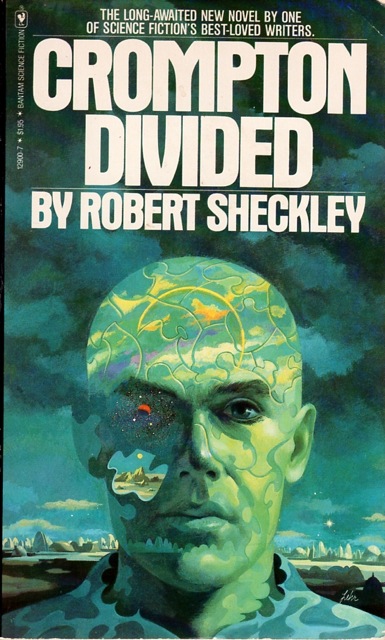
CRMPTNDVDD1979

(Paul Lehr’s cover for the 1979 edition of Crompton Divided (variant title: The Alchemical Marriage of Alistair Crompton) (1978), Robert Sheckley)

Paul Lehr’s cover for the 1979 edition of Robert Sheckley’s Crompton Divided (1978) was the inspiration for this post.  I found the cover many years ago while looking through Lehr’s entire (mostly brilliant catalogue) and was intrigued.  The man, comprised of puzzle-like pieces that slowly morph into the swirls of his clothes, stares at us with hybridized eyes — a planet, a pupil — while one missing puzzle piece allows the viewer a glimpse of a barren landscape.  His brain, entirely a puzzle, is complete, but are his senses crumbling?

 Dean Ellis’ cover for the 1971 edition of Larry Niven’s collection All the Myriad Ways (1971) is even more fantastic — the puzzle pieces (bones, faces, limbs) dangle in the air Continue reading

Updates (New Resource): List of Immortality Themed SF (a call to contribute!)

This post is a call for readers to submit their favorite immortality themed science fiction NOT included on my list below (and even examples they did not care for so I can make this a more substantial resource).  I’ll make a page with all the information I receive for easy consultation soon (INDEX of similar pages/articles).

A while back I started gathering a list of titles — via SF Encyclopedia, other online resources, and my own shelves — on immortality themed SF.  I have always been intrigued by the social space (one plagued by violence and despair or buoyed by the hope of a better future) that the possibility of immortality might generate.

I would argue that the single best example of social effects that the possibility of immortality might create is Clifford D. Simak’s Why Call Them Back From Heaven? (1967).  In similar fashion, James Gunn’s The Immortals (1962) takes place in a world where immortals do exist, they skirt Continue reading

Book Review: At the Seventh Level, Suzette Haden Elgin (1972)

(George Barr’s cover for the 1972 edition)

3/5 (Average)

At the Seventh Level (1972) is part of a loose sequence of novels that feature Trigalactic Intelligence Service agent Coyote Jones and his voyages to various worlds. Although this sequence ostensibly has the trappings of SF space opera, Suzette Haden Elgin subverts the genre conventions so that the premise functions as a polemical feminist text with satirical underpinnings.  At the Seventh Level is an important installment in a long line of “women as slaves trapped in vast repressive patriarchy propped up by appeals to tradition and brute force” type novels which, some might argue, culminated in Margaret Atwood’s The Handmaid’s Tale (1985).  It is important to note that there were many novels on similar themes before Atwood’s acknowledged masterpiece hit Continue reading

Book Review: And Strange at Ecbatan the Trees (variant title: Beneath the Shattered Moons), Michael Bishop (1976)

(Jonathan Weld’s cover for the 1976 edition)

4/5 (Good)

Michael Bishop’s And Strange at Ecbatan the Trees (variant title: Beneath the Shattered Moons) (1976) is a melancholic and allegorically inclined parable about a coming cataclysm that threatens a programmed and hierarchically rigid society (accomplished via genetic modification).  Bishop’s voice is an intensely humanistic once, futuristic technology is present but not a central concern…. The simple but effective plot is the perfect vehicle for his moralistic ruminations: a man forced into action, a world compelled — despite the external forces at play — to adapt.

 And Strange at Ecbatan the Trees is the first of Michael Bishop’s works I have read and I am definitely intrigued enough to place his supposedly superior Nebula-nominated first novel, Funeral for the Continue reading

Updates: A New Classic SF Review Blog to add to your list

MPorcius, a frequent and well-read commentator on my site, has started transferring his numerous amazon reviews and writing new reviews of classic SF (a substantial portion is pre-1980s) to his blog.  Please visit him and comment on his posts!

queue rant: I’ve noticed a surprising lack of frequently updated classic SF blogs online.  Yes, many bloggers occasionally dabble in the distant era of SF glory or publish yet another review of the obligatory masterpieces because they appear on a some “best of” list (Dune, The Left Hand of Darkness, etc).  However, few are devoted to the period and make it a point to write reviews of books that very few people will ever actually read due to their obscurity i.e. blogs that don’t sell out by churning out reviews of new Tor releases (I have declined their offer) or endless 4/5 or 5/5 starred let’s pat each other on the back reviews of self-published (and generally awful) ebooks Continue reading

Book Review: Doomsday Morning, C. L. Moore (1957)

powers_doomsday-morning

(Richard Powers’ cover for the 1958 edition)

4.25/5 (Good)

C. L. Moore’s Doomsday Morning (1957) — she’s best known for her revolutionary 1930s works including “Shambleau” (1934) and the “Jirel of Joiry” sequence — is perhaps her most ruminative and traditional SF novel (she tended to write more fantastical SF and fantasy).  Unfortunately, she quit writing around the time of the death of her husband and frequent collaborator Henry Kuttner (they often published under the pseudonym Lewis Padgett).  And her second husband forbid her to write altogether…

Moore creates a finely wrought dystopic vision where an oppressive future government utilizes communication networks to spread its tentacles across the United States.  Against this backdrop intriguing characters come to life.  Her descriptions of the political backdrop remain minimalistic which is surprising for SF of the 50s which often resorts to lengthy descriptive lectures.  Instead, the true extent of the government’s Continue reading